美元信任危机

Search documents
突然猛拉!黄金、白银,又大涨!
Zhong Guo Ji Jin Bao· 2026-01-02 06:33
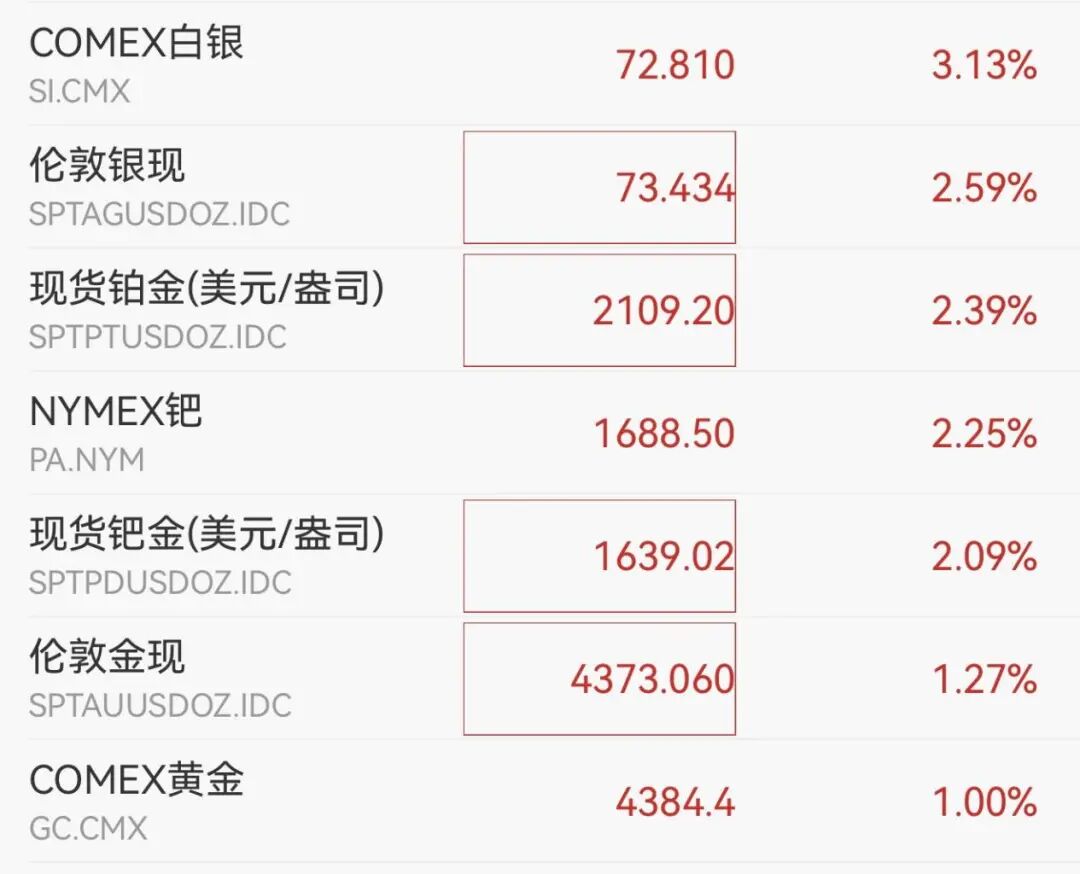
Group 1 - Precious metals experienced a collective surge, with spot gold opening high and rising by $55 to surpass $4,370 per ounce, marking a 1.27% increase [1] - Spot silver saw an intraday increase of up to 3%, reaching $73 per ounce, while platinum and palladium also rose by over 2% [1] - Recent silver price spikes are attributed to its industrial properties, economic expectations, and low domestic silver inventories in China, a major manufacturing country [2] Group 2 - Long-term outlook for gold assets remains positive due to factors such as a weak dollar, interest rate cuts, and global geopolitical risks, with no current reasons to be bearish on gold [3] - Silver's strength is driven by expanding demand, tightening inventory structures, and policy expectations, particularly from industrial sectors like photovoltaics and electronics [3] - There is a divergence in market opinions regarding silver's recent performance, with some viewing it as nearing the end of its bull run, while others believe it is leading a new market cycle due to its growing importance in technology [3]

突然猛拉!黄金、白银,又大涨!
中国基金报· 2026-01-02 06:30
Group 1 - Precious metals experienced a collective surge, with spot gold opening high and rising by $55 to surpass $4,370 per ounce, marking a 1.27% increase [2] - Spot silver saw an intraday increase of up to 3%, reaching $73 per ounce [3] - Both spot platinum and palladium also rose by over 2% [5] Group 2 - Guosen Securities noted that the recent surge in silver prices, exceeding historical levels, is primarily due to the industrial demand elasticity, supported by positive economic expectations and low domestic silver inventories in China [6] - The demand for silver is driven by growth in industrial applications, particularly in photovoltaic and electronics sectors, leading to a persistent supply gap [7] - There is a divergence in market opinions regarding silver's performance; some believe it is nearing the end of its upward trend, while others argue that its increasing importance in technology sectors may lead to a new market cycle [7][8] Group 3 - Dongwu Futures indicated that the long-term fundamentals, driven by global technological and green industry developments, provide solid support for silver demand, although the current excessive price increase poses a risk of significant corrections [8]
印度黄金存在美国,美国不还了!中国的600吨还能拿回吗?
Sou Hu Cai Jing· 2026-01-02 02:50
Core Viewpoint - The ongoing global controversy surrounding gold reserves, particularly those stored in the United States, has raised concerns among various countries about the security and transparency of their gold holdings [2][8]. Group 1: Gold Reserves and Security - The Federal Reserve's gold vault in Manhattan, known as the "golden fortress," is highly secure, located five stories underground with a main door weighing 90 tons and 24 inches thick [6]. - Countries like Germany and India have requested to inspect or repatriate their gold stored in the U.S., but these requests have been denied on the grounds of security risks and unclear intentions [8][13]. - Approximately 600 tons of gold from China is also stored in the Federal Reserve's vault, highlighting the global reliance on U.S. gold storage [15]. Group 2: Historical Context and Current Trends - The historical context of gold storage dates back to the Bretton Woods system established after World War II, which led many countries to store their gold in the U.S. for ease of international transactions [10]. - Germany's central bank has proposed to repatriate 50 tons of gold annually for inspection, while India has requested 100 tons, indicating a growing urgency among nations to secure their gold reserves [13]. - The U.S. holds 71.7% of its national reserves in gold, while major European countries maintain gold reserves between 40% and 70%, underscoring the importance of gold as a financial asset [19]. Group 3: Market Reactions and Trust Issues - The gold market has experienced significant volatility, with spot prices reaching a historical high of $2,610 per ounce in 2024, raising concerns among nations about the stability of their gold investments [19]. - The current situation reflects a broader trust crisis in the U.S. dollar as the global reserve currency, prompting countries to seek greater control over their gold reserves in preparation for potential financial turmoil [23][25]. - Speculation exists regarding the actual contents of the Federal Reserve's vault, with concerns that not all gold may be present or that some may have been misappropriated, leading to questions about the U.S.'s authority to deny repatriation requests [28][30].
短期多空力量交织,黄金价格中长期支撑仍在
Guoxin Securities Co., Ltd· 2025-12-31 13:23
Investment Rating - The industry investment rating is "Positive," indicating an expectation that the industry index will outperform the market index by more than 5% over the next six months [6]. Core Insights - The international gold price experienced a slight decline to $4,514 per ounce as of December 30, 2025, after reaching a historical high of $4,526 on December 24, 2025, but still recorded an annual increase of 65%-70%, marking the largest annual gain since 1979 [1]. - Short-term technical corrections are attributed to factors such as easing geopolitical risks, profit-taking pressures, and differing monetary policy expectations [1][2]. - In the medium to long term, factors such as the U.S. debt crisis, a weak dollar, and a rate-cutting cycle provide fundamental support for gold prices, with central banks continuing to purchase gold and increasing investment demand for gold ETFs [2][4]. Summary by Sections Market Performance - The market performance of the non-ferrous metals index and the CSI 300 index showed significant fluctuations, with a notable annual increase in gold prices [1]. Short-term Factors - Geopolitical risk reduction, profit-taking at year-end, and differing expectations regarding monetary policy are influencing short-term price movements [1][2]. Medium to Long-term Factors - The ongoing U.S. debt crisis, weak dollar, and anticipated rate cuts are expected to support gold prices in the medium to long term [2][4]. - Central banks are expected to continue their gold purchases, and investment demand for gold ETFs is likely to increase due to wealth effects [2][4]. Silver Market Dynamics - Recent volatility in silver prices, driven by its industrial properties and low domestic inventory in China, has attracted significant capital inflow, leading to price surges [3]. - The potential for a price correction in silver exists, while gold prices are expected to rise [3]. Investment Recommendations - Despite short-term risks, the long-term outlook for gold assets remains positive due to macroeconomic factors and geopolitical risks [4]. - Gold stocks have not seen significant price increases in line with physical gold and silver, indicating a potential for stability amidst market fluctuations [4].
贵金属周度观察-20251231
Guoxin Securities Co., Ltd· 2025-12-31 13:10
Investment Rating - The industry investment rating is Neutral [6] Core Insights - The precious metals sector saw a weekly increase of 3.8%, with lithium performing the best at 11.4% and rare earths performing the worst at -3% [2][15] - Gold and silver prices showed a weekly fluctuation of 1.5% and 13% respectively on the SHFE [3][23] - The latest gold-silver ratio is 58.4%, indicating a significant drop, while the gold-oil ratio stands at 75% and the gold-copper ratio at 763 [3][33] Summary by Sections Precious Metals Market Review - The precious metals sector experienced a weekly increase of 3.8% [15] Precious Metals Related Indicators Tracking - The SHFE gold price fluctuated by 1.5% and the SHFE silver price by 13% last week [3][23] - The U.S. November CPI decreased to 2.7% year-on-year, while the core CPI for September was slightly higher at 2.8% [3][26] - The U.S. dollar index as of December 30 was 98.2, continuing to decline [3][26] Investment Recommendations - Recent surges in silver prices are attributed to its industrial properties and improving economic expectations, with domestic silver inventories at historical lows [5][50] - Short-term price corrections for silver are anticipated, while gold prices are expected to rise [5][51] - Long-term outlook for gold remains positive due to weak dollar conditions and ongoing geopolitical risks [5][51] Major Company Earnings Forecast and Valuation - The report includes earnings forecasts and valuations for major companies in the sector, indicating varying performance metrics across different firms [52]
股债汇三杀,美国衰退如何影响全球市场
Sou Hu Cai Jing· 2025-11-16 11:18
Core Insights - The article discusses the "triple whammy" of stock, bond, and currency markets in the U.S. since 2025, driven by rising recession expectations and the spillover effects on global markets through financial, trade, and policy channels [1][2][3] - It highlights the significant differences in resilience among various economies, suggesting that diversified asset allocation and risk hedging are essential strategies for ordinary investors [1][3] Group 1: U.S. Market Movements - On November 13, 2025, the U.S. market experienced a notable "triple whammy" with declines in major indices: Nasdaq down 2.29%, S&P 500 down 1.66%, and Dow Jones down 1.65% [2] - The year 2024 saw increased volatility, with the S&P 500 ending at 5881.63 points, a 0.43% decline for the year, and a significant single-day drop of 2.95% on December 18 [2] - The 10-year U.S. Treasury yield rose from 3.95% at the beginning of 2024 to 4.58% by year-end, indicating a substantial increase in market volatility [2] Group 2: Economic Recession Signals - The expectation of an economic recession is supported by multiple data signals, including a potential 2 percentage point reduction in GDP growth due to a 43-day government shutdown [3] - The IMF has revised its fourth-quarter growth forecast for 2024 to below 1.9%, reflecting concerns over private investment and employment [3] - The unemployment rate is projected to rise to 4.4% in 2024, with core PCE inflation expected at 2.6%, indicating a risk of stagflation [3] Group 3: Causes of Market Movements - The "triple whammy" is attributed to a combination of factors: unexpected tightening of Federal Reserve policies, lack of economic data due to the government shutdown, and political instability [4][5] - The Federal Reserve's cautious stance has led to a "data blindness" situation, complicating accurate assessments of inflation and employment [4] - The shutdown is estimated to have caused an economic loss of $1.5 trillion, leading to increased market volatility and uncertainty [5] Group 4: Global Market Transmission - U.S. market movements affect global markets through three main channels: financial, trade, and policy [11] - The tightening of U.S. monetary policy has led to capital outflows from emerging markets, with significant impacts on bond and equity markets [11] - The U.S. recession expectations are likely to reduce global export growth, particularly affecting export-oriented economies [13] Group 5: Impact on Developed Economies - The Eurozone is expected to experience a GDP growth rate of only 1.3% in 2025, significantly lower than the U.S. [15] - The correlation between the DAX index and the S&P 500 is high, indicating that U.S. market adjustments directly impact European stock markets [15] - Japan faces challenges with a depreciating yen and rising import costs, complicating its economic recovery [16] Group 6: Impact on Emerging Markets - Emerging markets are experiencing widespread currency depreciation, with significant declines in currencies like the Brazilian real and Argentine peso [18] - Capital outflows from emerging markets reached $89 billion in 2024, with Asian markets particularly affected [18] - The rising U.S. debt yields are increasing debt servicing costs for emerging markets, leading to heightened default risks [19] Group 7: China's Market Response - China's exports to the U.S. grew by 5.9% in 2024, but future growth is expected to slow due to U.S. recession fears [20] - The Chinese yuan experienced a 2% depreciation against the dollar in 2024, reflecting the impact of U.S. market movements [21] - China is maintaining a proactive monetary policy, with two reserve requirement ratio cuts in 2024 to support economic growth [22]
【百利好热点追踪】大衰退要重现 4500只是起点
Sou Hu Cai Jing· 2025-10-19 09:53
Group 1 - The article discusses the historical context of gold price surges, highlighting that gold has experienced three significant rallies, with the first two resulting in substantial losses for investors due to high-level entrapment [1][3] - The first major surge occurred from 1978 to 1980, where gold prices increased from $244 to $850, marking a 248% rise amid geopolitical tensions and domestic economic issues in the U.S. [3] - The second surge took place from 2008 to 2011, with gold rising from approximately $700 to $1905, a 171% increase, driven by the global financial crisis and the Federal Reserve's quantitative easing policies [3] Group 2 - Recent warnings from financial institutions indicate that nearly half of U.S. states are facing economic recession, with Moody's reporting that over 22 states are in economic contraction [6] - The economic downturn is exacerbated in Washington D.C. due to significant federal layoffs and budget cuts, with the recession spreading across the entire U.S. [6] - The ongoing global geopolitical instability and the trend of de-dollarization have led to increased demand for gold, as countries seek to build independent banking systems and accumulate gold reserves [6] Group 3 - Analysts suggest that gold has entered a new phase of significant price increases even before the U.S. economy officially enters a recession, with expectations of gold prices potentially exceeding $4500 in the next three months [7]
ATFX汇评:特朗普政策危机延续,金银齐创历史新高,谨慎“逢高做空”心态
Sou Hu Cai Jing· 2025-10-14 11:39
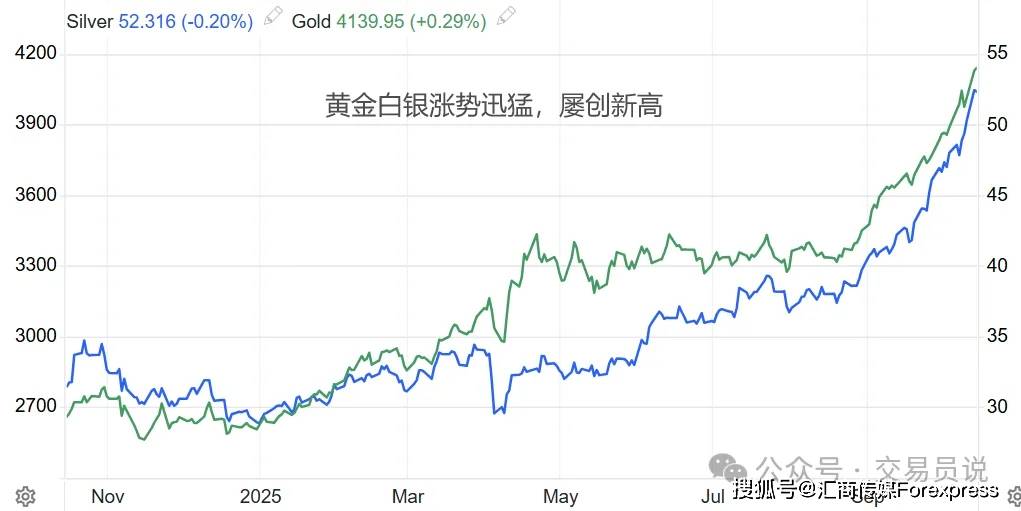
Core Viewpoint - The gold and silver markets have reached historical highs driven by risk aversion, with London gold rising from a low of $3947 to a peak of $4179, marking a cumulative increase of approximately 5.8% [1] - London silver has also shown strength, surpassing its previous historical high of $49.79, driven by a crisis of confidence in the US dollar due to aggressive policies from the Trump administration [3] Group 1: Gold Market Analysis - London gold has experienced a significant price increase, with expectations of breaking the $4200 mark [1] - The upward trend in gold prices is attributed to a loss of confidence in the US dollar, exacerbated by high tariffs imposed by the Trump administration, which have negatively impacted global economic potential [3] Group 2: Silver Market Analysis - London silver has consistently closed higher from October 8 to 13, reaching a peak of $53.48, thus achieving a new historical high alongside gold [3] - The current performance of silver indicates a strong market sentiment, reflecting a broader trend of investors seeking safe-haven assets amid economic uncertainty [3] Group 3: US Dollar and Economic Indicators - The US dollar index is currently at 99.36, showing signs of recovery after a decline earlier in the year, but the overall economic outlook remains challenging due to poor non-farm employment data [5] - The Federal Reserve's decision to restart interest rate cuts, with a 25 basis point reduction in September, is a response to a weak labor market, while inflation remains high, creating a complex economic environment [5] Group 4: Technical Analysis - London gold is in a strong upward trend, with the 10-day moving average serving as a key indicator of market strength; a drop below this average could signal a potential correction [7] - Given the significant prior gains, there is a possibility of profit-taking, which may lead to a deeper market correction [7]
人民币国际化关键一步,一文读懂央行本币互换协议
Hu Xiu· 2025-10-09 05:06
Core Insights - Central banks around the world have shown a lack of trust in the US dollar by increasing their gold reserves while reducing their holdings of US Treasury bonds [1] - The article raises questions about the attitude of central banks towards the Chinese yuan and whether the internationalization of the yuan has progressed amid the dollar's declining trust [1] Summary by Categories - **Central Bank Actions** - Central banks are continuously increasing their gold holdings [1] - There is a notable reduction in the holdings of US Treasury bonds by these banks [1] - **Chinese Yuan Internationalization** - The article suggests that the internationalization of the yuan may have advanced, especially in the context of the dollar losing credibility [1] - A specific news item from September is mentioned as potentially revealing insights into the yuan's status [1]
美国37万亿债务压顶,中国悄然出手,连续增持黄金,有什么深意?
Sou Hu Cai Jing· 2025-10-08 20:57
Core Insights - The People's Bank of China (PBOC) continues to increase its gold reserves despite high international gold prices, indicating a strategic long-term approach rather than short-term speculation [1][12] - As of September 2025, China's gold reserves reached 74.06 million ounces, marking the 11th consecutive month of accumulation, although the latest increase was modest at 40,000 ounces [3][12] - China's gold reserves account for only 7.7% of its official international reserve assets, significantly lower than the global average of around 15% and much less than countries like Germany and France, which exceed 70% [3][12] Strategic Rationale - The primary motivation for increasing gold reserves is to diversify the foreign exchange reserve portfolio, as gold has a low correlation with major currencies like the US dollar and euro, providing a hedge against currency fluctuations [5][12] - The current geopolitical climate, characterized by uncertainties such as trade tensions and rising national debt, has led to decreased trust in the US dollar, prompting central banks globally to increase their gold holdings [5][7] - Gold is viewed as a universally accepted "last means of payment," making it a critical asset for national financial security, especially in extreme situations [7][12] Global Context - In Q2 2025, global central banks collectively increased their gold reserves by 166 tons, with notable purchases from Poland, Turkey, and Qatar, reflecting a broader trend of central banks seeking to bolster their gold holdings [7][12] - The PBOC's actions signal a commitment to supporting the internationalization of the renminbi, as gold backing enhances the currency's credibility [7][9] - The shift in global reserve dynamics is evident, with the US dollar's share in global foreign exchange reserves declining to historical lows, while gold and other assets are expected to gain prominence [11][12]