
高质量增长

Search documents
2026,李斌选择回到最原始的命题
2 1 Shi Ji Jing Ji Bao Dao· 2026-01-08 15:27
Core Insights - NIO has reached a significant milestone with the production of its one millionth vehicle, marking its entry into the "million club" alongside other new energy vehicle manufacturers [1] - The company aims for high-quality growth of 40%-50% annually without setting a specific sales target for 2026, focusing instead on sustainable operations and profitability [2][7] - NIO's strategy emphasizes efficiency improvements, channel expansion, and the integration of its three brands into a unified sales model [2][9] Group 1: Company Performance and Strategy - NIO delivered 326,000 vehicles in 2025, a year-on-year increase of approximately 47%, with December alone seeing deliveries surpassing 48,000 units, a record high [1][4] - The company is optimistic about achieving profitability in Q4 2025, with expectations of significant gross profit growth from the new ES8 model, which has a gross margin exceeding 20% [5] - NIO's CEO emphasizes the importance of maintaining a steady growth rhythm rather than chasing specific sales figures, highlighting the need for a sustainable operational pace [2][7] Group 2: Market Position and Competitive Landscape - NIO acknowledges its position as a smaller player in the competitive Chinese automotive market, which is projected to reach annual sales of over 34 million vehicles, allowing space for multiple companies to thrive [3][24] - The company is committed to its core business of electric vehicles, avoiding distractions from non-automotive ventures, and focusing on enhancing its product offerings and user experience [29][31] - NIO's long-term vision includes a robust battery swapping network, with plans to build at least 1,000 new battery swap stations to address the challenges of battery lifespan and vehicle longevity [2][16][26] Group 3: Future Plans and Innovations - For 2026, NIO plans to continue investing heavily in R&D and infrastructure while expanding its sales network through the launch of the "SKY" integrated store model in 210 cities [9][10] - The company aims to maintain a focus on high-end vehicles while also introducing new models, including three new large vehicles in the second and third quarters of 2026 [12][14] - NIO's commitment to technological innovation is evident in its development of advanced components, such as the first mass-produced 5nm automotive chip, which enhances performance while reducing costs [6][20]

李斌:蔚来发展迈入第三阶段,未来将保持每年40%-50%销量增长
Xin Lang Cai Jing· 2026-01-06 02:42
Core Viewpoint - NIO has entered its third development stage, focusing on high-quality growth as its core objective [1][2] Group 1: Strategic Goals - NIO will continue to invest in its full-stack technology to ensure a leading advantage in both technology and products [1][2] - The company aims to build over 10,000 charging and battery swap stations by 2030 [1][2] - NIO plans to enhance brand synergy across its three brands, aiming for a market share increase in various segments while maintaining an annual growth rate of 40%-50% [1][2] - The company will deepen its focus on the Chinese market while expanding globally in a more stable and efficient manner [1][2]
2025年科尔尼行业系列回顾|消费品
科尔尼管理咨询· 2026-01-05 09:50
Core Insights - The consumer goods industry is transitioning from high growth to a phase of structural differentiation by 2025, with luxury goods, beauty, and food & beverage sectors losing their natural anti-cyclical attributes as consumer demands for "value, health, and transparency" increase [1] - The focus of competition is shifting from scale expansion to the reconstruction of competitive advantages, with key determinants being product mix, operational efficiency, and technological empowerment [1] Luxury Goods - The luxury sector is entering a low growth range of 1%-3%, facing headwinds from key markets and peak pricing, leading consumers to prioritize value and transparency; brands need to enhance uniqueness, upgrade experiences, and streamline operations to navigate through cycles [2] - India is emerging as a significant growth market for luxury goods, with brands needing to align with local culture and consumer upgrade rhythms to build replicable growth models [7] Food & Beverage - The food and beverage industry is seeking innovative paths amid diversified demand and reshaped market dynamics, with a consensus shifting towards "high-quality growth" that emphasizes industry collaboration, innovation, and structural upgrades [6] - Companies must leverage automation, data integration, regionalization, and flexible sourcing to reconstruct operations from "farm to table" in response to consumer, supply chain, and technological pressures [10] Beauty and Personal Care - The beauty and personal care sector is experiencing record-high merger and acquisition activity, with increasing industry differentiation and rising asset supply; the next 12-18 months present a low valuation window for buyers to complete portfolio restructuring before competition intensifies [9] - The U.S. high-end beauty market is transitioning from an expansion phase to slower growth and stronger competition, with consumers becoming more rational and demanding; brands must reshape loyalty, efficacy, and channel strategies to succeed in the next phase [19] Sustainability and Circular Fashion - Circular fashion is progressing but has yet to achieve scalable breakthroughs; the industry requires a more systematic indicator framework and business loop to transform sustainability from a concept into profitability [12] - Alliance marketing serves as both a growth lever and a potential threat to profit and pricing structures, necessitating careful mechanism design, attribution governance, and channel boundary management to avoid "expansion" turning into "internal consumption" [13]


累计10亿重金提振信心!中炬高新回购增持“组合拳”释放增长新周期底气
Cai Jing Wang· 2025-12-30 12:22
Core Viewpoint - The company Zhongju Gaoxin (600872.SH) announced a share buyback plan of 300 million to 600 million yuan to enhance shareholder value and investor confidence, following a significant increase in shareholding by its major shareholder, Torch Group, which invested approximately 400 million yuan [1][2]. Group 1: Share Buyback and Stake Increase - The buyback plan is seen as a strong recognition of the company's value, with a buyback price cap set at 26 yuan per share, allowing for substantial room compared to current market prices [2]. - The total investment in the buyback and shareholding increase by the major shareholder and the chairman amounts to approximately 1 billion yuan, demonstrating confidence in the company's future [1][2][3]. - Following the completion of the shareholding increase, Torch Group's ownership in Zhongju Gaoxin rose to 23.71% [2]. Group 2: Business Transformation and Strategy - The company is transitioning from "extensive expansion" to "high-quality growth," focusing on scientific and digital channel management to optimize inventory and pricing systems [4]. - A strategic partnership with Jiangnan University aims to enhance product development, driving the core business towards healthier and functional products, resulting in improved gross margins [4][5]. - The company is shifting its business model to empower the restaurant sector, providing tailored solutions to small and medium-sized restaurants, which is expected to become a new revenue growth driver [6]. Group 3: Brand Positioning and Market Strategy - Zhongju Gaoxin is actively reshaping its brand image to reflect "high-end, healthy, and professional" attributes, moving away from traditional perceptions of the seasoning industry [5]. - The company is implementing a diversified strategy that includes building product centers and pursuing strategic acquisitions to overcome growth bottlenecks [6]. - The management is committed to enhancing market share and achieving sustainable growth in enterprise value through a restructured supply chain and scaled growth in the restaurant channel [6].

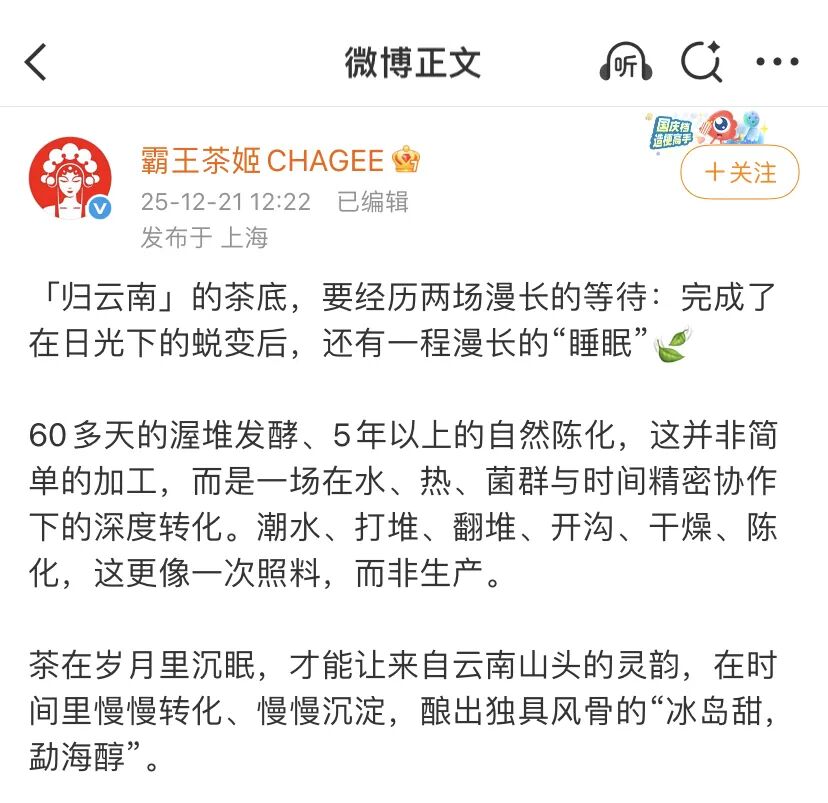
三季报后的首款新品,霸王茶姬如何用冰岛普洱落地“高质量增长”
Mei Ri Jing Ji Xin Wen· 2025-12-25 11:42
Core Insights - The article highlights the launch of the "Return to Yunnan" series by Bawang Chaji, which emphasizes a slower, quality-focused approach in the competitive new tea beverage industry [1][3] - This new product is seen as a response to the company's "high-quality growth" strategy, marking a significant moment as it coincides with the brand's eighth anniversary [3][6] Product Development - The "Return to Yunnan" series features a core tea base of Ice Island and Menghai ripe Pu'er tea, focusing on the origin, blending, and flavor structure of the tea [1][4] - The product aims to transform traditional, niche tea into a daily beverage appealing to younger consumers by showcasing the tea's sourcing and fermentation processes [5] Pricing Strategy - Despite using high-quality Ice Island ripe Pu'er tea, the pricing for the "Return to Yunnan" series remains in the mid-range, with products priced between 14-21 yuan, reflecting a strategy to internalize costs through supply chain efficiency [5][6] - The management emphasizes that maintaining high quality does not necessarily equate to high prices, aiming for sustainable growth [5] Market Positioning - Bawang Chaji's approach contrasts with the fast-paced, price-cutting strategies prevalent in the new tea beverage industry, focusing instead on building long-term brand loyalty through consistent quality [7] - The brand's commitment to quality over short-term gains is seen as a way to strengthen consumer trust and create a competitive advantage [6][7] Global Expansion - Bawang Chaji has expanded internationally, with over 200 stores opened overseas, including a significant location in Kuala Lumpur, Malaysia [8][9] - The brand aims to establish cultural recognition of Chinese new tea beverages in foreign markets, emphasizing quality and a relatable modern tea narrative [9]
旧地图找不到新大陆,新地图藏在小红书
Sou Hu Cai Jing· 2025-12-25 03:32
Core Insights - The article discusses the shift in business strategies from chasing short-term traffic to nurturing long-term user relationships, emphasizing the need for companies to adapt to changing consumer demands and market conditions [3][4][6][17]. Group 1: User Engagement and Retention - Companies are realizing that true growth comes from establishing deep connections with users rather than merely seeking traffic [5][6]. - Many brands face challenges such as misalignment between target and actual consumer demographics, regional barriers, and product functionality not matching real-life scenarios [5][6]. - Successful brands are focusing on user retention and building comprehensive user engagement strategies that span from initial contact to conversion and retention [6][9]. Group 2: Evolving Consumer Demands - The consumer landscape has evolved, with users now prioritizing emotional and experiential aspects over mere functionality and specifications [10][11]. - Brands must shift their focus from traditional parameter-based competition to understanding and addressing the nuanced needs of consumers [11][13]. - The case of Hisense illustrates how brands can leverage community insights to connect with specific user groups, such as gamers, by translating technical specifications into relatable experiences [11][13]. Group 3: Quality Over Scale - The article highlights a transition from a focus on rapid scale to a commitment to high-quality growth, where brands prioritize genuine consumer needs over mere sales volume [14][15][19]. - The example of the tomato brand "Yike Da" demonstrates how targeted marketing and community engagement can lead to sustainable growth without succumbing to price wars [15][19]. - Companies are encouraged to adopt a long-term perspective on growth, utilizing data-driven strategies to ensure that marketing efforts translate into real user value [17][18][19]. Group 4: Strategic Transformation - The concept of "effectiveness in grass planting" is introduced as a new business paradigm that emphasizes user-centric thinking and cross-departmental collaboration [20]. - Companies are urged to view user engagement as a core business strategy rather than a mere marketing tactic, fostering a holistic approach to growth [20]. - By understanding and addressing the deeper motivations behind consumer behavior, brands can create sustainable competitive advantages in a rapidly changing market [20].


小摩:假设美联储明年再降息两次,预测明年底标普500指数目标为7500点
Ge Long Hui A P P· 2025-12-23 08:23
Core Insights - The main investment focus for 2026 will revolve around artificial intelligence (AI) and data center expansion, infrastructure development, and the pursuit of high-quality growth and operational resilience by companies [1] Group 1: Investment Themes - Key themes include long-term growth driven by AI and data center expansion, favorable conditions from infrastructure development and electrification, and companies' ongoing pursuit of high-quality growth and operational resilience [1] - Investors are advised to pay special attention to companies with strong pricing power, long-term growth momentum, robust balance sheets, and those benefiting from structural trends like data center expansion and infrastructure investment [1] Group 2: Market Predictions - JPMorgan forecasts the S&P 500 index to reach a target of 7500 points by the end of 2026, with expected earnings per share of $315 in 2026 and $355 in 2027, surpassing market expectations of $309 and $352 respectively [1] - The outlook is based on the assumption that the Federal Reserve will lower interest rates twice before entering a long-term policy pause, with potential for the S&P 500 to exceed 8000 points if inflation improves and leads to further rate cuts [1]
中金公司:食品饮料行业筑底接近尾声 聚焦高质量增长
Di Yi Cai Jing· 2025-12-18 00:04
Core Insights - The food and beverage industry has entered a new normal since the beginning of the year, with an overall weak consumption environment [1] - The industry is focusing on high quality-price ratios, functionality, health, and emotional consumption trends [1] - The demand for the liquor industry continues to show weak prosperity, compounded by new regulations leading to significant adjustments on both supply and demand sides [1] - There is a divergence in performance among consumer goods, with beverages and snacks showing better prosperity [1] - Looking ahead to next year, the industry is expected to continue a weak recovery with strong differentiation, relying more on product innovation, fragmented channel layouts, and expanding consumer demographics [1] - Companies with strong brand power, product innovation capabilities, channel control, and excellent supply chain efficiency will be able to navigate through cycles and achieve high-quality growth [1]

《2026中国消费趋势报告》发布
Zhong Guo Jing Ji Wang· 2025-12-08 14:26
Group 1 - The 2026 Consumer Trends Conference and Innovation Conference was held in Beijing, showcasing the annual China Consumer Trends Report, which has been a key indicator of the Chinese consumer market for 10 years [1] - The report covers ten key industries including food and beverage, home appliances, outdoor sports, retail, health, automotive, AI, and cultural tourism, providing insights from trend foresight to practical applications [1] - The founder and CEO of Zhimo Consulting, Xiao Mingchao, highlighted a shift in business from "high-speed growth" to "high-quality growth" over the past decade, with increasing consumer recognition of local culture and brands [1] Group 2 - The 2026 Consumer Trends Report emphasizes "meaning" and "value" as the key themes for consumer behavior, indicating a shift from mere purchasing to a focus on personal experiences and the significance of consumption [1] - Expert Guan Lixin from the Ministry of Commerce Research Institute discussed the transformation of the consumer market, the challenges faced, and future trends, emphasizing the coexistence of rational and emotional needs, as well as the upgrade of aesthetic and spiritual demands [2]
瑞银资产管理:国际投资者正在回流中国市场
Zheng Quan Shi Bao Wang· 2025-12-04 07:27
"中国股票的估值还远没有到'过热'的程度,下一阶段的市场走向将由基本面驱动。"他指出,"十五 五"规划释放出从"数量扩张"到"可持续与创新驱动增长"的转型信号。高质量增长的主线有望成为未来 十二个月行业板块轮动和估值切换的关键力量。在基本面持续改善的背景下,创新板块将依旧保持稳健 增长。同时,高股息价值将与创新增长双线并行,高股息股票在中国低利率环境下仍具吸引力,部分龙 头股息率超过5%。 人民财讯12月4日电,近日,瑞银资产管理发布2026年投资展望。瑞银资产管理中国股票主管施斌提 到,中国股票估值仍具吸引力,包括长线基金和对冲基金在内的全球投资者正在积极参与中国股票的基 石投资与二级市场交易。当前外资大多选择通过ETF的方式进入中国市场,这意味着目前市场仍处"技 术性修复"阶段,要实现持续资金回流,投资者仍需看见结构性改革的持续推进与可持续性增长的迹 象。 ...