
Token经济学

Search documents
2026 英伟达 GTC 大会点评:LPU 融入推理体系,全栈设计能力塑造领先优势
GUOTAI HAITONG SECURITIES· 2026-03-21 00:45
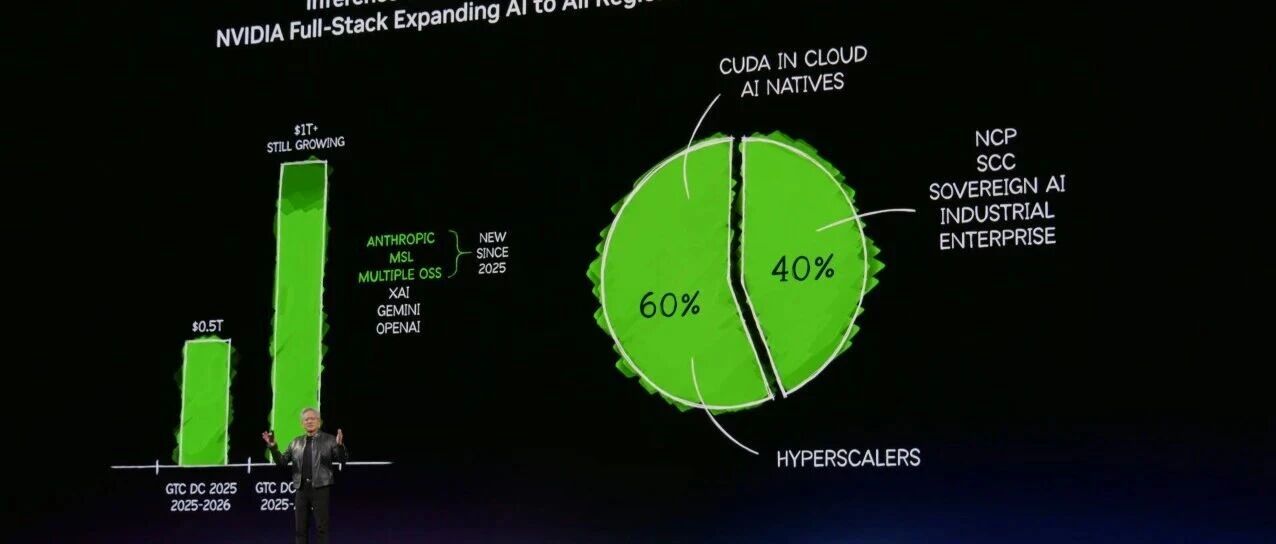
Investment Rating - The report maintains a rating of "Buy" for NVIDIA (NVDA.O) [1] Core Insights - The NVIDIA 2026 GTC conference highlighted the explosive demand for tokens and the evolution of next-generation architectures, enhancing computational efficiency and driving AI into a new phase centered on inference and agents [2] - NVIDIA's revenue guidance has been raised significantly due to the anticipated explosion in token demand, with projections for the Blackwell and Rubin platforms increasing from $500 billion for 2025-2026 to $1 trillion for 2025-2027, surpassing market expectations [11][14] - The report emphasizes NVIDIA's competitive edge in token efficiency, with the GB300 NVL72 achieving approximately 50 times the token output per unit of energy compared to competitors, and a 35 times reduction in token costs [14][17] Financial Summary - Revenue projections for NVIDIA are as follows (in million USD): - 2025: $130,497 - 2026: $215,938 - 2027: $380,098 - 2028: $523,847 - 2029: $637,418 - Year-over-year growth rates are projected at 114.2% for 2025, 65.5% for 2026, 76.0% for 2027, 37.8% for 2028, and 21.7% for 2029 [4] - Non-GAAP net profit projections are as follows (in million USD): - 2025: $74,266 - 2026: $116,996 - 2027: $223,590 - 2028: $306,380 - 2029: $371,027 - Year-over-year growth rates for non-GAAP net profit are projected at 129.8% for 2025, 57.5% for 2026, 91.1% for 2027, 37.0% for 2028, and 21.1% for 2029 [4] Revenue Drivers - The report identifies that approximately 60% of NVIDIA's revenue comes from Cloud Service Providers (CSPs), with the remaining 40% from sovereign AI, enterprise, and emerging cloud demands, indicating a broadening of AI computational needs [11] - The introduction of the LPU (Logic Processing Unit) significantly enhances inference efficiency, with potential revenue from a 1GW data center projected to increase from approximately $300 billion with Blackwell NVL72 to $1,500 billion with Rubin NVL72, and further to $3,000 billion with Rubin+LPX [17][18] System Architecture Evolution - The Rubin large-scale computing cluster features a modular architecture with an increased proportion of LPU and independent CPU cabinets, enhancing system capabilities [23][27] - Future iterations of NVIDIA's architecture include the launch of the Rubin rack in 2026, Rubin Ultra in 2027, and Feynman rack in 2028, which will introduce new CPUs and continue to enhance system bandwidth and computational density [30] Software Ecosystem Development - NVIDIA has launched the NemoClaw platform to expand enterprise-level AI agent development and deployment capabilities, integrating NVIDIA Nemotron models and OpenShell runtime environments for rapid AI agent construction [34][36] Profit Forecast and Investment Advice - The report maintains revenue forecasts for FY2027E-FY2029E at $380.1 billion, $523.8 billion, and $637.4 billion respectively, with non-GAAP net profit forecasts at $223.6 billion, $306.4 billion, and $371.0 billion respectively [39] - The target price is set at $275, maintaining a "Buy" rating based on NVIDIA's position as a leading growth engine in the token economy [39]

投资人准备用Token打款了
投资界· 2026-03-20 08:30
Core Viewpoint - The article discusses the emergence of Token as the currency of the AI era, highlighting its increasing importance in funding AI projects and the associated costs for startups [2][8]. Group 1: Token as Currency - Token has become essential for AI startups, with companies like Nvidia indicating that engineers will require an annual Token budget [2][9]. - The Token Grant initiative by Zhenge Fund aims to support entrepreneurs by providing Token funding for AI projects [2]. - The concept of Token as a form of salary is gaining traction, with companies considering it as a fundamental part of their operational budget [9]. Group 2: Rising Costs of Tokens - Startups are experiencing significant anxiety over the rising costs of Tokens, which are necessary for utilizing AI tools [3][4]. - The cost of Tokens has increased dramatically, with reports of some companies seeing their AI-related expenses triple due to Token consumption [4][5]. - A specific example includes a toy company claiming to consume 200 million Tokens daily, raising concerns about balancing Token costs with product pricing [6]. Group 3: Economic Implications - The traditional business model of decreasing marginal costs is being disrupted by the need to pay for each interaction with AI, leading to a new economic model centered around Token consumption [7][8]. - Companies that can effectively manage Token costs while delivering unique value will be more successful in the competitive landscape [11]. - The importance of human judgment in leveraging AI and managing Token resources is emphasized, suggesting that the ability to make strategic decisions remains crucial [12]. Group 4: Price Increases and Market Response - Major cloud service providers like Alibaba and Baidu have announced price increases for Token-related services due to rising demand and costs [10]. - The adjustments in pricing reflect the growing pressure on startups that rely heavily on Tokens for their operations [10].


解析AI云IAAS涨价投资机遇
2026-03-20 02:27
Summary of Conference Call Records Industry Overview - The AI Cloud IaaS sector is entering a price increase cycle driven by surging demand from applications like OpenCL, with significant price upside potential for AIDC, computing power leasing, and CDN services [1][2] Key Insights and Arguments - **Price Increases**: Major cloud computing companies, including Tencent Cloud, Alibaba Cloud, and Baidu Cloud, have announced price hikes primarily due to a surge in Token usage, indicating a bullish outlook for the AI Cloud IaaS sector [2][3] - **Token Economics**: Industry giants like NVIDIA and Alibaba are emphasizing "Token Economics," with NVIDIA introducing the concept of "Token Power Plants" at its GTC conference, suggesting that future data centers will focus on producing Tokens as a core revenue driver [3][4] - **Tencent's Strategic Shift**: Tencent's recent financial report indicates a strategic pivot towards AI investments, with plans to reduce stock buybacks to fund AI initiatives, reflecting a strong confidence in the future of AI [4] Market Dynamics - **Supply and Demand**: The domestic AIDC and computing power leasing markets are experiencing extreme demand, with prices for H100 and 5,090 servers doubling in the past month. Some companies expect a sixfold increase in B card orders by 2026 [7] - **Market Expectations**: There is a discrepancy in market expectations regarding the sustainability of AI applications, with some skepticism about the longevity of current trends. However, the demand for AI products continues to rise, indicating a shift from a buyer's market to a seller's market [7] Investment Logic and Recommendations - **AIDC Investment Logic**: AIDC serves as a leading indicator for AI infrastructure, with high-power domestic computing cards driving demand and revenue. Recommended companies include Guanghui New Network, which is seen as a core supplier for ByteDance and has significant growth potential [8][9] - **Valuation Model**: AIDC resources are estimated to correspond to a market value of approximately 50 billion, based on a model that considers the investment required and expected EBITDA [9] - **Emerging Trends**: The global shift towards liquid cooling technology is expected to benefit companies like Invec, while CDN services are also poised for growth due to the rise of AI applications and edge computing [9][10] Additional Noteworthy Content - **Core Investment Targets**: Key investment targets in the AI infrastructure space include companies involved in liquid cooling, AIDC power supply, CDN, and AI computing networks. Specific companies mentioned include Shenyang Environment, Zhongheng Electric, and NetEase Technology [9][10] - **Future Infrastructure Upgrades**: The 2026 super node is identified as a critical technological direction that will drive upgrades across servers, liquid cooling, switches, optical modules, and power supplies [10]


黄仁勋宣布“推理拐点”已至,你还在死磕 Prompt 吗?
混沌学园· 2026-03-19 12:54
Core Insights - The article emphasizes that AI has crossed a significant threshold, entering an era of autonomous intelligent agents, transforming data centers from cost centers into "AI factories" that continuously generate intelligence [1] - It highlights the need for a shift in mindset from merely acquiring technical skills to understanding the underlying logic of intelligent emergence and the principles of large models [3] Group 1: Misconceptions about Data - A significant portion of historical data (99%) held by companies is deemed worthless, as it often consists of logs generated from outdated processes, which cannot be leveraged to train advanced models [6][7] - Companies mistakenly believe that hoarding old data provides a competitive advantage, but this data can hinder innovation and adaptability in the AI era [7] Group 2: The Illusion of "Infinite Context" - The belief in "infinite context" for model training is criticized, as longer inputs dilute the attention given to critical information, leading to ineffective outcomes [9][10] - The focus should be on enhancing the "signal-to-noise ratio" of data rather than overwhelming models with excessive information [11] Group 3: The End of Certainty in Business Processes - The traditional reliance on Standard Operating Procedures (SOPs) for business management is becoming obsolete in the AI era, where flexibility and adaptability are paramount [13][14] - Companies must transition from a deterministic management style to one that embraces probabilistic approaches, allowing for organic growth and innovation [16] Group 4: Understanding the Underlying Principles - The article suggests that many apparent challenges stem from a lack of understanding of the foundational principles governing AI and large models [18] - It encourages businesses to explore the connections between various concepts, such as supervised fine-tuning (SFT) and reinforcement learning (RL), to better navigate the evolving landscape [18]

“龙虾”会吞噬SaaS公司吗
经济观察报· 2026-03-18 14:23
Core Viewpoint - The current business model of SaaS companies must undergo transformation, but this does not imply that the value of "enterprise services" itself is disappearing [5]. Group 1: Impact of AI on SaaS - NVIDIA's CEO Huang Renxun introduced a new narrative about AI agents, specifically an open-source AI called "OpenClaw," suggesting that companies may no longer need numerous SaaS subscriptions, as AI can automate processes across various systems [2][4]. - Huang's assertion raises concerns about the traditional SaaS business model, particularly for companies like Salesforce, as AI agents could potentially replace the need for human-driven software solutions [2][4]. - The shift from traditional software to AI-driven solutions indicates a fundamental change in how businesses will operate, moving from a model of providing tools to delivering results [5]. Group 2: New Business Models - The future of traditional SaaS companies may involve transitioning from software subscription models to outcome-based or token-sharing models, where AI agents deliver direct business value [6]. - The emergence of AI agents is expected to unlock previously unmet long-tail demands, reshaping the value chain in the enterprise service sector [6][7]. - The concept of One-Person Companies (OPC) is gaining traction, suggesting that in the AI era, individuals can collaborate with AI agents to achieve complete business processes, fundamentally altering organizational structures [5][6]. Group 3: Strategic Considerations for SaaS Companies - Companies in the enterprise service sector must focus on defining their "AI-native service logic" rather than clinging to outdated software interfaces [7]. - The evolution of AI agents like "OpenClaw" is not just about replacing old architectures but also about creating fertile ground for new business opportunities [7].

英伟达塑造“Token经济学”
2 1 Shi Ji Jing Ji Bao Dao· 2026-03-17 23:10
Core Insights - NVIDIA's GTC event showcased the launch of the Vera Rubin architecture, marking a significant leap in AI technology with seven new chips entering production, aimed at establishing the largest AI factory globally [1][14] - The introduction of Vera Rubin is expected to double the revenue forecast for AI chips from $500 billion to $1 trillion by the end of 2027 [2][16] - The event emphasized a shift from individual chip competition to a comprehensive system-level competition among tech giants, highlighting the importance of "Token" economics and the AI "five-layer cake" theory [2][16] Chip Architecture and Performance - The Vera Rubin architecture will utilize TSMC's 3nm process and features a tightly integrated design that enhances performance, achieving 50 PFlops for inference and 35 PFlops for training, with a fivefold increase in efficiency compared to the previous Blackwell architecture [4][18] - The architecture includes various chips such as NVIDIA Vera CPU, Rubin GPU, NVLink 6, and Groq 3 LPU, which can be configured into five different racks for data center operations [1][15] Application and Infrastructure - Vera Rubin is designed specifically for "Agentic AI" and long-context reasoning, featuring advanced components like the Transformer Engine 3.0 and Inference Context Memory, enabling AI agents to manage extensive token contexts and perform multi-step reasoning [5][19] - The infrastructure supports high-density liquid cooling and is built on NVIDIA's MGX framework, integrating 256 Vera CPUs to provide scalable and energy-efficient capacity [5][20] Collaborations and Market Impact - Key partners deploying the Vera CPU include Alibaba, ByteDance, Meta, and Oracle Cloud Infrastructure, with full production expected in the second half of the year [6][20] - NVIDIA is positioning itself as a leader in AI infrastructure, with the Vera Rubin DSX AI Factory reference design aimed at maximizing productivity and energy efficiency in AI token generation [6][20] Groq LPU and Real-Time Processing - The Groq LPU architecture, set to be integrated by the end of 2025, is designed for low-latency, real-time interactions, featuring 256 LPU processors with high bandwidth capabilities [21][22] - The LPU's deterministic pipeline architecture eliminates traditional GPU complexities, ensuring consistent execution times critical for applications like autonomous driving and high-frequency trading [22][23] AI Agent and Open Model Ecosystem - NVIDIA introduced the NemoClaw software stack for AI agents, which allows for continuous operation and complex task management, marking a significant development in the open-source AI landscape [11][24] - The company is also expanding its open model ecosystem, launching the Nemotron Coalition to foster collaboration among leading AI labs and model developers [12][24] Real-World Applications - New models for robotics and autonomous driving were unveiled, including the NVIDIA Isaac GR00T for humanoid robots and the NVIDIA Alpamayo for enhanced vehicle reasoning capabilities [13][25] - NVIDIA aims to create a comprehensive AI technology framework that bridges digital and physical worlds, promoting innovation and application across various sectors [13][25]
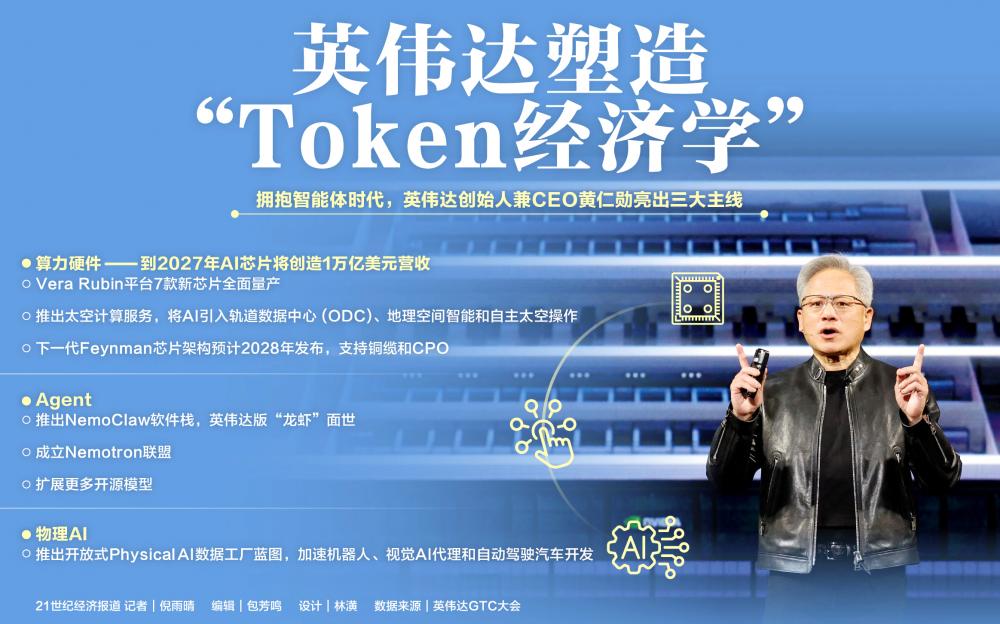
黄仁勋塑造“Token经济学” 英伟达拥抱智能体时代
2 1 Shi Ji Jing Ji Bao Dao· 2026-03-17 22:29
Core Insights - NVIDIA's GTC event showcased the launch of the Vera Rubin architecture, marking a significant leap in AI technology with seven new chips and the establishment of the largest AI factory globally [1][2] - The introduction of Vera Rubin is expected to double the revenue forecast for AI chips, reaching $1 trillion by the end of 2027, compared to the previous estimate of $500 billion [2] - The event emphasized a shift from individual chip competition to a comprehensive system-level competition among tech giants, highlighting the importance of integrated solutions [2] Chip Innovations - The Vera Rubin platform includes a diverse range of chips: NVIDIA Vera CPU, NVIDIA Rubin GPU, NVIDIA NVLink 6, NVIDIA ConnectX-9 SuperNIC, NVIDIA BlueField-4 DPU, and NVIDIA Spectrum-6, which together form a robust data center infrastructure [1] - The architecture utilizes TSMC's 3nm process and features a tightly coupled design that enhances performance, achieving 50 PFlops for inference and 35 PFlops for training [3][4] AI Infrastructure - The Vera CPU rack, built on NVIDIA MGX, integrates 256 Vera CPUs, providing scalable and energy-efficient capacity, with performance improvements over traditional CPUs [4] - The introduction of the Groq LPU architecture aims to enhance real-time interaction capabilities, with the LPX rack containing 256 LPU processors and a bandwidth of 640 TB/s [5][6] AI Agent Development - NVIDIA launched the NemoClaw software stack for AI agents, which allows for continuous operation and complex task execution, positioning it as a foundational tool for the next generation of AI applications [8][10] - The company is also forming the Nemotron Coalition to advance open model development, supporting various applications across industries [10][11] Real-World Applications - New models for robotics and autonomous driving, such as NVIDIA Isaac GR00T and NVIDIA Alpamayo, are designed to enhance decision-making capabilities in real-world environments [11]
黄仁勋的Token经济学
经济观察报· 2026-03-17 14:23
Core Viewpoint - The core of Huang Renxun's speech at the GTC conference is not just the $1 trillion figure but a new business logic where data centers are transforming from model training facilities to token production factories [1][4]. Group 1: Market Predictions and Reactions - Huang Renxun predicts that global demand for AI infrastructure will reach $1 trillion by 2027, with actual demand potentially exceeding this figure [2]. - Following the announcement, NVIDIA's stock price jumped over 4%, while A-share stocks in the computing industry saw significant declines, with Tianfu Communication dropping over 10% [2]. - The disparity in market reactions stems from the time scale of Huang's predictions, as the next-generation Feynman chip architecture will not be available until 2028 [3]. Group 2: Token Consumption and Economic Model - Tokens, the basic units of information processed by large language models, have seen significant consumption increases due to events like the launch of ChatGPT and the release of Claude Code [6][7]. - The demand for inference services has grown 100 times in the past year, with inference now accounting for nearly 60% of server shipments in China [8]. - Huang outlines a tiered pricing model for tokens, ranging from free to $150 per million tokens, indicating that larger models and faster response times will command higher prices [9]. Group 3: Data Center Economics - Data centers are limited by power constraints, and the efficiency of token production per watt of electricity will determine profitability [11]. - A single 1GW data center could generate revenues ranging from $30 billion to $300 billion depending on the architecture used, highlighting the potential for revenue multiplication with new technologies [11][12]. - Huang emphasizes that companies have not fully utilized their existing data centers, suggesting that upgrading to new equipment could significantly increase revenue under the same power conditions [12]. Group 4: Hardware Innovations - The newly announced Vera Rubin platform consists of a system rather than a single chip, featuring liquid cooling and a significant increase in inference throughput [17]. - The combination of Vera Rubin GPUs and Groq's LPU allows for a decoupled inference process, optimizing for both high throughput and low latency [19]. - Huang projects that token generation rates could increase from 22 million to 700 million per second within two years for the same data center [20]. Group 5: Future Trends and Collaborations - Huang predicts that companies will need to budget for token usage similarly to how they budget for computers and software, with engineers receiving annual token budgets [14][15]. - NVIDIA has announced collaborations in the autonomous driving sector with companies like Uber and BYD, which positively impacted the automotive sector's stock prices [22].
英伟达 FY26Q4 业绩点评:指引超预期,Token 经济学的最佳增长引擎
GUOTAI HAITONG SECURITIES· 2026-02-27 10:30
Investment Rating - The investment rating for the company is "Buy" [7] Core Insights - The report indicates a long-term revenue upgrade and stable gross margins, with the Agent application reaching a turning point, positioning the company to lead in AI infrastructure with optimal token costs [3][4] - The company has adjusted its revenue forecasts for FY2027E-FY2029E to $380.1 billion, $523.8 billion, and $637.4 billion respectively, with corresponding Non-GAAP net profits of $223.6 billion, $306.4 billion, and $371.0 billion [11] - The data center revenue exceeded expectations, with a year-on-year increase of 73% to $68.1 billion, driven by a diverse customer base and significant growth in data center computing and networking revenues [11] Financial Summary - Revenue projections for the company are as follows (in million USD): - FY2025: $130,497 - FY2026: $215,938 - FY2027E: $380,098 - FY2028E: $523,847 - FY2029E: $637,418 - Year-on-year growth rates are projected at 114.2% for FY2025, 65.5% for FY2026, 76.0% for FY2027E, 37.8% for FY2028E, and 21.7% for FY2029E [5] - Non-GAAP net profit projections are as follows: - FY2025: $74,266 - FY2026: $116,996 - FY2027E: $223,590 - FY2028E: $306,380 - FY2029E: $371,027 - The Non-GAAP gross margin is expected to be approximately 75% for FY2027Q1, reflecting significant performance improvements [11][5] Market Data - The current stock price is $184.89, with a 52-week price range of $94.31 to $207.04 [8] - The current market capitalization is approximately $4,492.827 million [8]
英伟达(NVDA):FY26Q4 业绩点评:指引超预期,Token经济学的最佳增长引擎
GUOTAI HAITONG SECURITIES· 2026-02-27 08:17
Investment Rating - The report assigns an "Accumulate" rating to Nvidia (NVDA.O) [7] Core Insights - Nvidia's long-term revenue guidance has been raised, and its gross margin remains robust. The company is expected to lead AI infrastructure with optimal token costs as the agent application inflection point has been reached [3][4] - The financial summary indicates significant revenue growth, with projected revenues of $380.1 billion in FY2027, $523.8 billion in FY2028, and $637.4 billion in FY2029, reflecting year-on-year growth rates of 76.0%, 37.8%, and 21.7% respectively [5][11] - Nvidia's data center revenue exceeded expectations, with a 75% year-on-year increase in Q4 FY26, driven by diverse customer growth and significant contributions from cloud service providers (CSPs) [11] Financial Summary - Revenue projections for FY2027E, FY2028E, and FY2029E are adjusted to $380.1 billion, $523.8 billion, and $637.4 billion respectively, with corresponding Non-GAAP net profits of $223.6 billion, $306.4 billion, and $371.0 billion [11][12] - The Non-GAAP gross margin for Q4 FY26 reached 75.2%, with guidance for Q1 FY27 around 75% (±50 basis points), indicating strong performance [11][12] - The report highlights a significant improvement in token economics, with the cost per million tokens reduced to one-thirty-fifth compared to previous architectures, enhancing revenue potential [11] Market Data - The current stock price is $184.89, with a market capitalization of approximately $4.49 trillion [7][8] - The stock has traded within a 52-week range of $94.31 to $207.04 [8]