
人民币国际化

Search documents
增强资本市场主场吸引力,提升全球配置力
Sou Hu Cai Jing· 2026-02-04 22:19
尤其是在新一轮科技革命和产业变革加速突破、全球竞技场比拼科技硬实力的背景下,做强主场,吸引 全球长期资本,提升人民币资产吸引力与人民币国际化支撑力,增强关键品种的定价影响力尤为重要, 是让中国市场更好融入全球金融体系的必要之举。 展望未来,资本市场高水平制度型开放仍将向纵深推进。可以预期,双向开放将以更成熟的节奏、更完 善的制度、更开放的姿态,建设具有全球竞争力的资本市场,为经济高质量发展与金融强国建设提供坚 实支撑。 资本市场高水平对外开放迈向规则对接、机制互通、生态共建的制度型开放新阶段。合格境外投资者资 格核准常态化,吸引长期资本稳步入市;新增一批期货期权特定品种开放,覆盖新能源、大宗商品等关 键领域,提升境内市场定价影响力与风险管理供给;境外上市备案制透明高效,企业跨境融资更便捷更 快速。开放节奏与市场需求同频,政策成效快速转化为市场活力。 要统筹开放与安全,兼顾速度与质量,风险防控不可掉以轻心。当前全球金融市场波动加大,资本市场 开放始终坚持稳字当头、稳中求进。一方面,以制度型开放筑牢基础,推动规则、规制、管理、标准逐 步与国际接轨,提升政策透明度与可预期性;另一方面,强化跨境监管协同与执法合作,健 ...
数字货币全球博弈升级,人民币飞跃新关口|《财经》封面
Sou Hu Cai Jing· 2026-02-04 11:27
计息机制落地,数字人民币实现了从"数字现金"到"数字存款"的跨越;数字资产价值凸显的同时,为数 字经济时代的货币体系重构,勾勒出清晰的中国路径 文|《财经》记者 唐郡 编辑 | 张威 袁满 "数字人民币有利息了。"李女士在数字人民币App方寸之间,所看到的0.05%利息,却是数字人民币的 历史性记录。 在全球金融数字化转型与货币形态重构的博弈关键期,中国法定数字货币迎来里程碑式突破。 2026年1月1日,数字人民币计息机制正式落地,标志着中国版央行数字货币完成从"数字现金"到"数字 存款"的质变,以制度创新开启2.0时代新征程。 这一变革的背后,是顶层设计的精准谋篇。2025年12月29日,中国人民银行(下称"央行")党委委员、 副行长陆磊在《金融时报》发表署名文章,明确《关于进一步加强数字人民币管理服务体系和相关金融 基础设施建设的行动方案》(下称《行动方案》)于2026年1月1日正式实施。 新一代计量框架、管理体系、运行机制与生态体系同步启动,为数字人民币的功能升级筑牢制度根基。 《行动方案》的核心突破,在于重塑数字人民币的价值属性。方案明确银行机构需为客户实名数字人民 币钱包余额计付利息,并遵守存款利率 ...

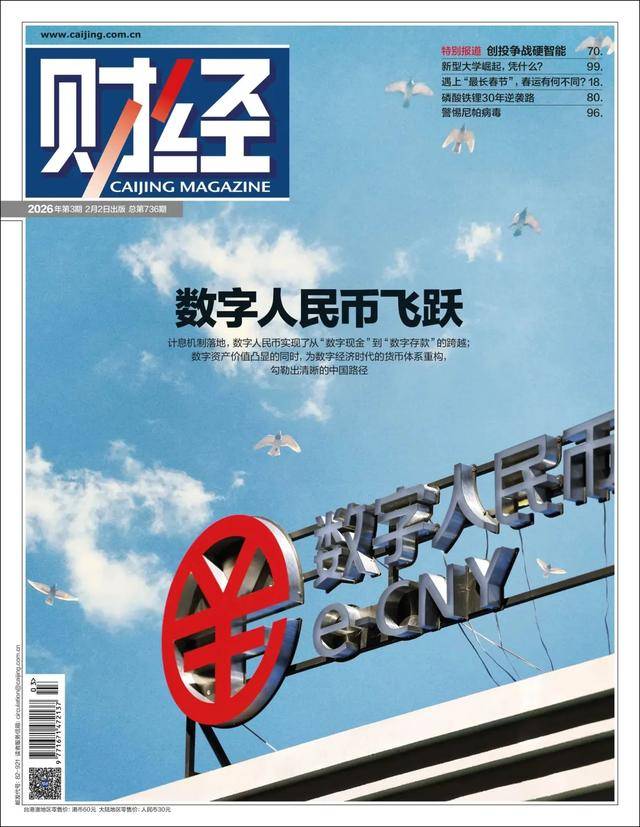
建设银行牵头主承摩根士丹利本年度首单熊猫债
Xin Lang Cai Jing· 2026-02-04 11:16
责任编辑:曹睿潼 来源:今日建行 近日,中国建设银行作为牵头主承销商和牵头簿记管理人,成功支持摩根士丹利在中国银行间债券市场 发行26亿元熊猫债。本次发行主体为摩根士丹利私人有限公司,由集团母公司摩根士丹利提供全额、无 条件且不可撤销的担保,期限5年,票面利率2.10%,吸引境内外投资者的踊跃认购,体现出国际市场 对中国债券市场与人民币资产的坚定信心。 来源:今日建行 该项目是建设银行首次作为牵头主承销商服务美资背景主体发行的熊猫债,也是建设银行与摩根士丹利 长期合作的重要里程碑。摩根士丹利作为首批进入中国市场的国际知名投资银行之一,三十余年来积极 参与中国金融市场的建设与发展。本次债券发行也体现了摩根士丹利与建设银行的合作再上新台阶。 近日,中国建设银行作为牵头主承销商和牵头簿记管理人,成功支持摩根士丹利在中国银行间债券市场 发行26亿元熊猫债。本次发行主体为摩根士丹利私人有限公司,由集团母公司摩根士丹利提供全额、无 条件且不可撤销的担保,期限5年,票面利率2.10%,吸引境内外投资者的踊跃认购,体现出国际市场 对中国债券市场与人民币资产的坚定信心。 该项目是建设银行首次作为牵头主承销商服务美资背景主体发行 ...


数字人民币的关键一步
Xin Lang Cai Jing· 2026-02-04 10:01
Core Insights - The digital renminbi has officially entered its 2.0 era after ten years of exploration, marking a significant transition from cash to deposit currency with the introduction of an interest mechanism and an expanded ecosystem [2][8] Group 1: Digital Renminbi Development - The People's Bank of China has implemented an action plan to enhance the management and service system of the digital renminbi, which includes a 0.05% interest rate, representing a crucial step in its development journey [2][8] - The digital renminbi has processed over 3.48 billion transactions, amounting to 16.7 trillion yuan, with 230 million personal wallets and 1.884 million corporate wallets opened, showcasing its achievements in the global central bank digital currency landscape [3][9] Group 2: Key Adjustments in Digital Renminbi 2.0 - The transition to digital renminbi 2.0 involves four key adjustments: inclusion in the reserve requirement framework, allowing interest on wallet balances, enabling commercial banks to use digital renminbi for loans, and incorporating digital renminbi deposits into deposit insurance [4][10] - This transformation signifies a shift from a "payment tool" to "financial infrastructure," aligning its institutional attributes and financial functions with traditional currencies [5][10] Group 3: Strategic Implications - The advancement of the digital renminbi is part of a strategic response to global digital currency competition, with China firmly promoting its central bank digital currency while the U.S. and EU pursue different paths [5][10] - The digital renminbi's capabilities in cross-border payments, utilizing blockchain technology for "payment and settlement," have shown advantages in various trade scenarios, contributing to the internationalization of the renminbi [11] Group 4: Future Directions - The development of the digital renminbi must balance stability and progress, focusing on serving the real economy while exploring applications in supply chain finance and trade financing [6][11] - The new roadmap for the digital renminbi represents a deepening of financial reform and a strategic choice for China's participation in global financial governance, aiming to enhance monetary sovereignty and support high-quality development [6][11]

许正宇:多措并举着力推动香港本地债券市场发展
智通财经网· 2026-02-04 08:01
Core Viewpoint - The Hong Kong government is committed to developing the local bond market to enhance its role as an international financial center, focusing on innovative bond issuance and various supportive measures [1][2]. Group 1: Bond Market Development - The Hong Kong government aims to activate the bond market through regular issuance of government bonds, including institutional, retail, green, and tokenized bonds [1]. - Since 2008, Hong Kong has been the leading hub for bond issuance in Asia, with over $130 billion in issuance planned for 2024, capturing nearly 30% of the market share [1]. - Hong Kong accounts for approximately 70% of the first-time bond issuance market and 45% of the green and sustainable bond issuance market, indicating its leadership in various segments [1]. Group 2: Regulatory and Market Measures - The Hong Kong government and financial regulators are implementing measures to enhance primary market issuance, improve secondary market liquidity, and expand offshore RMB business [2]. - As of January 2, 2026, there are 1,351 listed bonds on the Hong Kong Stock Exchange, with 1,302 being professional investor bonds, which are primarily traded over-the-counter [2]. - The Hong Kong Securities and Futures Commission is exploring the feasibility of an electronic bond trading platform to improve market liquidity [3]. Group 3: Offshore RMB and Risk Management - The offshore RMB bond market has seen significant growth, with issuance reaching 1.07 trillion RMB in 2024, a 37% year-on-year increase [1]. - The Hong Kong Stock Exchange is enhancing its role in the offshore RMB market by allowing foreign investors to use onshore government bonds as collateral for derivatives trading [3]. - The Hong Kong government is working on introducing offshore government bond futures to provide effective risk management tools for investors [5]. Group 4: Tokenized Bonds - The Hong Kong government has issued three batches of tokenized green bonds since 2023, with the largest issuance of 10 billion HKD in November 2025, attracting significant global institutional interest [5]. - The Hong Kong Monetary Authority is researching the secondary market applications for tokenized bonds to enhance their attractiveness and demand [6]. - Efforts are underway to optimize the legal framework for broader application of tokenization technology in the bond market [6].

如何让服务消费“花得起、买得到、放心买”?
2 1 Shi Ji Jing Ji Bao Dao· 2026-02-04 02:19
孙立坚(复旦大学金融研究中心主任) 消费是拉动经济增长的第一动力,服务消费作为消费升级的关键载体,正在成为中国经济增长的"结构 性变量"。当前,我国人均GDP已突破1.3万美元,居民消费需求从"物质型"向"服务型"加速转型,2025 年居民人均服务性消费支出占比达46.1%,服务零售额增速持续高于商品零售额。当前,加快培育服务 消费新增长点,推动服务消费提质扩容,既是顺应居民消费升级的必然选择,更是增强经济内生动力、 实现产业结构优化升级的战略突破口。本文立足"为何是它、怎么做"的逻辑主线,系统剖析服务消费成 为经济新动能的深层逻辑,直面现实堵点,把握多维机遇,提出打造现代化的服务消费供给体系,为激 活服务消费增长潜力、赋能经济高质量发展提供系统性思路。 三重逻辑:服务消费为何是关键 服务消费能成为中国经济高质量发展的新动能,是居民需求升级、经济结构转型、政策持续赋能三重逻 辑叠加的结果,兼具民生与经济双重属性,是推动发展与改善民生的重要抓手。 居民消费升级为服务消费筑牢需求根基,场景经济释放乘数效应。随着居民可支配收入增长,消费需求 从"满足基本生活"向"追求品质体验"转变,服务消费需求弹性持续提升。刚性领 ...
陆前进:人民币国际化之路,“稳”是压舱石
Sou Hu Cai Jing· 2026-02-03 23:14
Core Viewpoint - The recent steady appreciation of the Renminbi (RMB) against the US dollar and other major currencies has become a focal point in the international financial market, driven by changes in the global monetary environment and supported by strong trade fundamentals [1][2]. Group 1: RMB Exchange Rate Trends - The RMB has steadily appreciated against the US dollar, recovering over 3% since January after a period of decline due to external pressures [1]. - The RMB has also strengthened significantly against other major currencies, appreciating over 14% against the Japanese yen and approximately 4% against the euro in the past six months [1]. - The overall value of the RMB has been recognized, with a cumulative appreciation of about 5.6% since the second half of last year, according to the Bank for International Settlements (BIS) [1]. Group 2: Factors Supporting RMB Appreciation - The weakening of the US dollar, driven by expectations of interest rate cuts, has reduced the attractiveness of dollar assets, creating upward pressure on the RMB/USD exchange rate [2]. - The narrowing interest rate differential between China and the US has enhanced the relative attractiveness of RMB assets, contributing to a positive outlook for RMB appreciation [2]. - A solid and diverse trade structure, with continued engagement with traditional partners and expansion into emerging markets, has provided a stable foundation for the RMB's value [2]. Group 3: RMB Internationalization Strategy - The RMB's steady appreciation presents a significant opportunity for its internationalization, contingent upon deep financial market reforms and systematic opening [3][4]. - Key areas for deepening RMB internationalization include enhancing exchange rate marketization, gradually opening the capital account, and improving financial infrastructure to align with international standards [3]. - The extension of trading hours and the development of the Cross-Border Interbank Payment System (CIPS) are essential for facilitating RMB's role as an international currency [3].
美联储新掌门上任,2026年江西节奏将如何影响跨境电商?
Sou Hu Cai Jing· 2026-02-03 13:55
美联储新掌门上任了,是更具专业色彩和略偏鹰派的凯文·沃什,而不是特朗普的办公室主任凯文·哈塞特。 可以预见,2026年美联储降息将继续稳定2-3 次,而不会如特朗普想要的那般快,而美联储降息次数,会带动外贸汇率的变动。 元旦后人民币悄悄"破 7",这只是开始。 2026年人民币汇率走强的核心 驱动力,在于美联储货币政策周期的历史性转向。"东升西降"的货币汇率,使得美元资产越来越不值钱,国际资本将加速流向更具增值潜力的人民币资产。 意外因素: 1、美国最高法院如何裁定川普"对等关税",为汇率增添短期不可预测性; 2、爆发新战争,或南美/中东/俄乌战争外溢,外资流入美元避险,美 元升值; 3、人民币兑欧元双向波动、温和贬值,走势更复杂胶着,都受美元深刻影响。 2025年,在关税杀威棒之下,中国外贸展现出强大韧性。2025年前11个月进出口总值突破7.5万亿美元,贸易顺差规模达到创纪录的1.02万亿美元,这也是首 次破万亿,相当于德国全年GDP的五分之一。 2026年,市场预期这个顺差越拉越大,将会带动持汇观望的企业,加紧结汇,也带动了人民币升值。 值得注意的是,人民币国际化进程也在加速推进。截至2025年底,人民 ...
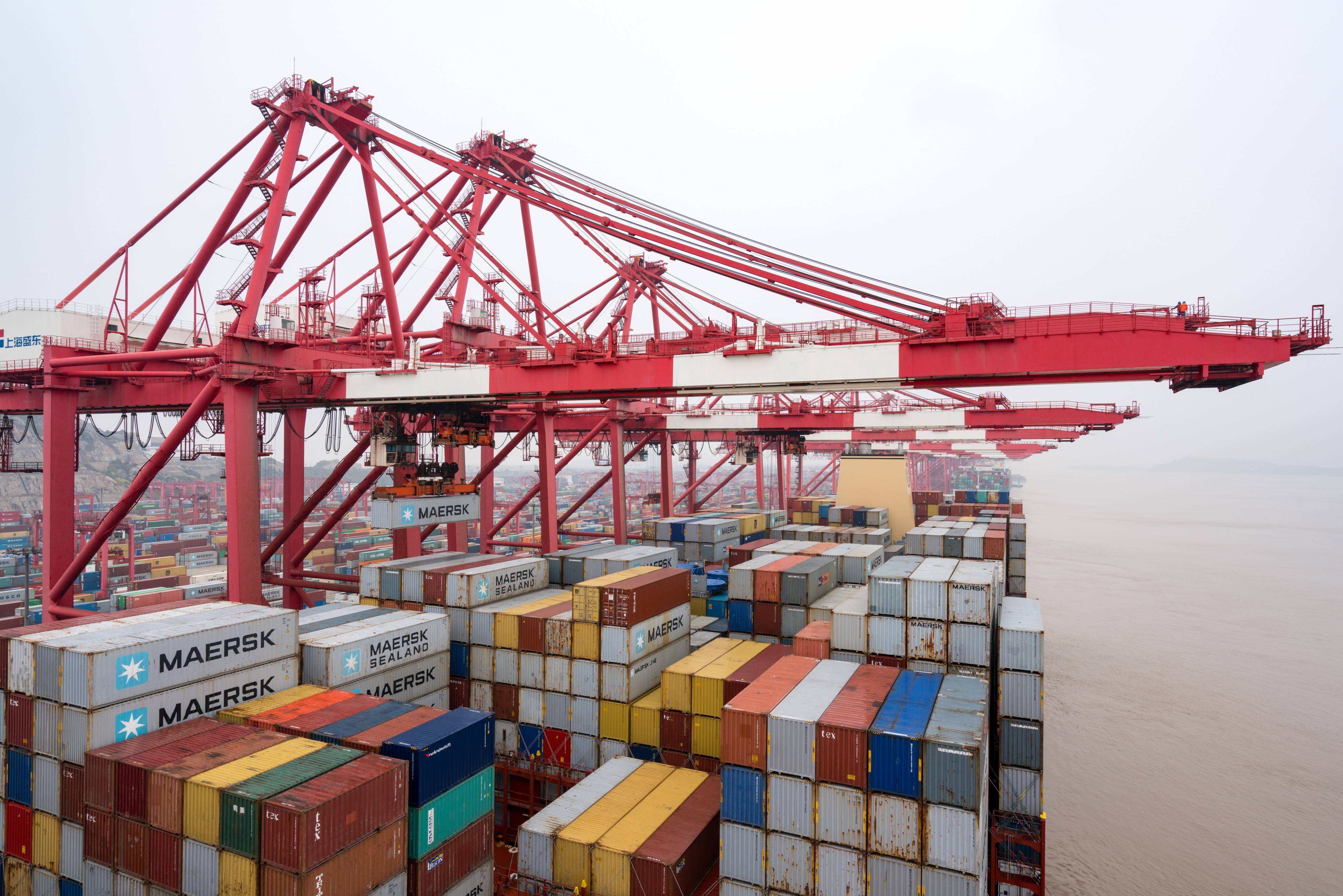
中国货币趁势崛起?IMF宣布提高人民币权重,欧元英镑权重被下调
Sou Hu Cai Jing· 2026-02-03 09:46
援引环球网5月15日消息,国际货币基金组织(IMF)时隔五年,再次启动了特别提款权(SDR)定值 审查工作。此次审查具有特殊意义,因为这是自2016年10月人民币首次纳入特别提款权货币篮子以来的 首次调整。在这次审查中,美元的权重由41.73%上调至43.38%,增幅为1.68个百分点。而人民币的权重 则从10.92%提升至12.28%,增幅为1.36个百分点。与此同时,欧元、日元和英镑在特别提款权篮子中的 权重则分别进行了不同幅度的下调。 人民币权重的提升,不仅仅是因为中国在国际出口市场、外汇储 备和外贸结算中的地位不断上升,更重要的是,它体现了中国在全球贸易中稳步推进的成果。尤其是在 全球疫情引发的供应链危机中,中国始终保持着稳定的出口供应。这种变化也正是中国综合国力增强、 在全球经济格局中日益占据更大份额的直接反映。IMF对人民币权重的调整,实际上也在印证着这一 点。然而,令人关注的是,美元的权重提升幅度要高于人民币,提升了1.68个百分点,相比人民币的 1.36个百分点,超出0.32个百分点。这一现象颇具深意。 人民币之所以能在全球范围内扩展其使用,源于中国作为"诚实商品劳动"的贡献,持续为全球各国提 ...
金融行业周报:25年券商业绩预喜,人民币贷款增速回落-20260203
Ping An Securities· 2026-02-03 04:11
金融行业周报 ——25年券商业绩预喜,人民币贷款增速回落 证券分析师 证券研究报告 袁喆奇S1060520080003(证券投资咨询) 李冰婷S1060520040002(证券投资咨询) 许 淼S1060525020001(证券投资咨询) 研究助理 李灵琇S1060124070021(一般证券业务) 请务必阅读正文后免责条款 2026年2月3日 1 核心观点 25年券商业绩预喜,人民币贷款增速回落 1、上市券商2025业绩密集预喜,或迎估值修复窗口期。截至1月30日,已有23家上市券商披露2025年业绩预告或快报,整 体实现较快增长,业绩增速较往年明显回暖。受益于权益市场回暖及资本市场活跃度提升,头部券商业绩表现稳健。其中, 中信证券2025年全年营收同比增长28.75%,归母净利润同比增长38.46%;国海证券营收同比增长7.14%,归母净利润同比 大幅增长78.88%。在"慢牛"市场环境及政策支持并购重组背景下,券商业绩修复趋势有望延续,头部券商相对优势进一 步巩固。 2、央行发布2025年四季度金融机构人民币各项贷款余额。2025年4季度末,金融机构各项人民币贷款余额同比增长6.4%, 较3季度末回落0 ...

