去美元化

Search documents
资讯早班车-2026-03-02-20260302
Bao Cheng Qi Huo· 2026-03-02 02:34
Report Industry Investment Rating - Not provided in the content Core Viewpoints - The geopolitical conflict between the United States, Israel, and Iran has intensified, impacting the Middle - East financial market and potentially causing significant fluctuations in the global financial market, including stocks, bonds, and oil prices [2][10][12] - The market's attitude towards bonds has changed due to various expected differences, such as the impact of the new economy led by AI on the traditional economy, inflation judgment, and better - than - expected bond supply - demand relationship [25] - In the short term, the A - share market is risk - controllable, and the tense Middle - East situation may bring investment opportunities to some sectors [26] Summary by Directory Macro Data Overview - In December 2025, GDP growth at constant prices was 4.5% year - on - year, down from 4.8% in the previous quarter and 5.4% in the same period of the previous year [1] - In January 2026, the manufacturing PMI was 49.3%, up slightly from 49.0% in the previous month, and the non - manufacturing PMI for business activities was 49.4%, down from 50.1% in the previous month [1] - In January 2026, the monthly value of social financing was 7220.8 billion yuan, a significant increase from 817.8 billion yuan in the previous month [1] - In January 2026, CPI was 0.2% year - on - year, the same as the previous month, and PPI was - 1.4% year - on - year, an improvement from - 2.1% in the previous month [1] Commodity Investment Reference Comprehensive - After the death of Iran's Supreme Leader Khamenei, the conflict between the United States, Israel, and Iran escalated, causing the Iranian stock market to halt trading and leading to declines in Saudi and Egyptian stock indices [2] - Shipping in the Strait of Hormuz has stopped, and major shipping companies have avoided the Persian Gulf [2] - Barclays Bank predicts that Brent crude prices could reach $100 per barrel, with a 35% upside [3] - The Dominican Republic may become a major supplier of rare earth minerals [3] Metals - On February 27, the price of battery - grade lithium carbonate decreased by 1160 yuan to 171,900 yuan per ton, while the price of lithium hydroxide decreased by 490 yuan to 162,600 yuan per ton [4] - Zhangyuan Tungsten Industry adjusted the prices of its cemented carbide products on March 1 [5] Energy and Chemicals - Due to the deteriorating security situation in the Middle - East, the IMX container shipping route has been redirected via the Cape of Good Hope [6] - OPEC+ agreed in principle to increase oil production by 206,000 barrels per day in April [6] - India plans to cut coal imports for power plants by at least 30% in 2026 [6] Agricultural Products - Indonesia raised the export tariff on crude palm oil to 12.5% starting from March 1 [7] Financial News Compilation Open Market - Last week, the central bank's open market had a net withdrawal of 611.4 billion yuan, and this week, 1525 billion yuan of reverse repurchases will mature [8] - On February 28, the central bank conducted 116 billion yuan of 7 - day reverse repurchase operations, resulting in a net injection of 116 billion yuan on that day [9] Key News - The conflict between the United States, Israel, and Iran has intensified, and China has expressed its stance of opposing military actions and promoting dialogue [10][11] - Analysts predict that the military action may cause the global stock market to decline by 1% - 2% next Monday, the US Treasury yield to drop by 5 - 10 basis points, and oil prices to rise by 5% - 10% [12] - In 2025, China's GDP was 140.1879 trillion yuan, a 5.0% increase year - on - year [12] - The 4th session of the 14th National Committee of the Chinese People's Political Consultative Conference will be held in Beijing on March 4, 2026 [13] Bond Market Summary - On Saturday, due to the escalation of the conflict, the yields of major inter - bank interest - rate bonds declined by 1 - 2 basis points, and trading activity increased [20] - On Saturday, most money - market interest rates showed an upward trend, while short - term Shibor rates mostly declined, and inter - bank repurchase fixed - term rates and inter - bank repurchase rates among banks were mostly down [21][22] Foreign Exchange Market Express - On Friday, the on - shore RMB against the US dollar closed at 6.8559, down 162 basis points from the previous trading day [23] Research Report Highlights - CITIC Securities believes that three key signals will determine the impact on the global market [24] - CICC Fixed Income states that the market's attitude towards bonds has changed due to expected differences [25] - Shenwan Fixed Income suggests that the downward space of certificate of deposit rates may be limited, and the downward space of long - term bond yields may narrow [26] - Everbright Fixed Income believes that the A - share market is stable in the long - term and risk - controllable in the short - term, and the Middle - East situation may bring investment opportunities [26] Today's Reminders - On March 2, 85 bonds will be listed, 114 bonds will be issued, 49 bonds will make payments, and 414 bonds will repay principal and interest [27][28] Stock Market Key News - In the first two months of this year, the Hang Seng Tech Index fell 6.86%, but southbound funds continued to flow in, with Tencent, Xiaomi, and Meituan being the top net - bought stocks in the past 20 trading days [29]
招商期货-期货研究报告:商品期货早班车-20260302
Zhao Shang Qi Huo· 2026-03-02 02:02
Report Industry Investment Ratings There is no information provided about the report industry investment ratings in the given content. Core Views - The Middle East situation has become tense due to the conflict between the US, Israel, and Iran, leading to a sharp increase in market risk - aversion sentiment, which has a significant impact on the prices of precious metals, energy, and other commodities [1]. - Different commodities have different supply - demand situations and price trends. For example, some commodities are affected by supply disruptions, while others are influenced by demand changes and inventory levels [1][2][3][4][5][6][7][8][9][10]. Summary by Commodity Categories Precious Metals - **Market Performance**: On Friday night, international gold prices denominated in London gold rose 1.8% to $5277 per ounce, and international silver prices denominated in London silver rose 6.28% to $93.82 per ounce [1]. - **Fundamentals**: The conflict in the Middle East has increased risk - aversion sentiment. The US PPI has increased more than expected, the US Treasury bond prices have risen, and the yield of the 10 - year US Treasury bond has fallen below 4.0%. There are changes in the inventory of gold and silver in various markets [1]. - **Trading Strategies**: It is expected that the domestic market will open higher today. Gold is recommended to hold long positions, and silver is recommended to reduce long positions and wait and see [1]. Base Metals Copper - **Market Performance**: Copper prices fluctuated and trended slightly stronger yesterday [1]. - **Fundamentals**: The conflict between the US and Iran has led to an increase in gold and oil prices and a stronger US dollar. The supply of copper ore remains tight, and the visible global inventory has increased rapidly [1]. - **Trading Strategies**: Temporarily wait and see [1]. Aluminum - **Market Performance**: On Friday, the closing price of the main electrolytic aluminum contract increased by 0.02% compared with the previous trading day, closing at 23,745 yuan per ton [1]. - **Fundamentals**: Electrolytic aluminum plants maintain high - load production, and the weekly aluminum product operating rate has increased slightly [1]. - **Trading Strategies**: It is expected that the electrolytic aluminum price will maintain a slightly stronger fluctuating trend. Attention should be paid to the progress of the Middle East geopolitical conflict, overseas capacity changes, and the inventory reduction rhythm after domestic downstream resumption of work [1]. Alumina - **Market Performance**: On Friday, the closing price of the main alumina contract decreased by 2.70% compared with the previous trading day, closing at 2744 yuan per ton [2]. - **Fundamentals**: Alumina plants have both maintenance and resumption of production, and the operating capacity continues to decline. Electrolytic aluminum plants maintain high - load production [2]. - **Trading Strategies**: In the short term, the spot circulation of alumina is tight, and the price is stable with a slight increase. In the future, the upward driving force of the alumina price still requires substantial production cuts on the supply side or the implementation of anti - involution policies [2]. Industrial Silicon - **Market Performance**: The main 05 contract closed at 8395 yuan per ton, an increase of 60 yuan per ton compared with the previous trading day, with a closing price increase of 0.72% [2]. - **Fundamentals**: The number of open furnaces increased by 2 last week. Both weekly warehouse receipts and social inventories increased slightly. The production of polysilicon and the output of the silicone industry have increased [2]. - **Trading Strategies**: The market is expected to fluctuate between 8200 - 8600. If the duration of large - factory production cuts is limited, short positions can be considered at high prices [2]. Lithium Carbonate - **Market Performance**: LC2605 closed at 176,040 yuan per ton, an increase of 2380 yuan, with a closing price increase of 1.37% [2]. - **Fundamentals**: The spot price of lithium concentrate and lithium carbonate has decreased. The production and demand in March are expected to increase compared with January. The inventory is expected to be reduced in Q1 [2]. - **Trading Strategies**: The impact of the US - Iran conflict on lithium is expected to be small. The short - term price increase is mainly restricted by demand concerns, while the low inventory and increased inventory reduction support the price to oscillate at a high level [2]. Polysilicon - **Market Performance**: The main 05 contract closed at 46495 yuan per ton, an increase of 180 yuan per ton compared with the previous trading day, with a closing price increase of 0.39% [2]. - **Fundamentals**: The weekly production is flat, and the industry inventory has increased by 3.5% this week. The downstream prices are stable, and the production schedules of silicon wafers, battery cells, and components in March have recovered [2]. - **Trading Strategies**: Affected by factors such as the reduction of spot quotes by leading manufacturers, the expected resumption of production in March, and the unresolved position limit, the market sentiment is pessimistic. It is expected that the short - term market will maintain a weak oscillation between 45000 - 53000 yuan [2]. Tin - **Market Performance**: Tin prices rose significantly on Friday [3]. - **Fundamentals**: The market is worried about the supply disruptions in Myanmar and Congo. The downstream demand is good, and the global visible inventory has increased slightly after the Spring Festival [3]. - **Trading Strategies**: It is recommended to hold long positions [3]. Black Industry Rebar - **Market Performance**: The main 2605 rebar contract closed at 3074 yuan per ton, an increase of 14 yuan per ton compared with the previous night - session closing price [4]. - **Fundamentals**: The steel spot market trading has not yet picked up, and the supply - demand contradiction is not significant. The demand for building materials is expected to be weak, and the supply has decreased significantly year - on - year. The demand for plates is stable, and the inventory level is still high [4]. - **Trading Strategies**: Mainly wait and see. The reference range for RB05 is 3040 - 3100 [4]. Iron Ore - **Market Performance**: The main 2605 iron ore contract closed at 745.5 yuan per ton, a decrease of 3.5 yuan per ton compared with the previous night - session closing price [4]. - **Fundamentals**: The supply - demand of iron ore is neutral. The molten iron output has increased slightly month - on - month and is basically the same year - on - year. The steel mill profit is poor, and the subsequent blast furnace output may decrease slightly. The port inventory has increased year - on - year, and there is a structural contradiction [4]. - **Trading Strategies**: Mainly wait and see. The reference range for I05 is 740 - 770 [4]. Coking Coal - **Market Performance**: The main 2605 coking coal contract closed at 1078 yuan per ton, a decrease of 6.5 yuan per ton compared with the previous night - session closing price [4]. - **Fundamentals**: The steel mill profit is poor, and the subsequent blast furnace output may decrease slightly. The first round of price increase has been implemented, and there is no subsequent price increase plan. The inventory in each link is differentiated, and the overall inventory level is neutral. The 05 contract futures are at a premium to the spot [4]. - **Trading Strategies**: Close long positions. Aggressive investors can try to short the 2605 coking coal contract. The reference range for JM05 is 1050 - 1110 [4]. Agricultural Products Soybean Meal - **Market Performance**: CBOT soybeans rose last Friday [5]. - **Fundamentals**: There is an expected bumper harvest in South America. The US soybean crushing is strong, and the export expectation is strong. The global supply - demand is expected to be more relaxed [5]. - **Trading Strategies**: US soybeans are strong. Pay attention to the US soybean export and the realization of South American production. The domestic market is expected to oscillate slightly stronger in the short term but lacks upward driving force in the medium term [6]. Corn - **Market Performance**: Corn futures prices continued to strengthen, and corn spot prices continued to rise [6]. - **Fundamentals**: The grain sales progress has exceeded 60%, but the progress is slow. The downstream inventory is low, and the downstream is in a loss state. The spot price is still dominated by the producing area [6]. - **Trading Strategies**: The deep - processing industry replenishes inventory, and the futures price is expected to oscillate slightly stronger [6]. Fats and Oils - **Market Performance**: Malaysian palm oil fell last Friday [6]. - **Fundamentals**: The expected production in Malaysia in February decreased month - on - month, and the export also decreased month - on - month. It is expected to enter the seasonal production increase period later [6]. - **Trading Strategies**: Fats and oils are in a weak cycle. Trade the expected seasonal production increase, but there may be a short - term rebound driven by a sharp increase in crude oil. Use the reverse spread structure. Pay attention to the subsequent production and biodiesel policy [6]. Eggs - **Market Performance**: Egg futures prices oscillated in a narrow range, and egg spot prices were stable [6]. - **Fundamentals**: After the Spring Festival, it is the traditional off - season for egg demand. The overall supply is sufficient, and egg prices are expected to run at a low level [6]. - **Trading Strategies**: The demand is weakening, and the futures price is expected to oscillate weakly [6]. Pigs - **Market Performance**: Pig futures prices oscillated in a narrow range, and spot prices mostly fell [6]. - **Fundamentals**: According to the seasonal pattern, the supply pressure after the Spring Festival is large, and the demand is in the off - season. The futures and spot prices are expected to run weakly [6]. - **Trading Strategies**: The supply is strong and the demand is weak, and the futures price is expected to oscillate weakly [6]. Energy and Chemicals LLDPE - **Market Performance**: Due to the conflict between the US, Israel, and Iran, the low - price spot quotation of LLDPE in North China rose by 50 - 80 yuan per ton, and the market trading volume increased [7]. - **Fundamentals**: There is no new device put into production in the first half of the year, and some existing devices will undergo spring maintenance. If Iran's supply is interrupted, the import volume to China will decrease. The current downstream demand is weak but is improving month - on - month [7]. - **Trading Strategies**: In the short term, the inventory in the industrial chain has accumulated during the Spring Festival, and the basis is weak. It is expected to oscillate slightly stronger in the short term, and the upward space is limited by the import window. Pay attention to the development of the US - Iran incident [7][8]. PVC - **Market Performance**: v05 closed at 4803, an increase of 0.2% [8]. - **Fundamentals**: PVC is suppressed by high inventory and is still oscillating at the bottom. The supply is large, and the demand from downstream factories has not recovered. The social inventory has reached a new high [8]. - **Trading Strategies**: The supply is balanced and the demand is weak, and the valuation is low. It is recommended to wait and see [8]. PTA - **Market Performance**: The CFR China price of PX is $932 per ton, and the East China spot price of PTA is 5155 yuan per ton, with a spot basis of - 63 yuan per ton [8]. - **Fundamentals**: The supply of PX is at a high historical level, and the supply of PTA has increased to a high level. The polyester factory load is at a seasonal low, and the comprehensive inventory pressure is not large [8]. - **Trading Strategies**: The geopolitical conflict has little impact on the fundamentals. The mid - term long - allocation view of PX remains unchanged. Pay attention to buying opportunities. PTA has a seasonal inventory increase, and the mid - term supply - demand pattern is improving. The processing fee has reached a high level, and it is appropriate to take profits [8]. Glass - **Market Performance**: fg05 closed at 1050, a decrease of 0.1% [8]. - **Fundamentals**: Glass is restricted by high inventory, and the price is hovering at the bottom. The supply has decreased significantly, and the inventory has accumulated again. The downstream demand is weak, and the glass production is in a loss state [8]. - **Trading Strategies**: The supply is decreasing and the demand is weak, and the valuation is very low. It is recommended to buy glass and sell soda ash [8]. PP - **Market Performance**: Due to the conflict between the US, Israel, and Iran, the spot price of PP in East China rose by 50 yuan per ton, and the overall market trading was okay [8]. - **Fundamentals**: In the short term, the new device put - into - production in the first half of the year has decreased, and some devices have stopped unexpectedly. The domestic supply is gradually increasing, and the export window is open. The downstream is still on holiday, and the start - up rate is low [8]. - **Trading Strategies**: In the short term, the inventory in the industrial chain has accumulated during the Spring Festival, and the basis is weak. It is expected to oscillate slightly stronger in the short term, and the upward space is limited by the import window. In the medium - to - long - term, the new devices put into production in the first half of the year have decreased, and the supply - demand pattern has slightly improved but the contradiction is still large. It is mainly in a range - bound oscillation, and it is recommended to short at high prices [8]. MEG - **Market Performance**: The East China spot price of MEG is 3621 yuan per ton, with a spot basis of - 80 yuan per ton [9]. - **Fundamentals**: If Iran's MEG supply is in short supply, it will have a greater impact on the MEG price. From March, MEG devices will have more maintenance, and the polyester demand will pick up, and MEG will start to reduce inventory [9]. - **Trading Strategies**: The inventory increase has been fully expected, and inventory reduction may start in March. The current valuation is at a low level, and with geopolitical disturbances, it is recommended to continue to hold long positions [9]. Crude Oil - **Market Performance**: Due to the conflict between the US, Israel, and Iran, the outer - market price rose about 7% on Monday morning, and SC is expected to open at the daily limit [9]. - **Fundamentals**: Iran's crude oil production is 3.3 million barrels per day, and the export volume is 1.8 million barrels per day. The conflict may lead to the paralysis of the Strait of Hormuz, which will have a significant impact on oil prices. OPEC has sufficient idle capacity to deal with Iran's supply interruption. OPEC+ will hold a meeting on Sunday to formulate a production plan for April [9]. - **Trading Strategies**: The current core of crude oil trading is the Middle East geopolitical risk. It is not recommended to directly participate in futures trading. Enterprises worried about rising oil prices can buy out - of - the - money call options at low prices, and enterprises worried about oil prices falling after rising can buy out - of - the - money put options at high prices [9]. Styrene - **Market Performance**: The main EB contract rose slightly by 80 yuan per ton on Saturday, and the spot market quotation in East China was 7700 yuan per ton, with a general trading atmosphere [9]. - **Fundamentals**: The pure benzene inventory is at a normal - to - high level during the Spring Festival. The supply - demand pattern of pure benzene and styrene will improve in the second and third months, but the overall contradiction is still large. The styrene inventory has accumulated during the Spring Festival, and the supply - demand is weak in the second and third months and will improve in the second quarter [9]. - **Trading Strategies**: In the short term, the pure benzene inventory is at a high level, and the supply - demand has marginally improved. It will follow the cost (crude oil) to rise. The styrene inventory has accumulated during the Spring Festival, and the basis is stable. In the short term, the supply - demand is weak in the second and third months, but it will follow the cost (crude oil) to rise due to the impact of the Iran geopolitical event. The upward space is limited by the import window. In the medium - to - long - term, it is recommended to go long on styrene at low prices in the second quarter [9][10]. Soda Ash - **Market Performance**: sa05 closed at 1189, an increase of 0.2% [10]. - **Fundamentals**: The bottom price of soda ash is in a stalemate, and the upstream orders are okay. The supply is large, and the inventory has increased slightly. The downstream demand from photovoltaic glass is stable, and there is still an expectation of production reduction in float glass [10]. - **Trading Strategies**: The supply is increasing and the demand is weak, and the valuation is low. It is recommended to short at high prices [10].
地缘风波升温-哪些资产受益
2026-03-01 17:22
Summary of Key Points from Conference Call Records Industry or Company Involved - The discussion primarily revolves around the geopolitical landscape affecting international relations, particularly between the U.S. and China, and its implications for various asset classes, including equities and commodities. Core Insights and Arguments 1. **Geopolitical Adjustments**: There is a systematic increase in diplomatic engagement between Western developed countries and China, indicating a potential stabilization in international relations over the next month, which supports a relatively optimistic outlook for equity assets [1][2][3]. 2. **U.S.-China Trade Relations**: The potential for a temporary easing of tariffs and export controls on semiconductors is noted, but long-term agreements remain uncertain due to political pressures and ongoing investigations [1][3][4]. 3. **Tariff Changes**: Following a Supreme Court ruling against "emergency tariffs," the average effective tariff rate in the U.S. is expected to decrease from 16.9% to approximately 9%, which could improve profit expectations for export-oriented companies [5][6]. 4. **Baseline Scenario for Trade**: The baseline scenario suggests that U.S. tariffs on China will stabilize between 20% and 25%, with China's exports to the U.S. remaining around 10% [6][7]. 5. **Agricultural Purchases**: China is expected to purchase around 12 million tons of U.S. soybeans, aligning with previous agreements, which is crucial for U.S. farmers facing declining profits [7]. 6. **Iran Conflict Risks**: The potential for military conflict with Iran remains high, which could influence market pricing but is not expected to significantly impact A-share risk preferences [8][9]. 7. **Oil and Gold Prices**: Geopolitical tensions may lead to short-term increases in oil and gold prices, but long-term trends will depend on fundamental economic conditions [9][10]. 8. **Market Reactions to Geopolitical Events**: Historical patterns indicate that A-share performance is influenced by geopolitical events, with sectors like military, finance, and energy likely to benefit during conflicts [18][19][20]. Other Important but Possibly Overlooked Content 1. **Energy Supply Dynamics**: The ongoing imbalance in oil supply and demand, particularly in the context of potential military actions in the Middle East, could lead to increased oil prices, but also presents short-selling opportunities [9][11]. 2. **Long-term Economic Implications**: The long-term trajectory of oil prices will be determined by economic fundamentals rather than short-term geopolitical events [10][12]. 3. **Investment Strategies**: The current market environment suggests that any corrections in equity markets due to geopolitical tensions could present buying opportunities, particularly for resilient sectors like A-shares compared to Hong Kong stocks [10][17]. 4. **Historical Context**: The analysis draws parallels with past geopolitical conflicts, indicating that while immediate reactions may be volatile, the overall market trend tends to recover post-conflict [18][19][20]. 5. **Sector Rotation**: The anticipated sector rotation in response to geopolitical events suggests that defensive sectors may outperform during initial conflict phases, while growth sectors may rebound as stability returns [19][21]. This summary encapsulates the key insights and arguments presented in the conference call records, highlighting the implications for various sectors and the overall market outlook in light of geopolitical developments.
美伊冲突,影响几何?
Orient Securities· 2026-03-01 08:13
Group 1: Impact of US-Iran Conflict - The US began significant military operations in Iran on February 28, 2026, which may disrupt China's crude oil imports[6] - In 2025, China's crude oil imports were primarily sourced from the Middle East (44.3%), Russia (16.8%), ASEAN (12.8%), and Latin America (9.4%)[6] - Trade with Iran constitutes a small portion of China's overall trade, with crude oil imports at 0.12% and exports at 0.18%[6] Group 2: Belt and Road Initiative - Despite the conflict, China will continue to expand its maritime trade with Belt and Road countries, including the Middle East[6] - The growth in capital goods exports to Belt and Road regions is significant, driven by China's economic transformation[6] Group 3: Commodity Price Trends - Geopolitical factors are now a core driver of commodity prices, affecting precious metals, industrial metals, and crude oil[6] - The concentration of exporting countries for commodities has led to greater price increases, indicating a shift towards "political pricing" rather than economic factors[6] - Oil price trends will depend on the conflict's outcome, with potential for both short-term spikes and longer-term adjustments[6]
基本金属行业周报:美伊局势扰动加剧,宏观带动金属价格上行
HUAXI Securities· 2026-03-01 07:20
Investment Rating - The industry rating is "Recommended" [5] Core Insights - The geopolitical tensions between the US and Iran have significantly increased risk aversion, leading to a rise in gold prices. The price of COMEX gold increased by 4.59% to $5,296.40 per ounce, while COMEX silver rose by 22.15% to $94.39 per ounce. SHFE gold and silver also saw increases of 3.41% and 16.36%, respectively [1][34] - The ongoing geopolitical conflicts and the trend of "de-dollarization" are expected to support gold prices in the long term. The US national debt has surpassed $38.5 trillion, and the projected budget deficit for the 2025 fiscal year is $1.8 trillion, which raises concerns about debt levels and supports the case for gold investment [7][51] - Silver prices are expected to rise due to its dual role as both a precious metal and an industrial metal. The inclusion of silver in the US "critical minerals" list has led to increased investment interest, and supply constraints are expected to support prices in the coming years [8][52] Summary by Sections Precious Metals - The recent military actions by Israel against Iran have escalated tensions in the Middle East, leading to a surge in gold prices and increased demand for safe-haven assets [4][51] - The gold-silver ratio has decreased by 14.37% to 56.11, indicating a shift in market dynamics favoring gold over silver [34] - SPDR gold ETF holdings increased by 781,154.27 ounces, while SLV silver ETF holdings decreased by 1,586,043.90 ounces, reflecting changing investor sentiment [34] Base Metals - In the LME market, copper prices rose by 2.82% to $13,296.00 per ton, while aluminum increased by 1.65% to $3,141.50 per ton. SHFE copper and aluminum also saw gains of 3.53% and 2.76%, respectively [10] - The macroeconomic environment is expected to support copper prices, with anticipated Fed rate cuts and ongoing geopolitical tensions contributing to a favorable outlook for copper as a key metal in energy transition [14][27] Minor Metals - Magnesium prices increased by 1.28% to 18,260 yuan per ton, supported by recovering demand as downstream processing enterprises resume operations [21] - Molybdenum prices rose by 5.77% to 282,500 yuan per ton, driven by strong demand for raw materials from smelting enterprises [22] - Vanadium prices increased by 1.27% to 79,500 yuan per ton, supported by tight supply and strong cost support [23]
基本金属行业周报:美伊局势扰动加剧,宏观带动金属价格上行-20260301
HUAXI Securities· 2026-03-01 06:52
Investment Rating - The industry rating is "Recommended" [5] Core Insights - The geopolitical tensions between the US and Iran have significantly increased risk aversion, leading to a rise in gold prices. The price of COMEX gold increased by 4.59% to $5,296.40 per ounce, while COMEX silver rose by 22.15% to $94.39 per ounce. SHFE gold and silver also saw increases of 3.41% and 16.36%, respectively [1][34] - The ongoing "de-dollarization" trend globally is driving central banks and investors to continue purchasing gold, which is expected to benefit gold prices in the long term. The US national debt has surpassed $38.5 trillion, and the projected budget deficit for the 2025 fiscal year is $1.8 trillion [7][24] - Silver prices are expected to rise due to its dual role as both a precious metal and an industrial metal, with strong demand from sectors like AI and clean energy. The supply-demand gap for silver is anticipated to widen in the coming years [8][54] Summary by Sections Precious Metals - The recent military actions in the Middle East have led to a surge in gold prices, with significant increases in both COMEX and SHFE markets. The gold-silver ratio has decreased by 14.37% to 56.11, indicating a shift in market dynamics [1][34] - The overall precious metals sector is currently in a low valuation phase, presenting a potential opportunity for investment in gold resource stocks, which are expected to see enhanced profit forecasts due to rising gold prices [24][55] Base Metals - Base metals have benefited from improved macroeconomic sentiment, with copper prices rising by 2.82% to $13,296.00 per ton on the LME and 3.53% to 103,920.00 yuan per ton on the SHFE. Aluminum prices also saw increases, while zinc and lead experienced slight declines [10][11] - The copper market is facing supply disruptions, with ongoing labor issues in major mining regions. However, demand from emerging industries is expected to provide long-term support for copper prices [11][27] Minor Metals - Magnesium prices have increased by 1.28% to 18,260 yuan per ton, supported by a gradual recovery in downstream demand. However, overall demand remains limited as companies focus on depleting existing inventories [21] - Molybdenum prices have risen due to strong demand for raw materials from smelting enterprises, with domestic prices supported by the closure of import windows [22] - Vanadium prices are expected to remain strong due to tight supply and robust cost support, despite a slower recovery in downstream steel production [23]






人生发财靠周期:2026年展望
泽平宏观· 2026-03-01 05:04
Core Viewpoint - The article discusses the cyclical nature of economic and technological trends, predicting significant shifts in global dynamics by 2026, including a new wave of technological revolution led by AI, a surge in commodity prices, and the onset of a new economic cycle characterized by inflation and monetary tightening [2][4]. Group 1: Economic Cycles - The article identifies the end of a century-long economic cycle, with increasing income disparity, populism, and geopolitical tensions, leading to a global arms race [5][10]. - It highlights the emergence of a new Kondratiev wave driven by AI, which is expected to surpass the previous IT revolution, initiating substantial capital expenditures in new infrastructure [5][16]. - The article outlines the cyclical nature of various economic factors, including the real estate cycle, capacity cycle, inventory cycle, and debt cycle, all converging around 2026 [4][6]. Group 2: AI and Technological Revolution - AI is positioned as the catalyst for the fourth technological revolution, with a significant impact on national strength and global order, leading to a massive increase in capital spending on new infrastructure [5][17]. - The article notes that the AI revolution is in its early stages, with rapid advancements in GPU and large model technologies, paving the way for widespread commercial applications [18][19]. - It anticipates that AI will lead to transformative applications in various sectors, including autonomous driving, healthcare, and robotics, fundamentally altering the global landscape [18][19]. Group 3: Real Estate Market Dynamics - The real estate market is expected to experience a bifurcation, with core cities seeing price stabilization while lower-tier cities face prolonged downturns [6][19]. - The article predicts that by 2026, policies will shift from merely stabilizing the market to actively encouraging growth, including potential subsidies and relaxed purchasing restrictions [20][21]. - It emphasizes the need for continued policy support to stimulate demand and restore confidence in the real estate sector [20][21]. Group 4: Capacity and Inventory Cycles - The article discusses the transition in capacity cycles, with traditional industries undergoing adjustments while new productive forces, particularly AI, drive significant investments in infrastructure [23][25]. - It notes that the inventory cycle is moving from passive destocking to active restocking, although the recovery may be constrained by long-term pressures [27][29]. - The article highlights the role of "anti-involution" policies in improving supply-side dynamics and supporting price recovery in industrial sectors [27][29]. Group 5: Debt Cycle and Policy Outlook - The article outlines the ongoing deleveraging process in the household sector, with a focus on repairing balance sheets and the need for supportive fiscal and monetary policies [32][33]. - It anticipates that government leverage will increase, but the pace of fiscal action may be limited by local government financial constraints [37]. - The article suggests that 2026 will see a more aggressive policy stance aimed at stimulating new productive forces and addressing structural economic challenges [42][44]. Group 6: Asset Class Outlook - The article predicts a "confidence bull market" in the stock market, driven by technological advancements and a favorable policy environment [48][50]. - It highlights the expected rise in commodity prices, particularly in the context of a weakening dollar and global monetary easing [51][52]. - The article emphasizes the potential for the RMB to appreciate due to favorable economic conditions and improved export competitiveness [52].

全球资本市场面临两大不确定性,影响几何,如何找寻相对确定性?|资本市场
清华金融评论· 2026-02-28 09:01
Group 1 - The core uncertainty in the global capital market for 2026 is the unclear path of AI transformation and the uncertain outcomes of the U.S. midterm elections, which will have multidimensional impacts on the market [2] Group 2 - AI capital expenditure is unprecedented, but there are critical contradictions in its commercialization, as highlighted by BlackRock's report indicating a mismatch between computing power investment and returns [4] - Morgan Stanley raises concerns about the "scale wall," questioning whether a tenfold increase in computing power will lead to a non-linear leap in intelligence, which could trigger valuation corrections if technical bottlenecks are encountered [4] - Short-term impacts include increased volatility, with AI hardware stocks at historical high valuations; if applications do not meet expectations or energy bottlenecks arise, sector adjustments may occur [4] - Long-term structural differentiation is anticipated, with investment focus shifting from hardware to infrastructure such as power, liquid cooling, and domestic computing power, expanding into AI-enabled sectors like finance, healthcare, and industry [4] - The need to identify "winners" that can capture AI benefits while being cautious of "pseudo-diversification" traps is emphasized [4] Group 3 - The outcome of the U.S. midterm elections could lead to significant policy direction changes, particularly in trade and tariffs, with a 20% chance of the Republican Party winning the House of Representatives, potentially altering U.S.-China tariff strategies [6] - If the Democratic Party wins, trade tensions may ease, impacting fiscal policies, regulatory frameworks, and AI antitrust legislation [6] - Market implications include fluctuations in the dollar and U.S. Treasury yields, with policy uncertainties likely to increase term premiums and upward pressure on long-term Treasury yields [6] - Regulatory tightening on tech stocks related to AI could exacerbate valuation pressures, while ongoing geopolitical tensions may sustain defense spending and favor energy infrastructure [6] Group 4 - The restructuring of global capital flows is noted, with emerging markets benefiting from a weak dollar cycle, directing funds towards more favorably valued Asian markets such as A-shares, Hong Kong stocks, and Korean stocks [8] - The potential for renminbi appreciation is highlighted, with high-value exports enhancing exchange rate elasticity, projecting the USD/CNY exchange rate to fluctuate between 6.5 and 6.9 [8] - Opportunity areas include AI applications in healthcare and automation, resource commodities like copper, lithium, and rare earths, as well as power infrastructure and emerging market dividend assets [8] - Risks to monitor include corrections in high-valued U.S. tech stocks and potential policy shifts in the U.S. impacting supply chains [8] - In the context of ongoing geopolitical conflicts and intensified great power competition, de-dollarization is emerging as a trend, with gold remaining a key investment target [8] - Despite uncertainties in AI transformation, essential resources like computing power, electricity, copper, and aluminum are in demand, suggesting investment opportunities in these areas [8]

现货黄金大涨!多家品牌酝酿新一轮涨价
Sou Hu Cai Jing· 2026-02-28 00:49
Group 1 - The core viewpoint is that international gold prices have continued to rise, with spot gold surpassing $5200 per ounce, indicating a strong market trend and renewed interest in gold as an investment asset [1][2] - Gold stocks have also strengthened, with notable increases in companies such as Hunan Gold and Huayu Mining, reflecting heightened market activity and investor sentiment towards gold [2][3] - The rising gold prices are beginning to affect the retail sector, as major domestic gold jewelry brands are preparing for price increases, signaling a transmission of market trends from financial to physical consumption [2][3] Group 2 - The scale of leading gold ETFs has been steadily increasing, with significant inflows reported, indicating sustained investor interest despite price fluctuations [3] - Structural factors supporting gold prices remain unchanged, with central bank gold purchases and weakening dollar credibility identified as key long-term drivers for gold investment [4][5] - The recent ruling against U.S. tariffs is expected to alleviate inflationary pressures and may create favorable conditions for gold, enhancing its appeal as a safe-haven asset [4]
美股三大股指全线收跌,英伟达跌超4%,白银大涨
Xin Lang Cai Jing· 2026-02-28 00:25
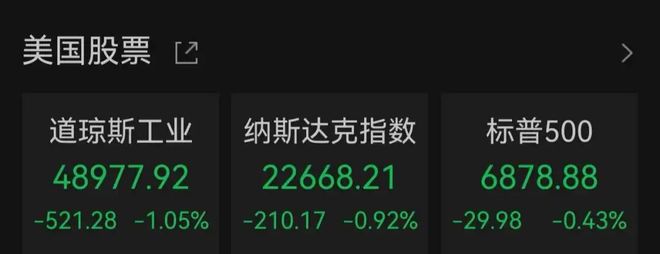
来源:中国证券报-中证网 Wind数据显示,当地时间2月27日,美股三大指数全线收跌,道指跌1.05%。 美股科技股、银行股普跌,高盛集团跌超7%,英伟达跌超4%,苹果跌逾3%。中概股多数下跌,阿特斯 太阳能、爱奇艺等跌幅居前。 大宗商品市场方面,国际贵金属价格普涨,白银大涨,国际油价上涨。 美股三大指数全线收跌 当地时间2月27日,美股三大指数全线收跌。Wind数据显示,截至收盘,道指跌1.05%报48977.92点, 标普500指数跌0.43%报6878.88点,纳指跌0.92%报22668.21点。 中概股多数下跌,纳斯达克中国金龙指数跌1.81%。个股方面,阿特斯太阳能、爱奇艺、世纪互联、蔚 来等跌幅居前;金山云、涂鸦智能等涨幅居前。 | W 京新 | 成分 | 资讯 | 相关基金 | 月度收益 | | --- | --- | --- | --- | --- | | 名称 | | | 现价 | 涨跌 == | | 阿特斯太阳能 | | | 17.710 | -11.18% | | CSIQ.O | | | | | | 灿谷 | | | 0.762 | -9.47% | | CANG.N | | | | ...