
存款搬家

Search documents
银保渠道锁定26年新单增长主阵地
Ge Long Hui· 2026-01-13 00:08
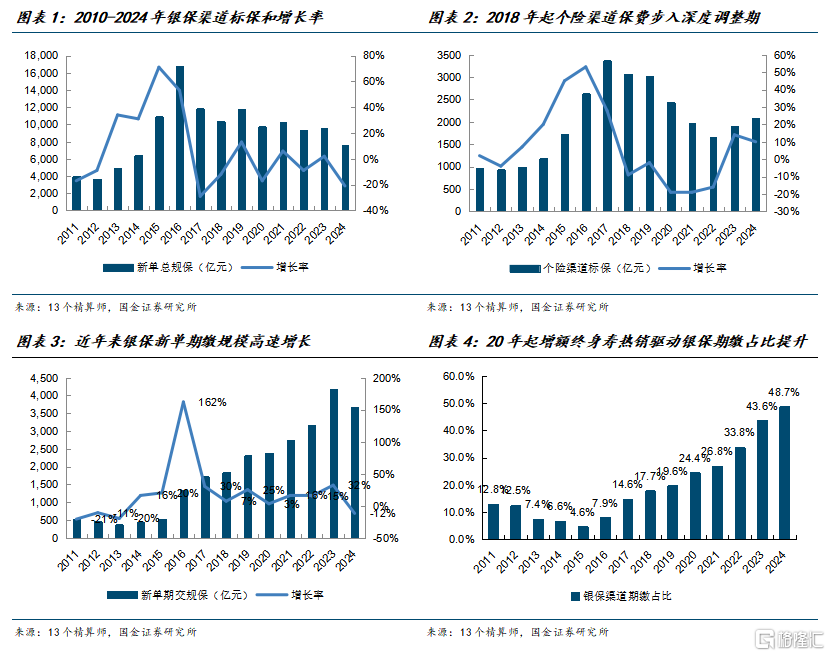
Investment Logic - The core view is that new individual insurance premiums for listed insurance companies are expected to achieve double-digit growth by 2026, primarily driven by the bancassurance channel [1][18] - The individual insurance channel is anticipated to maintain steady growth, while the bancassurance channel will benefit from the migration of deposits, leading to an increase in market share for large insurance companies [1][18] - The growth in the bancassurance channel is expected to dilute fixed costs, significantly enhancing overall profitability [1][18] Bancassurance Channel - Since 2020, leading insurance companies have refocused on the bancassurance channel, transitioning from scale compensation to value pursuit, resulting in a rise in market share [2][8] - The bancassurance channel has seen a compound annual growth rate (CAGR) of 16.2% from 2019 to 2023, while individual insurance premiums have declined [9] - The "reporting and banking integration" policy implemented in August 2023 has significantly reduced costs, enhancing the value rate of the bancassurance channel [14][9] Customer Deposit Analysis - A survey of 88 frontline bank wealth managers indicates that a significant portion of residents' deposits will mature in 2026, with expectations of low renewal rates due to the withdrawal of high-yield time deposits [3][25] - The majority of maturing depositors are aged 45 and above, indicating a lower risk appetite, with insurance products being the second choice for reallocating maturing deposits [4][30] - Wealth managers believe that bank wealth management products will be the most accepted option for maturing deposits, followed by insurance products [30][27] Sales Logic for Insurance Products - Wealth managers prioritize customer returns and the brand of insurance companies when recommending insurance products [5][33] - The core advantages of participating in dividend insurance sales include stable returns, capital safety, and alignment with long-term financial planning [36][40] - Challenges in selling dividend insurance include uncertainty in returns and the long duration of products, which may deter potential customers [40][36] Market Forecast - The insurance industry is projected to see new single premium growth exceeding 25% in 2026, driven by the bancassurance channel [42][44] - The expected influx of maturing deposits into insurance products will be significant, with estimates of new funds in the bancassurance channel reaching 11,150 billion by the end of 2026 [44][44] - The concentration trend among leading insurance companies is expected to continue, with larger firms benefiting from improved profitability in the bancassurance channel [47][48]




70万亿定期存款年内到期,留在银行还是进入股市?
第一财经· 2026-01-12 13:13
Core Viewpoint - The article discusses the significant amount of deposits maturing in 2026, estimated to exceed 160 trillion yuan, and the implications for potential "deposit migration" into the capital markets, emphasizing the need for a rational perspective on where these funds will flow in a low-interest-rate environment [3][4][6]. Summary by Sections Deposit Maturity Estimates - Various institutions have provided differing estimates on the scale of maturing deposits, with a consensus indicating that the amount could reach between 160 trillion and 170 trillion yuan in 2026, with approximately 70 trillion yuan of one-year and longer-term deposits maturing, marking an increase of about 10 trillion yuan from 2025 [3][4][6]. - According to CICC's latest estimates, the total amount of maturing resident deposits in 2026 is around 75 trillion yuan, with one-year and above deposits accounting for approximately 67 trillion yuan, reflecting a year-on-year growth of 12% and 17% respectively [6][11]. Institutional Insights - State-owned banks are identified as the primary source of maturing deposits due to their large deposit bases and lower interest rates, with estimates suggesting that the six major banks will have around 57 trillion yuan in maturing deposits in 2026 [7][10]. - The distribution of long-term deposits varies among different types of banks, with rural commercial banks having a higher proportion compared to joint-stock banks [7]. Deposit Retention and Migration - Historically, over 90% of deposits tend to remain within the banking system, with the retention rate for deposits remaining high at around 96% in 2025 [10][11]. - The article highlights that while some deposit migration is expected, the majority of deposits are likely to stay in banks due to stable risk preferences among residents and liquidity management needs [10][11]. Potential Investment Channels - The primary channels for potential deposit migration include consumption, home purchases, loan repayments, and diversified financial products such as bank wealth management, insurance, and mutual funds, with direct stock market entry being a less common route [12][13]. - The article notes that only about 6% of the total deposits are allocated for financial asset configuration, indicating a cautious approach among the general public towards entering the stock market [13][14]. Market Trends and Future Outlook - The growth of non-bank deposits has been significant, with bank wealth management products contributing the most to this increase, suggesting a shift in asset allocation preferences among high-net-worth individuals [14]. - The article suggests that the recovery of resident confidence in 2026 may lead to increased investment in various asset management products, particularly among higher-income groups, which could stimulate further capital market activity [14].

70万亿定期存款年内到期,留在银行还是进入股市?
Di Yi Cai Jing· 2026-01-12 12:12
存款搬家"叙事"迎来验证期 开年资本市场火热,加上"天量"存款将在今年到期,市场对"存款搬家"的讨论热度更加激烈。 多家机构抛出对存款到期规模的最新测算数据,结果不尽相同。综合来看,2026年面临到期的居民存款 规模可能超过160万亿元甚至170万亿元,其中1年期以上定期存款到期量接近70万亿元,比2025年高出 约10万亿元。今年一季度是这些定存到期的重要时点;机构层面,国有大行是主力。 "67万亿元中长期定存到期存在重新配置需求,但从历史经验看,90%以上的存款仍然留存于银行系 统。从分流的方向来看,私募基金和保险对于风险偏好较高、流动性需求较低的高净值投资者存在吸引 力,而普遍的存款大规模入市迹象尚不明显。"中金公司银行业分析师林英奇认为,相比67万亿元"天 量"存款到期的"叙事",6万亿元"超额储蓄"的去向可能更为关键。 今年到底有多少存款到期? 去年以来,不少机构对存款到期规模进行了相关测算,但因为统计口径差异等原因,各家测算结果存在 差异。 综合来看,2026年到期的居民存款是百万亿级的,其中1年期以上的定存到期规模预计在50万亿元至70 万亿元,2年期以上定存到期规模则在30万亿元上下。(详见报 ...
2025年全球最赚钱银行,被中国包场了!
Jin Tou Wang· 2026-01-12 08:22
Group 1 - The ranking of the world's most profitable banks in 2025 shows that the top four positions are held by Chinese banks, with Industrial and Commercial Bank of China (ICBC) at the first place, followed by China Construction Bank (CCB), Agricultural Bank of China (ABC), and Bank of China (BOC) [1] - Among the top 10 banks globally, six are from China, and in the top 20, there are ten Chinese banks, indicating a significant presence in the global banking sector [3] - Chinese banks accounted for 25% of the total profits of over 11 trillion yuan generated by the world's top 1000 banks, amounting to approximately 2.6 trillion yuan [3] Group 2 - China's total bank savings have surpassed 80 trillion yuan, which is higher than the combined savings of the United States, Germany, and Japan, showcasing a leading savings rate [4] - The trend of high savings has led to challenges for banks, as the lack of loan demand affects profitability, prompting a continuous decline in interest rates [4] - The one-year fixed deposit rate has fallen below 1%, and the five-year rate has dropped to 1.3%, indicating a shift in the banking landscape [4] Group 3 - Since 2010, China has experienced two significant rounds of deposit "migration" and one round of deposit return, influenced by the growth of the asset management industry and regulatory changes [5] - From 2018 to 2023, the introduction of new regulations and market conditions led to a rebound in resident deposit growth, reaching 20% by 2023 [7] - As of 2024, with declining deposit rates and a recovering capital market, a new wave of deposit migration is expected, with a projected 30 trillion yuan in fixed deposits maturing [8] Group 4 - Many depositors are shifting their funds into bank wealth management products, with the scale of these products exceeding 32 trillion yuan by the third quarter of 2025 [8] - The average annualized return of alternative products, such as "Stable Profit Treasure," is reported at 2.32%, attracting younger investors [8] - The ongoing trend of wealth diversification in a low-interest-rate environment emphasizes the need for individuals to enhance their financial literacy and adapt their investment strategies [10]




四箭齐发!2026年A股新增资金大潮,到底有多猛?
Xin Lang Cai Jing· 2026-01-12 06:18
Core Viewpoint - The stock market is expected to enter a "golden period" in 2026, driven by four major factors: the influx of deposits, RMB appreciation, increased insurance funds, and a shift of funds from the bond market to equities [3][11]. Group 1: Influx of Deposits - A significant amount of deposits, approximately 32 trillion yuan, will mature between 2025 and 2026, leading to a potential influx into the stock market [3][11]. - The estimated inflow scenarios for 2026 are: conservative scenario of 800 to 1,000 billion yuan, neutral scenario of 1,500 to 2,200 billion yuan, and optimistic scenario reaching up to 3,000 billion yuan [3][11]. - It is noted that not all matured deposits will flow into the stock market, with 60%-70% potentially diverted to other uses, but even 30%-40% represents a substantial increase [3][11]. Group 2: RMB Appreciation - Starting from the end of 2025, the RMB is expected to enter an appreciation phase, with potential funding sources including northbound capital, foreign trade settlement, and foreign direct investment [4][12]. - The estimated inflow scenarios for RMB appreciation are: conservative scenario of 500 to 600 billion yuan, neutral scenario of 800 to 1,200 billion yuan, and optimistic scenario of 1,500 to 1,800 billion yuan [4][12][13]. - The sustainability of RMB appreciation is deemed more important than the magnitude, with domestic economic recovery being crucial for attracting long-term foreign capital [4][13]. Group 3: Increased Insurance Funds - Insurance capital has already shown its strength by investing in the CSI A500 index fund, indicating a strong commitment to the market [5][14]. - Predictions for insurance capital inflow in 2026 range from 3,000 to 7,700 billion yuan, with estimates from various institutions varying significantly [5][14]. - Insurance funds are characterized as long-term value investors, suggesting a positive outlook for the A-share market in 2026 [5][14]. Group 4: Shift of Funds from Bond Market - A historical shift of funds from the bond market to equities has been observed, which is expected to continue into 2026 due to declining bond yields and the attractiveness of equity returns [6][15]. - The estimated inflow scenarios for bond market funds are: conservative scenario of 800 to 1,000 billion yuan, neutral scenario of 1,500 to 2,200 billion yuan, and optimistic scenario reaching up to 3,000 billion yuan [6][15]. - In total, under a neutral scenario, the combined new funding sources for 2026 could reach 4.1 to 6.17 trillion yuan, with optimistic scenarios exceeding 9 trillion yuan [6][15].

存款搬家与市占率提升双重加持,银保渠道锁定26年新单增长主阵地
SINOLINK SECURITIES· 2026-01-12 05:16
Investment Rating - The report maintains a positive investment rating, recommending continued active investment in the insurance sector due to expected double-digit growth in new premiums driven by the bancassurance channel [5]. Core Insights - The insurance industry is projected to achieve double-digit growth in new premiums by 2026, primarily driven by the bancassurance channel, which benefits from the migration of deposits and the competitive advantages of large insurance companies [1][26]. - The bancassurance channel has seen a significant increase in market share, with the "old seven" insurance companies' new premium market share rising from 8.2% in 2019 to 23.8% in 2023, and expected to reach 26.0% in 2024 [2][22]. - A survey of 88 frontline bank wealth managers indicates that a substantial portion of household deposits will mature in 2026, with expectations that many will not be renewed, leading to a shift towards insurance products [3][35]. - The demographic of clients with maturing deposits is predominantly older, with a lower risk appetite, making insurance products a preferred option for reallocating funds [4][40]. - The report highlights that the bancassurance channel's growth will significantly enhance the overall profitability of large insurance companies by spreading fixed costs over a larger premium base [1][26]. Summary by Sections Bancassurance Channel - The bancassurance channel is identified as the main driver of value growth in the insurance industry for 2026, with a compound annual growth rate of 16.2% from 2019 to 2023 [12]. - The report notes that the shift in focus from individual insurance channels to bancassurance began in 2020, driven by the need to compensate for declining individual premium growth [2][12]. Bank Wealth Manager Survey Analysis - The survey indicates that a significant portion of maturing deposits will not be renewed, with expectations that 50% of clients will have deposits maturing in the 10%-30% and 30%-50% ranges [3][35]. - Wealth managers believe that the most acceptable financial products for clients will be bank wealth management and insurance, with insurance ranking second [4][40]. Projections for 2026 - The report estimates that the new premium growth rate for the bancassurance channel will exceed 25% in 2026, with expected incremental funds of 3,057 billion in January, 5,094 billion in Q1, and 11,150 billion for the entire year [5][62]. - The anticipated growth is attributed to the large volume of maturing deposits and the expected shift towards insurance products due to lower renewal rates for traditional bank deposits [60].
国金证券:存款搬家与市占率提升双重加持 银保渠道锁定26年新单增长主阵地
智通财经网· 2026-01-12 03:45
Core Viewpoint - The insurance industry is expected to see robust growth in the individual insurance channel and significant benefits from the bancassurance channel, driven by the migration of deposits and the proactive expansion of large insurance companies in the bancassurance market, leading to an increase in market share by 2026 [1][2]. Group 1: Insurance Premium Growth - It is anticipated that new insurance premiums from listed insurance companies will achieve double-digit growth by 2026, primarily driven by the bancassurance channel [2]. - The growth in scale will dilute fixed costs, particularly in the bancassurance channel, resulting in overall profit enhancement [2]. - Since 2020, leading insurance companies have refocused on the bancassurance channel, leading to a 15.6 percentage point increase in market share from 2019 to 2023, reaching 23.8% [2]. Group 2: Customer Behavior and Preferences - A survey of 88 frontline bank wealth managers indicates that a significant portion of residents will have maturing deposits in 2026, with 50% of respondents expecting 10%-30% and 27.3% expecting 30%-50% of their clients' deposits to mature [3]. - The overall age of customers with maturing deposits is skewed towards older demographics, with a lower risk appetite, making insurance products the second choice for reallocating maturing deposits [4]. - Wealth managers prioritize customer returns and the brand of insurance companies when recommending insurance products, with customer returns rated highest at 5.5 points [5]. Group 3: Bancassurance Channel Dynamics - The bancassurance channel is projected to see significant inflows, with estimated incremental funds of 3,057 billion, 5,094 billion, and 11,150 billion for January, Q1, and the entire year of 2026, respectively, reflecting growth rates of 91%, 59%, and 28% [5]. - The growth rate is expected to be higher for leading insurance companies, continuing the trend of concentration in the bancassurance channel [5]. Group 4: Investment Recommendations - The insurance sector is recommended for active investment, with expectations of sustained high growth in the liability side and favorable market conditions for assets [6]. - The anticipated growth in the bancassurance channel, coupled with a favorable environment for stock markets and interest rates, is expected to support the expansion of large insurance companies [6].

四大证券报精华摘要:1月12日
Zhong Guo Jin Rong Xin Xi Wang· 2026-01-12 00:43
Group 1: Capital Market Developments - The 30th China Capital Market Forum highlighted the importance of the 14th Five-Year Plan for advancing China's modernization and building a strong financial nation, with a focus on risk prevention, strong regulation, and high-quality development [1] - As of January 11, 2026, 108 A-share companies disclosed their 2025 earnings forecasts, with 60 companies showing positive expectations, resulting in a positive growth trend overall [1] - The China Securities Regulatory Commission (CSRC) announced that A-share companies are expected to distribute a record cash dividend of 2.55 trillion yuan in 2025, reflecting improved profitability and cash flow [2] Group 2: Pharmaceutical Innovations - Zai Lab announced the approval of its innovative product, a human thyroid-stimulating hormone beta injection, marking a significant milestone in China's domestic innovative drug development [3] - The National Medical Products Administration (NMPA) plans to enhance support for innovative drugs, focusing on new mechanisms and targets to facilitate their approval and market entry [3] Group 3: Stock Market Performance - The A-share market has seen a significant upward trend since December 17, 2025, with the Shanghai Composite Index surpassing 4100 points, the highest since July 2015 [4] - The market's strong performance is attributed to multiple factors, including policy support, capital influx, and industry trends, with a notable increase in trading volume [5] - Public funds have seen substantial inflows, with over 450 billion yuan entering the market since the beginning of 2026, indicating a shift in investment strategies [6] Group 4: Foreign Investment Trends - There is a growing enthusiasm among global investors for Chinese assets, driven by stable fundamentals, attractive valuations, and ongoing market liberalization [8] - Foreign capital is increasingly focusing on companies with strong R&D capabilities and global presence, particularly in the technology sector [8] Group 5: ETF Market Dynamics - The theme-based ETFs have gained significant traction, with a net inflow of 9.519 billion yuan and an average net value growth rate of 6.6% since the start of 2026 [9] - The public fund industry is moving towards differentiated product offerings, aiming to provide investors with more precise asset allocation tools [9]
中金:存款搬家的“叙事”与现实
中金点睛· 2026-01-11 23:58
"天量"存款到期"叙事"的来龙去脉。 市场对"天量"存款到期的讨论实际上可以追溯到2022-2023年的居民长期限存款的高增长:当时两年居民存 款净增28万亿元,相比2021年的水平形成约5万亿元的长期限"超额存款",这一部分存款在2025-2026年陆续到期。但我们认为存款并非居民储蓄 的唯一形式,居民储蓄应同时将存款和银行理财产品纳入考虑范围。实际上,2022-2023年的存款高增长实际上主要由于理财的再配置,当时由于 债市利率迅速上行导致理财产品出现净值回撤和赎回的"负反馈"。因此,我们认为这一部分"超额存款"的性质上与理财产品近似,主要在低风险 偏好资产中进行配置切换。 如何衡量存款搬家的潜力? 相比市场关注的存款到期"叙事",我们认为综合考虑居民存款和理财的"超额储蓄"更为关键。我们使用每年居民储蓄/ 可支配收入测算储蓄率,将超出长期趋势水平的储蓄作为"超额储蓄"。根据我们的测算,2022年-2025年期间居民共形成约6万亿元超额储蓄,并 且2025年居民储蓄倾向仍然位于21%左右的高位,显示出虽然资本市场回暖,居民投资和消费的边际倾向总体上并未明显提升。 因此,我们认为 当前市场"存款搬家"叙事并 ...

2026年以来入市的公募资金预计在450亿元以上
Zheng Quan Shi Bao Wang· 2026-01-11 23:29
人民财讯1月12日电,新年行情暖意融融,公募增量资金持续入市。根据证券时报记者统计,截至1月9 日,2026年以来入市的公募资金预计在450亿元以上,主要包括:一是新年上市的22只股票ETF,合计 规模63.45亿元。二是岁末年初成立、进入建仓期的主动含权基金,规模大约接近400亿元。 从证券时报记者跟踪观察的情况来看,公募增量资金是"存款腾挪"趋势下的典型映射,在新年入市基金 产品上主要有两个表现:一是个人投资者成为ETF主力军,不少产品的份额占比超90%;二是主动基金 份额自2025年三季度后已不再下降,还出现了小幅回升。业内人士表示,存款搬家趋势有望在2026年带 来万亿级流向投资领域的活化增量资金,多数将寻求稳健型产品。 ...