
汽车出口

Search documents
奇瑞汽车首挂上市 早盘高开11.22% 奇瑞为中国第二大自主品牌乘用车公司
Zhi Tong Cai Jing· 2025-09-25 01:30
Core Viewpoint - Chery Automobile (09973) has successfully listed, pricing each share at HKD 30.75, with a total issuance of 297 million shares, resulting in a net amount of approximately HKD 8.879 billion. The stock has seen an increase of 11.22%, trading at HKD 34.2 with a transaction volume of HKD 678 million [1] Group 1: Company Performance - Since its establishment in 1997, Chery has focused on industry innovation and international market penetration, providing high-quality passenger vehicles to global users [1] - According to Frost & Sullivan, Chery ranks as the second largest domestic brand passenger vehicle company in China and the eleventh largest globally based on projected 2024 passenger vehicle sales [1] - Chery is the only company among the top twenty global passenger vehicle manufacturers in 2024 to achieve over 25% year-on-year growth in four key metrics: new energy vehicles, fuel vehicles, domestic sales, and overseas sales [1] Group 2: Export and Market Position - Chery has maintained the top position in passenger vehicle exports among Chinese domestic brands for 22 consecutive years since 2003 [1] - The company ranks first among Chinese domestic brands in passenger vehicle sales in Europe, South America, and the Middle East and North Africa as of the nine months ending September 30, 2024, and second in North America and Asia (excluding China) [1]
乘联分会:9月1-21日全国乘用车市场零售119.1万辆 同比去年同期增长1%
智通财经网· 2025-09-24 08:40
Group 1 - The core viewpoint of the article highlights the performance of the passenger car market in China, indicating a stable retail trend in September 2025 compared to previous years, with a slight year-on-year growth [1][5] - From September 1 to 21, 2025, the national retail sales of passenger cars reached 1.191 million units, a year-on-year increase of 1% and an 8% increase compared to the previous month [1][5] - The cumulative retail sales for the year reached 15.955 million units, reflecting a 9% year-on-year growth [1][5] Group 2 - The retail sales of new energy vehicles from September 1 to 21, 2025, amounted to 697,000 units, marking a 10% year-on-year increase and an 11% increase from the previous month [1][5] - The penetration rate of new energy vehicles in the passenger car market reached 58.5%, with cumulative retail sales for the year at 8.267 million units, a 24% year-on-year increase [1][5] - The article notes that the market is entering the traditional peak season of "Golden September and Silver October," with various local subsidies encouraging consumer purchases [5] Group 3 - The wholesale performance of passenger cars from September 1 to 21, 2025, showed 1.307 million units sold, a 0% year-on-year change and a 16% increase from the previous month [9] - Cumulative wholesale sales for the year reached 19.349 million units, reflecting a 12% year-on-year growth [9] - The article discusses the cautious approach of manufacturers in increasing domestic sales while maintaining price stability and reducing dealer inventory pressure [9]

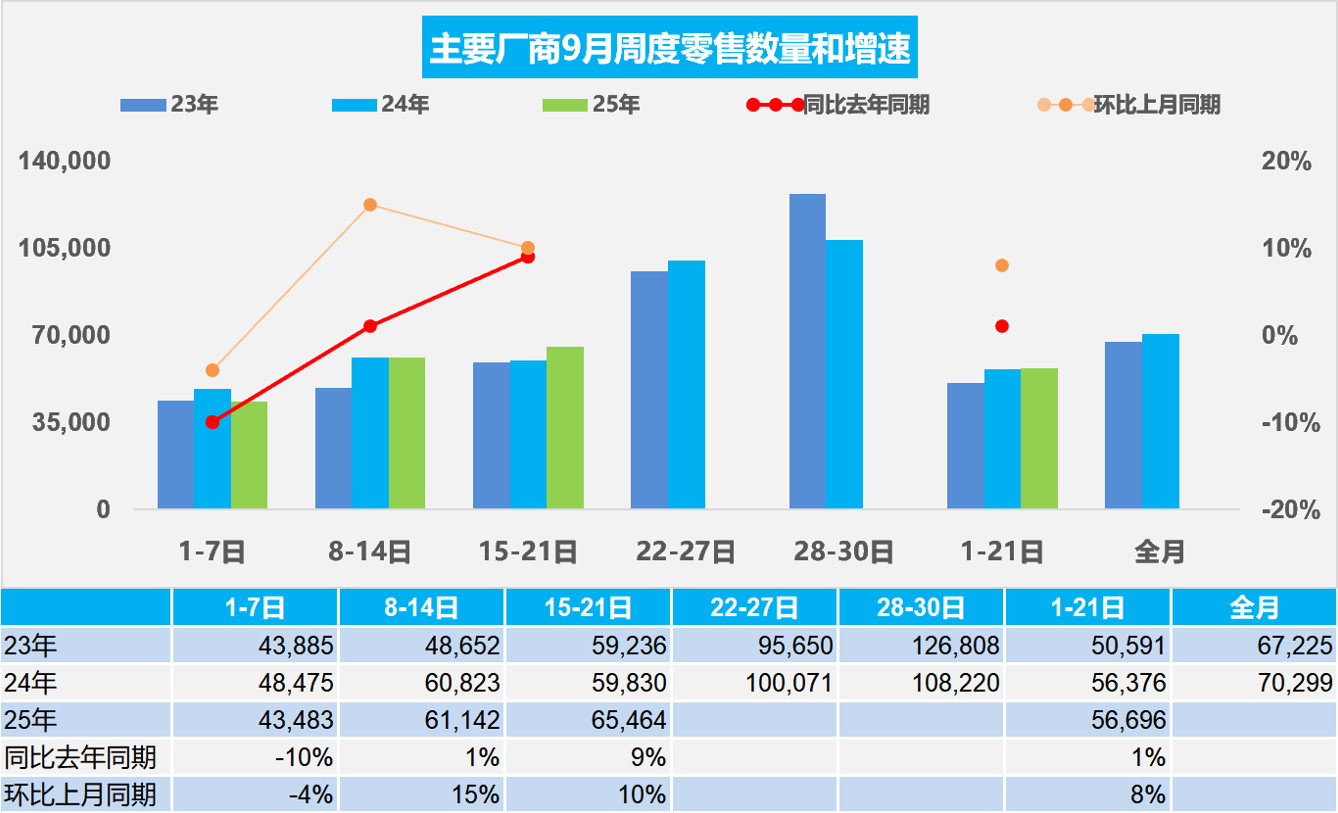
【周度分析】车市扫描(2025年9月15日-9月21日)
乘联分会· 2025-09-24 08:36
Group 1: Market Overview - From September 1 to 21, 2025, the national passenger car retail market reached 1.191 million units, a year-on-year increase of 1% and an 8% increase compared to the previous month. Cumulative retail for the year is 15.955 million units, up 9% year-on-year [2][5] - During the same period, wholesale of passenger cars reached 1.307 million units, showing no year-on-year growth but a 16% increase from the previous month. Year-to-date wholesale totals 19.349 million units, up 12% year-on-year [2][9] Group 2: New Energy Vehicles - Retail sales of new energy passenger vehicles from September 1 to 21 reached 697,000 units, a 10% year-on-year increase and an 11% increase from the previous month. The penetration rate for new energy vehicles is 58.5%, with cumulative retail for the year at 8.267 million units, up 24% year-on-year [2][5] - Wholesale of new energy vehicles during the same period was 724,000 units, also a 10% year-on-year increase and a 19% increase from the previous month. Year-to-date wholesale totals 9.668 million units, up 31% year-on-year [2][5] Group 3: Market Trends and Challenges - The market is experiencing a stable start in September 2025, with performance similar to 2023 but weaker than September 2024. The "trade-in" policy initiated in late July 2024 has positively impacted sales, but some regions are cautious about the sustainability of subsidies [5][6] - The introduction of new models at the Chengdu Auto Show has generated significant interest, but the overall contribution of new models is below expectations due to a lack of entry-level popular models [6] Group 4: Wholesale Trends - Daily average wholesale for passenger cars in the first three weeks of September showed a mixed performance, with a decline in the first week but growth in the subsequent weeks. The cumulative wholesale for the first 21 days is 1.307 million units, reflecting a 0% year-on-year change [9][10] - Major manufacturers are focusing on maintaining price stability and reducing dealer inventory pressure, indicating cautious optimism in domestic sales growth [9] Group 5: Commercial Vehicles - The domestic commercial vehicle market saw a 14% year-on-year increase in insurance data, with August sales reaching 246,000 units. Year-to-date sales for commercial vehicles are 2.01 million units, up 8% year-on-year [10][11] - The penetration rate of new energy commercial vehicles has significantly increased, reaching 25% in the first eight months of 2025, indicating strong growth in this segment [11] Group 6: Future Outlook - The "14th Five-Year Plan" anticipates a total automotive sales volume of 40 million units, with an average annual growth rate of 3%. The growth is expected to be driven by increased domestic demand and exports [12][13] - The potential for growth in the automotive market is attributed to the expansion into lower-tier cities, the impact of electrification on vehicle ownership cycles, and the increasing share of Chinese brands in international markets [13] Group 7: International Market Analysis - The Russian automotive market saw a significant increase in sales in 2024, with a total of 1.83 million units sold, but a decline in 2025. Chinese brands have captured over 60% of the market share in Russia, indicating strong performance [14][15] - Chinese automakers are adopting various strategies to enhance their presence in the Russian market, including local production and supply chain restructuring to mitigate risks associated with tariffs and delivery times [16]

冲刺年销目标、消化乘用车库存,车企如何破局?
第一财经· 2025-09-24 08:17
Core Viewpoint - The automotive industry in China is facing challenges in inventory reduction and sales growth, with a focus on the "golden September and silver October" period to meet annual sales targets. The production capacity utilization rate for passenger cars is around 52% in the first half of 2025, with both production and sales exceeding 15 million units, driven by policies like trade-in programs and growth in export business [3][5]. Summary by Sections Production and Sales Trends - In the 18 months from January 2024 to July 2025, the average price of passenger cars has decreased by 5,000 to 9,000 yuan, representing a discount range of 2.8% to 5.6% [3]. - The number of new models, particularly plug-in hybrid and extended-range vehicles, has nearly doubled compared to last year, although the marginal effect on sales growth is diminishing [3][4]. Sales Performance of Different Vehicle Types - As of August this year, plug-in hybrid vehicle sales were 314,000 units, showing a year-on-year decline of 7.3%, while extended-range vehicle sales growth was only about 0.3% [5]. - In contrast, pure electric vehicle sales reached 686,000 units in August, with a year-on-year growth rate of 17.2%, significantly outpacing plug-in and extended-range vehicles [5]. Inventory and Market Strategy - The cumulative inventory of plug-in hybrid vehicles has reached one million units, suggesting a need for a 33-month period to clear this inventory at a rate of 30,000 units per month [5]. - To address inventory issues, companies are considering expanding into overseas markets, with a focus on increasing production capacity in target markets amid global trade protectionism [5][6]. Export Dynamics - Exports have become a major driver of automotive production growth since 2023, although the growth rate of complete vehicle exports is expected to slow down due to local production requirements in target markets [6]. - The export performance of Chinese new energy vehicles has exceeded expectations, with significant growth in markets such as the Middle East and developed countries, particularly in Western Europe and Asia [6]. Future Outlook - Despite a projected 12% year-on-year increase in light vehicle production in the first half of 2025, the second half may face challenges such as slowing consumption and inventory reduction [6]. - Overall, the automotive industry is expected to maintain a stable and positive development trend, with improvements in industrial scale and quality efficiency driven by policies like trade-in programs [6].
冲刺年销目标、消化乘用车库存,车企如何破局?
Di Yi Cai Jing· 2025-09-24 07:09
Group 1 - The automotive industry is focusing on inventory reduction and increasing sales, particularly through overseas markets as a strategy to meet annual sales targets [1][2] - In the first half of 2025, domestic passenger car capacity utilization is projected to be around 52%, with production and sales both exceeding 15 million units, driven by policies like vehicle trade-ins and growth in export business [1] - The average price of passenger cars has decreased by 5,000 to 9,000 yuan (approximately 2.8% to 5.6% discount) from January 2024 to July 2025, coinciding with a surge in new vehicle launches, especially in the plug-in hybrid and extended-range segments [1] Group 2 - Data from the China Automobile Dealers Association indicates that sales of plug-in hybrid vehicles are expected to grow over 80% year-on-year in 2024, while extended-range vehicles are projected to see over 70% growth [2] - However, since March 2023, the growth rate of plug-in hybrid vehicles has significantly declined, with sales in August 2023 showing a negative growth of 7.3% year-on-year [2] - In contrast, pure electric vehicle sales reached 686,000 units in August 2023, with a year-on-year growth of 17.2%, indicating a shift in consumer preference [2] Group 3 - Exports have become a major driver of automotive production growth since 2023, but the pace of complete vehicle exports is expected to slow down due to localization requirements in target markets [3] - The top ten countries for Chinese automotive exports from January to August 2023 include Russia, but exports to Russia have significantly decreased due to heightened risk awareness among Chinese automakers [3] - The export performance of new energy vehicles has exceeded expectations, with growth in plug-in hybrids and hybrids becoming new growth points, particularly in developed markets in Western Europe and Asia [3]
提前完成产业规划目标,中国新能源车市场格局逐步清晰|“十四五”规划收官
Di Yi Cai Jing· 2025-09-24 01:40
Group 1: Industry Overview - During the 14th Five-Year Plan period, China's new energy vehicle (NEV) industry has rapidly developed, becoming a core driving force in the global NEV market [1] - The penetration rate of NEVs in China exceeded 20% in 2022, three years ahead of the 2025 target, and reached 44.3% in the first half of 2025, indicating a potential early achievement of the 2035 goal [1][2] - China has maintained its position as the world's largest NEV market for several consecutive years, with a competitive advantage in the global NEV supply chain [1][4] Group 2: Market Growth and Sales - In 2021, NEV sales reached 3.31 million units, a year-on-year increase of 183%, and in 2024, sales are expected to exceed 10 million units, accounting for 70.5% of global NEV sales [2] - In the first half of 2023, NEV sales in China reached 6.94 million units, with a market share of 44.3% [2] - It is projected that NEV sales will exceed 15 million units in 2023, with a significant increase in plug-in hybrid electric vehicles (PHEVs) [4][5] Group 3: Competitive Landscape - The market structure has shifted, with domestic brands like BYD capturing nearly 70% of the market share, breaking the dominance of joint venture brands [2][3] - The competition in the NEV market has intensified, with a growing focus on smart driving features, leading to a price war among manufacturers [7][8] - The industry is undergoing a significant reshuffle, with many new entrants facing financial difficulties, while established players like BYD continue to lead in sales [8][9] Group 4: Technological Advancements - Chinese companies, particularly CATL and BYD, have rapidly advanced in battery technology, establishing a leading position in the global market [3] - Collaborations between foreign brands and Chinese companies for technology solutions indicate a shift from "market for technology" to a new phase of technology export [3] - Key technological breakthroughs are expected in areas such as solid-state batteries and AI applications, which will create significant development opportunities [9]



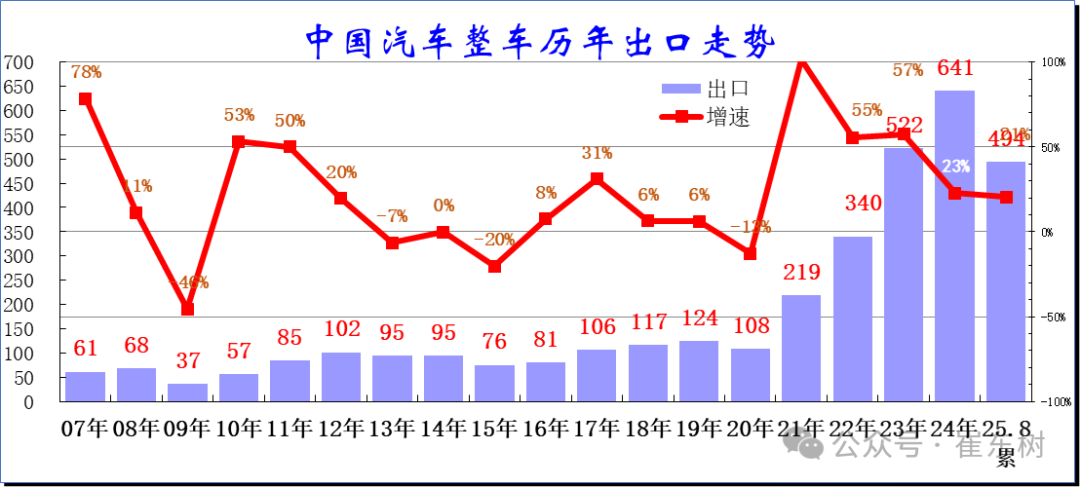
崔东树:1-8月中国汽车实现出口494万辆 同比走势总体较强
智通财经网· 2025-09-23 12:26
Summary of Key Points Core Viewpoint - China's automobile exports are experiencing significant growth, with a total export of 764,000 units in August 2025, representing a year-on-year increase of 25% and a month-on-month increase of 12% [1][7]. Export Performance - From January to August 2025, China exported 4.94 million vehicles, marking a year-on-year growth of 21% compared to the same period in 2024 [1][7]. - The top ten countries for China's automobile exports in August 2025 included Russia (58,707 units), UAE (46,616 units), and Mexico (38,994 units) [1]. - The cumulative export figures for 2025 show Mexico leading with 362,103 units, followed by UAE and Russia [2]. Electric Vehicle Exports - In August 2025, China's electric vehicle exports totaled 76,400 units, with significant contributions from Belgium (27,247 units) and the Philippines (21,957 units) [2][3]. - The performance of China's new energy vehicle exports from January to August 2025 was better than expected, driven by the growth of plug-in hybrid and hybrid vehicles, particularly in the pickup segment [3][12]. Historical Trends - China's automobile exports have seen a steady increase since 2021, with a growth rate of over 50% in 2022 and 2023, and a projected growth rate of around 20% for 2024 and 2025 [6][7]. - The export volume reached 641,000 units in 2024, continuing the upward trend from previous years [6]. Market Dynamics - The growth in exports is attributed to the enhanced competitiveness of Chinese products and slight growth in markets of southern countries globally [1][7]. - The export structure shows a rising share of passenger vehicles, which accounted for 85% of total exports in 2023, while the share of commercial vehicles has been declining [11][15]. Regional Contributions - In 2025, Anhui province emerged as the leading exporter of automobiles, surpassing Shanghai, with a total of 670,000 units exported from January to August [17][18]. - The strong performance of companies like Chery and JAC in Anhui has contributed to this growth, alongside increased contributions from Jiangsu and Henan provinces [18].
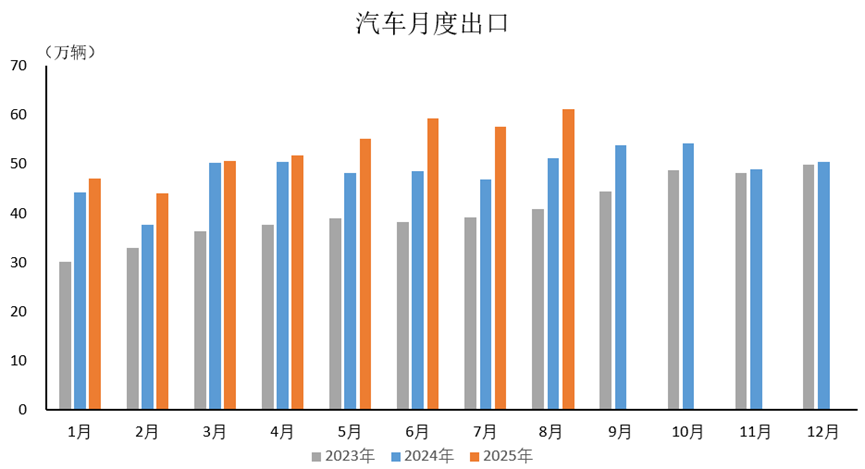
中汽协:8月汽车出口61.1万辆 环比同比双增长
Zhi Tong Cai Jing· 2025-09-18 07:48
Group 1: Overall Export Performance - In August 2025, total automobile exports reached 611,000 units, with a month-on-month increase of 6.2% and a year-on-year increase of 19.6% [1] - From January to August 2025, total automobile exports amounted to 4.292 million units, reflecting a year-on-year growth of 13.7% [1] Group 2: Passenger Vehicle Exports - In August 2025, passenger vehicle exports were 533,000 units, showing a month-on-month increase of 6.7% and a year-on-year increase of 21.8% [4] - From January to August 2025, passenger vehicle exports totaled 3.636 million units, with a year-on-year growth of 14.5% [4] Group 3: Commercial Vehicle Exports - In August 2025, commercial vehicle exports reached 78,000 units, with a month-on-month increase of 3.3% and a year-on-year increase of 6.6% [5] - From January to August 2025, commercial vehicle exports were 656,000 units, reflecting a year-on-year growth of 9.7% [5] Group 4: Traditional Fuel Vehicle Exports - In August 2025, traditional fuel vehicle exports were 387,000 units, with a month-on-month increase of 10.6% but a year-on-year decrease of 3.5% [6] - From January to August 2025, traditional fuel vehicle exports totaled 2.76 million units, showing a year-on-year decline of 6.6% [6] Group 5: New Energy Vehicle Exports - In August 2025, new energy vehicle exports were 224,000 units, with a month-on-month decrease of 0.6% but a year-on-year increase of 100% [7] - From January to August 2025, new energy vehicle exports reached 1.532 million units, reflecting a year-on-year growth of 87.3% [7]
【周度分析】车市扫描(2025年9月8日-9月14日)
乘联分会· 2025-09-17 08:39
Group 1: Market Overview - From September 1 to 14, the national passenger car retail market sold 732,000 units, a year-on-year decrease of 4%, but a month-on-month increase of 6%. Cumulative retail sales for the year reached 15.497 million units, a year-on-year increase of 9% [4][5] - During the same period, wholesale of passenger cars reached 774,000 units, a year-on-year decrease of 3%, but a month-on-month increase of 18%. Cumulative wholesale for the year was 18.816 million units, a year-on-year increase of 12% [4][8] - The retail penetration rate for new energy vehicles (NEVs) was 59.8%, with retail sales of 438,000 units, a year-on-year increase of 6% and a month-on-month increase of 10% [4][5] Group 2: Sales Trends - The first week of September saw an average daily retail of 44,000 units, a year-on-year decrease of 10%, while the second week saw an average daily retail of 61,000 units, a year-on-year increase of 1% [3][4] - The market is expected to enter a traditional peak season in September, supported by national subsidies and local purchase incentives, although these incentives are skewed towards high-priced models, which may hinder mainstream market growth [5][8] Group 3: Inventory and Production - As of the end of August 2025, the national passenger car industry inventory was 3.16 million units, a decrease of 130,000 units from the previous month. The inventory pressure has eased due to cautious production control by manufacturers [8][9] - The inventory days are estimated to be 42 days, indicating a decrease in overall inventory pressure compared to previous years [9] Group 4: Export and International Market - The export of Chinese automobiles has been favorable, with a significant increase in market share for domestic brands in overseas markets. The share of domestic new energy vehicles in overseas markets rose to 16% [8][9] - The export of pickup trucks has also seen substantial growth, with a total of 20,200 units exported in the first eight months of 2025, a year-on-year increase of 32% [11]

码头探访记!
Jin Rong Shi Bao· 2025-09-17 03:35
Core Insights - Shanghai's automotive export sector has achieved remarkable growth, with over 1.66 million vehicles exported in 2024, marking a 26.6% year-on-year increase, and accounting for nearly 40% of the national total [1][4] - The efficiency of customs processes and innovative logistics solutions, such as the "water-water intermodal" transport model, have significantly contributed to this growth [2][3] Group 1: Export Performance - In 2024, Shanghai's automotive exports reached over 1.66 million units, a 26.6% increase compared to the previous year [1] - The Shanghai Haitong International Automobile Logistics Co. reported a throughput of 3.63 million vehicles in 2024, making it the world's largest automotive throughput for the first time [1][2] - From January to August 2025, the external customs supervision at the Haitong Port recorded 962,700 vehicles exported, a 19.35% increase, with 339,000 vehicles (35.2%) exported via the "water-water intermodal" model [2] Group 2: Innovations in Logistics - The establishment of a "green" customs channel has enabled zero-delay exports, optimizing the entire logistics process from vehicle entry to release [1] - The introduction of a large automated three-dimensional warehouse has alleviated space constraints at the port, allowing for the storage of 6,160 vehicles in a 14,600 square meter area, significantly improving operational efficiency [2] - The "one-box system" policy and the "digital comprehensive protection zone" have enhanced customs efficiency, allowing for smoother transitions from rail to sea transport for electric vehicles [3] Group 3: Economic Impact - The Yangshan Special Comprehensive Protection Zone reported an import and export value of 211 billion yuan from January to July 2025, reflecting a 32% year-on-year growth, driven by the automotive industry [3] - The continuous growth in automotive exports showcases Shanghai's robust position as an international shipping hub and highlights the integration of the Yangtze River Economic Belt [2][3][4]

