
高端化战略

Search documents
小米稳住业务增长点,高端化战略要从单品类向全生态冲击
Xin Lang Cai Jing· 2025-08-19 14:53
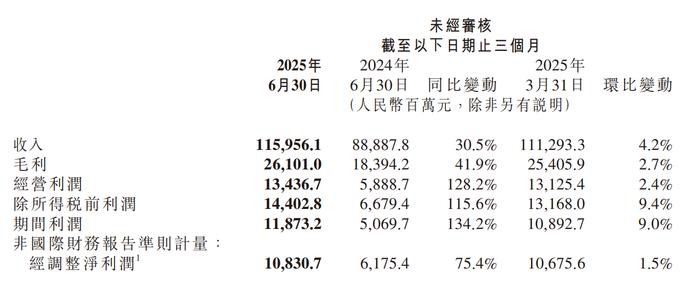
Core Viewpoint - Xiaomi Group reported a record high revenue of 116 billion RMB for Q2 2025, marking a 30.5% year-on-year increase, and an adjusted net profit of 10.8 billion RMB, up 75.4% year-on-year, indicating strong financial performance and growth potential in key business segments [1][2]. Financial Performance - Revenue for Q2 2025 reached 115,956.1 million RMB, a 30.5% increase from 88,887.8 million RMB in Q2 2024, and a 4.2% increase from 111,293.3 million RMB in Q1 2025 [2]. - Gross profit was 26,101.0 million RMB, up 41.9% year-on-year, and operating profit increased by 128.2% to 13,436.7 million RMB [2]. - Adjusted net profit for the quarter was 10,830.7 million RMB, reflecting a 75.4% increase compared to 6,175.4 million RMB in the same period last year [2]. Business Segments - The smartphone segment generated 455 million RMB in revenue with a shipment of 42.4 million units, showing a slight increase from 42.2 million units year-on-year [3]. - IoT and lifestyle products revenue reached 387 million RMB, a 44.7% increase, with smart home appliances seeing a significant growth of 66.2% [3]. - The automotive and innovative business segment reported revenue of 213 million RMB, a remarkable 234% increase, with 81,302 units delivered in the quarter [3]. Strategic Focus - Xiaomi is focusing on a dual strategy of scaling and high-end positioning in the smartphone market, shifting its focus from the 4000-6000 RMB range to the ultra-high-end segment above 6000 RMB [3][4]. - The company aims to expand its retail presence, targeting 30,000 stores in China and 400-500 overseas by the end of the year [4]. - Xiaomi's goal is to join the "2 billion club" alongside Apple and Samsung within the next three to five years, emphasizing its commitment to growth despite a stagnant global market [4][5]. R&D and Innovation - R&D investment reached a record high of 7.8 billion RMB in Q2 2025, a 41.2% increase, with an annual target of 30 billion RMB [6]. - Key technological advancements are focused on automotive, chips, and AI, including the development of a prototype car and a self-developed 3nm flagship chip [6]. - The company believes that having self-developed chips will create a significant competitive advantage in the future [6].


欧菲光20250819
2025-08-19 14:44
Summary of the Conference Call for OFILM Technology Co., Ltd. Company Overview - **Company**: OFILM Technology Co., Ltd. - **Date**: 2025 H1 Conference Call Key Points Industry and Company Performance - In H1 2025, the company experienced a revenue decline due to the off-season in consumer electronics and poor new product sales, with gross margin dropping from 11% in the previous year to 9.98% [2][3][5] - Total revenue for H1 2025 was approximately 9.8 billion yuan, a year-on-year increase of 3%, but net profit attributable to shareholders was a loss of nearly 110 million yuan [3][4] - Major revenue contributors included smartphone-related business (7.4 billion yuan), automotive business (1.3 billion yuan), and new business (1.1 billion yuan) [2][3] Business Segments - Camera module revenue was 7 billion yuan, with smartphone camera modules contributing 6.4 billion yuan and automotive camera revenue reaching 1.5 billion yuan [4][7] - The company is focusing on high-margin projects and plans to optimize operations through new smartphone releases and adjustments in product lines and organizational structure [2][4][5] Challenges and Strategic Adjustments - The camera module business is under significant pressure, prompting organizational restructuring and a shift towards digital and automated processes [8] - The automotive sector is facing intense competition, but the company is optimistic about long-term prospects due to strategic adjustments and prioritizing high-quality clients [17] Client Relationships and Market Dynamics - The top five clients contributed 69% of total revenue, with expectations of a 10% increase in shipments from a major client and over 20% revenue growth [3][9] - The company is in discussions with Samsung regarding camera module supply, aiming to enter their supply chain [10] New Business Opportunities - The new business segment, particularly in smart locks, showed rapid revenue growth, with expectations for significant contributions from DJI's handheld photography devices in H2 2025 [11][12] - The company anticipates that the launch of the Pocket 4 will further enhance revenue in 2026 [12][14] Market Trends and Future Outlook - The trend towards high-end smartphone camera modules is expected to continue, with advancements in technology likely to expand application ranges [19][22] - The company is committed to maintaining a high-end strategy and expanding its client base to improve revenue and profitability [16] Financial Management and Cost Control - The company plans to enhance profitability by optimizing project management, improving product quality, and controlling costs in the automotive sector [17] Conclusion - Despite facing challenges in H1 2025, the company is implementing strategic measures to optimize operations, enhance product offerings, and improve client relationships, positioning itself for potential growth in the latter half of the year and beyond [2][4][5][17]

历史新高!小米大消息!
Zhong Guo Ji Jin Bao· 2025-08-19 11:54
Core Insights - Xiaomi Group achieved record high revenue and profit in Q2 2025, with total revenue reaching 116 billion yuan, a year-on-year increase of 30.5%, and adjusted net profit of 10.8 billion yuan, up 75.4% [1] Business Segments - The "Mobile × AIoT" segment generated revenue of 94.7 billion yuan in Q2 2025, marking a historical high with a year-on-year growth of 14.8% [2] - Smartphone shipments reached 42.4 million units in Q2 2025, reflecting a 0.6% year-on-year increase, maintaining growth for eight consecutive quarters [2] - Xiaomi ranked among the top three global smartphone vendors with a market share of 14.7%, continuing a 20-quarter streak in the top three [2] - The number of active users reached a record high of 731.2 million globally, up 8.2% year-on-year, and the number of connected IoT devices grew to 989.1 million, a 20.3% increase [2] Innovative Business Growth - Revenue from smart electric vehicles and AI-related innovative businesses reached 21.3 billion yuan in Q2 2025, a significant increase of 233.9% from 6.4 billion yuan in Q2 2024 [3] - Smart electric vehicle revenue alone was 20.6 billion yuan, up 230.3% year-on-year, driven by increased delivery volumes and average selling prices (ASP) [3] - Vehicle deliveries surged to 81,302 units, a 197.7% increase from 27,307 units in Q2 2024, attributed to enhanced production capacity [3] - The ASP for smart electric vehicles rose to 253,700 yuan, a 10.9% increase, largely due to higher deliveries of the Xiaomi SU7 Ultra [3] Market Positioning - In the 4000-5000 yuan price segment, Xiaomi held the top market share in China, increasing by 4.5 percentage points to 24.7% year-on-year [4] - In the 5000-6000 yuan price segment, market share improved by 6.5 percentage points to 15.4% year-on-year [4]
小米Q2汽车业务高速成长,“人车家全生态”释放强劲增长活力,推动业绩再创历史新高
Jin Rong Jie· 2025-08-19 11:45
Core Viewpoint - Xiaomi Group reported a strong Q2 performance with record-high revenue and profit, showcasing significant growth across multiple business segments, particularly in smartphones, IoT, and innovative sectors like electric vehicles and AI [1][2][4]. Financial Performance - Revenue reached 116 billion yuan, a year-on-year increase of 30.5%, marking the third consecutive quarter exceeding 100 billion yuan [1]. - Adjusted net profit was 10.8 billion yuan, up 75.4% year-on-year, continuing a trend of surpassing 10 billion yuan for two consecutive quarters [1]. Business Segments - The smartphone and AIoT segment generated 94.7 billion yuan, a 14.8% increase year-on-year, with smartphone revenue at 45.5 billion yuan and IoT products at 38.7 billion yuan, which grew by 44.7% [1][2]. - The innovative business segment, including electric vehicles and AI, reported revenue of 21.3 billion yuan, a staggering 234% increase year-on-year [1]. Market Position - Xiaomi maintained a strong position in the global smartphone market, ranking in the top three for 20 consecutive quarters, with a domestic market share of 16.8% [2][3]. - In Southeast Asia, Xiaomi's market share rose to 18.9%, while in Europe, it returned to second place with a 23.4% share [3]. Product Performance - Smart home appliances saw significant growth, with smart air conditioning units shipped exceeding 5.4 million, a growth rate of over 60% [3]. - The high-end smartphone segment saw Xiaomi's share in the 4000-5000 yuan price range increase to 24.7%, while the 5000-6000 yuan segment reached 15.4%, reflecting a shift towards premium products [5][6]. R&D and Innovation - R&D investment reached a record high of 7.8 billion yuan, a 41.2% increase year-on-year, with plans to invest 30 billion yuan this year [7]. - Xiaomi launched its first 3nm flagship chip, becoming the first in mainland China to develop such technology, and achieved significant milestones in the electric vehicle sector [7][8]. Brand Recognition - Xiaomi ranked second in the Kantar BrandZ Globalization Brand list and improved its position in the Fortune Global 500, moving up 100 places to rank 297 [4].
华润啤酒(00291):高端化持续兑现,毛利率创历史新高
GOLDEN SUN SECURITIES· 2025-08-19 10:37
Investment Rating - The report maintains a "Buy" rating for China Resources Beer [5] Core Views - The company continues to achieve high-end product growth, with a historical high gross margin of 48.9% in H1 2025, driven by the high-end strategy and cost savings in raw material procurement [2][4] - The beer business shows balanced growth across regions, with revenue of 23.16 billion RMB in H1 2025, up 2.6% year-on-year, and sales volume of 6.487 million kiloliters, up 2.2% year-on-year [1][2] - The white liquor business faces industry pressure, with revenue declining by 33.7% year-on-year to 0.781 billion RMB in H1 2025, prompting the company to implement management measures to drive development [2] Summary by Sections Beer Business - Revenue reached 23.16 billion RMB in H1 2025, a 2.6% increase year-on-year - Sales volume was 6.487 million kiloliters, up 2.2% year-on-year - Average selling price increased by 0.4% year-on-year - High-end beer products saw significant growth, with premium and above beer sales increasing by 10% year-on-year [1][2] White Liquor Business - Revenue fell to 0.781 billion RMB in H1 2025, a decrease of 33.7% year-on-year - Major single products contributed nearly 80% of revenue - The company is focusing on management initiatives to drive business development [2] Financial Performance - Gross margin reached a historical high of 48.9%, up 2.0 percentage points year-on-year - The beer business gross margin was 48.3%, up 2.5 percentage points year-on-year - The net profit margin increased by 4.4 percentage points year-on-year to 24.2% [2][4] Future Outlook - The company aims to continue its high-end development strategy, with expectations for net profit growth of 27.7%, 6.9%, and 9.2% for 2025, 2026, and 2027, respectively [2][4]

小米集团-W二季度收入及盈利均再创历史新高 公司拥有人应占溢利119.04亿元 同比增长133.51%
Zhi Tong Cai Jing· 2025-08-19 09:53
Core Insights - Xiaomi Group reported a record high revenue of approximately RMB 1159.56 billion for Q2 2025, representing a year-on-year growth of 30.5% and a quarter-on-quarter growth of 4.2% [1] - The adjusted net profit for Q2 2025 was approximately RMB 108.31 billion, showing a significant year-on-year increase of 75.4% [1] - The company continues to execute its "steady and progressive" core operational strategy, achieving historical highs in both revenue and profit [1] Financial Performance - For the first half of 2025, Xiaomi's revenue reached approximately RMB 2272.49 billion, a year-on-year increase of 38.2% [1] - Gross profit for the same period was approximately RMB 515.07 billion, up 46.2% year-on-year [1] - The profit attributable to shareholders for H1 2025 was RMB 228.29 billion, reflecting a year-on-year growth of 146% [1] Business Segments - In Q2 2025, the "Mobile × AIoT" segment generated revenue of RMB 947 billion, a year-on-year increase of 14.8% [1] - The "Smart Electric Vehicles and AI Innovation" segment reported revenue of RMB 213 billion, also achieving a historical high [1] Market Position - Xiaomi's smartphone shipments reached 42.4 million units in Q2 2025, marking a 0.6% year-on-year growth and maintaining growth for eight consecutive quarters [2] - The company ranked among the top three global smartphone vendors with a market share of 14.7%, maintaining this position for 20 consecutive quarters [2] User Ecosystem - As of June 2025, Xiaomi's global monthly active users reached a record high of 731.2 million, reflecting an 8.2% year-on-year increase [2] - The number of connected IoT devices on the AIoT platform grew to 989 million, a year-on-year increase of 20.3% [2] Strategic Initiatives - Xiaomi is advancing its "human-vehicle-home ecosystem" strategy, with R&D expenditure reaching RMB 78 billion in Q2 2025, a 41.2% year-on-year increase [2] - The number of R&D personnel reached a historical high of 22,641 [2] High-End Strategy - Xiaomi's high-end smartphone sales in mainland China accounted for 27.6% of total smartphone sales, an increase of 5.5 percentage points year-on-year [3] - The company achieved the highest market share in the RMB 4,000–5,000 price segment, increasing by 4.5 percentage points to 24.7% [3] Retail Expansion - Xiaomi added over 1,700 new retail stores in mainland China in Q2 2025, bringing the total to over 17,000 [3] - The company also expanded its retail presence internationally, with approximately 200 new retail stores [3]
华润啤酒(00291.HK)上半年纯利增长23.0%至57.89亿元,毛利率升至48.9%创新高,拟派中期息每股0.464元
Ge Long Hui· 2025-08-19 04:12
Group 1 - The core viewpoint of the articles highlights the strong performance of China Resources Beer in the first half of 2025, driven by a high-end strategy and cost savings in raw material procurement [1][2] - The group's total revenue for the first half of 2025 reached RMB 23.942 billion, reflecting a year-on-year growth of 0.8% [1] - The gross profit margin increased by 2.0 percentage points to a record high of 48.9% in the first half of 2025, benefiting from the high-end beer strategy [1] - The group's profit before interest and tax and attributable profit to shareholders reached RMB 7.691 billion and RMB 5.789 billion, respectively, marking year-on-year increases of 20.8% and 23.0% [1] - The beer business achieved sales volume of approximately 6.487 million kiloliters, a year-on-year increase of 2.2% [1] - The average selling price of the beer business rose by 0.4% year-on-year, contributing to the revenue growth [2] Group 2 - The beer business revenue for the first half of 2025 was RMB 23.161 billion, up 2.6% year-on-year [2] - The gross profit margin for the beer business increased by 2.5 percentage points to 48.3% [2] - The white liquor business faced industry adjustments, generating revenue of RMB 0.781 billion, with a major product contributing nearly 80% of this revenue [2] - The company plans to continue its high-end strategy and adapt to new consumer trends in the second half of 2025 [2] - A mid-term dividend of RMB 0.464 per share was declared, representing a 24.4% increase compared to the same period last year [2]
重庆啤酒(600132):二季度吨价压力增大,税率波动拖累盈利能力
Guoxin Securities· 2025-08-18 05:10
Investment Rating - The investment rating for the company is "Outperform the Market" [5][9]. Core Views - The company reported a slight decline in revenue and net profit for the first half of 2025, with total revenue at 8.84 billion yuan, down 0.2% year-on-year, and net profit at 860 million yuan, down 4.0% year-on-year [1][7]. - The pressure on beer prices has increased, particularly in the second quarter of 2025, leading to a decline in profitability despite a slight improvement in gross margin due to cost benefits [2][8]. - The company is expected to face ongoing price pressures, with future improvements dependent on the recovery of consumer spending and the introduction of new products [3][9]. Revenue and Profitability Summary - In the first half of 2025, beer sales volume increased by 1.9% year-on-year, but the average price per ton decreased by 1.1%, primarily due to increased promotional efforts [1][7]. - The gross margin for the beer business was 51.3%, an increase of 0.8 percentage points year-on-year, while the net profit margin decreased by 0.4 percentage points due to a rise in the effective tax rate [2][8]. - The company has adjusted its revenue forecasts for 2025-2027, now expecting revenues of 14.73 billion, 15.03 billion, and 15.35 billion yuan respectively, with corresponding net profits of 1.26 billion, 1.31 billion, and 1.35 billion yuan [3][9]. Financial Projections - The earnings per share (EPS) for 2025 is projected to be 2.61 yuan, with a price-to-earnings (PE) ratio of 21 times [4][9]. - The company maintains a high dividend payout ratio, reflecting its commitment to shareholder returns [3][9].

4500家门店的喜茶要玩“高端局”,10年老将被传离职
3 6 Ke· 2025-08-18 04:09
Core Insights - The departure of the long-time brand vice president, Ziyu, marks a significant leadership change at Heytea, with Wang Xiaodong, former CEO of GENTLE MONSTER China, taking over the role [1][2][3] - Heytea is shifting its strategy back towards a high-end positioning after a period of focusing on mass-market appeal, which has led to dilution of its premium brand identity [5][6][7] Leadership Change - Ziyu, a key figure in Heytea's branding since 2015, has left the company after 10 years, having played a crucial role in various brand activities [2] - Wang Xiaodong brings a diverse background from various industries, including luxury goods and lifestyle brands, and has a strong focus on experiential retail [3] Strategic Shift - Heytea is moving away from its recent mass-market strategy, which included lowering prices and expanding into smaller store formats, to re-emphasize its high-end offerings [6][7] - The company plans to enhance its product pricing back to the 20-25 yuan range, moving away from the previous 15-19 yuan pricing strategy [7] Store Expansion and Experience - Heytea is reintroducing its DP (Day Dreamer Project) store format, which focuses on larger, uniquely designed locations that emphasize customer experience [4] - The company has also seen significant growth in its overseas presence, with over 100 international locations, including high-profile openings in Paris and New York [8] Market Context - The competitive landscape in the tea beverage industry has intensified, with many brands facing profitability challenges, prompting Heytea to reassess its market approach [7][9] - The brand's previous strategy of rapid expansion and low pricing has led to operational challenges, including reports of franchisee losses [7]
永久自行车出海遇阻母公司中路股份半年亏831万元
Xin Lang Cai Jing· 2025-08-17 12:03
Core Viewpoint - The traditional bicycle brand "Yongjiu" faces significant challenges from international market pressures and rising internal costs, leading to a decline in profitability despite a revenue increase. Financial Performance - In the first half of 2025, the company reported total revenue of 574 million yuan, a year-on-year increase of 10.66%, but incurred a net loss of 8.31 million yuan, a dramatic decline of 4% [2] - The company's gross margin decreased from 15.53% in the same period last year to 14.93%, while the net margin fell from -0.10% to -1.89% [2] - In Q2, revenue was 324 million yuan, with a modest growth of 1.91%, but the net loss increased to 5.08 million yuan, a year-on-year decline of 162.24% [2] Cost Structure - Management expenses surged to 51.92 million yuan, a 51.09% increase year-on-year, primarily due to increased intermediary service fees from cross-border equity investments [3] - Sales expenses reached 31.67 million yuan, up 7.38%, driven by costs associated with new product launches; financial expenses were 1.00 million yuan, a 24.24% increase [3] - Total period expenses amounted to 95.53 million yuan, an increase of 19.34 million yuan year-on-year, with a period expense ratio of 16.65%, up 1.95 percentage points [3] Market Environment - The bicycle industry is facing severe impacts from tariff policies, with the U.S. imposing a 53% tariff on general bicycles and 42% on e-bikes, significantly affecting demand [4] - The U.S. market accounts for 33% of Taiwan's bicycle exports, making it the second-largest market after the EU, but demand remains weak due to tariffs and uncertainty [4] - Southeast Asia shows resilience and potential for growth, but it remains uncertain whether it can compensate for losses in the U.S. and European markets [4] Strategic Initiatives - The company is pursuing high-end and diversified strategies to overcome operational challenges, including acquiring a stake in the high-end bicycle brand Factor [5] - Factor specializes in high-performance carbon fiber road bicycles, aiming to penetrate the high-end market [5] - The company is also investing in high-altitude wind energy technology in collaboration with Tsinghua University, indicating a diversification strategy [5] Financial Health - As of the end of Q2, the company's net assets were 570 million yuan, a 3.2% decrease from the previous year, with a net asset value per share of 1.77 yuan, down 6.72% [6] - The company's median ROIC over the past decade is only 3.27%, indicating challenges in capital efficiency [6] - The global bicycle market is undergoing structural adjustments, and the company's ability to adapt will be crucial for its future success [6]
