
AI产业

Search documents
昊志机电20251214
2025-12-15 01:55
Summary of Haoshi Electromechanical Conference Call Industry and Company Overview - **Company**: Haoshi Electromechanical - **Industry**: Commercial aerospace, PCB drilling and forming equipment, robotics, and automation Key Points and Arguments - **Commercial Aerospace Applications**: Haoshi's liquid oxygen-methane engine motors are utilized in Blue Arrow rockets, with each engine valued at approximately 4 million yuan. It is expected that 30% of the motors will need replacement after each recovery due to wear and tear, indicating a potential increase in value as rocket capacity expands and new products are developed [2][4][13][18] - **Growth Projections**: The company anticipates a nearly 90% revenue growth in 2025, with a further 100% increase expected in 2026. This growth is driven by advancements in AI and changes in the Apple supply chain, which are projected to boost spindle business by 40%-50% [2][3][6] - **Acquisition Impact**: The acquisition of a European automation group in 2020 has stabilized revenue at around 300 million yuan annually. However, inflation has led to losses, with expectations of returning to profitability by 2026 [2][7] - **Production Capacity Expansion**: Due to unexpected demand from the AI market, Haoshi has invested nearly 100 million yuan in new equipment to double production capacity by February 2026 [2][9][10] - **Market Share in Apple Supply Chain**: Haoshi holds over 60% market share in the glass and touch screen polishing market, with expected growth in spindle business from 100 million yuan in 2025 to 200 million yuan in 2026 [2][11] - **Joint Ventures**: A joint venture with Fengze Sheng aims to invest in high-end linear guide rail projects, expected to generate 150 million yuan in revenue by March 2026 [2][14] - **Overall Performance Expectations**: The company forecasts a 40%-50% increase in overall performance for 2026, with revenues projected to reach around 2.3 billion yuan, primarily driven by the industrial mother machine and robotics sectors [3][15] Additional Important Insights - **Commercial Space Development**: Haoshi is focusing on expanding its customer base in the commercial aerospace sector and enhancing product technology to meet growing market demands [16] - **Competitive Advantages**: Haoshi's products are competitively priced, approximately 30% cheaper than those from state-owned manufacturers, providing a significant advantage in the commercial aerospace market [19] - **Collaborations in Robotics**: Ongoing collaboration with Lens Technology, a key player in the Apple supply chain, is expected to strengthen as Lens builds a large factory for robotics components [20] - **Satellite Sector Plans**: Haoshi is exploring opportunities in the satellite sector, with plans to develop motor systems for satellite movement and power, expected to commence in 2026 [21]

中泰国际每日晨讯-20251215
ZHONGTAI INTERNATIONAL SECURITIES· 2025-12-15 01:50
Market Overview - On December 12, the Central Economic Work Conference emphasized the need for internal strengthening to address external challenges and to continue implementing a moderately loose monetary policy[1] - The Hang Seng Index rose by 446 points (1.8%) to close at 25,976 points, with a peak increase of 475 points during the day[1] - The Hang Seng Technology Index increased by 103 points (1.9%) to close at 5,638 points, with total market turnover expanding to HKD 242.7 billion[1] - Southbound capital experienced a net outflow of HKD 5.29 billion[1] Sector Performance - Gold prices increased, with Zijin Mining (2899 HK) rising by 3.6%, Shandong Gold (1787 HK) and Zhaojin Mining (1818 HK) both up by 3.4%[1] - Consumer stocks performed well, with Mengniu Dairy (2319 HK) up 2.7%, Nongfu Spring (9633 HK) up 2.2%, and Haidilao (6862 HK) up 2.9%[1] - Technology stocks also saw gains, with Alibaba (9988 HK) and Tencent (700 HK) rising by 2.3% and 2.4%, respectively[1] U.S. Market Dynamics - Despite interest rate cuts, U.S. tech stocks continued to decline, with the Nasdaq Composite falling by 245 points (0.5%) to close at 48,458 points[2] - The S&P 500 index dropped by 73 points, closing at 6,827 points, while long-term bond yields rose to 4.189%[2] Macroeconomic Indicators - As of the end of November, China's broad money supply (M2) stood at CNY 336.99 trillion, growing by 8% year-on-year, slightly below the market expectation of 8.2%[3] - Narrow money supply (M1) reached CNY 112.89 trillion, with a year-on-year growth of 4.9%, also below the expected 5.7%[3] - The loan balance grew by 6.4% year-on-year, down from the previous 6.5%[3] Industry Insights - In the automotive sector, stocks related to smart driving performed well, with Xiaoma Zhixing (2026 HK) up 4.9% and Horizon Robotics (9660 HK) up 3.8%[4] - The energy/utilities sector saw traditional power equipment stocks rise, with Dongfang Electric (1072 HK) increasing by 16.8% over the week[4] - The pharmaceutical sector remained stable, with WuXi AppTec (2359 HK) and WuXi Biologics (2269 HK) showing solid performance despite potential regulatory challenges[5]
邓正红能源软实力:欧佩克联盟政策效能边际递减 AI产业催生石油消费新变量
Sou Hu Cai Jing· 2025-12-14 06:48
Core Insights - The oil market is expected to experience significant fluctuations in 2025, with Brent crude oil prices dropping from approximately $81 per barrel at the beginning of the year to around $61 per barrel recently, indicating a bearish trend in the second half of the year [1] - OPEC's ability to manage production is diminishing due to structural imbalances, with a projected global surplus of 4.09 million barrels per day by 2026, while OPEC's spare capacity is limited to about 2 million barrels per day concentrated in Saudi Arabia and the UAE [2] - The U.S. energy policy is reshaping the global supply landscape, with shale oil production expected to increase by 1.2 million barrels per day in 2025, accounting for 60% of non-OPEC growth in 2026 [3] - The rapid growth of the AI industry is creating new demand for oil, with AI-related electricity demand projected to reach 1,050 terawatt-hours by 2026, a 128% increase from 2022 [4] - The international oil market in 2026 will be characterized by a multipolar power structure, with OPEC, U.S. supply, and AI demand forming a balance of power [5] Group 1: Oil Market Trends - The oil market is expected to see a significant downturn in the second half of 2025, with Brent crude prices falling to around $61 per barrel [1] - OPEC's production management is facing challenges, with a projected surplus of 4.09 million barrels per day by 2026 [2] - The U.S. shale oil industry is projected to increase production significantly, contributing to a major shift in the global oil supply [3] Group 2: Demand Dynamics - The AI industry's growth is expected to create a new demand for oil, with substantial increases in electricity consumption related to AI [4] - The demand structure is evolving, with a notable increase in fuel oil demand driven by the electricity sector [4] Group 3: Strategic Implications - The oil market is entering a phase of soft power restructuring, necessitating a focus on resource integration and value innovation [5] - Investors are advised to pay attention to companies that can integrate oil and electricity sectors effectively and to avoid traditional oil companies overly reliant on OPEC [5]

特朗普破大防,不如中国?美国AI电力遥遥领先,都要归功于我
Sou Hu Cai Jing· 2025-12-12 13:32
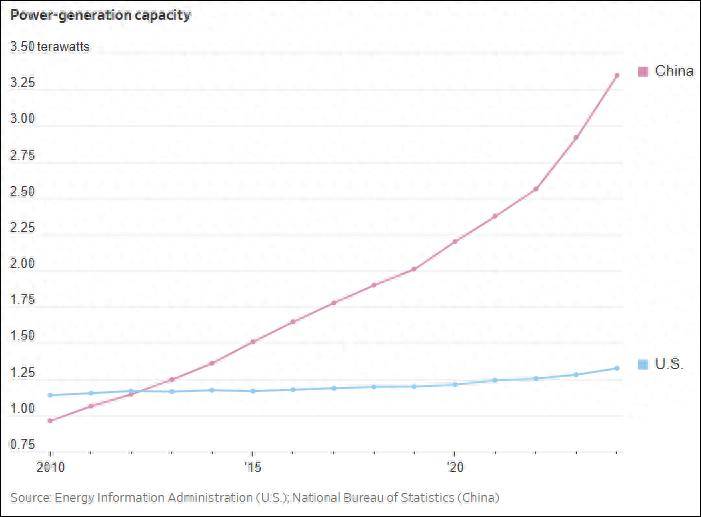
Core Viewpoint - The article discusses China's dominance in AI-related electricity production, contrasting it with the U.S. response led by former President Trump, highlighting the competitive landscape between the two nations in the AI sector and the underlying energy infrastructure needed to support it [1][6]. Group 1: China's Strengths in AI and Energy - China's electricity generation has significantly outpaced other regions, with growth from 2010 to 2024 exceeding the total growth of the rest of the world [6]. - In 2022, China's electricity generation was more than double that of the U.S., and the electricity costs for data centers in China are less than half of those in the U.S. [8]. - Inner Mongolia's "Grassland Cloud Valley" has become a hub for data centers, with over 100 centers either operational or under construction, and a total investment exceeding 160 billion yuan [8]. Group 2: U.S. Response and Challenges - Trump's claims about the rapid construction of AI factories and self-built power facilities in the U.S. were met with skepticism, especially as the U.S. Energy Secretary emphasized AI as a top priority for the government [4][10]. - The U.S. faces significant challenges in electricity reliability, particularly in the Midwest and Southwest, where summer power shortages are common [12]. - The slow progress on infrastructure projects, such as the "Southern Spirit" transmission project in Texas, highlights the difficulties the U.S. faces in meeting the growing energy demands of the AI industry [12][14]. Group 3: Long-term Planning and Future Outlook - Morgan Stanley predicts that China's investment in grid projects will reach $560 billion by 2030, with Goldman Sachs estimating that China's backup power capacity could be three times the expected global data center electricity demand [10]. - The article suggests that the competition in AI and energy will continue, with China's centralized energy system and ongoing policy investments providing a distinct advantage over the U.S.'s fragmented and aging infrastructure [14][16].
紧握年末政策窗口,掘金A股跨年行情
市值风云· 2025-12-12 10:25
Core Viewpoint - The article discusses the upcoming investment opportunities and risks in the A-share market as the year-end approaches, highlighting the significance of fundamental factors and policy directions for the next year [3][4]. Group 1: Cross-Year Market Logic and Historical Review - The A-share market exhibits seasonal characteristics, with a "cross-year market" being a notable investment window, showing over 70% probability of gains from November to January since 2010, with an average increase of 11.5% for the Shanghai Composite Index and 14.9% for the ChiNext Index during this period [5][6]. - The cross-year market typically lasts about 44 trading days, with historical data indicating varying performance based on previous year's market conditions [6][7]. - Factors contributing to this phenomenon include increased bank credit issuance at year-end, which enhances market liquidity, and positive signals from key policy meetings that boost market expectations [7][8]. Group 2: Special Background for 2024-2025 Cross-Year Market - The current macroeconomic environment presents unique conditions for the upcoming cross-year market, particularly with a moderate internal economic recovery and anticipated liquidity improvements from the Federal Reserve's interest rate cuts [13][14]. - The Federal Reserve has cut rates by 75 basis points throughout the year, signaling a potential end to the rate-cutting cycle, which may ease pressure on the RMB exchange rate [15][17]. - As the first year of the "14th Five-Year Plan," there is heightened policy expectation focusing on technological innovation and new productivity, which may lead to early market movements and increased volatility [17]. Group 3: Investment Opportunities Selection - The article suggests a positive outlook for the new year, emphasizing that internal economic recovery, policy support, and valuation corrections provide a solid foundation for A-shares [18]. - Recommended investment themes include the AI industry, globally competitive high-end manufacturing, and industries benefiting from supply-side optimization [18][20]. - Specific ETFs are highlighted for investment, such as those focusing on AI trends, advantageous manufacturing, and sectors experiencing supply-side improvements, providing efficient tools for investors to participate in the cross-year market [21][26][29].

聚焦AI算力与半导体 信达澳亚多只科技基金业绩跻身同类前列
Jin Rong Jie· 2025-12-12 07:59
Core Insights - The article highlights the significant performance of Xinda Australia Fund in the technology sector, particularly in AI, semiconductors, and robotics, amidst the ongoing investment wave in technology since 2025 [1] Group 1: Fund Performance - Xinda Australia Fund's "Xinao Performance-Driven Mixed A" (016370) ranks 4th among 3,902 similar strong stock mixed funds, showcasing its strong management capabilities [1] - The "Xinao Transformation Innovation Stock A" (001105) achieved a return ranking of 73rd out of 918 similar actively managed stock open-end products, placing it in the top 8% [1] - The "Xinao Technology Innovation One-Year Open Mixed A" (009437) and "Xinao Xingyi Mixed A" (011188) also demonstrated solid performance, ranking 197th and 838th respectively among their peers [1] Group 2: Investment Strategy - The fund's strategy focuses on early-stage opportunities in the AI industry and aligns with the new productivity policies driving technological upgrades [1] - The management team, including fund managers Liu Xiaoming, Wu Kai, Li Bo, and Zhu Ran, emphasizes deep research into the technology sector to identify investment opportunities [1] - The fund aims to capture commercialization opportunities in areas such as edge AI and self-controlled hardware, striving for long-term stable returns for investors [2]
BBMarkets:美国9月贸易逆差收窄,跌至五年最低
Sou Hu Cai Jing· 2025-12-12 02:47
Group 1 - The U.S. trade deficit narrowed significantly in September to $52.8 billion, down from $59.3 billion in August [1] - Gold exports surged to $6.1 billion in September, contributing significantly to the overall export growth of $8.4 billion, while gold imports only increased by $1.9 billion [3] - The overall U.S. export value rose to $289.3 billion in September, while imports saw a modest increase to $342.1 billion [3] Group 2 - Computer and accessory imports fell by $2.7 billion in September, contrary to expectations of growth driven by the AI industry [4] - Pharmaceutical imports skyrocketed by $12.9 billion in September, driven by concerns over potential tariffs on brand-name drugs [4] - Despite the significant narrowing of the trade deficit in September, the year-to-date trade deficit remains 17% higher compared to the first nine months of 2024 [4]
“航天热”带飞乾照光电,海信视像“狂揽”40亿浮盈
Huan Qiu Lao Hu Cai Jing· 2025-12-11 12:10
Core Viewpoint - The significant rise in the stock price of Qianzhao Optoelectronics is attributed to the active commercial aerospace sector, with the company benefiting from increased market interest and investment in this area [3][4]. Group 1: Stock Performance - On December 10, Qianzhao Optoelectronics' stock reached a historical high of 27.51 CNY per share, with a market capitalization of 234.7 billion CNY [2][3]. - Since the beginning of 2025, the company's stock price has increased by 147.24%, and from the low point in July 2024, it has surged by 376.28% [2][4]. - The stock price increase has resulted in substantial gains for shareholders, including notable investors who entered the market at lower prices [5][6]. Group 2: Business Operations - Qianzhao Optoelectronics specializes in the research, production, and sales of semiconductor optoelectronic products, with a focus on gallium arsenide solar cells used in commercial aerospace [4][8]. - The company is the leading domestic supplier of gallium arsenide solar cells, particularly for low-orbit commercial satellites, and has seen rapid revenue growth in recent years [4][8]. Group 3: Market Dynamics - The recent surge in the commercial aerospace sector is supported by government initiatives, including a national three-year roadmap for high-quality development in this field [3][4]. - The successful launch of the Zhuque-3 reusable rocket has further stimulated interest in the commercial aerospace market, despite not achieving all its recovery goals [3][4]. Group 4: Major Shareholders - The largest beneficiary of the stock price increase is Hisense Visual, which holds 26.31% of Qianzhao Optoelectronics' shares, with a current market value of approximately 61.46 billion CNY [8][10]. - Hisense Visual's total investment in Qianzhao Optoelectronics is around 19.41 billion CNY, resulting in a floating profit exceeding 40 billion CNY due to the recent stock price surge [10].

全市场近4400只个股下跌,风电与核聚变概念股表现强势
Qi Huo Ri Bao· 2025-12-11 10:59
Core Viewpoint - The A-share market experienced a collective pullback, with major indices declining, while the new energy sector, particularly wind power and controlled nuclear fusion, showed strong performance [1] Market Performance - The Shanghai Composite Index fell by 0.7% - The Shenzhen Component Index decreased by 1.27% - The ChiNext Index dropped by 1.41% - The North Stock 50 Index increased by 3.84% - Total market turnover was approximately 1.88 trillion yuan, with nearly 4,400 stocks declining [1] Sector Highlights - New energy concept stocks were active, with the wind power equipment sector leading in gains - Companies such as Goldwind Technology (002202), Tianli Composite, Yongding Co. (600105), and Hezhu Intelligent (603011) reached their daily limit up [1] Industry Insights - According to Everbright Securities, fusion energy is regarded as "the ultimate energy for humanity" and holds significant strategic value - Major AI companies are increasingly investing in fusion energy - The controlled nuclear fusion industry is expected to have long-term growth potential due to the restructuring of electricity consumption driven by future AI industry developments - As the controlled nuclear fusion industry progresses, related companies are likely to continue benefiting [1]



筹划半年,两大巨头重组计划搁浅
Jin Rong Shi Bao· 2025-12-11 06:58
Core Viewpoint - The merger plan between Haiguang Information and Zhongke Shuguang has been terminated due to changes in market conditions and the complexity of the transaction, which involved multiple parties and a large scale [2][4][7]. Group 1: Announcement of Termination - On December 9, Haiguang Information and Zhongke Shuguang announced the termination of their major asset restructuring plan [2][4]. - The companies cited that the transaction's large scale and involvement of many parties led to prolonged discussions, and the current market environment has changed significantly since the initial planning [7][8]. Group 2: Impact on Operations - Both companies stated that the termination of the merger will not have a significant adverse impact on their operational and financial conditions [8][12]. - Haiguang Information and Zhongke Shuguang have committed to maintaining a good collaborative relationship in the future, focusing on high-end computing core business and advanced technologies [8][13]. Group 3: Historical Context - The merger was initially announced on May 25, with Haiguang Information planning to absorb Zhongke Shuguang through a share exchange, with a transaction value of approximately 115.97 billion [10][11]. - Following the announcement, both companies experienced an increase in stock prices and market capitalization until the recent termination news [11]. Group 4: Investor Reactions and Future Plans - Investor meetings were held to address concerns regarding the termination, with management explaining the complexities and market changes that led to the decision [12]. - Haiguang Information indicated that it may consider other forms of industry integration based on its business development needs [13].


