美国通胀

Search documents
民生证券:四季度美国核心通胀同比将面临上行拐点
智通财经网· 2025-10-24 00:03
Core Insights - The report from Minsheng Securities indicates that September's inflation is just the beginning of a series of "data shocks," with expectations of accelerated inflation in Q4 and better-than-expected employment data, leading to a more cautious approach from the Federal Reserve regarding monetary easing [1][3][14] - The market's previous "blind euphoria" is expected to cool down, with short-term fluctuations in precious metals and risk assets likely to continue [1][3] Inflation Trends - Q4 core inflation is anticipated to face an upward turning point, driven by new inventory demands and the impact of tariffs, which will further amplify inflationary pressures [1][15] - The September CPI is projected to rise above 3%, with core CPI growth expected to remain steady at 3.1%, reflecting a divergence between rising goods prices and declining service inflation [8][14] Factors Influencing Prices - Price increases in goods are primarily driven by two factors: heightened demand for new vehicles and the impact of tariffs on retail prices, particularly for imported goods [7][15] - Service inflation is expected to slow down, which may offset some of the upward pressure from goods inflation, particularly in housing and travel sectors [11][14] Federal Reserve's Monetary Policy - The Federal Reserve's path for easing may be more constrained than the market currently anticipates, with potential for a pause in rate cuts in December or January due to rising inflation alongside a recovering job market [1][15] - The upcoming Supreme Court ruling on tariffs could provide the Fed with a more flexible decision-making window, potentially easing inflationary pressures if tariffs are deemed unlawful [15][18]


每日机构分析:10月23日
Sou Hu Cai Jing· 2025-10-23 09:57
Core Insights - The direction of inflation changes in the U.S. may cause concern for the Federal Reserve [1] - A decline in U.S. Treasury yields signals a potential interest rate cut by the Federal Reserve [2] - U.S. inflation rate in September is expected to reach a 17-month high [3] Inflation Analysis - The U.S. September CPI data is likely to show a growth rate similar to August, with energy prices rising by 0.7% in August and expected to show rapid growth in September [1] - The overall and core CPI year-on-year rates for September are anticipated to be close to 3.0%, exceeding the Federal Reserve's target by one percentage point [1][3] - The increase in inflation is attributed to the impact of tariffs, with the overall price index expected to rise by 3.1% year-on-year [3] Monetary Policy Outlook - U.S. investors predict that the Federal Reserve will cut interest rates in meetings on October 29 and December 10, with a nearly 97% probability for a 25 basis point cut in October [2] - The European Central Bank is expected to reiterate its September stance in the upcoming October meeting, indicating stability in its policy [4] - The Bank of Korea appears less dovish, with expectations of a potential rate cut in November [5] Currency and Exchange Rate Projections - CITIC Securities forecasts a moderate appreciation of the RMB in 2026, influenced by the Federal Reserve's rate cuts and the impact of tariffs on the U.S. economy [3] - The Indonesian central bank is expected to cut rates by 25 basis points in the fourth quarter, maintaining a cautious stance amid global uncertainties [5]
美国债务规模首破38万亿美元 增速创纪录同时美债收益率降至年内低位
Xin Hua Cai Jing· 2025-10-23 06:41
Core Points - The total U.S. federal government debt has surpassed $38 trillion as of October 21, marking a rapid increase from $37 trillion just two months prior [1][2] - The growth rate of the debt has accelerated significantly, with the time taken to increase from $30 trillion to $38 trillion being only three years, and the time to increase by $1 trillion now measured in months rather than years [3] - The current federal debt is 126.8% of GDP, exceeding the IMF's recommended threshold of 100% for developed economies, and is projected to reach 133% by 2035 without major reforms [3] Debt Sustainability Concerns - The high level of debt has raised market concerns regarding the sustainability of U.S. debt, especially in light of the recent government shutdown, which has intensified worries about economic impacts [4] - The ongoing political conflicts are expected to further damage the economy, making the current "borrow new to pay old" debt strategy increasingly difficult to maintain [4] Investor Behavior and Market Reactions - Investors are buying U.S. Treasuries driven by risk-averse sentiment, betting that the Federal Reserve will continue to ease tightening policies to support employment and mitigate economic downturn risks [6] - As of October 22, the 2-year Treasury yield reached a new low of 3.38%, while the 10-year yield was at 3.95%, indicating a trend towards lower yields amid economic uncertainty [6] Inflation and Federal Reserve Actions - The upcoming release of the September Consumer Price Index (CPI) report is anticipated to show a 0.3% increase in both overall and core CPI, maintaining core inflation around 3.1% [6] - The Federal Reserve is expected to lower interest rates, with a 97.3% probability of a 25 basis point cut in October and a 95.5% probability of a cumulative 50 basis point cut by December [7]

机构:美国9月整体与核心CPI年率或均接近3%,通胀的变化方向可能使美联储担忧
Sou Hu Cai Jing· 2025-10-23 06:29
Core Insights - The U.S. September CPI data is expected to show a growth rate similar to August, with energy prices rising by 0.7% in August and likely continuing to show rapid growth in September [1] - The household food component increased by 0.6% in August, but the growth in September may slow down [1] - The September core CPI month-on-month rate is likely to reach 0.3%, rounding up to possibly show 0.4% [1] - Both overall and core CPI year-on-year rates for September are expected to be close to 3.0%, exceeding the Federal Reserve's target of 2.0% by a full percentage point [1] - The inflation level may be less concerning than the direction of change for the Federal Reserve, with inflation likely to rise rather than fall until the full impact of tariffs is passed on to consumers [1] - The situation could become more complex if new tariffs are implemented and affect more industries, making it difficult to envision inflation reaching the Federal Reserve's target in the short term without a significant economic recession [1]
KVB PRIME:美国9月CPI数据即将公布,或成美元四季度走势关键
Sou Hu Cai Jing· 2025-10-23 02:59
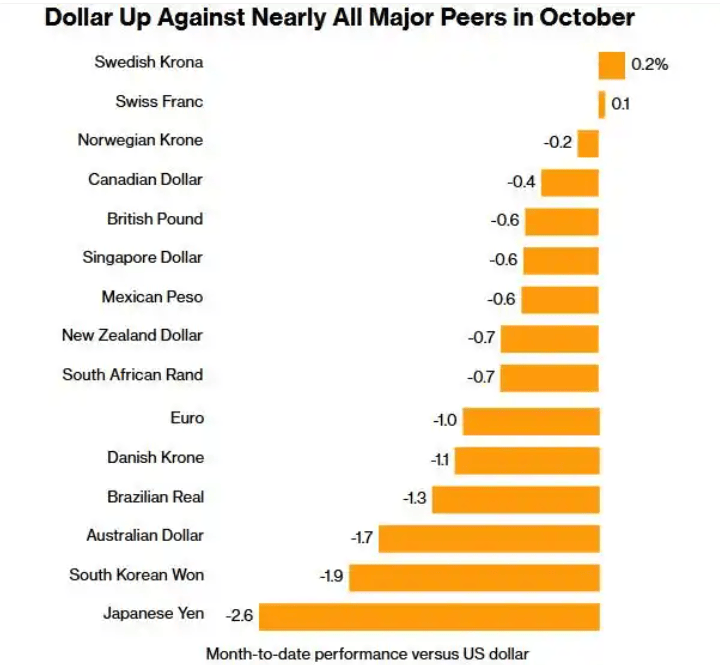
Group 1 - The US dollar has shown a strong start in the foreign exchange market, supported by risk aversion due to the government shutdown and heightened attention on the upcoming September CPI data [1][2] - The government shutdown has led to a "data vacuum," increasing the appeal of the US dollar as a traditional global safe-haven asset, resulting in sustained buying support [2][6] - The September CPI data, set to be released soon, is crucial as it is one of the first significant data points post-shutdown and provides insight into the true inflation situation [4] Group 2 - Economists predict a year-on-year increase of 3.1% in the September CPI, which would be the highest level since May 2024, potentially impacting the Federal Reserve's policy path in 2026 [4][6] - There is an asymmetry in the market's response to the CPI data; if the data meets or falls below expectations, the dollar may only see minor fluctuations, but a higher-than-expected figure could drive the dollar significantly higher [6][8] - Recent Canadian inflation data exceeding expectations has raised caution among traders, suggesting that US inflation may also remain resilient [6] Group 3 - Despite a cumulative decline of about 7% in the Bloomberg Dollar Spot Index for 2025, most of the losses occurred in the first half of the year, with the dollar showing resilience in the latter half [7] - The options market indicates optimism, with traders favoring the purchase of bullish dollar options, reflecting a belief that the dollar will continue to strengthen in the next three months [7] - There is a growing perspective that the market may be underestimating the dollar's rebound potential, as the relative strength of the US economy could limit the Fed's rate-cutting capacity [8]
美股前瞻 | 三大股指期货齐跌 奈飞、德州仪器绩后跳水 特斯拉盘后公布财报
智通财经网· 2025-10-22 12:11
Market Overview - US stock index futures are all down ahead of the market opening, with Dow futures down 0.00%, S&P 500 futures down 0.04%, and Nasdaq futures down 0.27% [1] - European indices show mixed performance, with Germany's DAX down 0.21%, UK's FTSE 100 up 0.90%, France's CAC40 down 0.33%, and the Euro Stoxx 50 down 0.21% [2][3] - WTI crude oil increased by 1.96% to $58.36 per barrel, while Brent crude oil rose by 1.83% to $62.44 per barrel [3][4] Economic Insights - Bank of America strategist Savita Subramanian has shifted from a bullish to a cautious stance on the US stock market, citing five emerging risks that could impact the S&P 500 index, including high valuations and signals of an impending bear market [5] - A survey indicates that the Federal Reserve is expected to cut interest rates by 25 basis points next week, with significant uncertainty regarding the interest rate path for next year [6] - Goldman Sachs warns that market estimates for US GDP may be overly optimistic due to data gaps during the government shutdown, which could lead to disappointing employment data [7] Company-Specific News - Netflix (NFLX.US) missed earnings expectations due to a tax dispute in Brazil, reporting a 17% revenue growth to $11.5 billion but an EPS of $5.87, below the expected $6.94 [8][9] - Texas Instruments (TXN.US) reported a 14% revenue increase to $4.74 billion but provided a weaker outlook for Q4, leading to an 8% pre-market drop [9] - Alliance West Bank (WAL.US) reported a 15.2% revenue increase to $938.2 million and a net profit surge of over 27%, alleviating market concerns [10] - Intuitive Surgical (ISRG.US) saw a 23% revenue increase to $2.51 billion, driven by strong growth in surgical procedures [10] - Barclays Bank (BCS.US) announced a £235 million provision for auto credit but raised its profit guidance, leading to a 4% pre-market increase [11] - AT&T (T.US) reported mixed Q3 results, with revenue of $30.7 billion slightly below expectations but exceeding new wireless subscriber growth forecasts [12] - Teck Resources (TECK.US) reported a nearly 20% increase in adjusted core earnings to CAD 1.17 billion, benefiting from rising metal prices [12] - Beyond Meat (BYND.US) experienced a significant stock price increase driven by a short squeeze, despite concerns over its fundamental business outlook [12]

布米普特拉北京投资基金管理有限公司:巴尔对美联储连续降息表怀疑
Sou Hu Cai Jing· 2025-10-22 11:13
Core Viewpoint - Federal Reserve Governor Barr emphasizes the need for caution in monetary policy adjustments amid persistent inflation and a cooling job market, adding uncertainty to expectations of consecutive rate cuts [1][3]. Group 1: Monetary Policy Stance - Barr supports the Fed's decision to cut rates by 25 basis points in September but clarifies that this does not imply a series of continuous rate cuts [3]. - He highlights ongoing concerns about inflation, citing that it may not return to the 2% target until the end of 2027, which he considers a long wait for consumers [3][6]. Group 2: Economic Indicators - The latest data shows that the Personal Consumption Expenditures (PCE) price index rose by 2.7% year-on-year in August, with the core index reaching 2.9% [6]. - Barr anticipates that the core PCE price index will remain above 3% by the end of the year, indicating a prolonged path to achieving the inflation target [6]. Group 3: Labor Market Conditions - The labor market has shown signs of cooling, with job creation significantly slowing since May, although the unemployment rate remains at 4.3% as of August [6][9]. Group 4: Tariff Policy Impact - Barr expresses skepticism about the impact of tariff policies on inflation, noting that the effective tariff rate has risen significantly, reaching approximately 11% in August, which may lead businesses to pass costs onto consumers [6]. Group 5: Internal Policy Discrepancies - Barr's cautious stance contrasts with other Fed officials, such as New York Fed President Williams, who supports further policy easing, and newly appointed Governor Stephen Milan, who advocates for more aggressive rate cuts [9].

彻彻底底不装了?就在刚刚!贝森特再发警告:美国经济正在承受苦果,这次警告与他之前的讲话可谓大相径庭
Sou Hu Cai Jing· 2025-10-16 15:11
Economic Overview - The U.S. economy, previously described as resilient, is now facing significant challenges due to a government shutdown that has lasted 15 days, resulting in an estimated economic loss of approximately $1.5 billion per day, totaling around $15 billion so far [3][5] - The current GDP growth rate is around 1.6%, and the shutdown's economic losses could potentially erase half of this quarter's growth [3][5] Historical Context - The U.S. has experienced 21 government shutdowns since 1976, with the longest lasting 35 days from late 2018 to early 2019, which resulted in over $11 billion in economic losses and affected over 200,000 employees [5] - The current situation is exacerbated by a political stalemate between Republicans and Democrats, with conflicting priorities on budget cuts and social welfare [7][9] Employment and Inflation - The September employment report revealed only 89,000 new non-farm jobs, significantly below the market expectation of 150,000, marking the worst performance since December of the previous year [5] - Although the Consumer Price Index (CPI) year-on-year growth rate dropped to 3.3% in September, core inflation remains around 4%, far from the Federal Reserve's target of 2% [5] Political Dynamics - The current political deadlock is characterized by a lack of effective governance, with only 17% of respondents in a Gallup poll believing Congress can govern effectively, a figure lower than during the peak of the COVID-19 pandemic [7] - The Biden administration faces pressure to compromise, but doing so may be perceived as an admission of fiscal mismanagement ahead of the upcoming elections [9] Fiscal Challenges - The projected federal deficit for this year is approximately $1.7 trillion, a 23% increase from the previous year, with total national debt exceeding $34 trillion, accounting for over 120% of GDP [10] - The reliance on consumer debt is highlighted by the record high of $1.13 trillion in credit card debt as of the second quarter, indicating a fragile economic foundation [12][14] Structural Issues - The current economic situation is described as structurally fatigued rather than a temporary setback, with ongoing job losses and financial strain on households [14][16] - The combination of fiscal constraints, inflation, and employment challenges suggests that mere rhetoric will not resolve the underlying issues facing the economy [16]

大摩:美联储言论“一叶障目”,只见美国通胀,不见全球通缩
Hua Er Jie Jian Wen· 2025-10-14 06:34
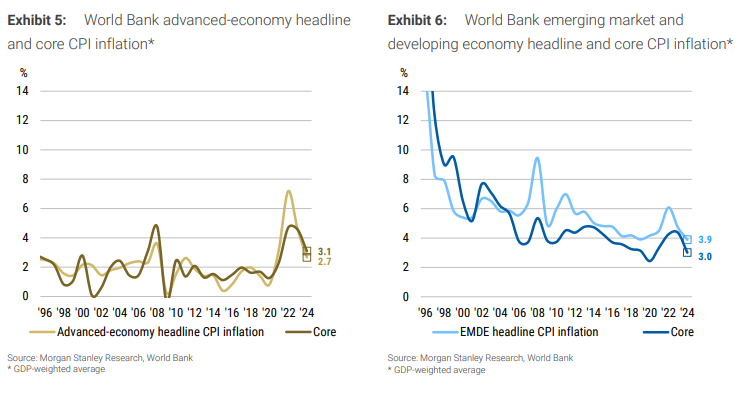
Group 1 - The core message of the report emphasizes a significant downward trend in global inflation, suggesting that investors may be overly concerned about U.S. inflation [1][2] - The report highlights that as of September, the global CPI annual inflation rate stands at 3.3%, down from 4.5% a year ago, indicating a strong downward momentum over the past 35 months [3] - The primary drivers of this global deflation are emerging markets and developing economies, where core inflation has reached multi-decade lows [5] Group 2 - The report argues that tariffs, while a visible risk, may not necessarily lead to higher inflation, as companies might absorb costs rather than pass them on to consumers [6] - It recommends that investors adopt a global perspective and hedge against U.S. inflation risks by buying U.S. Treasuries, particularly 5-year bonds, and shorting the dollar [6]
中资离岸债每日总结(10.13) | 宝龙地产与特别小组成员订立重组支持协议
Sou Hu Cai Jing· 2025-10-14 03:00
Economic Outlook - Economists have raised their forecasts for U.S. economic growth for this year and next, with GDP expected to grow by 1.8% in 2023, up from a previous estimate of 1.3% [2] - The upward revision is primarily due to significantly improved expectations for business investment [2] - The U.S. economy is projected to grow at a similar pace in 2026 [2] Employment Trends - The average monthly job growth in the U.S. is now expected to be 60,000 for this year, down from a prior forecast of 87,000 [2] - Recent months have shown a notable slowdown in job growth, prompting the Federal Reserve to lower interest rates by 25 basis points in September [2] - Economists anticipate another 25 basis point rate cut from the Federal Reserve this year, followed by a total of 75 basis points in cuts by 2026 [2] Inflation Expectations - The NABE group expects U.S. inflation to remain above the Federal Reserve's 2% target until next year [2] - The year-on-year increase in the PCE price index is projected to decline from 3% this year to 2.5% by the end of 2026 [2] Trade and Economic Policy - The economic outlook has been complicated by significant and frequently changing policy measures from the Trump administration, particularly regarding tariffs [2] - The impact of tariffs on inflation has been slower and more moderate than many economists had anticipated [2]