
半导体国产替代

Search documents
主动权益基金又行了?
阿尔法工场研究院· 2025-08-07 00:08
Core Viewpoint - The performance of active equity funds has significantly outperformed passive index funds in 2023, but rebuilding investor trust will take time [4][5][8]. Group 1: Performance Comparison - As of the end of July, over 70% of active equity funds outperformed their benchmarks, a notable increase from less than 30% in the previous year [5]. - The average return of active equity funds this year is 14.05%, surpassing major indices like CSI 300 (3.58%) and CSI 500 (8.74%), with 92.33% of active funds achieving positive returns [7]. - In contrast, passive index funds have an average return of 10.94% this year, with 90.38% showing positive returns [7]. Group 2: Sector Performance - The innovative drug sector has emerged as a significant winner among active equity funds, with top-performing funds achieving returns exceeding 100% [8]. - Specific funds like Changcheng Medical Industry Selection and Zhongyin Hong Kong Stock Connect Medicine have led the pack with returns of 127.05% and others closely following [7]. Group 3: Redemption Pressure - Despite strong performance, active equity funds face increasing redemption pressure, with total assets decreasing by 366.62 billion and total shares down by 866.98 million in Q2 [9]. - Notably, funds with strong performance, such as Huatai-PineBridge Innovation Medicine, have seen significant inflows, indicating that individual fund performance can attract investor interest [9][11]. Group 4: Investor Behavior - The "anchoring effect" in behavioral finance suggests that past performance influences current investor decisions, leading many to hold onto funds that have not performed well in recent years [15]. - The growth of "fixed income plus" funds and multi-asset strategies reflects a shift in investor preference towards more stable products amid the challenges faced by active equity funds [15][16]. Group 5: Future Outlook - Historical trends indicate that active equity funds excel in identifying growth opportunities in emerging sectors, suggesting potential for future outperformance as market conditions evolve [18]. - The transition from a "star-driven" to a "return-driven" approach in the industry may pave the way for a resurgence in investor confidence in active equity funds [18].

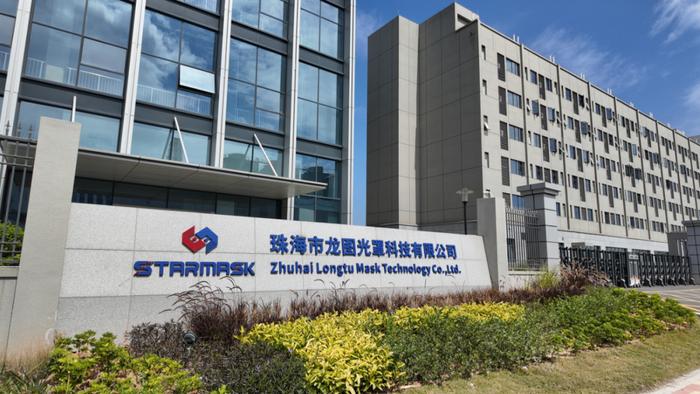
从科创板启航:龙图光罩的产业突围之路
Xin Lang Cai Jing· 2025-07-31 02:11
Core Viewpoint - Longtu Photomask, a leading player in the semiconductor photomask sector, successfully listed on the STAR Market, with its closing price on the first day rising by 121.6% from the issue price, marking it as a notable company in the semiconductor supply chain [1]. Company Performance - In 2024, Longtu Photomask achieved a revenue of 247 million yuan, a year-on-year increase of 12.92%, and a net profit attributable to shareholders of 91.83 million yuan, up 9.84%, indicating stable performance [6]. - The company has maintained a high level of R&D investment, with R&D expenses reaching 23.05 million yuan in 2024, a 14.25% increase year-on-year, and accounting for 10.40% of revenue [6]. - Longtu Photomask has established long-term stable partnerships with key clients such as SMIC, Silan Microelectronics, and BYD Semiconductor, enhancing its competitive edge through rich project experience and industry know-how [6]. Technological Advancements - Longtu Photomask has developed a comprehensive technical system covering CAM, lithography, and inspection, with 14 core process technologies, including industry-leading OPC compensation and PSM phase-shifting mask technologies [4]. - The company has made significant progress in its third-generation PSM products, with successful transitions from R&D to mass production for 90nm products and ongoing sample testing for 65nm products [8]. Market Outlook - The global semiconductor photomask market is projected to reach $6 billion by 2025, with China's market expected to approach 5 billion yuan, indicating a growing demand for photomasks [9]. - The shift of semiconductor chip production capacity to mainland China is becoming inevitable, with 15 out of 60 new 300mm wafer fabs being established in the region from 2020 to 2024, further driving the local semiconductor materials supply chain [9]. Industry Context - Currently, the domestic production rate of semiconductor photomasks in China is around 10%, with high-end photomasks at only 3%, highlighting the critical need for domestic production to address supply chain vulnerabilities [10]. - Government policies are increasingly supporting the semiconductor industry, with investments directed towards key materials like photomasks, which are essential for ensuring supply chain security [10]. - Longtu Photomask is positioned to benefit significantly from the domestic substitution trend, leveraging its technological and production capacity advantages to capture growth opportunities in the market [11].
政策催化+业绩共振,新一轮主线确立!
Sou Hu Cai Jing· 2025-07-29 11:29
7月29日,A股市场主要指数全线飘红,科技成长风格表现亮眼,主线切换逻辑愈加清晰。 港股市场行业分化显著,医疗保健业涨3.77%,恒生港股通创新药精选指数大涨4.43%;工业、能源板 块分别涨1.34%、0.89%。资讯科技业跌0.72%,金融业跌0.59%,恒生港股通中国内地银行指数跌 1.51%。概念板块中反恐指数、CRO指数领涨,大气治理、券商板块跌幅居前。 当前市场呈现三大特征:一是结构性行情突出,科技成长与传统板块分化加剧;二是政策驱动效应显 著,工信部关于人工智能终端、人形机器人等产业政策的部署,以及国家育儿补贴政策落地,持续引导 资金流向硬科技及消费领域;三是资金博弈加剧,热点轮动从"赛道抱团"转向"细分领域轮动",医药、 算力、半导体等板块交替成为领涨主线,同时港股与A股联动性增强,特别是在医药、银行等板块形成 跨市场共振。。 策略上,短期建议紧扣资金动向,关注业绩确定性强的创新药、半导体设备等板块,政策催化下的人工 智能终端产业链,以及暑期档超预期的影视传媒行业。 中期可布局产业变革带来的长期红利,重点把握三大方向:一是泛科技领域,包括半导体国产替代、算 力基础设施、人形机器人核心零部件;二 ...
世界人工智能大会闭幕式成功举办,半导体产业发展方兴未艾
Mei Ri Jing Ji Xin Wen· 2025-07-29 01:57
Market Performance - As of July 28, the Shanghai Composite Index rose by 0.12% to close at 3597.94 points, the Shenzhen Component Index increased by 0.44% to 11217.58 points, and the ChiNext Index gained 0.96% to 2362.60 points [1] - The overnight performance of U.S. markets showed the Dow Jones Industrial Average decreased by 0.14%, the S&P 500 rose by 0.02%, and the Nasdaq Composite increased by 0.33% [1] - The Philadelphia Semiconductor Index rose by 1.62%, with notable performances from companies like Micron Technology, which fell by 0.01%, ARM which increased by 0.74%, NXP Semiconductors which rose by 2.33%, Microchip Technology which gained 1.91%, and Applied Materials which increased by 2.47% [1] Industry Developments - Alibaba has launched a new open-source model, Wan2.2, which enhances video production efficiency by integrating cinematic elements and allows users to generate 5 seconds of high-definition video with over 60 controllable parameters [2] - Jinghe Integrated announced a capital increase of 1.195 billion yuan for Anhui Jingmei Optical Mask Co., with the company contributing 200 million yuan to acquire a 16.67% stake, aiming to enhance its optical mask business and supply chain stability [2] - The World Artificial Intelligence Conference concluded with 31 major projects signed, totaling over 15 billion yuan in investments, focusing on areas such as intelligent driving and robotics [3] AI and Semiconductor Insights - CITIC Securities noted that since the release of ChatGPT, large models are evolving towards greater efficiency and reliability, with the U.S. leading in powerful model exploration while Chinese companies excel in efficiency under computational constraints [4] - The year 2025 is projected to be a pivotal year for AI application acceleration, with OpenAI achieving an annual recurring revenue of 10 billion USD and Claude's monthly revenue growth exceeding 20% [4] - The AI computing power shift from training to inference is expected to create significant growth, with domestic trends towards self-controlled computing power becoming more pronounced [4] - The semiconductor materials ETF (562590) focuses on the upstream semiconductor sector, with 59% in semiconductor equipment and 24% in semiconductor materials, benefiting from the AI revolution and domestic substitution trends [5]
持股超5% 星源材质再增持Ferrotec加速半导体领域布局
Zheng Quan Shi Bao Wang· 2025-07-28 07:44
Core Viewpoint - The company Xingyuan Material (300568) has increased its stake in Ferrotec (6890.T) to over 5%, signaling its commitment to expanding into the semiconductor sector and establishing a second growth curve amid declining lithium battery separator prices [1][2]. Group 1: Company Strategy - Xingyuan Material is a leader in the lithium battery separator market, holding over 80% of the global market share, but faces pressure to diversify due to slowing growth in the new energy sector [2][3]. - The investment in Ferrotec, a company with strong vertical integration in semiconductor equipment and materials, aligns with Xingyuan's strategy to respond to national industrial security and ensure sustainable development [2][3]. Group 2: Market Position and Collaboration - Ferrotec holds approximately 60% market share in semiconductor equipment cleaning in China and has a significant presence in various segments globally, including a 35% share in thermoelectric semiconductor coolers [3][4]. - The partnership between Xingyuan Material and Ferrotec is expected to create synergies in technology and market access, enhancing both companies' capabilities in the semiconductor industry [5][7]. Group 3: Future Prospects - The semiconductor market presents vast opportunities, and Xingyuan Material's strategic investments, including a partnership with RSTechnologies, aim to strengthen its position in semiconductor materials [4][5]. - The establishment of a factory in Malaysia by Xingyuan Material, alongside Ferrotec's operations in the same region, provides a platform for collaborative growth in international markets [6][7].
A股收评:三大指数齐跌!海南自贸区板块回调,半导体板块逆势拉升
Ge Long Hui· 2025-07-25 07:47
Market Overview - On July 25, major A-share indices collectively declined, with the Shanghai Composite Index falling by 0.33% to 3593 points, the Shenzhen Component Index down by 0.22%, and the ChiNext Index decreasing by 0.23% [1][2] - Over 2700 stocks in the market experienced declines [1] Sector Performance Declining Sectors - The Hainan Free Trade Zone and related stocks saw significant declines, with Shen Nong Agriculture and Xinlong Holdings dropping over 9% [4][5] - The hydropower concept stocks also faced major pullbacks, with Shen Shui Gui Yuan hitting the daily limit down [4][6] - The liquor sector experienced a downturn, with Gujing Gongjiu and Tianyoude Jiu falling nearly 3% [7] Gaining Sectors - The Sora concept led the market with gains, as Sai Group hit the daily limit up [8] - The semiconductor sector rose, with Hanwha Microelectronics increasing over 12% [10][11] - The film and television stocks saw a rise, with Shanghai Film gaining over 5% [12][13] Individual Stock Movements Notable Declines - Shen Nong Agriculture (code: 300189) fell by 9.69% to 4.94 [5] - Xinlong Holdings (code: 000222) decreased by 9.03% to 5.14 [5] - Deep Water Planning Institute (code: 301038) dropped by 20.01% to 26.70 [6] Notable Gains - Sai Group (code: 300781) surged by 19.99% to 44.95 [9] - Hanwha Microelectronics (code: 688256) rose by 12.17% to 673.30 [11] - Shanghai Film (code: 601595) increased by 5.65% to 33.07 [13] Industry Insights - The liquor industry is expected to face pressure in Q2 due to new regulations affecting government consumption [7] - The semiconductor sector is showing signs of recovery, with improved demand and technological advancements [11] - The film industry is experiencing a strong summer box office, with total ticket sales exceeding 4.5 billion yuan [13]

半导体投资进入深水区,持续看好高端设备环节
2025-07-25 00:52
Summary of Semiconductor Industry Conference Call Industry Overview - The semiconductor industry is experiencing strong demand with high utilization rates in domestic wafer fabs and ongoing operations in downstream logic and memory manufacturers [1][2] - The domestic semiconductor supply chain is focusing on the progress of domestic substitution in critical processes such as photolithography, metrology, and coating/developing, which will directly impact stock trading strategies [1][2] Key Insights - Significant progress has been made in domestic production rates, moving from 28nm mature processes to breakthroughs in 14nm and more advanced processes, leading to simultaneous increases in value and volume [1][3] - The global semiconductor equipment sales are projected to reach $110.8 billion this year, with expectations to exceed $120 billion next year, driven primarily by AI [4][12] - The domestic semiconductor equipment market is expected to see record investment levels in 2024, despite a slight sales adjustment in Q1 2025 [4][16] Investment Opportunities - Investment focus should be on areas with low penetration but large market potential, such as photolithography components, metrology, and developing processes, as well as fast-growing core materials like masks and gases [1][6] - Key components in bottleneck processes, such as photolithography parts and core components of electron beam equipment, are also highlighted as important investment directions [6] Market Dynamics - The semiconductor equipment sector has shown strong upward trends since the beginning of the week, with a notable increase in the index [9] - The domestic semiconductor industry chain is undergoing rapid integration and development, with a decrease in verification cycles and an acceleration in mergers and acquisitions among listed companies [10][11] Policy and Regulatory Impact - Future domestic and international policies will significantly influence the development of domestic semiconductors, with recent adjustments in tariffs and technology controls favoring domestic self-sufficiency [13][21] - The new AI action plan from the U.S. government emphasizes increased semiconductor controls, necessitating accelerated domestic production of components and materials in China [21][22] Emerging Trends - The number of companies focusing on component production has increased, indicating a growing diversity in the parts sector, which now includes around 20 companies [7] - The bottleneck segments in the semiconductor equipment industry have a significant impact on valuations, with breakthroughs in these areas leading to higher market valuations [8] Future Outlook - Companies to watch in the long-term include Huachuang Zhongwei, Tuojing, Xinyuan Micro, and Jingce Electronics, which are positioned to benefit from advancements in the domestic semiconductor industry [19] - Major Chinese memory manufacturers are planning significant expansions in NAND and DRAM, with expectations for demand to more than double [20]

公募二季度最新重仓股出炉
Guo Ji Jin Rong Bao· 2025-07-24 12:17
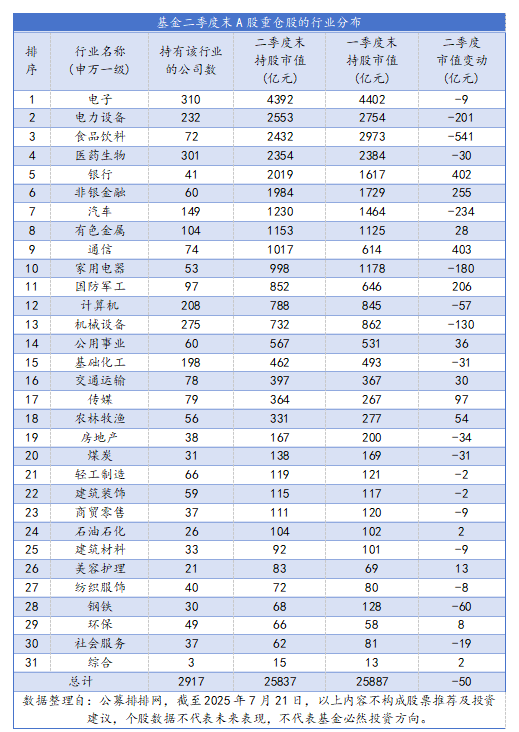
Core Insights - The public fund's second quarter report for 2025 reveals a total of 2,917 A-share companies held, with a total market value of approximately 25,837 billion yuan, a decrease of about 50 billion yuan compared to the previous quarter [1][2] Industry Distribution - The electronics industry has the highest market value among the sectors, totaling approximately 4,392 billion yuan, followed by power equipment, food and beverage, pharmaceutical biology, and banking, each exceeding 2,000 billion yuan [1][2] - Significant increases in holdings were observed in the communication and banking sectors, with both seeing an increase of over 400 billion yuan, while the food and beverage sector experienced the largest decrease, dropping over 500 billion yuan [1][2] Changes in Holdings - The top ten heavy stocks include Ningde Times with a holding value of about 1,426 billion yuan and Kweichow Moutai at approximately 1,252 billion yuan [3] - The report indicates a shift in fund allocation towards TMT (Technology, Media, and Telecommunications) and financial real estate sectors, with notable increases in communication and banking sub-sectors, while automotive and food and beverage sectors faced reductions [3][4] Strategic Insights - The electronics sector's strong performance is attributed to multiple driving factors, including the acceleration of national technology self-sufficiency strategies and the deepening of semiconductor domestic substitution [4] - The outlook for the second half of the year suggests a structural evolution towards a dual focus on "technology growth and value safety," with continued interest in electronics and semiconductors, while undervalued blue-chip stocks in banking and non-bank financial sectors are expected to provide stability and defensive characteristics [4]






英伟达松绑H20,索尼推迟市场目标:芯片背后的大国角逐
格隆汇APP· 2025-07-22 08:36
Core Viewpoint - The article discusses the recent approval of NVIDIA to resume sales of H20 computing cards in China and the introduction of new GPU products tailored for the Chinese market, highlighting the rapid progress of domestic semiconductor companies in the context of increasing local competition [1] Group 1: Market Dynamics - The loosening of restrictions is driven by the need to prevent overseas giants from losing market share in China due to the accelerated advancement of local competitors [1] - In the CMOS image sensor (CIS) sector, Sony has postponed its target of achieving a 60% market share by 2025 due to lower-than-expected sales from major clients and intensified competition in the high-end Chinese market [1][21] - Geke Micro has successfully captured the second position globally in terms of product sales, emerging as a significant competitor to Sony [1][21] Group 2: Geke Micro's Performance - Geke Micro achieved a revenue of 6.383 billion yuan in 2024, marking a year-on-year growth of 35.90%, while the first quarter of 2025 saw an 18.21% increase in revenue [3] - Despite high revenue growth, Geke Micro reported a net loss in the first quarter, attributed to strategic investments aimed at seizing technological leadership and optimizing product mix [3][5] - The company significantly increased its R&D expenditure to 952 million yuan in 2024, a 19.66% increase, with Q1 2025 R&D expenses surging to 262 million yuan, reflecting a 30% increase [3] Group 3: Strategic Shifts - Geke Micro's high-end product line, particularly those with pixel counts of 13 million and above, has become a key revenue growth driver, contributing approximately 40% to its mobile CIS business in 2024 [6] - The successful mass production of 50MP CIS products has allowed Geke Micro to penetrate mainstream Android brand supply chains, altering market perceptions of its reliance on low-end products [8][6] - The company’s management expressed confidence that the mass shipment of 50MP products will lead to a recovery in gross margins, supported by a stock incentive plan tied to revenue growth from high-pixel products [9] Group 4: Fab-Lite Model - Geke Micro's Fab-Lite model, which combines elements of traditional fabless and IDM strategies, is crucial for maintaining supply chain security and enhancing long-term competitiveness [10][12] - The shift towards the Fab-Lite model is evident among leading domestic chip design companies, aiming to secure core processes and ensure supply chain stability [12][14] - Geke Micro's self-built production lines enable close integration of design and manufacturing, facilitating rapid iteration and optimization of high-pixel products [15][16] Group 5: Market Position and Future Outlook - The semiconductor sector has faced significant volatility, with Geke Micro's stock performance reflecting broader industry trends [19] - Despite recent challenges, Geke Micro has demonstrated resilience, continuously enhancing its technological capabilities and market share [20] - The article concludes that the ability of domestic companies to build irreplaceable core technologies and capacities will determine the competitive landscape in the semiconductor industry [22]


市场有望再上一个台阶
GOLDEN SUN SECURITIES· 2025-07-20 23:30
Quantitative Models and Construction Methods - **Model Name**: CSI 500 Enhanced Portfolio **Model Construction Idea**: The model aims to enhance the performance of the CSI 500 index by leveraging quantitative strategies to generate excess returns over the benchmark[2][59] **Model Construction Process**: The portfolio is constructed based on a strategy model that selects stocks with specific characteristics and allocates weights accordingly. The detailed holdings include stocks like Guolian Minsheng (4.40%), Changjiang Securities (3.92%), and others, with varying weights[61][64] **Model Evaluation**: The model has demonstrated consistent excess returns over the benchmark since 2020, with a maximum drawdown of -4.99%[59][63] - **Model Name**: CSI 300 Enhanced Portfolio **Model Construction Idea**: Similar to the CSI 500 Enhanced Portfolio, this model seeks to outperform the CSI 300 index by employing quantitative strategies[2][65] **Model Construction Process**: The portfolio is constructed using a strategy model, with holdings such as COSCO Shipping (7.92%), China Railway Rolling Stock Corporation (6.51%), and others, each assigned specific weights[68] **Model Evaluation**: The model has achieved an excess return of 33.69% relative to the CSI 300 index since 2020, with a maximum drawdown of -5.86%[65][68] Model Backtesting Results - **CSI 500 Enhanced Portfolio**: Weekly return of 1.24%, outperforming the benchmark by 0.04%; cumulative excess return since 2020 is 48.71%; maximum drawdown is -4.99%[59][63] - **CSI 300 Enhanced Portfolio**: Weekly return of 2.29%, outperforming the benchmark by 1.20%; cumulative excess return since 2020 is 33.69%; maximum drawdown is -5.86%[65][68] Quantitative Factors and Construction Methods - **Factor Name**: Beta Factor **Factor Construction Idea**: Measures the sensitivity of a stock's returns to market returns, capturing the systematic risk exposure of the stock[2][70] **Factor Construction Process**: Calculated as the slope of the regression line between the stock's returns and the market's returns over a specific period. The formula is: $ \beta = \frac{\text{Cov}(R_i, R_m)}{\text{Var}(R_m)} $ where $R_i$ is the stock return, $R_m$ is the market return, Cov is the covariance, and Var is the variance[70] **Factor Evaluation**: High Beta stocks have shown superior performance recently, while low Beta stocks underperformed[2][71] - **Factor Name**: Liquidity Factor **Factor Construction Idea**: Captures the ease of trading a stock without significantly impacting its price[70] **Factor Construction Process**: Typically measured using metrics like turnover rate or bid-ask spread. The specific formula or metric used in this report is not detailed[70] **Factor Evaluation**: Liquidity factor exhibited significant negative excess returns during the week, indicating underperformance of highly liquid stocks[71] - **Factor Name**: Non-linear Size Factor (NLSIZE) **Factor Construction Idea**: Accounts for the non-linear relationship between stock size and returns, complementing the traditional size factor[70] **Factor Construction Process**: Constructed by introducing higher-order terms of size (e.g., squared or cubed size) into the regression model. The exact formula is not provided in the report[70] **Factor Evaluation**: The factor showed significant negative excess returns during the week, indicating underperformance of stocks with extreme size characteristics[71] Factor Backtesting Results - **Beta Factor**: Demonstrated high positive excess returns during the week, outperforming other style factors[71][75] - **Liquidity Factor**: Showed significant negative excess returns, underperforming during the week[71][75] - **Non-linear Size Factor (NLSIZE)**: Also exhibited significant negative excess returns, indicating poor performance[71][75]