半导体自主可控

Search documents
万联晨会-20250703
Wanlian Securities· 2025-07-03 01:16
Core Viewpoints - The A-share market experienced a collective decline on Wednesday, with the Shanghai Composite Index down by 0.09%, the Shenzhen Component down by 0.61%, and the ChiNext Index down by 1.13%. The total trading volume in the Shanghai and Shenzhen markets reached 1.376727 trillion yuan [2][6] - In the Shenwan industry sector, steel, coal, and building materials led the gains, while electronics, communications, and defense industries lagged behind. Concept sectors such as low-radiation glass, silicon energy, and special steel saw significant increases, while military restructuring, brain-computer interface, and EDR concepts faced declines [2][6] Market Performance - Domestic market performance showed the Shanghai Composite Index closing at 3,454.79 with a decrease of 0.09%, the Shenzhen Component at 10,412.63 down by 0.61%, and the ChiNext Index at 2,123.72 down by 1.13% [4] - Internationally, the Dow Jones closed at 44,484.42 down by 0.02%, the S&P 500 at 6,227.42 up by 0.47%, and the Nasdaq at 20,393.13 up by 0.94% [4] Important News - The National Development and Reform Commission has allocated over 300 billion yuan to support the third batch of "two heavy" construction projects for 2025, completing the annual allocation of 800 billion yuan for such projects [3][7] - In the U.S., the ADP employment numbers for June unexpectedly decreased by 33,000, marking the first negative growth since March 2023, with service sector jobs declining by 66,000, the largest drop since the pandemic [3][7] Industry Insights - The electronic industry has outperformed the Shanghai and Shenzhen 300 Index since the beginning of 2025, with Q1 performance showing record highs in revenue and net profit [8] - Investment opportunities are identified in semiconductor self-sufficiency, AI computing power construction, and terminal innovation, driven by intensified U.S.-China tech tensions and the ongoing AI wave [8][9] - The semiconductor industry is expected to see accelerated domestic substitution due to increased demand for advanced process semiconductor equipment and materials, with significant room for growth in domestic production capabilities [8][9] Investment Recommendations - Focus on semiconductor equipment and materials, particularly in advanced process semiconductor supply chains, and leading companies in semiconductor equipment and materials [10][11] - Monitor developments in AI chips, especially those from domestic leaders like Huawei, as their market share continues to grow [10][11] - Pay attention to the storage chip sector, where domestic manufacturers are likely to benefit from rising prices due to supply adjustments by overseas manufacturers [10][11] - The PCB market is expected to grow rapidly due to global AI computing power demands, with domestic companies well-positioned to capitalize on this trend [10][11] - In the mobile phone sector, observe leading manufacturers as they release new AI-enabled products, which could drive demand across the supply chain [10][11]
证监会:始终把维护市场稳定作为监管工作首要任务;贵州茅台回购超52亿元股票……盘前重要消息还有这些
证券时报· 2025-07-03 00:15
Group 1 - The China Securities Regulatory Commission emphasizes maintaining market stability as a primary regulatory task and aims to create a favorable environment for high-quality capital market development [2] - The People's Bank of China issued a notice on anti-money laundering and anti-terrorist financing management for precious metals and gemstones, effective from August 1, 2025, requiring institutions to report large cash transactions [3] - The first batch of 10 science and technology innovation bond ETFs has been approved, enhancing the bond ETF market in China [3] Group 2 - The Longhua District of Shenzhen released a three-year action plan to promote the cultivation of listed companies, encouraging social participation and cooperation with financial research institutions [4] - The Guangzhou Housing Provident Fund Management Center announced a draft for public consultation regarding the implementation of commercial housing loans transitioning to provident fund loans, with specific thresholds for action based on loan rates [4] Group 3 - The Civil Aviation Administration and China Railway Group jointly issued a task list for promoting high-quality development of "air-rail intermodal transport" from 2025 to 2027, focusing on collaboration and integration [5] - Guizhou Moutai reported a total of 3.3821 million shares repurchased by the end of June 2025, with a total expenditure of 5.202 billion yuan [7] - Jiangnan Waterworks received a stake increase from Anren Life Insurance, raising its holding to 5.03% [9] - Hainan Highway is planning to acquire a 51% stake in Jiaokong Petrochemical, which is expected to constitute a major asset restructuring [17]





2025年中期电子行业投资策略报告:芯声澎湃,精彩纷呈-20250702
Wanlian Securities· 2025-07-02 13:10
Core Insights - The report indicates that the SW electronics industry has outperformed the CSI 300 index since the beginning of 2025, with a slight increase in valuation compared to recent years [1] - The performance in Q1 2025 shows record highs in revenue and net profit for the SW electronics sector, suggesting a positive outlook for the second half of 2025, particularly in semiconductor self-sufficiency, AI computing power construction, and terminal innovation [1][2] Semiconductor Self-Sufficiency - The intensifying US-China tech friction is accelerating the domestic substitution process in semiconductors, with China being the largest semiconductor equipment market globally [2] - The report highlights that the domestic market still has significant room for improvement in the localization of advanced process equipment, components, and materials, particularly in areas like photolithography machines and high-end photoresists [2][40] - The expansion of wafer fabs is expected to boost demand for semiconductor equipment, indicating a strong growth momentum in advanced processes [2] AI Computing Power Construction - The report notes that AI computing power construction has entered a competitive phase, with key segments including AI chips, advanced packaging, storage chips, and PCBs being critical to the computing power foundation [3] - Domestic internet companies are increasing their AI spending, supported by favorable policies for domestic AI innovation, leading to a gradual increase in the market share of domestic AI chips [3][39] - The storage chip market is expected to benefit from price increases due to adjustments in production plans by overseas manufacturers, with domestic storage companies likely to gain from this trend [3] Terminal Innovation - The report emphasizes that the combination of national subsidies and the AI innovation wave is driving growth in consumer terminals, with AI smartphones and AIPC expected to penetrate the market rapidly [4] - AI smartphones are projected to exceed a penetration rate of 30% in the smartphone market by 2025, with major brands like Apple, Huawei, and Xiaomi actively innovating in AI terminal products [4][39] - The report also mentions that the user base for AI applications is accelerating, with the potential for several billion-level AI application opportunities in the future [4][8] Investment Recommendations - The report suggests focusing on investment opportunities in semiconductor self-sufficiency, AI computing power construction, and terminal innovation [9] - Specific recommendations include investing in advanced process semiconductor industry chains, domestic AI chip leaders, and companies involved in advanced packaging and storage chips [9] - The report also highlights the importance of monitoring leading companies in the PCB sector and those involved in AI smartphone and AIPC developments [9]
这30家公司决定中国硬科技未来!
和讯· 2025-07-01 08:33
Core Viewpoint - "Hard technology" has become a strategic support for national competitiveness and a key engine for high-quality development in the context of intensified Sino-U.S. technological competition and the deep restructuring of global supply chains [1][28]. Summary by Sections Overview of the Hard Technology Sector - The "2025 China Hard Technology Listed Company Value List" was jointly launched by Hexun Financial Research Institute and ZD Insights, focusing on identifying resilient and technologically advanced companies in China's capital market [1]. - The first sub-list, the Growth Potential List, highlights the top 30 high-growth representatives from 1,326 listed companies in the information technology sector, covering key areas such as semiconductors, artificial intelligence, and IT hardware [1][28]. Growth Potential List Highlights - The top companies include: 1. Changchuan Technology - Semiconductor testing equipment supplier [4] 2. Lexin Technology - IoT chip design company [4] 3. Haitai Ruisheng - AI data service provider [5] 4. Haiguang Information - High-end processor supplier [6] 5. Hengxuan Technology - Smart audio SoC chip supplier [6] - These companies demonstrate strong performance in revenue expansion and R&D investment, representing the "future new forces" in China's hard technology sector [1]. Key Trends in the Hard Technology Sector - **Trend 1: Accelerated Progress in Semiconductor Self-Control** The domestic semiconductor industry is showing strong resilience and growth potential, with many companies in the top 30 focusing on semiconductor design, manufacturing, and packaging [29]. - **Trend 2: Continuous Increase in R&D Investment Intensity** The average R&D expense ratio for the top 30 companies is 24%, with an average growth rate of 24% in R&D investment, indicating a strong commitment to technological innovation [32][33]. - **Trend 3: Scene-Driven Technology Application Efficiency** Companies are leveraging specific application scenarios to drive technological advancements, enhancing overall industry competitiveness [36][37]. - **Trend 4: Accelerated Release of Data Element Value** Companies like Haitai Ruisheng and Kirin Xinan are capitalizing on data value, contributing to the rapid growth of China's digital economy [39][40]. - **Trend 5: Significant Regional Cluster and Industry Chain Synergy** Major cities like Shenzhen, Beijing, and Shanghai are forming high-concentration industrial belts, enhancing collaboration and growth among technology companies [41][44]. Conclusion - The growth potential list and the identified trends illustrate a shift in China's new generation of information technology from scale expansion to quality improvement, with a focus on self-reliance and innovation [28][29].
2025全球数字经济大会即将召开,数字经济ETF(560800)半日收涨1.18%
Xin Lang Cai Jing· 2025-06-30 05:12
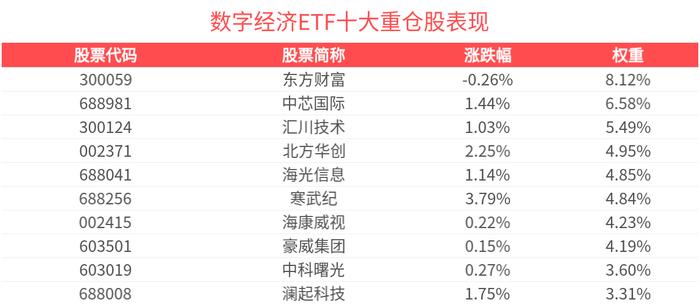
数据显示,截至2025年5月30日,中证数字经济主题指数(931582)前十大权重股分别为东方财富 (300059)、中芯国际(688981)、汇川技术(300124)、北方华创(002371)、海光信息(688041)、寒武纪 (688256)、豪威集团(603501)、海康威视(002415)、中科曙光(603019)、澜起科技(688008),前十大权重 股合计占比50.98%。 Wind数据显示: 规模方面,数字经济ETF近1周规模增长1305.43万元,实现显著增长,新增规模位居可比基金1/2。 份额方面,数字经济ETF近3月份额增长2400.00万份,实现显著增长,新增份额位居可比基金1/2。 消息面方面,2025全球数字经济大会将于7月2日在国家会议中心召开。本届大会将举办新技术新产品新 方案"首发首秀"特色活动,并围绕人工智能融合应用、数字安全等新兴领域举办46场专题论坛,全面展 现北京建设全球数字经济标杆城市工作成果。 有机构认为,海外市场的AI训练需求正在阶段性放缓,逐步过渡到推理需求驱动的阶段;而中国市场 由于大模型仍在快速演进,训练侧算力仍处于高速增长阶段。此外,得益于我国在数据与应用 ...
看好COC材料、封装材料、半导体材料的国产突破
2025-06-30 01:02
Summary of Conference Call Records Industry Overview - The conference call discusses the advancements in domestic production of high-end optical materials, specifically COC (Cyclic Olefin Copolymer) materials, packaging materials, and semiconductor materials, highlighting the potential for domestic breakthroughs in these sectors [1][2][4]. Key Points and Arguments COC Materials - COC materials are characterized by high transparency and lack of monomer residue, making them suitable for applications in high-end mobile phone lenses, displays, and medical devices. The demand is expected to grow due to the rise of 5G smartphones and autonomous driving [1][2]. - Domestic companies such as Akril, Tuo Xi Technology, and Jinfa Technology are actively pursuing localization, with Akril having established a production line for high-transparency materials and planning a 30,000-ton optical materials project. Akril anticipates sales of over 1,000 tons of COC monomers and polymers by 2026, increasing to over 3,000 tons by 2027, with a net profit exceeding 50 million [1][3]. PSPI (Polyimide Resin) - PSPI combines the functions of photoresist and dielectric insulation, reducing material costs and shortening the integrated circuit manufacturing process while improving pattern accuracy and yield. It is primarily used in integrated circuits and OLEDs [1][4]. - The PSPI market is currently dominated by Japanese companies such as Toray, Hitachi Chemical, and Asahi Kasei, as well as DuPont from the U.S. However, domestic firms like Aolide and Dinglong Co. have achieved breakthroughs in localization [4]. Semiconductor Market Trends - The global semiconductor sales are projected to reach $630.5 billion in 2024, representing a year-on-year growth of 19.7%, with the Asia-Pacific region accounting for $340.79 billion, a growth of 17.5% [2][5]. - By 2025, the global semiconductor market size is expected to reach $697.1 billion, with an annual compound growth rate of 10% from 2024 to 2029, indicating a steady increase in semiconductor material demand [5][6]. - The importance of self-sufficiency in China's semiconductor sector is emphasized due to export controls imposed by foreign companies on Chinese semiconductor equipment and materials. Key areas to monitor include photoresists, wet electronic chemicals, electronic specialty gases, and CMP (Chemical Mechanical Planarization) [6]. Additional Important Information - The conference highlights the potential health benefits of COC materials, as they do not contain bisphenol A, which is a concern in PC materials, making them suitable for high-end food-grade plastics [2]. - The ongoing developments in the semiconductor supply chain post-2023 are noted, with a significant recovery in sales expected in 2024 [5]. This summary encapsulates the critical insights from the conference call, focusing on the advancements in high-end optical materials and the semiconductor industry, along with the implications for domestic production and market growth.
中原证券晨会聚焦-20250630
Zhongyuan Securities· 2025-06-30 00:21
Core Insights - The report highlights a moderate recovery in the Chinese economy, driven by consumption and investment, with long-term capital inflows into the market [8][13][24] - The communication and financial technology sectors are leading the A-share market's upward trend, while the semiconductor and internet service industries also show strong performance [5][9][13] - The report emphasizes the importance of monitoring policy changes, market liquidity, and external market conditions for investment strategies [9][13] Domestic Market Performance - The Shanghai Composite Index closed at 3,424.23, down 0.70%, while the Shenzhen Component Index rose by 0.34% to 10,378.55 [3] - The average P/E ratios for the Shanghai Composite and ChiNext are 14.20 and 38.05, respectively, indicating a suitable environment for medium to long-term investments [9][13] International Market Performance - Major international indices, including the Dow Jones and S&P 500, experienced slight declines, with the Dow down 0.67% and the S&P 500 down 0.45% [4] Economic Indicators - In May, profits of large-scale industrial enterprises in China fell by 9.1% year-on-year, indicating challenges in the industrial sector [5][8] - The report notes a 5.8% year-on-year increase in industrial added value and a 6.4% increase in retail sales in May, reflecting resilience in industrial production and consumer demand [11] Industry Analysis - The new materials sector outperformed the market, with a 6.91% increase in the new materials index, surpassing the Shanghai Composite Index's 3.24% rise [14] - The semiconductor industry continues to show growth, with global semiconductor sales reaching $56.96 billion in April, a 22.7% year-on-year increase [15] - The power and utilities sector maintains a "stronger than market" investment rating, driven by stable earnings from large hydropower companies [21] Sector-Specific Insights - The automotive industry showed positive trends, with production and sales of vehicles increasing by 11.65% and 11.15% year-on-year in May, respectively [35][36] - The gaming industry is expected to benefit from a favorable policy environment and the integration of AI technology, which could enhance valuation [30][31] - The pet food sector saw a 6.90% year-on-year increase in export volume in April, indicating growth potential in this market [34] Investment Recommendations - The report suggests focusing on sectors with stable fundamentals and high dividend yields, such as traditional engineering machinery and high-speed rail equipment [28] - It also recommends monitoring the impact of policies promoting electric vehicle adoption and the commercialization of smart driving technologies in the automotive sector [37]


英伟达市值重回全球第一,AI人工智能ETF(512930)盘中涨超1%,新易盛股价创历史新高
2 1 Shi Ji Jing Ji Bao Dao· 2025-06-26 03:08
Group 1 - The three major indices showed mixed performance on June 26, with the AI ETF (512930) reaching a peak increase of over 1% during the day, closing up 0.44% with a trading volume exceeding 60 million [1] - Notable stocks within the AI ETF included Zhongke Shuguang and Xinyi Sheng, both rising over 5%, while other companies like Stone Technology, Qi Anxin-U, and others also saw significant gains [1] - Nvidia's stock surged over 4%, reaching a new all-time high with a market capitalization of $3.77 trillion, making it the highest-valued company globally. Nvidia reported a 69% year-on-year revenue growth in its latest earnings report, with data center business increasing by 73% [1] Group 2 - The AI ETF (512930) closely tracks the CSI Artificial Intelligence Theme Index, which selects representative companies that provide foundational resources, technology, and application support for AI [2] - The Consumer Electronics ETF (561600) tracks the CSI Consumer Electronics Theme Index, selecting 50 listed companies involved in component production and brand design within the consumer electronics sector [2] - Guojin Securities emphasizes the importance of focusing on the semiconductor self-control industry, core hardware for computing power, the Apple supply chain, and AI-driven industry chains, highlighting opportunities in AI smart glasses and related components [2]

电子行业2025年中期投资策略:人工智能创新百花齐放,半导体自主可控加速推进
Zhongyuan Securities· 2025-06-20 11:02
Group 1: AI and DeepSeek Innovations - DeepSeek leads the rise of domestic large models, significantly enhancing AI application deployment through technological innovations, achieving high cost-performance ratios in model training and inference [6][15][32] - The release of DeepSeek-V3, with a total parameter count of 671 billion, demonstrates competitive performance against OpenAI's GPT-4o, while maintaining a lower training cost of approximately $557.6 million [16][23][34] - The introduction of model distillation techniques in DeepSeek-R1 enhances inference capabilities, allowing smaller models to retain much of the performance of larger models, thus facilitating faster AI application deployment [19][28][32] Group 2: Semiconductor Industry Trends - The semiconductor industry is experiencing a push for domestic self-sufficiency due to increasing restrictions from the US and Japan, with a focus on accelerating domestic replacements in critical areas [9][10] - The demand for AI computing chips is expected to grow significantly, driven by the ongoing AI boom, with domestic manufacturers poised to capture market share as they enhance their capabilities [9][10] - The memory market is showing signs of recovery, with DRAM and NAND prices increasing from March to May 2025, indicating the potential for a new upward cycle in the semiconductor sector [9][10] Group 3: Investment Recommendations - Investment opportunities are identified in various sectors, including AI computing chips (e.g., Haiguang Information), AI glasses SoC (e.g., Hengxuan Technology), and smart driving technologies (e.g., OmniVision Technologies) [9][10] - The report suggests focusing on companies involved in advanced semiconductor equipment and manufacturing, such as North Huachuang and SMIC, as well as memory manufacturers like Zhaoyi Innovation, which are expected to benefit from the domestic market's growth [9][10]




机构表示自主可控驱动业绩高增+订单兑现!半导体材料ETF(562590)涨超1%
Sou Hu Cai Jing· 2025-06-20 04:22
截至2025年6月20日11:04,中证半导体材料设备主题指数(931743)强势上涨1.33%,成分股中光刻胶板块大涨,晶瑞电材上涨13.95%,三佳科技上涨 5.39%,上海新阳上涨4.36%,富创精密,江化微等个股跟涨。半导体材料ETF(562590)上涨1.05%,冲击3连涨。 数据显示,截至2025年5月30日,中证半导体材料设备主题指数前十大权重股分别为北方华创、中微公司、沪硅产业、南大光电、华海清科、拓荆科技、长 川科技、鼎龙股份、TCL科技、安集科技,前十大权重股合计占比61.33%。 半导体材料ETF(562590),场外联接(华夏中证半导体材料设备主题ETF发起式联接A:020356;华夏中证半导体材料设备主题ETF发起式联接C: 020357)。 每日经济新闻 长江证券表示,当前,半导体设备与材料的国产化率仍然处于较低水平,2024年半导体设备上市公司营收占中国大陆半导体设备销售额(不含进口光刻机) 的比重为22.4%,材料则为30.7%,后续随着研发的大力投入,国产替代仍将稳步推进。展望后续行情,估值进一步下行的可能性有限,且随着本土晶圆制 造综合能力的不断提升,业绩的兑现和订单的落地 ...