
固定资产投资

Search documents
前三季度云南省GDP超2.35万亿元 同比增长4.3%
Zhong Guo Xin Wen Wang· 2025-10-23 09:03
Core Insights - Yunnan Province's GDP for the first three quarters exceeded 2.35 trillion yuan, with a year-on-year growth of 4.3% [1] Economic Performance - The primary industry achieved a value-added of 250.37 billion yuan, growing by 2.8% [1] - The secondary industry recorded a value-added of 739.54 billion yuan, with a growth of 3.2% [1] - The tertiary industry saw a value-added of 1.36 trillion yuan, increasing by 5.2% [1] Agricultural Sector - The total output value of agriculture, forestry, animal husbandry, and fishery reached 427.62 billion yuan, with a year-on-year growth of 2.9% [1] - Summer grain and early rice production totaled 2.79 million tons, an increase of 0.63% compared to the previous year [1] Industrial Sector - The value-added of large-scale industries grew by 4.3%, accelerating by 0.3 percentage points compared to January-August [1] - Mining industry value-added increased by 9.7%, manufacturing by 4.6%, and electricity, heat, gas, and water production and supply by 1.9% [1] Consumer and Investment Trends - The total retail sales of consumer goods reached 953.77 billion yuan, with a year-on-year growth of 3.8% [2] - Fixed asset investment grew by 0.2%, with the primary industry investment increasing by 4.6%, while the secondary and tertiary industries saw declines of 0.1% and 0.3%, respectively [2] - The operating income of large-scale service industries was 251.23 billion yuan, growing by 6.4% [2] Income and Price Trends - The per capita disposable income of residents was 22,543 yuan, with a nominal growth of 5.0% and a real growth of 5.1% after adjusting for price factors [2] - The Consumer Price Index (CPI) saw a year-on-year decline of 0.1% [2] Policy and Future Outlook - The Yunnan Provincial Statistics Bureau indicated that economic indicators are stable and improving, supported by policies aimed at stabilizing the economy and employment [2] - Challenges such as insufficient effective demand and difficulties in transitioning between old and new growth drivers remain [2] - Future efforts will focus on enhancing the business environment, promoting economic growth, and developing a modern industrial system unique to Yunnan [2]
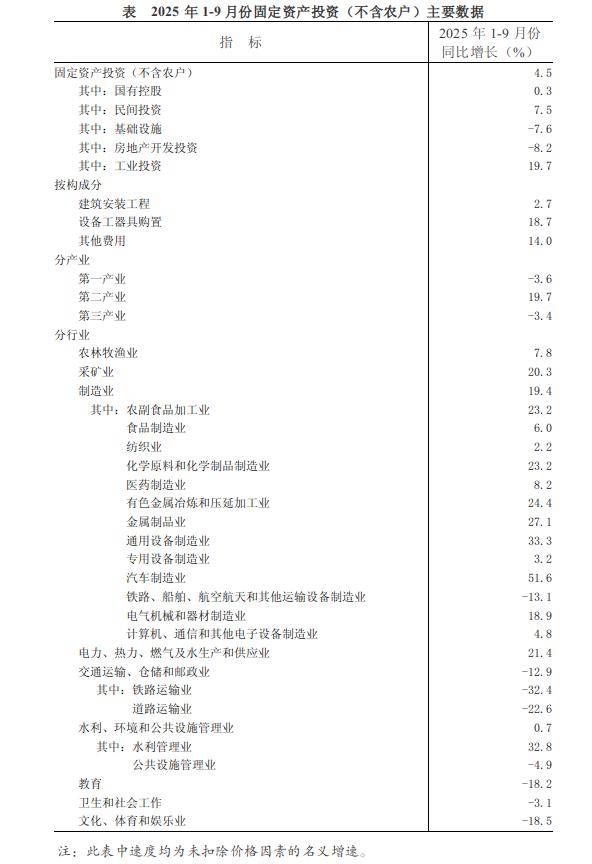
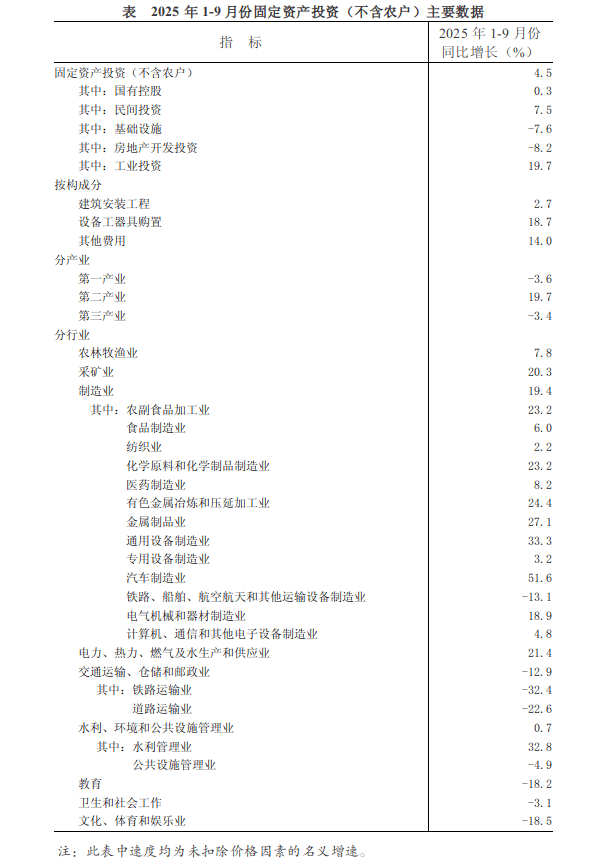
2025年1-9月份河南固定资产投资增长4.5%
Sou Hu Cai Jing· 2025-10-22 07:50
Core Insights - In the first nine months of 2025, fixed asset investment in Henan (excluding rural households) increased by 4.5% year-on-year, with private investment growing by 7.5% [1] Investment by Industry - Investment in the primary industry decreased by 3.6%, while the secondary industry saw a significant increase of 19.7%. The tertiary industry experienced a decline of 3.4% [2] - Industrial investment rose by 19.7%, infrastructure investment (excluding electricity, heat, gas, and water production and supply) fell by 7.6%, and real estate development investment decreased by 8.2% [2] - Within industrial investment, mining investment grew by 20.3%, manufacturing investment increased by 19.4%, and investment in electricity, heat, gas, and water production and supply rose by 21.4% [2] - In infrastructure investment, water, environment, and public facility management (excluding land management) saw a slight increase of 0.4%, while transportation and postal services investment dropped by 19.5%, and information transmission investment fell by 2.6% [2] Investment by Ownership - Central project investment increased by 2.4% year-on-year, while local project investment grew by 4.6% [3]

前三季度北京地区生产总值同比增5.6%
Zhong Guo Xin Wen Wang· 2025-10-22 06:30
Economic Growth - Beijing's GDP for the first three quarters reached 38,415.9 billion RMB, with a year-on-year growth of 5.6% [1] - The primary industry saw a decrease in value added by 1.1%, while the secondary industry grew by 4.0% to 5,055.9 billion RMB, and the tertiary industry increased by 5.8% to 33,282.0 billion RMB [1] Sector Performance - The information transmission, software, and IT services sector achieved a value added of 9,225.5 billion RMB, growing by 11.2%, contributing significantly to the tertiary industry's growth [1] - The financial sector's value added reached 6,700.0 billion RMB, with a growth rate of 9.0%, together with the information sector, accounting for nearly 80% of the tertiary industry's growth [1] - The rental and business services sector grew by 3.9% to 2,114.8 billion RMB, while transportation, warehousing, and postal services increased by 7.9% to 1,056.0 billion RMB [1] Investment and Consumption - Fixed asset investment in Beijing (excluding rural households) grew by 9.0%, with equipment purchase investment surging by 83.1%, now accounting for 29.3% of total fixed asset investment [2] - Total market consumption in Beijing increased by 0.5%, driven by a 4.8% rise in service consumption, while retail sales of consumer goods totaled 9,803.1 billion RMB, declining by 5.1% [2] - The per capita disposable income of Beijing residents reached 67,206 RMB, marking a growth of 4.5%, with a real growth of 4.9% after adjusting for price factors [2]
GDP同比增长5.5% 上海2025年前三季度经济数据出炉
Zhong Guo Xin Wen Wang· 2025-10-22 03:50
Economic Growth - Shanghai's GDP for the first three quarters of 2025 reached 40,721.17 billion yuan, with a year-on-year growth of 5.5%, surpassing the national average by 0.3 percentage points [1][2] - The primary industry added value was 64.26 billion yuan, growing by 0.9%; the secondary industry added value was 8,448.67 billion yuan, growing by 3.9%; and the tertiary industry added value was 32,208.24 billion yuan, growing by 5.9% [1] Industrial Performance - The industrial added value in Shanghai increased by 5.2% year-on-year, with the total output value of above-scale industries growing by 5.7%, an increase of 0.1 percentage points compared to the first half of the year [1] - The three leading industries in manufacturing saw an output value growth of 8.5%, outpacing the overall growth of above-scale industrial output value by 2.8 percentage points [1] Tertiary Sector Insights - The tertiary sector's added value grew by 5.9% year-on-year, with significant contributions from the information transmission, software, and IT services sector, which saw a 15.5% increase in added value [1] - The financial sector's added value reached 6,965.27 billion yuan, growing by 9.8%, while transportation, storage, and postal services increased by 5.2% [1] Investment and Consumption - Fixed asset investment in Shanghai increased by 6.0% year-on-year, while the total retail sales of social consumer goods reached 12,302.77 billion yuan, growing by 4.3%, with an acceleration of 2.6 percentage points compared to the first half of the year [2] - The average urban survey unemployment rate in Shanghai was 4.2% [2] Financial Market and Budget - The transaction volume in major financial markets in Shanghai grew by 12.7% year-on-year [2] - Local general public budget revenue was 6,555.68 billion yuan, a 1.0% increase, while expenditures rose by 8.0% to 6,876.39 billion yuan [2]
郭磊:三季度经济数据值得关注的一些线索
Di Yi Cai Jing· 2025-10-22 03:28
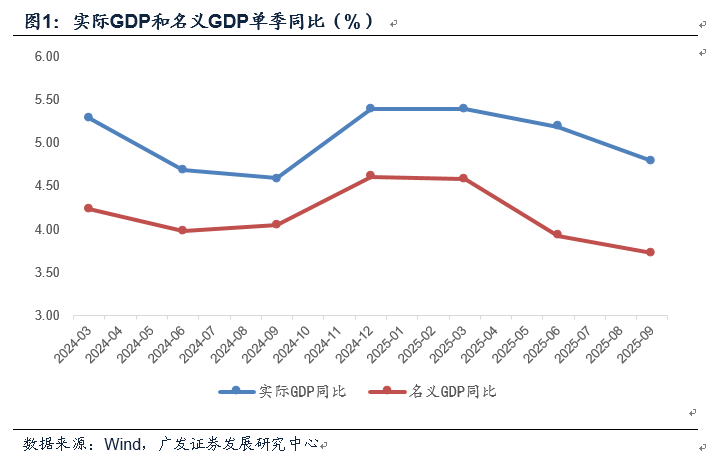
Economic Overview - The actual GDP growth in Q3 was 4.8% year-on-year, showing a slowdown compared to the first half of the year, but still within expectations. The GDP growth for the first three quarters was 5.2%, indicating strong resilience in the Chinese economy [1] - The nominal GDP growth for the first three quarters was 4.1%, which is considered low and is one of the factors constraining microeconomic sentiment [1] Industrial Sector - The capacity utilization rate for industrial enterprises improved in Q3, reaching 74.6%, an increase of 0.6 percentage points from Q2. Key sectors such as electrical machinery and automobiles showed significant improvements [3] - Despite a decline in the capacity utilization rate for black metallurgy, it remained above 80%, higher than last year's levels. However, coal and non-metallic minerals showed low and declining utilization rates, indicating a need for capacity optimization [3] Consumer Spending - There was a noticeable slowdown in both income and expenditure growth for residents, with per capita disposable income and consumption expenditure growing by 4.5% and 3.4% year-on-year, respectively. The consumption expenditure growth was significantly lower than in the previous three quarters [3] - The decline in consumer spending may be influenced by a shift in capital market activity towards investment, as well as a decrease in consumption inclination due to marginal income slowdown [3] Investment Trends - Fixed asset investment continued to decelerate, with a cumulative year-on-year decline further deepening to -6.8%. This decline was observed across manufacturing, real estate, and infrastructure sectors [6] - Excluding real estate, the cumulative year-on-year growth of fixed asset investment was 3%, down from 4.2%, indicating that investment in other sectors is also a significant drag [6] Real Estate Market - In the real estate sector, key indicators such as sales area and investment completion amounts continued to show expanding year-on-year declines, while new construction and funding availability showed some improvement [9] - The price pressure remains significant, with new residential prices in 70 major cities declining by 0.4% month-on-month, with a notable increase in the decline rate in first-tier cities [9] Employment Situation - The urban surveyed unemployment rate was 5.2%, slightly lower than the previous 5.3%, indicating stable performance in existing employment. However, new employment data still shows some pressure [9] - The improvement in new employment requires a rebound in corporate profit growth, which is influenced by nominal growth and corporate profitability [9] Policy Response - The government has recognized the need to address the shortfall in fixed asset investment, with recent policy measures including the acceleration of new policy financial tools and the allocation of 500 billion yuan from local government debt limits for project construction [10]
前三季度,北京固定资产投资同比增长9%
Xin Jing Bao· 2025-10-22 03:12
Core Insights - Beijing's fixed asset investment (excluding rural households) increased by 9% year-on-year in the first three quarters [1] - The primary driver of this growth was equipment investment, which surged by 83.1%, accounting for 29.3% of total fixed asset investment [1] - High-tech industry investment remained robust, growing by 51.7% in the same period [1] Investment Breakdown - Infrastructure investment grew by 2.3% [1] - Manufacturing investment saw a growth of 5.4% [1] - Real estate development investment declined by 13.7% [1] Real Estate Sector Performance - The total construction area in Beijing was 101.5 million square meters, a decrease of 7.8% year-on-year [1] - Residential construction area was 50.5 million square meters, down by 8.5% [1] - New commercial housing sales area reached 7.396 million square meters, a decline of 3.5%, while residential sales area fell by 8.2% to 4.917 million square meters [1] - Sales of pure commercial residential properties increased by 20.1% [1]
河南省前三季度固定资产投资增长4.5%
Sou Hu Cai Jing· 2025-10-22 02:03
Core Insights - In the first nine months of 2025, Henan Province's fixed asset investment (excluding rural households) increased by 4.5% year-on-year, with private investment growing by 7.5% [1] Investment Breakdown - By industry, the first industry saw a decline in investment by 3.6%, while the second industry experienced a significant increase of 19.7%. The third industry also faced a decrease of 3.4% [1] - Industrial investment rose by 19.7% year-on-year, while infrastructure investment (excluding electricity, heat, gas, and water production and supply) fell by 7.6%, and real estate development investment decreased by 8.2% [1] Sector-Specific Investment - Within industrial investment, mining investment grew by 20.3%, manufacturing investment increased by 19.4%, and investment in electricity, heat, gas, and water production and supply rose by 21.4% [1] - In infrastructure investment, water conservancy, environment, and public facility management (excluding land management) saw a slight increase of 0.4%, while transportation and postal services investment dropped by 19.5%, and information transmission investment decreased by 2.6% [1] Project Investment Analysis - Central project investment increased by 2.4% year-on-year, while local project investment grew by 4.6% [2]
开源晨会-20251021
KAIYUAN SECURITIES· 2025-10-21 14:44
Overall Economic Perspective - The industrial economy shows steady progress, with industrial production increasing by 6.5% year-on-year in September 2025, and a month-on-month increase of 0.64% [4][3] - The manufacturing sector continues to advance towards high-end development, with high-tech manufacturing value-added growing by 10.3% year-on-year in September [4] Consumer Sector - The retail sales growth rate slightly declined to 3.0% year-on-year in September 2025, influenced by the timing of the Mid-Autumn Festival and the diminishing effects of the "trade-in" policy [5][11] - Restaurant income growth was only 0.9% year-on-year, with a decline in revenue from large-scale dining establishments [5][11] Investment Sector - Fixed asset investment decreased by 0.5% year-on-year from January to September 2025, with real estate investment continuing to decline, down 13.9% year-on-year [6][24] - The sales area of new commercial housing fell by 5.5% year-on-year, indicating ongoing challenges in the real estate market [6][21] Food and Beverage Industry - The food and beverage sector is expected to gradually improve as macroeconomic stability and consumption policies take effect, with the liquor industry showing signs of bottoming out [10][11] - Key companies in the sector, such as Wei Long and Ximai Foods, are recommended for investment due to their growth potential [10] Retail Sector - The retail sector maintained steady growth, with online retail sales increasing by 9.8% year-on-year from January to September 2025, while offline retail growth showed signs of slowing down [18][19] - The performance of optional consumption categories, such as cosmetics and jewelry, remains strong, indicating a shift in consumer preferences [17][19] Real Estate Sector - The real estate market is facing significant challenges, with a notable decline in sales and investment, particularly in lower-tier cities [21][24] - Recommendations for investment focus on companies with strong credit ratings and those that can adapt to changing consumer demands [25] Agricultural Sector - Haida Group reported a 13.24% year-on-year increase in revenue for the first three quarters of 2025, driven by strong feed sales [26][27] - The company is planning to spin off its subsidiary for a separate listing, which is expected to enhance its overseas business development [28][29] Home Appliance Sector - The home appliance company, Yingshi Network, achieved steady growth in revenue and profit, with a focus on AI capabilities [31][32] - The company is expanding its product applications and enhancing its cloud platform services, indicating a positive growth trajectory [33] Chemical Industry - Lianlong's Q3 net profit increased by 24.9% year-on-year, reflecting a recovery in profitability and a focus on high-quality development [35][36] - The company is advancing its projects in anti-aging agents and lubricating oil additives, which are expected to stabilize growth [36][38]


前三季度固定资产投资首现负增长,政策发力四季度增速有望转正
Hua Xia Shi Bao· 2025-10-21 12:58
Core Viewpoint - China's fixed asset investment showed a "generally weak and structurally differentiated" trend in the first three quarters of the year, with key data attracting market attention [2] Investment Overview - From January to September, the total fixed asset investment (excluding rural households) reached 371.535 billion yuan, a year-on-year decrease of 0.5%, marking the first negative growth since October 2020 [2] - Excluding real estate development investment, fixed asset investment grew by 3.0% [2] - In September, fixed asset investment maintained a year-on-year growth rate of -7.1%, continuing the slowdown observed in July and August, indicating a clear "off-season" characteristic [2] Sectoral Investment Analysis - Infrastructure investment grew by 1.1% year-on-year, manufacturing investment increased by 4.0%, while real estate development investment fell by 13.9% [4] - Equipment and tool purchases in manufacturing saw a cumulative year-on-year growth of 14%, contributing 2 percentage points to overall investment growth [5] - Investment in related sectors such as computer and office equipment manufacturing, general equipment manufacturing, and transportation equipment manufacturing showed significant growth rates of 7.4%, 11.8%, and 22.3% respectively [5] Real Estate Sector - Real estate investment continued to face pressure, with a year-on-year decline of 21.3% in September, a drop of 1.8 percentage points from the previous month [6] - Residential investment decreased by 12.9%, significantly impacting overall fixed asset investment [6] - The share of real estate fixed development investment in total investment has decreased to 18.2%, down from 25%-30% in earlier periods [6] Future Investment Outlook - Policies are being implemented to stimulate investment in the fourth quarter, including a central government announcement of 500 billion yuan in local government debt limits, which is an increase of 100 billion yuan from the previous year [7] - The combination of fiscal and financial policies is expected to support infrastructure investment and equipment upgrades, potentially leading to a marginal improvement in investment [8][9] - There are suggestions for further monetary policy adjustments, including potential interest rate cuts to lower comprehensive financing costs [9]

新旧动能切换,债市依然承压:——9月经济数据点评
Shenwan Hongyuan Securities· 2025-10-21 11:19
Economic Overview - In Q3 2025, China's GDP growth rate declined to 4.8%, down 0.4 percentage points from Q2's 5.2%, but the cumulative growth for the first three quarters reached 5.2%, indicating that achieving the annual target of 5.0% is still feasible [1][2] - Fixed asset investment has been a major drag on growth, with a cumulative year-on-year decline of 0.5% in September 2025, marking the first negative growth since 2021 [1][10] Consumption Trends - Retail sales continued to decline in September 2025, with a cumulative year-on-year growth rate of 4.5%, down 0.1 percentage points from August [1][24] - The restaurant sector also saw a slowdown, with a cumulative year-on-year growth rate of 3.3%, down 0.3 percentage points from the previous month [1][28] Industrial Production - The cumulative year-on-year growth rate of industrial added value remained stable at 6.2% in September 2025, with significant differentiation between real estate-related and non-real estate-related industries [1][4] - Real estate-related industries such as glass, cement, and crude steel experienced accelerated production contraction, while non-real estate-related industries showed marginal growth [1][11] Inflation and Price Trends - Inflation remains weak, with the Consumer Price Index (CPI) rising slightly by 0.1 percentage points to 0.1% month-on-month in September, while the year-on-year decline narrowed to -0.3% [1][7] - Core CPI increased to 1.0% year-on-year, marking the fifth consecutive month of growth, driven by rising gold and service prices [1][7] Investment Landscape - Fixed asset investment showed a downward trend across real estate, infrastructure, and manufacturing sectors, with real estate investment down 13.9% year-on-year in September [1][10] - Infrastructure investment grew by 3.3% year-on-year, but this was a decline of 2.1 percentage points from the previous month [1][10] Debt Market Conditions - The debt market remains under pressure, with short-term fluctuations driven by U.S.-China trade news, but lacking strong long-term support [1][18] - The short end of the debt market shows higher certainty, while long-term and ultra-long-term bonds are experiencing increased volatility [1][18]