
房地产发展新模式

Search documents
2026 年房地产 稳市场、防风险与促转型
Jing Ji Guan Cha Bao· 2025-12-15 11:38
Group 1 - The core viewpoint of the news is the emphasis on stabilizing the real estate market while managing risks, with a focus on dynamic adjustments in supply and demand to address the current market imbalance [1][2] - The policy framework for 2026 aims to stabilize the market and prevent risks, transitioning from "digesting inventory" to a more direct approach of "reducing inventory" [2] - The new supply focus is on improving the quality of newly built residential properties, encouraging a shift from scale expansion to quality enhancement in the industry [3] Group 2 - The policy tools will include fiscal and monetary measures, with fiscal policies supporting affordable housing and urban renewal, while monetary policies will maintain a moderately loose stance [3][4] - There will be a combination of stock policies and incremental tools, such as reforms in the provident fund system and exploring special loans to support urban renewal and affordable housing construction [4] - The long-term industry transformation is inevitable, with a shift from reliance on land finance to high-quality development, focusing on areas like REITs expansion and green buildings [6] Group 3 - The policy space will see regional differentiation, with potential easing of purchase restrictions in first-tier cities and support for demand release and inventory digestion in third- and fourth-tier cities [5] - The real estate policy for 2026 will revolve around "stabilizing the market, reducing inventory, and improving supply," with a focus on the implementation of stock policies like provident fund reforms and affordable housing acquisitions [6]
政策动态 | 2026年房地产定调稳发展,已有25省级行政区发布“十五五”规划建议(12.8-12.14)
克而瑞地产研究· 2025-12-15 09:50
Core Viewpoint - The article emphasizes the Chinese government's focus on stabilizing the real estate market and promoting urban renewal as part of the economic development strategy for the 14th Five-Year Plan, highlighting the importance of affordable housing and quality living conditions [1][3][12]. Group 1: Central Government Policies - The Politburo meeting set the tone for economic work in 2026, emphasizing stability, quality improvement, and the need for a strong domestic market while addressing existing market risks [2][3]. - The Central Economic Work Conference identified eight key tasks for 2026, with a focus on stabilizing the real estate market and promoting urban renewal as a separate priority under domestic demand [3][4]. Group 2: Local Government Initiatives - A total of 25 provinces and cities have released planning suggestions for the 14th Five-Year Plan, with a strong emphasis on affordable housing, quality living conditions, and urban renewal [5][6]. - Shandong Province introduced a "housing exchange" policy to support residents in upgrading their homes, which includes various models and financial support measures [7][8]. - Changsha has adjusted its housing provident fund policies to enhance home purchasing power, including new loan options and direct rental payment services [9][10]. Group 3: Market Trends and Observations - The frequency of policy announcements related to affordable housing and urban renewal has increased significantly, indicating a strong governmental push to stabilize the real estate market [12][14]. - The article notes that the focus on affordable housing and urban renewal is crucial for ensuring a stable supply of quality housing in the market, especially as urbanization trends evolve [16].


西藏“十五五”规划建议:加快构建房地产发展新模式,推进“好房子”建设
Cai Jing Wang· 2025-12-15 08:59
Core Viewpoint - The article emphasizes the importance of establishing a comprehensive social security system in Tibet, focusing on various insurance and welfare programs to enhance the well-being of its residents [2] Group 1: Social Security System - The proposal includes improving basic pension, medical, unemployment, work injury, maternity, and nursing insurance policies to cover both urban and rural areas [2] - It aims to expand the coverage of unemployment, work injury, and maternity insurance, encouraging flexible workers, migrant workers, and new employment forms to participate in employee pension insurance [2] - The plan outlines the need to enhance the funding and benefit adjustment mechanisms for basic pension insurance for urban and rural residents [2] Group 2: Healthcare and Welfare - The initiative seeks to improve the multi-tiered medical security system and establish a comprehensive social welfare system along with a categorized social assistance framework [2] - It emphasizes the need to refine the social security system and care services for people with disabilities [2] - The proposal includes enhancing the service guarantee system for retired military personnel and actively safeguarding the legal rights of women and children [2] Group 3: Housing and Real Estate - The plan calls for continuous improvement of the housing system and guarantee mechanisms, aiming to accelerate the construction of a new model for real estate development [2] - It highlights the importance of promoting the construction of "good houses" to meet the housing needs of the population [2]
城楼网|从历年政策表述看“稳楼市”与“深改革”的协同路径
Sou Hu Cai Jing· 2025-12-15 07:22
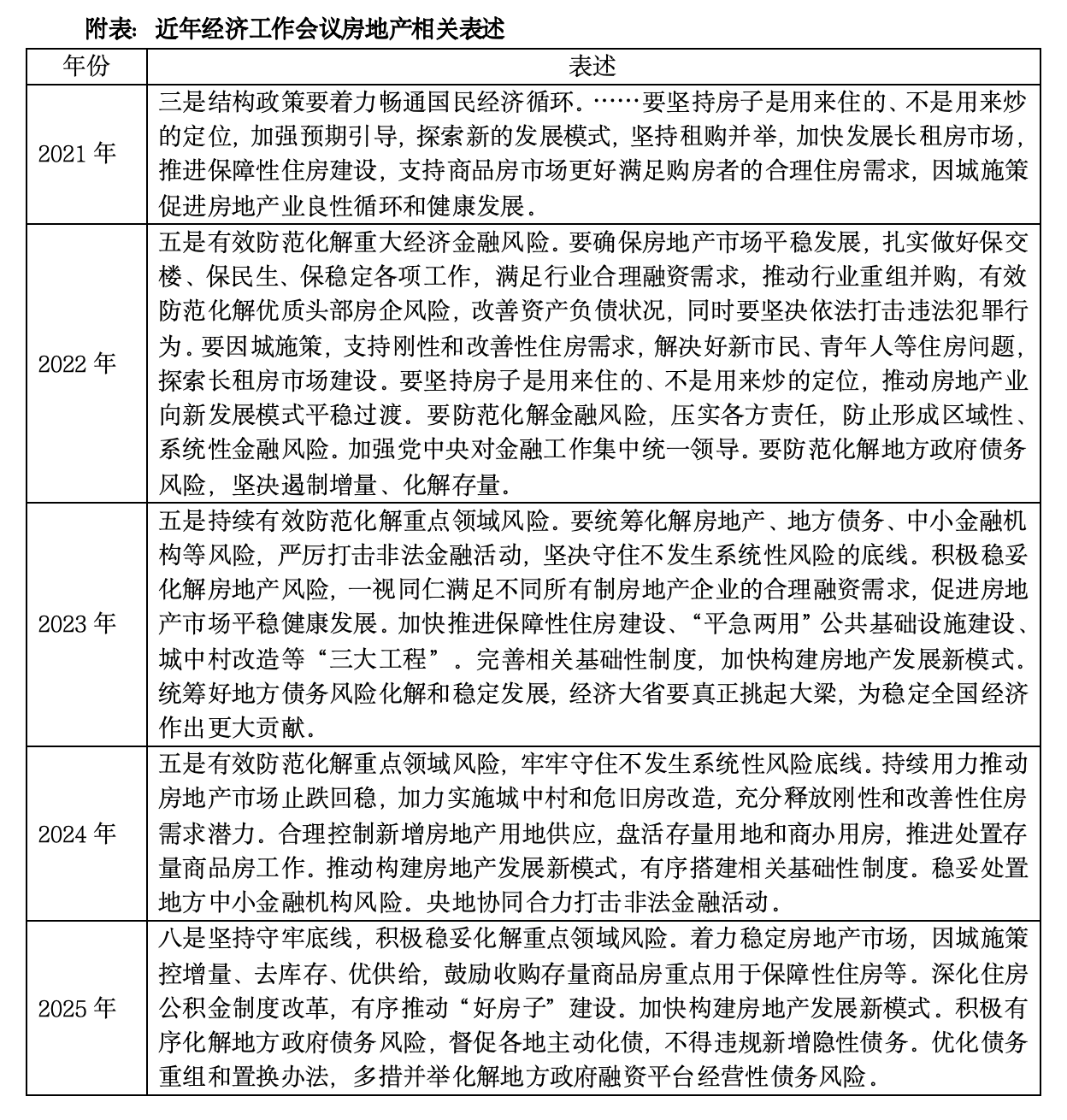
近日,中央经济工作会议在京举行,为衔接"十四五"收官与"十五五"开局明确方向。会议将推动高质量发展作为核心,在房地产领域作出系统部署,强调 以"稳预期、防风险、促转型"为主线,通过稳楼市与深化改革的协同推进,筑牢行业长期健康发展的基石。 "稳楼市"主线随形势动态强化:从2021年"促进良性循环"的宏观定调,迅速转向2022-2023年"保交楼、防风险"的应急应对,再升级为2024-2025年"止跌回 稳"、"控增量、去库存、优供给"的主动管理。其核心是防范系统性风险,为转型创造安全空间。 "深改革"主线则持续深化构建长效机制:从2021年"探索新发展模式",到2023年明确"三大工程"与"完善基础性制度"作为抓手,再到2025年具体化为收购存 量房作保障房、推动"好房子"建设。这旨在从根本上优化供给结构,告别"高负债、高杠杆、高周转"旧模式。 二者协同体现为:短期"稳"的措施(如保交楼、去库存)直接缓解风险,为长期"改"的制度建设(基础性制度、新模式)赢得窗口期;而长期"改"的举措 (如保障房体系建设、"好房子"供给)又从源头稳定预期、创造新需求,巩固"稳"的基础。2025年表述中,将"收购存量商品房用于保障 ...
中央经济工作会议点评:在稳市场、防风险与促转型之间寻求平衡
Caixin Securities· 2025-12-15 05:48
Investment Rating - The industry investment rating is "In line with the market" and the rating has been maintained [3]. Core Insights - The central economic work conference emphasizes balancing market stability, risk prevention, and transformation in the real estate sector. The focus has shifted from urgent measures to stabilize the market to a more balanced approach aimed at long-term risk resolution and high-quality development [6][7]. - The probability of large-scale, nationwide support policies for the real estate market is low, with "city-specific policies" becoming the main theme. The focus is on local governments as the main implementers of policies [6][7]. - The role of real estate has transitioned from driving economic growth to risk prevention and social welfare, highlighting the sector's importance in social security and housing attributes [6][7]. Summary by Sections Investment Outlook - The investment suggestion indicates that the real estate policy environment in 2026 will seek a balance between market stability, risk prevention, and transformation, with a moderately positive but more rational and structured policy environment [6][7]. - Short-term focus should be on the implementation pace and scale of "stock housing acquisition policies," which will be crucial for market sentiment and improving liquidity for real estate companies [7]. Policy Directions - The core policy measures include controlling new supply, reducing inventory, and optimizing supply, with an emphasis on acquiring existing housing for social housing and promoting the construction of quality homes [6][7]. - The new development model aims to enhance the quality of housing rather than merely expanding scale, indicating a shift towards quality improvement in the industry [6][7].
中央经济工作会议地产表态解读:政策改革促稳提质,好房建设新程启航
Haitong Securities International· 2025-12-15 05:27
Investment Rating - The investment rating for the real estate industry is "Outperform" with a focus on quality companies [26][30]. Core Insights - The primary goal of the industry is to stabilize the real estate market, with a clear policy direction to maintain stability and prevent fluctuations in fundamentals [31][34]. - Supply-side issues and housing security are emphasized, with a shift towards utilizing existing housing for security purposes rather than new construction [32][33]. - Demand-side support focuses on reforming the housing provident fund system and promoting quality housing construction, with an aim to stabilize prices and expectations [33][34]. - The development model is shifting from exploration to deepening, indicating a collaborative breakthrough in supply optimization, inventory reduction, and demand stabilization [34][11]. Summary by Sections Investment Recommendations - Preferred companies include: 1) Development: A-Shares - China Vanke, Poly Developments, China Merchants Shekou, Gemdale; H-Shares - China Overseas Land & Investment 2) Residential and Commercial: Longfor Group 3) Property Management: Onewo, China Resources Mixc, China Overseas Property, Poly Property, China Merchants Property, ChongQing New DaZheng 4) Cultural Tourism: Shenzhen Overseas Chinese Town [26][30]. Market Stability - The focus on stabilizing the real estate market has been consistent since September 2024, with policies aimed at preventing fluctuations in the market fundamentals [31][8]. - The meeting emphasized city-specific policies to control new supply, reduce inventory, and optimize supply, aligning with previous approaches [32][9]. Supply-Side Focus - The meeting highlighted the importance of controlling new supply and reducing inventory, with an emphasis on converting existing housing for social welfare purposes [32][9]. - Future policies may continue to revolve around government acquisition of existing properties to balance supply and demand [9][11]. Demand-Side Support - The reform of the housing provident fund system is expected to expand its scope and functionality, providing sustainable financial support for housing [33][10]. - Quality housing construction is set to be a key topic in the Fifteenth Five-Year Plan, aiming to stabilize market prices and expectations [33][10]. Development Model - The emphasis on accelerating the new real estate development model indicates a transition from exploration to a more structured approach, focusing on optimizing supply and stabilizing demand [34][11].






中央定调,2026年楼市重点是去库存!三大招能化解地产风险吗?
Sou Hu Cai Jing· 2025-12-15 04:12
Core Viewpoint - The Central Economic Work Conference held on December 10-11 has set a clear direction for China's economic development in the coming year, with a significant focus on stabilizing the real estate market [1][3]. Group 1: Real Estate Market Stability - The conference emphasized the need for targeted policies in real estate, focusing on controlling new supply, reducing inventory, and improving supply quality [3][6]. - Encouragement for the acquisition of existing residential properties to be converted into affordable housing was highlighted, alongside reforms to the housing provident fund system [3][8]. - The importance of the real estate sector as a pillar of the national economy was reiterated, noting that risks in this sector could have widespread implications for the entire economy [3][5]. Group 2: Inventory Reduction Strategies - Reducing inventory is identified as a top priority, as excess inventory can lead to severe financial strain on real estate companies, affecting their cash flow and overall stability [5][7]. - Local governments are encouraged to purchase existing housing stock to alleviate inventory issues while addressing the housing needs of low-income families [8][10]. - The need to enhance housing quality and meet the demands of consumers for better living conditions was stressed, indicating a shift towards building high-quality homes [10][11]. Group 3: Collaborative Efforts for Implementation - Effective implementation of the conference's directives requires collaboration among local governments, regulatory bodies, and real estate companies [11][13]. - Local governments should introduce relevant policies to guide market development, while regulatory agencies must ensure compliance with these policies [13]. - Real estate companies are urged to adapt to market changes by improving product quality and service levels to foster sustainable development in the sector [13].

江西“十五五”规划建议:加快构建房地产发展新模式 健全多主体供给、多渠道保障、租购并举的住房制度
Jing Ji Guan Cha Wang· 2025-12-15 02:27
经济观察网中共江西省委关于制定全省国民经济和社会发展第十五个五年规划的建议发布,其中提出, 促进房地产高质量发展。加快构建房地产发展新模式,健全多主体供给、多渠道保障、租购并举的住房 制度,推动住房政策与就业、收入分配、社会保障等政策相互衔接。健全以配租型和配售型保障性住房 为主体的住房保障体系,满足城镇工薪群体和各类困难家庭基本住房需求。因城施策增加改善性住房供 给,推动建设安全舒适绿色智慧的"好房子"。实施房屋品质提升工程和物业服务质量提升行动,建立房 屋全生命周期安全管理制度 ...
交银国际_房地产行业:2026年展望,在新平衡中拥抱拐点与复苏_
2025-12-15 02:13
Summary of Key Points from the Conference Call Industry Overview - **Industry**: Real Estate - **Focus**: Chinese mainland and Hong Kong real estate markets - **Outlook for 2026**: The industry is expected to explore new development models under strong policy support, despite facing challenges. Structural opportunities from "good houses" and "good cities" are emerging [1][6][10]. Core Insights and Arguments Chinese Mainland Real Estate - **Sales Forecast**: The total sales area of commercial housing in China is projected to be between 900 million to 950 million square meters in 2026, down from approximately 970 million square meters in 2024. The expected sales amount is around 10 to 11 trillion RMB, including 8 to 9 trillion RMB from residential sales [1][11]. - **Investment Preference**: The preferred investment ranking is as follows: state-owned enterprises (SOEs) or SOE-backed developers > leading private enterprises with land reserves in first and second-tier cities > other private developers [1][26]. - **Market Dynamics**: The market is transitioning from quantity expansion to quality improvement, with a focus on "good housing" standards. The demand is shifting towards improvement-type housing, which is expected to dominate the market [10][13]. Hong Kong Real Estate - **Market Recovery**: Key catalysts for recovery include improved macroeconomic uncertainty (notably interest rate cuts), significant policy easing, and a return of fundamental demand drivers. The recovery is expected to be gradual, with residential properties leading the way, followed by quality retail assets and core office spaces [3][37]. - **Rental Growth**: Residential rents are expected to increase by approximately 3% in 2026, with small to medium-sized unit prices rising by 5%. The retail sector is also anticipated to see moderate growth due to stabilizing local consumption and increased tourist arrivals [3][39]. - **Investment Strategy**: Investors are advised to focus on residential recovery as a high-quality proxy, particularly in the context of the anticipated market rebound [3][37]. Additional Important Insights - **Policy Environment**: The current policy framework is expected to remain supportive, with a focus on maintaining a stable demand-side policy and normalizing supply-side regulations. The emphasis is on improving housing quality and service standards [10][12]. - **Market Segmentation**: The market is experiencing significant segmentation, with first and second-tier cities showing resilience while third and fourth-tier cities face structural adjustments. The share of sales in first and strong second-tier cities is expected to increase from 30% to 35-40% by 2026 [12][15]. - **Supply Dynamics**: New construction is projected to be between 550 million to 600 million square meters in 2026, reflecting cautious market expectations and cash flow conditions among developers. This is expected to help digest existing inventory levels [21][22]. - **Financial Health of Developers**: The industry is shifting towards a focus on cash flow management, with a significant emphasis on achieving positive operating cash flow as a key indicator of operational capability. Developers with strong cash flow management are likely to be favored by the market [24][25]. Conclusion The real estate industry in both the Chinese mainland and Hong Kong is at a pivotal point, with emerging opportunities driven by policy support and changing market dynamics. Investors are encouraged to adopt a selective approach, focusing on quality and location to capitalize on the anticipated recovery in the sector [25][26].
行业周报:新房二手房成交面积同比下降,着力稳定房地产市场-20251214
KAIYUAN SECURITIES· 2025-12-14 11:42
房地产 2025 年 12 月 14 日 《新房二手房成交面积同环比下降, 扎实推进好房子建设—行业周报》 -2025.12.7 《新房成交面积环比增长,支持城市 存 量 设 施 更 新 改 造 — 行 业 周 报 》 -2025.11.30 《新房成交面积环比增长,以高水平 安全保障城市高质量发展—行业周 报》-2025.11.23 新房二手房成交面积同比下降,着力稳定房地产市场 ——行业周报 | 齐东(分析师) | 胡耀文(分析师) | 杜致远(联系人) | | --- | --- | --- | | qidong@kysec.cn | huyaowen@kysec.cn | duzhiyuan@kysec.cn | | 证书编号:S0790522010002 | 证书编号:S0790524070001 | 证书编号:S0790124070064 | 核心观点:新房二手房成交面积同比下降,扎实推进好房子建设 投资评级:看好(维持) 行业走势图 数据来源:聚源 -36% -24% -12% 0% 12% 24% 2024-12 2025-04 2025-08 房地产 沪深300 相关研究报告 本周我们跟踪的 ...