
投资于人

Search documents
从托底到赋能 “投资于人”擦亮经济发展民生底色
Zheng Quan Shi Bao· 2025-12-09 17:45
Core Viewpoint - The article emphasizes the strategic shift in China's economic policy towards "investing in people," which aims to enhance the quality of life and stimulate domestic consumption through various social welfare initiatives [1][6]. Summary by Sections Social Welfare Investments - In 2025, China will increase investments in core social security areas such as pensions and medical insurance, with a 2% increase in basic pensions for retirees, marking the 21st consecutive year of pension increases [2]. - The per capita financial subsidy for urban and rural residents' medical insurance will rise by 30 yuan, reaching 700 yuan per person annually, alleviating the burden of medical expenses [2]. Fiscal Policy and Management - The fiscal policy for 2025 includes a historic increase in the general public budget deficit ratio to 4%, up by 1 percentage point from the previous year, and the issuance of 1.3 trillion yuan in special long-term bonds to support social welfare [2][3]. - Expenditures on social security, employment, education, and health have outpaced overall budget growth, with social security and employment spending increasing by 9.3% year-on-year [2]. Consumer Confidence and Spending - The "investment in people" strategy is expected to boost consumer confidence, with a consumer willingness index rising to 112.9, the highest in five quarters [5]. - The elderly care and childcare policies are designed to reduce household financial burdens, encouraging increased consumer spending [4]. Economic Growth and Structural Changes - The article highlights a shift from traditional social safety nets to strategic investments in human capital, indicating that future competition will focus on population quality and labor capabilities [3][6]. - The integration of "investment in material" and "investment in people" is anticipated to enhance domestic circulation and foster new growth drivers [7]. Future Outlook - Experts predict that the "investment in people" approach will enter a new phase in 2026, focusing on support for vulnerable groups and improving the social security system [6]. - Recommendations include building a robust guarantee system to reduce household risk exposure and creating a lifecycle policy framework for social welfare [6].
2025年经济热词盘点!你的生活因它们而变了吗?
Sou Hu Cai Jing· 2025-12-09 02:55
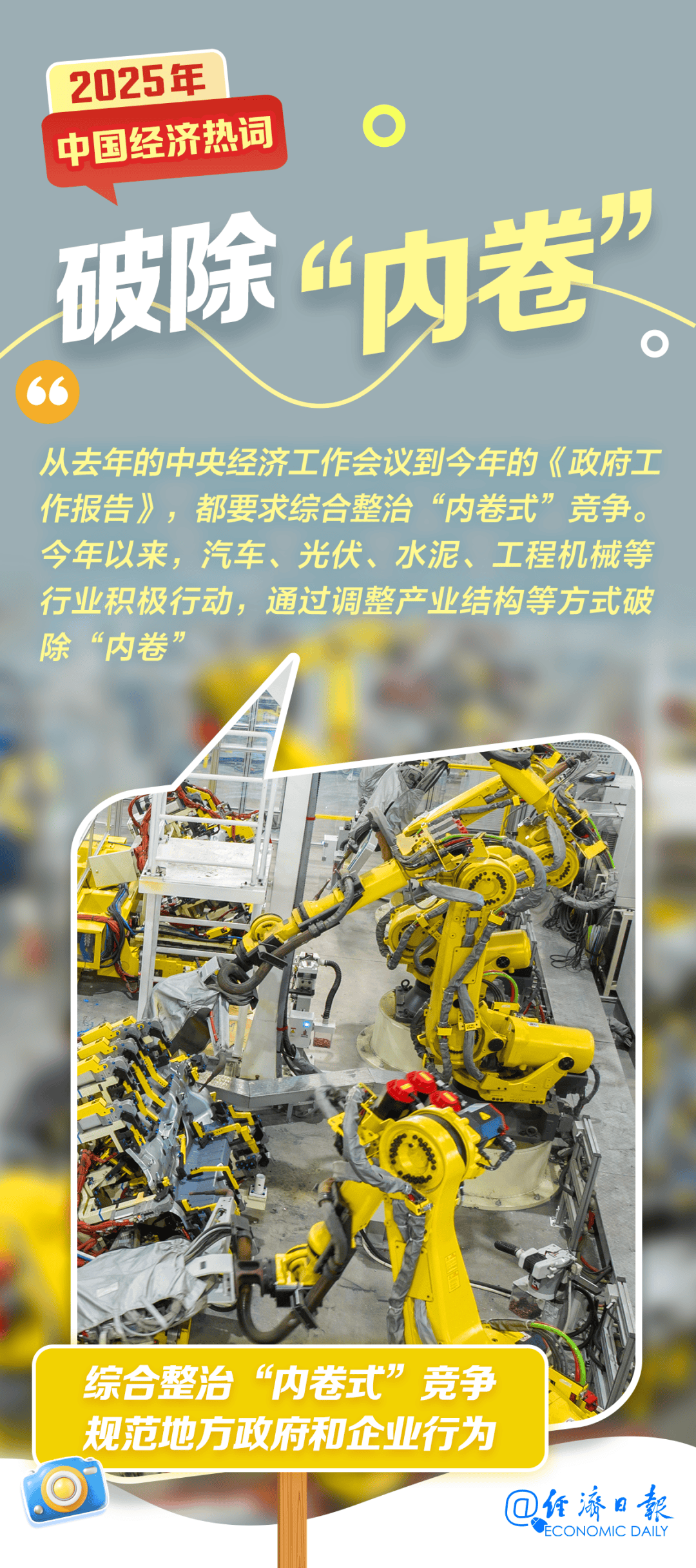
综合整治"内巷式"竞争 规范地方政府和企业行为 OK 海日報 ECONOMIC DAILY 2025年 中国经济热词 智能 今年是中国式现代化进程中具有重要意义的一年,我国经济运行总体平稳、稳中有进,新质生产力稳步发展,改革开放迈出新步伐,重点领域风险化解取 得积极进展,民生保障更加有力,社会大局保持稳定。回眸2025年,一起来盘点中国经济热词↓ 继"互联网+"之后,我国对数字经济进行又 一次战略部署。今年8月,国务院印发《关于 深入实施"人工智能+"行动的意见》,以六 大行动八大支撑赋能新质生产力发展, 为人工 智能发展按下"加速键" 人工智能领域 要占领先机、赢得优势 促进民营经济健康发展、 高质量发展 0 14 濟 取 2025年 中国经济热词 IF 2 5 IFF 上開封天 66 0.99 深日報 CONOMIC DAILY 2025年 中国经济热词 . "印尼 66 今年以来,"国补"资金按计划陆续下达、 个人消费贷款迎来财政贴息 …… 一系列真金 白银的政策加力提振消费,让消费者得到更 多实惠、市场获得更强动能 惠民生、促消费、增后劲 OF 海 海 取 2025年 0 中国经济热词 s经济促进法 ...

提振消费服务民生 财政政策将更加积极
Zhong Guo Zheng Quan Bao· 2025-12-08 20:26
● 本报记者 赵白执南 今年以来,积极财政政策持续发力,政策效应不断释放。中共中央政治局12月8日召开会议提出,明年 经济工作要坚持稳中求进、提质增效,继续实施更加积极的财政政策和适度宽松的货币政策。 专家表示,下一步,财政政策将延续积极取向,在提振消费方面,除综合运用财政补贴、贷款贴息等政 策工具外,还将着力"投资于人",把更多资金资源用于服务民生,针对公共服务的短板弱项精准施策, 激发消费动能。 "当前,中国经济正处于迈向高质量发展的蓄势攻坚期,更需发挥财政作为国家治理的基础和重要支柱 作用,持续发力、适时加力,坚持在发展中破解难题,以积极财政夯实经济平稳运行'压舱石'。"中诚 信国际研究院院长袁海霞说。(下转A02版) (上接A01版)明年继续实施更加积极的财政政策成为共识。专家预期,明年赤字规模有望保持在4% 左右,特别国债、地方政府专项债券规模有望适度增加。 申万宏源证券首席经济学家赵伟表示,在总量上,财政或将保证广义财政支出增速持平或略高于名义经 济增长速度。在结构上,财政或加大对新经济的投入,更多呵护民生以及培育居民消费动能;财政资金 或进一步向社会保障、"一老一小"等民生领域倾斜。 今年以来, ...
“十五五”深度研究系列报告(八):财政投资于人、投资于物如何结合?
ZHESHANG SECURITIES· 2025-12-08 10:58
Group 1: Investment in Physical Capital - China's capital stock reached approximately $93 trillion in 2024, accounting for about 503% of GDP[29] - The average growth rate of capital stock from 1961 to 1993 was about 5.2%, while from 1994 to 2016 it was approximately 10.8%, and is projected to decline to 5.8% by 2024[29] - In 2024, the total capital formation in China is estimated to be around 54.8 trillion yuan, contributing approximately 25.2% to GDP growth[2] Group 2: Investment in Human Capital - Investment in human capital focuses on enhancing capabilities across the entire population, including education, healthcare, and skills training[47] - The proportion of public spending on social welfare in China was 53.7% in 2023, compared to 60%-70% in developed countries, indicating significant room for improvement[6] - The government aims to increase the share of public investment in social welfare during the "14th Five-Year Plan" period, particularly in areas like education and healthcare[44] Group 3: Economic and Social Development - The urbanization rate in China is expected to reach 70% within five years, with a projected rate of about 67% in 2024, driving infrastructure and public service improvements[42] - The report emphasizes the need for a balanced approach between investment in physical and human capital to foster sustainable economic growth[1] - The government plans to enhance public services in nine key areas, including education, healthcare, and social security, to ensure equitable access for all citizens[52]
2026年经济政策有望维持宽松基调,更加强调质效并重丨第一财经首席经济学家调研
Di Yi Cai Jing· 2025-12-08 09:08
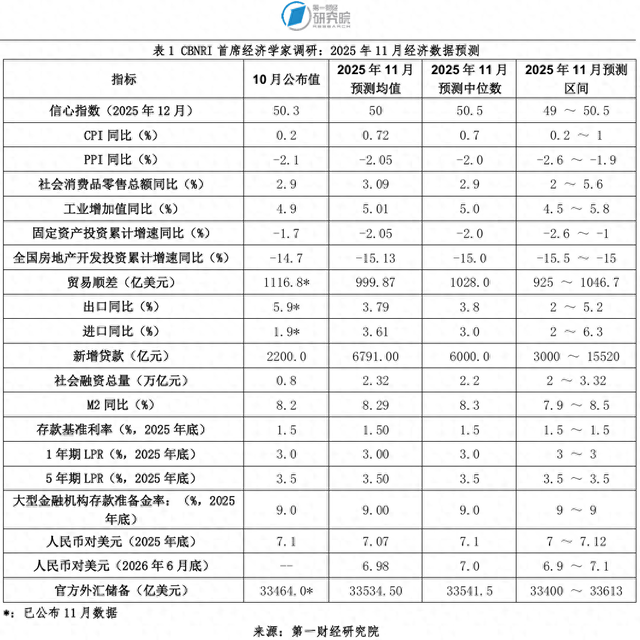
Economic Confidence Index - The "Economic Confidence Index" for December 2025 is reported at 50, slightly lower than the previous month, indicating a weak recovery in the economy [6][8]. Inflation Predictions - Economists predict the Consumer Price Index (CPI) for November 2025 to be 0.72%, up from 0.2% in the previous month, while the Producer Price Index (PPI) is expected to be -2.05% [9][10]. Retail Sales Growth - The forecast for the year-on-year growth of social retail sales in November is 3.09%, slightly higher than the previous month's 2.9%, driven by the "Double 11" shopping festival and a recovery in the dining sector [10][11]. Industrial Value Added - The predicted year-on-year growth rate for industrial value added in November is 5.0%, an increase from the previous month's 4.9% [11]. Fixed Asset Investment - The forecast for the year-on-year growth rate of fixed asset investment in November is -2.1%, lower than the previous month's -1.7%, indicating continued pressure from the real estate market [12][14]. Real Estate Investment - The predicted year-on-year growth rate for real estate development investment in November is -15.1%, reflecting ongoing challenges in the sector [14]. Trade Surplus - China's trade surplus for November is reported at $111.68 billion, with exports growing by 5.9% and imports by 1.9%, aligning with economists' expectations [15]. New Loans - Economists forecast new loans for November to rebound to 679.1 billion yuan, significantly higher than the previous month's 220 billion yuan [16]. Total Social Financing - The predicted total social financing for November is 2.32 trillion yuan, an increase from the previous month's 0.81 trillion yuan [17]. M2 Growth Rate - The forecast for the year-on-year growth rate of M2 in November is 8.29%, slightly above the previous month's 8.2% [18]. Monetary Policy Outlook - Economists expect the possibility of adjustments to the Loan Prime Rate (LPR) and reserve requirement ratios to be low in the near term, with a continued focus on maintaining liquidity in the market [20]. Exchange Rate Predictions - The predicted exchange rate for the Chinese yuan against the US dollar at the end of 2025 is 7.07, with expectations of a potential adjustment to 6.98 by mid-2026 [21]. Foreign Exchange Reserves - As of the end of November, China's foreign exchange reserves are reported at $33,464 billion, reflecting a slight increase from the previous month [22][23].
怎样理解投资于物和投资于人紧密结合
Sou Hu Cai Jing· 2025-12-08 05:48
Group 1 - The core viewpoint emphasizes the importance of integrating investments in physical assets and human capital to enhance development momentum, expand domestic demand, and promote comprehensive human development [1] - Investment in physical assets has played a crucial role in China's rapid economic growth, contributing to the accumulation of physical capital, enhancement of production capacity, and improvement of social productivity [1][2] - The need for further investment in physical assets is highlighted due to the relatively low per capita capital stock compared to developed countries, as well as the necessity to upgrade outdated infrastructure and equipment [2] Group 2 - The significance and urgency of investing in human capital are increasingly recognized, as it is essential for transitioning from an investment-driven economy to one that is innovation-driven and demand-driven [3] - There is a call for increased investment in education, healthcare, and social services to ensure high-quality living standards and promote common prosperity among the population [3] - Key directions for investment in human capital include improving income distribution systems, advancing public service equalization, and enhancing government investment in social welfare sectors [4]
学习规划建议每日问答|怎样理解投资于物和投资于人紧密结合
Sou Hu Cai Jing· 2025-12-08 03:58
Group 1 - The core viewpoint emphasizes the integration of investment in physical assets and human capital as a means to enhance development momentum, expand domestic demand, and promote comprehensive human development [1] - Investment in physical assets has played a crucial role in China's rapid economic growth, contributing to the accumulation of physical capital, enhancement of production capacity, and improvement of public service levels [1][2] - There is significant potential for further investment in physical assets, particularly in key industries and technological advancements, as China's per capita capital stock remains low compared to developed countries [2] Group 2 - The importance and urgency of investing in human capital are increasingly recognized, as the economy shifts from capital-intensive to talent-intensive growth, necessitating greater investment in education, healthcare, and skills training [3] - Enhancing the income distribution system and promoting equal access to basic public services are essential for improving human capital investment and ensuring a high-quality life for all citizens [4] - Establishing a long-term mechanism for human capital investment, including optimizing fiscal responsibilities and encouraging various stakeholders to invest in human development, is critical for sustainable economic growth [4]
【财金视野】“投资于人”重在落实落细
Jing Ji Ri Bao· 2025-12-08 02:08
近日,各地陆续启动向符合条件的3周岁以下婴幼儿家庭发放每年3600元的育儿补贴,在冬日里给千家 万户带来阵阵暖意。加大对人的投资力度,已成为全社会的普遍共识。一系列重大民生政策出台实施, 如何落实落细、充分发挥政策红利受到高度关注。 强化"投资于人",对于提升民生福祉、增强发展动能具有重要意义。近年来,我国不断加大对民生领域 的投入,民生建设更加公平、均衡、普惠、可及。特别是今年推出多项重要民生政策,受益范围广泛、 力度超过预期。其中,育儿补贴是新中国成立以来首次大范围、普惠式、直接性向群众发放的民生保障 现金补贴,中央财政今年安排预算达900亿元左右。逐步推行免费学前教育,免除公办幼儿园学前一年 在园儿童的保育教育费,有效降低家庭的教育支出,仅今年秋季一个学期即可相应减少家庭支出200亿 元。此外,稳定和扩大就业、提高基本医疗保障水平、提高基本养老金水平等举措也加力实施。 投资于人,很重要的环节还在于政策实施的"最后一公里"。投资于人,最终要落到具体的个人身上,基 层的工作至关重要。从一系列重大民生政策可以看出,中央财政在资金上给予了有力支撑。比如,对于 育儿补贴,中央财政按照一定比例对地方予以补助,中央总 ...

中经评论:“投资于人”重在落实落细
Jing Ji Ri Bao· 2025-12-08 00:04
Group 1 - The core viewpoint emphasizes the importance of investing in people to enhance public welfare and economic development momentum, with recent policies aimed at improving living standards receiving significant attention [1][2][4] - The introduction of a universal childcare subsidy of 3,600 yuan per year for families with children under three years old marks a significant milestone in China's social welfare policies, with a central government budget allocation of approximately 90 billion yuan for this initiative [1][2] - The implementation of free preschool education and the exemption of childcare fees for public kindergartens is expected to reduce family education expenses by around 20 billion yuan in just one semester [1][3] Group 2 - The "14th Five-Year Plan" highlights the integration of investments in both material and human resources, reflecting a people-centered development philosophy that aims to enhance domestic demand and economic competitiveness [2][3] - There is a call for increased public service spending as a proportion of total fiscal expenditure, with a focus on addressing the gaps in public services and meeting the urgent needs of the population [2][3] - Effective policy implementation is crucial, with a focus on ensuring that financial resources are allocated efficiently and that local governments are held accountable for timely and proper fund distribution [3][4]
贸易战再升级!面对美国超高关税,中国产业升级成果成硬刚底气
Sou Hu Cai Jing· 2025-12-07 15:16
2025年,在全球贸易保护主义抬头、不确定性弥漫的背景下,中国经济在"高质量发展"的主航道中稳健前行。 然而,政策刺激的边际效应在下半年显著递减。前期发力过猛导致后续额度受限,部分省份补贴暂停,加之部分家庭耐用消费品已完成更新,政策拉动效果 明显弱化。这引发了关于补贴效率与可持续性的深层思考,政策未来需向更精准、惠及更广泛人群的方向优化。 与此同时,"投资于人"理念在今年实现了历史性突破,首次与传统的"投资于物"置于同等战略高度。这标志着宏观政策从过往过度依赖基建与房地产投资, 向弥补民生短板、提升居民福祉的系统性转变。 育儿补贴、消费贷贴息、养老金上调等具体措施陆续出台,旨在通过减轻居民在养老、医疗、教育等方面的负担,激活消费潜力,扭转长期的高储蓄倾向。 这一根本思路的调整,预示着未来公共支出结构的持续优化。 2025年,中国对外经济关系经历了重大压力测试。面对美国再度掀起的超高关税战,中国一改2018年时的策略,采取了迅速而强硬的反制措施。 这份底气体现在经过十年布局形成的多元化贸易网络上:对美出口占比下降的同时,对东盟、非洲及"一带一路"沿线国家的出口实现了强劲增长。 新能源汽车、集成电路、船舶等高附加 ...
