新兴市场

Search documents
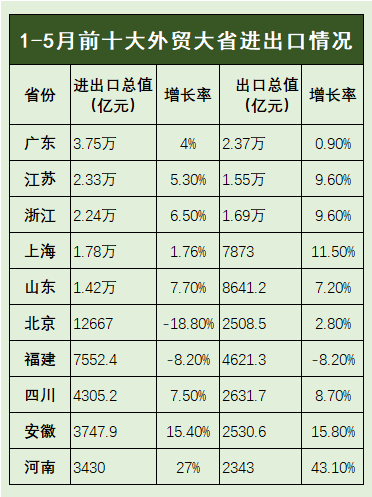
10打外贸省份前五月出口数据公布:江苏、浙江增9.6%,河南增43.1%,福建收窄至-8.2%
Guan Cha Zhe Wang· 2025-06-20 01:42
Core Insights - The export data for the first five months of this year shows that most of the top ten foreign trade provinces in China experienced growth, with only Fujian showing a decline, although its decline is narrowing [1][6][9]. Group 1: Export Performance by Province - Guangdong, the largest foreign trade province, saw a modest export growth of 0.9%, while Jiangsu and Zhejiang, the second and third largest provinces, reported a significant export growth of 9.6% [2][15]. - Fujian's export decline narrowed to -8.2%, with traditional industries in Fuzhou and Quanzhou experiencing notable drops, although the growth in machinery and electrical products helped mitigate the decline [1][6]. - Henan province reported an impressive export growth of 43.1%, driven by electric vehicles and silver processing, ranking third in national foreign trade growth [10][12]. Group 2: Key Export Products and Trends - In Zhejiang, machinery and electrical products accounted for a substantial portion of exports, with a growth rate of 12.6%, contributing significantly to the overall export growth [3][4]. - The export of electric vehicles in Zhejiang surged by 86.0%, while shipbuilding also showed strong performance with an 18.2% increase [3]. - In Henan, machinery and electrical products made up over 60% of exports, with a notable growth of 66.6% in this category [10][12]. Group 3: Market Dynamics and Challenges - Fujian's reliance on traditional industries, such as textiles and footwear, has led to a decline in export growth, highlighting the need for upgrading to higher value-added products [7][8]. - The shift of some orders to Southeast Asia and Latin America due to international supply chain restructuring has weakened Fujian's traditional manufacturing export advantages [6][7]. - Zhejiang's exports to emerging markets, including the EU and ASEAN, have shown robust growth, indicating a positive outlook for diversification in trade [4].

帮主郑重:新兴市场三连跌,全球避险情绪再起背后的门道
Sou Hu Cai Jing· 2025-06-19 12:47
Group 1 - The recent decline in emerging markets is attributed to two main factors: rising U.S. inflation and escalating tensions in the Middle East, particularly between Israel and Iran, which has led to a spike in oil prices to $94 per barrel [3] - Emerging markets are facing capital outflows, with foreign investment in A-shares decreasing, particularly in sectors like electronics and food and beverage [3] - Defensive sectors such as energy and precious metals in the A-share market have shown resilience, indicating a shift in investment strategies towards safer assets [3] Group 2 - Countries like Indonesia and Turkey are experiencing significant economic challenges, with Indonesia's foreign capital outflow reaching $165 billion and Turkey's currency hitting a historic low against the dollar [3] - Despite the current market turmoil, long-term investment opportunities may arise in commodities like palm oil in Indonesia and rubber in Thailand, which have seen price declines [3] - The potential for U.S. interest rate cuts later in the year remains, particularly if the job market weakens, which could further impact market volatility [4]

中东紧张局势打击风向偏好 新兴市场货币与股票齐跌
智通财经网· 2025-06-17 23:31
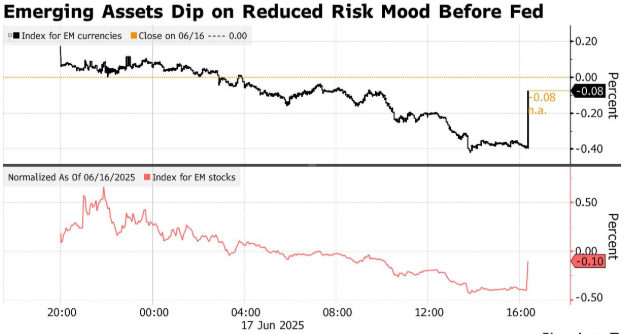
Group 1 - Emerging market currencies and stocks have declined due to escalating tensions in the Middle East and the upcoming Federal Reserve interest rate decision, with indices dropping over 0.4% before narrowing to a 0.1% decline at close [1] - The South African rand, Hungarian forint, and South Korean won were among the worst performers, each depreciating over 1% against the US dollar, while the Israeli shekel dropped as much as 0.8% before recovering [1] - The market is under pressure from risk aversion due to geopolitical tensions and uncertainty surrounding the Federal Reserve's decisions [1][3] Group 2 - Despite recent declines, fund managers believe that the strong performance of emerging markets relative to US assets will continue, as the risks from the conflict are not expected to be deep or prolonged [4] - Emerging markets are expected to outperform other markets in macroeconomic growth this year and next, with international investors recognizing the need to diversify their investments [7]
中国家电凭实力“破壁”
Jing Ji Wang· 2025-06-16 07:31
Core Viewpoint - The 137th Canton Fair highlights the resilience of the Chinese home appliance industry amidst the ongoing tariff challenges from the U.S., with large enterprises showing better preparedness and adaptability compared to smaller firms [1][3][5]. Group 1: Impact of Tariffs on Large Enterprises - Large home appliance companies have limited exposure to U.S. tariffs due to strategic planning and diversified supply chains, with many having established manufacturing bases in emerging markets [4][5]. - For instance, Midea Group reported a revenue of 409.1 billion yuan and a net profit of 38.5 billion yuan for the year ending December 31, 2024, with a low revenue share from the U.S. market [4]. - Haier Smart Home achieved an overseas revenue of 143.814 billion yuan in 2024, marking a year-on-year growth of 5.43%, with significant growth in emerging markets [4]. Group 2: Adaptation Strategies of the Industry - The home appliance industry has proactively adjusted to tariff impacts by shifting production capacities and exploring new markets, reducing reliance on the U.S. market [5][6]. - Companies like TCL and Hisense have minimized direct exports to the U.S. by utilizing production facilities in Mexico and Southeast Asia, thus mitigating tariff impacts [5][6]. - The overall export value of China's home appliance industry reached 112.42 billion USD in 2024, with exports to the U.S. accounting for 20.71 billion USD, reflecting a 4.3% year-on-year increase but a reduced share of total revenue [5]. Group 3: Challenges Faced by Small Enterprises - Smaller home appliance companies are facing significant challenges due to their heavy reliance on the U.S. market, with many experiencing customer defaults on orders [7][8]. - The Canton Fair has introduced initiatives to assist small enterprises in finding new clients, particularly in countries involved in the Belt and Road Initiative [8][9]. - Experts suggest that small enterprises should adjust their strategies by expanding overseas production and tapping into domestic markets through e-commerce platforms [9].






期待出海企业“窑变”万彩(现场评论)
Ren Min Ri Bao· 2025-06-08 21:54
Core Viewpoint - The article emphasizes the importance of foreign trade enterprises adapting to external uncertainties by exploring new markets and reducing reliance on single markets, as demonstrated by the success of Yue Li Group in increasing sales by 27% in the first four months of the year through expansion into Central and Eastern European countries, Russia, and Turkey [1] Group 1: Government Support and Policies - Two key policies praised by participating enterprises include AEO certification, which reduces customs inspection frequency to about 1/10 of that for general enterprises, and export credit insurance, which alleviates concerns over payment cycles in emerging markets [2] - There is a need for balanced policy coverage, as some small and medium-sized enterprises feel underserved by existing support measures, highlighting the importance of equal rights, opportunities, and rules for all enterprises [2] Group 2: Role of Trade Service Platforms - Foreign trade service platforms are encouraged to respond to market demands by offering targeted services for emerging markets, exemplified by Ningbo Guomai Cloud Commerce's collaboration with Romanian e-commerce platform eMAG to assist over 200 local companies [3] - Many foreign trade enterprises are adopting outsourcing or design agency models, which can lead to high costs and unpredictable returns when entering new markets alone; thus, leveraging platforms for collective market entry is becoming a practical choice [3] Group 3: Manufacturing Resilience - The article draws a parallel between the craftsmanship of local artisans and the resilience required in the manufacturing sector, suggesting that maintaining focus and adaptability is key for Chinese manufacturing enterprises to thrive in a complex and changing environment [3]
同和药业(300636) - 300636同和药业投资者关系管理信息20250605
2025-06-06 08:04
Group 1: Sales and Revenue Projections - The projected revenue for the new pharmaceutical raw materials market in 2024 is 180 million, with expectations for 2025 being similarly optimistic [1] - The total sales revenue for the company in 2025 is estimated to be around 850 million, with a growth rate of approximately 10% expected due to new capacity being released [3] - The revenue from old products may see a slight decline in 2025, but overall income is expected to grow in 2026 after the expansion of Celecoxib [2] Group 2: Production Capacity and Utilization - The production capacity for Celecoxib is set to increase from 170 tons to 500-600 tons by the end of this year [1] - The utilization rate for the first phase of the second plant is expected to be around 60-70% in 2025, with one workshop having completed expansion in May [2] - Two workshops in the second phase of the second plant are expected to begin trial production in the second half of this year, with full capacity release anticipated in 2026 [2] Group 3: Market and Competitive Landscape - The company faces competition from Indian firms, with varying cost advantages across different products; however, the company excels in synthesis process maturity and R&D speed [3] - The company anticipates strong sales performance for new products such as Rivaroxaban, Apixaban, and others in the future [3] Group 4: Research and Development - The company plans to maintain a high level of R&D investment, projected to be over 7% of revenue in 2025 and beyond [2] - The new R&D building is expected to be operational this year, leading to an increase in personnel and corresponding R&D expenditure [2]

IMF官员:贸易战对新兴市场的影响更甚于疫情期间
news flash· 2025-06-05 03:20
IMF官员:贸易战对新兴市场的影响更甚于疫情期间 金十数据6月5日讯,国际货币基金组织(IMF)第一副总裁戈皮纳特警告称,特朗普发起的贸易战给新 兴市场政策制定者带来的挑战,甚至比五年前的新冠疫情危机更为严峻。她表示,在疫情初期,全球各 地的央行都在朝着同一方向行动,迅速放松货币政策。但这一次,冲击的影响各不相同。这次的挑战将 比疫情期间更加严峻。戈皮纳特还指出,新兴经济体的韧性也受到非银金融渠道依赖加深以及加密货币 作为一种资产类别日益重要的影响。她说,这还处于早期阶段,但我们已经看到一些新兴市场对加密资 产的接受速度非常快。特别是稳定币的发展,可能会导致金融中介功能被削弱,甚至引发货币替代的风 险,这对新兴市场来说是一个日益增长的威胁。 ...
印度低迷、中东疲软,新兴手机市场集体“失速”
Tai Mei Ti A P P· 2025-06-03 02:03
Core Insights - The global smartphone market outlook has significantly declined, with a projected year-on-year growth of only 0.6% in 2025, reaching 1.24 billion units, down from an earlier forecast of 2.3% growth [2] - Emerging markets, particularly India, Southeast Asia, and the Middle East, have experienced a slowdown in smartphone shipments, attributed to inventory adjustments, the end of post-pandemic replacement cycles, rising product costs, and macroeconomic uncertainties [3][4][6] - The high-end smartphone segment continues to grow, with demand for devices priced over $800 reaching new highs, indicating a bifurcated market structure where premium products are less affected by economic downturns [7][8] Market Performance - In Q1 2025, India saw an 8% decline in smartphone shipments, totaling 32.4 million units, while Southeast Asia experienced a 3% drop, marking its first decline since 2024 [4] - The Middle East also faced a 4% decrease in shipments, totaling 11.7 million units [4] - The overall smartphone market is expected to remain flat, with a slight increase of 0.1% globally, while emerging markets are projected to be the largest growth drivers until 2029 [11] Competitive Landscape - Apple has gained significant market share in emerging markets, achieving a 19% market share in Q1 2025, driven by strong sales of the iPhone 16 series [10] - The smartphone market is increasingly polarized, with high-end consumers seeking brand and performance upgrades, while budget-conscious consumers focus on value [7][8] - Companies are adapting to external uncertainties, such as changing tariff policies, by diversifying channels and maintaining flexible product strategies [6][11] Future Trends - The shift towards experience-driven consumption in emerging markets is becoming a key competitive factor, with brands introducing subscription services to meet diverse consumer needs [12] - Long-term growth opportunities for Chinese brands in global markets will depend on effective risk management and compliance with local regulations [13][15] - The evolving market dynamics necessitate a balance between local policy requirements and the need for foreign investment, highlighting the importance of strategic partnerships [15]

新兴市场成引擎 摩托车出口有望逆势增长
Zhong Guo Chan Ye Jing Ji Xin Xi Wang· 2025-05-28 22:23
Core Insights - The global economy in 2025 faces multiple challenges, including geopolitical conflicts, trade barriers, and supply chain fluctuations, yet the Chinese motorcycle industry has shown remarkable export growth due to its flexible supply chain and deep market penetration in emerging markets [1] Group 1: Export Performance - In Q1 2025, China's motorcycle export value experienced double-digit growth, with 31% of companies reporting export increases exceeding 30% [2] - South America (77%) and Africa (69%) emerged as the primary export destinations, with a significant number of companies reporting growth in these regions [2] - In contrast, the U.S. market remains sluggish, with 46% of companies experiencing a decline or stagnation in exports, and over half expecting further contraction in the first half of the year [2] Group 2: Challenges and Pressures - Despite strong export performance, the industry faces challenges, with 62% of companies reporting critical component shortages and high international logistics costs [3] - 38% of companies are hindered by international trade barriers and chaotic industry competition, with 54% indicating they may abandon the U.S. market due to tariff costs [3] - The trend towards focusing on alternative markets like the EU and Latin America is evident, with 62% of clients at trade fairs coming from these regions [3] Group 3: Strategic Adjustments - To address challenges, companies are enhancing supply chain resilience and exploring local alternatives for components [3] - There is a push for government support, with 62% of companies seeking export credit insurance and 54% desiring tax reductions [3] - Companies are increasingly participating in emerging market trade fairs, with 38% focusing on Africa, Latin America, and Southeast Asia [3] Group 4: Future Outlook - Despite conservative expectations for the U.S. and EU markets, 62% of companies anticipate growth in Africa and South America [4] - Most companies expect continued export growth in the second half of the year, although the rate of increase may slow [4] - The Chinese motorcycle industry is poised to navigate the complexities of the international environment by deepening its focus on emerging markets and enhancing technological innovation and brand development [4]
全球教育科技 2025 Q1 融资「收缩」:为什么巨额投资还在「膨胀」?
3 6 Ke· 2025-05-24 05:19
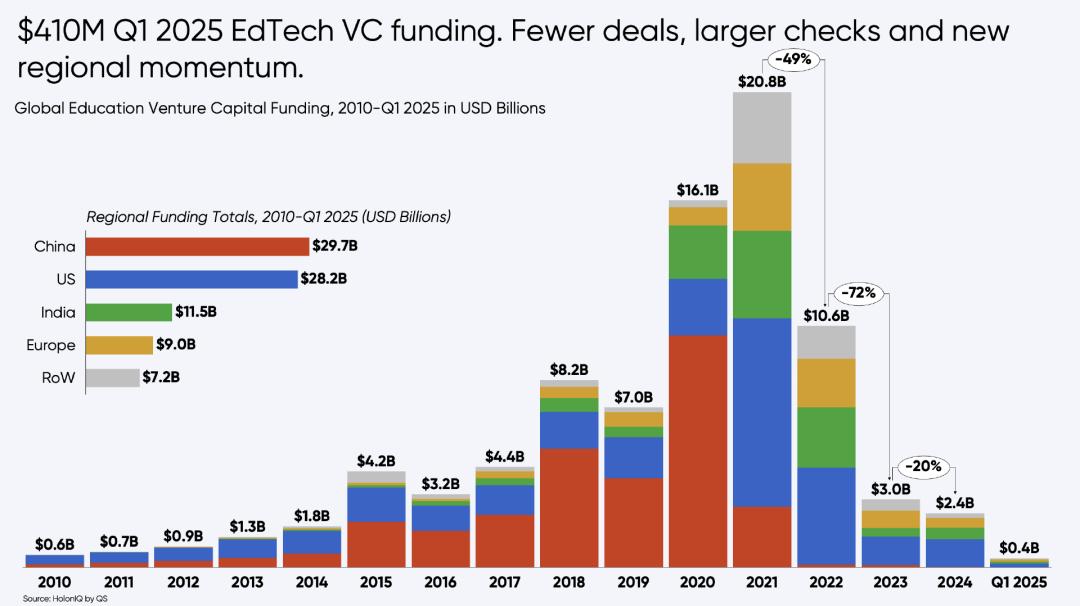
Group 1: Market Overview - The EdTech sector has experienced a significant decline in investment, with a year-on-year drop of 35% this quarter, indicating a cooling market overall [1][2] - Despite the overall decrease, investor interest remains strong in specific areas such as AI-driven solutions, international student mobility, and scalable models in emerging markets [1][2] Group 2: Investment Trends - The average investment amount has increased to $7.8 million, as investors concentrate funds on fewer, stronger projects, with three companies receiving nearly half of the total funding [2][5] - The trend of "fewer deals but larger investments" suggests a shift towards quality over quantity in the EdTech investment landscape, indicating a more mature and consolidated market [5][6] Group 3: Regional Insights - North America leads in EdTech VC funding, followed by Europe and Central Asia, while regions like the Middle East and Latin America receive comparatively less investment [10][11] - China and the U.S. remain the largest investment regions, with cumulative investments of $29.7 billion and $28.2 billion respectively from 2010 to Q1 2025 [4][5] Group 4: M&A Activity - M&A activity in the EdTech sector has decreased by 32% year-on-year, reflecting the tightening investment environment, yet workforce learning institutions remain active, accounting for nearly one-third of all transactions [12][13] - Notable acquisitions include TLG Learning and Clover Learning, highlighting the ongoing demand for employee skill enhancement and retraining [12][13] Group 5: Focus Areas - Key focus areas for investment and M&A include scalable technology-driven solutions, AI infrastructure for educational institutions, and innovations in STEM education content [12][13]