结构性货币政策工具

Search documents
前三季度主要金融数据变化怎么看
Xin Hua Wang· 2025-10-19 23:50
Core Viewpoint - The People's Bank of China reported that in the first three quarters of this year, RMB loans increased by 14.75 trillion yuan, with both broad money and social financing growth rates remaining high, creating a favorable monetary environment for economic recovery [1] Group 1: Loan Growth and Structure - As of the end of September, the balance of RMB loans reached 270.39 trillion yuan, a year-on-year increase of 6.6% [2] - The social financing scale stood at 437.08 trillion yuan, with a year-on-year growth of 8.7%, which is 0.7 percentage points higher than the same period last year [2] - The incremental social financing scale for the first three quarters totaled 30.09 trillion yuan, which is 4.42 trillion yuan more than the previous year [2] - The balance of inclusive small and micro loans was 36.09 trillion yuan, up 12.2% year-on-year, while medium and long-term loans for the manufacturing sector reached 15.02 trillion yuan, increasing by 8.2% [2] Group 2: Support for Key Industries - Key industries such as equipment manufacturing and high-tech manufacturing maintained high levels of prosperity, effectively releasing corporate financing demand [2] - A state-owned bank reported that manufacturing loans accounted for over half of its corporate loans, primarily in the form of medium and long-term loans, which align with the long-term needs of manufacturing enterprises for technological upgrades [2] Group 3: Policy Impact and Consumer Demand - Recent policy measures, including personal consumption loan subsidies and adjustments to housing purchase restrictions in major cities, have led to a rebound in consumer loan demand [3] - In September, the transaction volume of commercial housing in 30 major and medium-sized cities increased by approximately 7% year-on-year, indicating a recovery in personal housing loan demand [3] Group 4: Financing Costs and Transparency - Loan interest rates have remained low, with the weighted average interest rate for newly issued corporate loans at about 3.1%, down approximately 40 basis points year-on-year [5] - The implementation of the "loan transparency" initiative has helped reduce financing costs for small and medium-sized enterprises, ensuring that they are aware of all associated costs [4][5] Group 5: Monetary Policy and Economic Outlook - The current monetary policy remains moderately accommodative, with continuous effects from previous rate cuts and reserve requirement ratio reductions, supporting high growth rates in RMB loans [6] - The broad money (M2) balance reached 335.38 trillion yuan, growing by 8.4% year-on-year, while the narrow money (M1) balance was 113.15 trillion yuan, up 7.2% [7] - The economic indicators show strong vitality and resilience, with structural monetary policy tools expected to continue supporting key sectors [8]


信贷结构持续优化 前三季度主要金融数据变化怎么看
Ren Min Ri Bao· 2025-10-19 23:37
Core Viewpoint - The People's Bank of China reported that in the first three quarters of this year, RMB loans increased by 14.75 trillion yuan, with both broad money and social financing growth rates remaining high, creating a favorable monetary environment for economic recovery [1]. Financial Data Overview - As of the end of September, the balance of RMB loans reached 270.39 trillion yuan, a year-on-year increase of 6.6%. The total social financing scale was 437.08 trillion yuan, up 8.7% year-on-year, which is 0.7 percentage points higher than the same period last year. The cumulative increase in social financing for the first three quarters was 30.09 trillion yuan, 4.42 trillion yuan more than the previous year [3]. - By the end of September, the balance of inclusive small and micro loans was 36.09 trillion yuan, growing by 12.2% year-on-year, while medium and long-term loans for the manufacturing sector reached 15.02 trillion yuan, up 8.2% year-on-year [3]. Support for the Real Economy - Key industries such as equipment manufacturing and high-tech manufacturing maintained high levels of prosperity, with effective release of corporate financing demand. A state-owned bank reported that manufacturing loans accounted for over half of its corporate loans this year, primarily in the form of medium and long-term loans to support technological upgrades in the manufacturing sector [3]. - Recent policy financial tools have been deployed in various regions, targeting urban renewal, transportation, water services, logistics, and environmental protection, addressing capital shortages for major projects and boosting related credit growth [4]. Consumer Credit Trends - There has been a rebound in consumer credit demand, driven by the implementation of personal consumption loan interest subsidies and service industry loan subsidies. In September, the transaction volume in the real estate market increased by approximately 7% year-on-year, leading to a corresponding recovery in personal housing loan demand [4]. Financing Costs and Loan Rates - Loan interest rates have remained low, with the weighted average interest rate for newly issued corporate loans at approximately 3.1%, down about 40 basis points year-on-year. Similarly, the average interest rate for new personal housing loans was also around 3.1%, down about 25 basis points year-on-year [6]. - The introduction of the "Loan Clarity Paper" has made financing costs more transparent, helping to reduce the overall financing costs for small and medium-sized enterprises [5][6]. Monetary Policy Outlook - The current monetary policy remains moderately accommodative, with ongoing effects from previous rate cuts and reserve requirement ratio reductions. This has resulted in a high growth rate of RMB loans and low loan interest rates, indicating a sufficient supply of credit resources to meet the financing needs of the real economy [7]. - The broad money (M2) balance reached 335.38 trillion yuan, growing by 8.4% year-on-year, while the narrow money (M1) balance was 113.15 trillion yuan, up 7.2% year-on-year, reflecting increased business activity and consumer demand [8]. Future Policy Directions - The focus will continue on structural monetary policy tools to enhance financial support for key sectors, with expectations for ongoing collaboration between monetary and fiscal policies to sustain economic recovery [9].
前三季度主要金融数据变化怎么看(高质量发展看亮点·读数)
Ren Min Ri Bao· 2025-10-19 22:01
Core Insights - The People's Bank of China reported that in the first three quarters of this year, RMB loans increased by 14.75 trillion yuan, creating a favorable monetary environment for economic recovery [1] - The demand for corporate credit has been met, particularly in key sectors such as equipment manufacturing and high-tech manufacturing, which continue to show high levels of prosperity [2][3] Financial Data Overview - As of the end of September, the total RMB loans reached 270.39 trillion yuan, a year-on-year increase of 6.6%, while the total social financing scale was 437.08 trillion yuan, up 8.7% year-on-year [3] - The cumulative increase in social financing for the first three quarters was 30.09 trillion yuan, which is 4.42 trillion yuan more than the same period last year [3] - The balance of inclusive small and micro loans was 36.09 trillion yuan, growing by 12.2% year-on-year, and medium to long-term loans for the manufacturing sector reached 15.02 trillion yuan, up 8.2% year-on-year [3] Policy and Market Dynamics - Recent policy measures in regions like Jiangsu, Guangdong, and Guangxi have led to the deployment of new policy financial tools aimed at urban renewal, transportation, and environmental protection, addressing capital shortages in major projects [4] - The implementation of personal consumption loan interest subsidies and adjustments in housing purchase policies in major cities have contributed to a rebound in housing loan demand [4] Financing Costs and Loan Rates - Loan interest rates have remained low, with the weighted average interest rate for new corporate loans at approximately 3.1%, down about 40 basis points year-on-year [6] - The introduction of the "Loan Transparency Document" has helped reduce financing costs for small and medium enterprises, ensuring that they are aware of all associated costs [5][6] Monetary Policy Impact - The current monetary policy remains moderately accommodative, with measures such as reserve requirement ratio cuts and interest rate reductions showing positive effects on loan growth and economic stability [7][9] - The broad money supply (M2) reached 335.38 trillion yuan, growing by 8.4% year-on-year, indicating a healthy liquidity environment [8] Future Outlook - The fourth quarter is expected to see continued support for the real economy from monetary policy, alongside active fiscal measures aimed at promoting consumption and improving livelihoods [9] - The ongoing structural monetary policy tools are anticipated to enhance financial support for key sectors, fostering a more balanced economic supply-demand relationship [8][9]
央行副行长邹澜:立足中国国情 构建与科技创新相适应的科技金融体系
Zheng Quan Shi Bao Wang· 2025-10-19 03:35
Core Viewpoint - The People's Bank of China emphasizes the need for a financial system that aligns with the country's technological development stage, advocating for a tailored approach to fintech that suits China's unique circumstances [1]. Group 1: Financial System Development - The development of direct financing and the establishment of a multi-tiered capital market are crucial for optimizing the financial system to support innovation-driven development [1]. - China's bond market, currently over 190 trillion yuan, is the second largest globally and offers unique advantages in supporting technological innovation due to its large scale, low cost, and long-term funding [1]. Group 2: Bond Market Innovations - The introduction of the bond market technology board aims to support financial institutions, tech companies, and private equity firms in issuing technology innovation bonds, creating a comprehensive product system for such bonds [1][2]. - Since its launch five months ago, the technology innovation bond financing has seen significant growth, with approximately 670 billion yuan issued by around 280 entities in the interbank bond market [2]. Group 3: Characteristics of Technology Innovation Bonds - The technology innovation bond market features diverse tech enterprises, with 191 companies issuing 377 billion yuan in bonds across sectors like integrated circuits and biomedicine [3]. - Nearly half of the tech companies have bond maturities of three years or more, with private equity firms averaging a maturity of 5.8 years [3]. - The average coupon rate for these bonds is approximately 2%, indicating strong market demand and active trading [3]. Group 4: Structural Monetary Policy Tools - The People's Bank of China has introduced various structural monetary policy tools to address structural issues, including a carbon reduction support tool that has facilitated 1.4 trillion yuan in green loans, resulting in over 250 million tons of annual carbon reduction [4]. - Future plans include enhancing the structural tool system to better support technological innovation and improve the financial ecosystem for innovation [4].
全球财富管理论坛·2025上海苏河湾大会举行 专家建言“世界变革下的未来之路”
Jing Ji Guan Cha Wang· 2025-10-19 02:59
Group 1: Monetary Policy and Financial Regulation - The People's Bank of China emphasizes the dual function of monetary policy, focusing on both total and structural adjustments to address the structural challenges in the economy [1] - The design of structural monetary policy tools aims to create an incentive-compatible mechanism, linking the central bank's base currency issuance to commercial banks' lending to specific sectors [1] - The application of artificial intelligence in finance is expected to have significant and fundamental impacts, enhancing financial services and operational efficiency while ensuring risk management [2] Group 2: Financial Supply and Demand - AI technology is projected to drastically reduce the costs of financial product development and production, making it economically feasible to cater to previously neglected niche demands, thus generating a "long tail effect" [2] - Financial regulation encourages institutions to leverage the latest technologies to optimize services, reduce operational costs, and improve management efficiency while maintaining a balance between safety and efficiency [2] Group 3: Macro Policy and Economic Challenges - The rising global public debt and increasing leverage levels pose challenges, necessitating the use of macro policy space to enhance effective borrowing and investment in data-driven infrastructure [2][3] - China is advised to optimize its debt structure and implement comprehensive debt solutions while maintaining a sustainable government debt ratio aligned with economic resilience [3] - In the face of global protectionism and fragmented supply chains, China is adopting a more open approach to globalization and is actively constructing a new development pattern that balances safety and efficiency [3]
央行副行长邹澜:完善结构性货币政策工具体系,支持科技创新发展
Guo Ji Jin Rong Bao· 2025-10-19 01:07
Core Insights - The People's Bank of China (PBOC) is implementing structural monetary policy tools to incentivize the development of technology finance, including the establishment of technology innovation relending in 2022 and technology innovation and technological transformation relending in 2024 [1][4] Group 1: Monetary Policy Tools - The PBOC has created multiple structural monetary policy tools to address structural issues, forming a framework that primarily relies on aggregate tools supplemented by structural tools [4] - A carbon emission reduction support tool has been launched, which has facilitated financial institutions in issuing green loans amounting to 1.4 trillion yuan, leading to an annual carbon reduction of over 250 million tons [4] Group 2: Financing for Innovation - For growth-stage and mature enterprises with established technological routes, indirect financing such as bank credit can quickly respond and guide social capital towards the technology sector [3] - For seed-stage and startup enterprises, as well as unpredictable leading-edge innovations, direct financing through capital markets offers better pricing efficiency and risk-sharing capabilities, suitable for high-risk, high-growth characteristics [3] Group 3: Future Directions - The PBOC aims to cultivate a financial market ecosystem that supports technological innovation, enhancing the capacity, intensity, and level of financial support [4] - There is a commitment to strengthen international exchanges and continuously improve the structural tool system based on theoretical and practical developments [4]

21社论丨推动货币政策措施落实落细,充分释放政策效应
21世纪经济报道· 2025-09-29 23:50
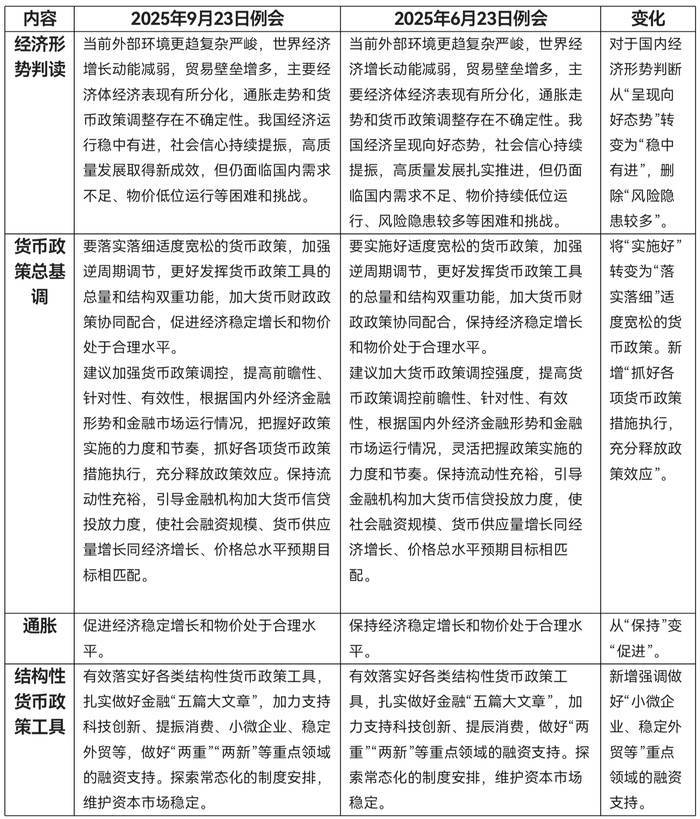
Group 1 - The core viewpoint of the article emphasizes the shift in China's monetary policy focus towards execution, reflecting confidence in the economy's stability and growth potential [1][2] - The People's Bank of China (PBOC) has adjusted its language regarding monetary policy from "implementing appropriate easing" to "ensuring detailed implementation," indicating a more stable approach in the short term [1][2] - Economic indicators show that industrial added value increased by 6.2% year-on-year in the first eight months, while the service production index remained steady at 5.9%, suggesting that the economy is performing above the 5.0% growth target [1] Group 2 - The narrowing net interest margin for commercial banks, which fell to a historical low of 1.42% in Q2, poses a challenge for monetary easing, as it could further pressure banks' profitability [2] - The PBOC is focusing on maintaining liquidity and has been using various tools like reverse repos to ensure sufficient market liquidity, especially across quarters [3] - Structural monetary policy tools are being utilized to support key sectors such as technology innovation, consumption, small and micro enterprises, and foreign trade [3] Group 3 - Coordination between fiscal and monetary policies is being emphasized, with discussions between the Ministry of Finance and the PBOC on enhancing financial market operations and government bond management [3][4] - The introduction of new policy financial tools, amounting to 500 billion yuan, aims to boost effective investment and promote stable economic growth [3] - The PBOC plans to adapt its monetary policy based on macroeconomic conditions and price trends, indicating a readiness to adjust policies as necessary [4]

央行三季度货政例会:促进经济稳定增长和物价处于合理水平
Zhong Guo Jing Ying Bao· 2025-09-29 14:43
Core Viewpoint - The People's Bank of China (PBOC) emphasizes the need for a proactive monetary policy to promote stable economic growth and maintain reasonable price levels, reflecting a more nuanced understanding of the current economic challenges [1][2]. Group 1: Monetary Policy Direction - The PBOC's recent meeting indicates a shift from "maintaining" to "promoting" economic stability, highlighting a more active approach to monetary policy [1][2]. - The meeting introduced a new requirement to "ensure the effective implementation of various monetary policy measures," indicating a focus on the execution of existing tools [2][3]. Group 2: Structural Monetary Policy Tools - The meeting reiterated the importance of structural monetary policy tools, particularly in supporting small and micro enterprises and stabilizing foreign trade [4]. - The emphasis on financing support for key areas such as technology innovation, consumption, and small businesses is crucial, especially in light of potential impacts from U.S. tariffs on Chinese exports [4]. Group 3: Future Outlook - The expectation for the fourth quarter is to maintain a moderately loose monetary policy stance, with decisions on rate cuts or reserve requirement ratio adjustments to be based on comprehensive assessments of economic performance and external conditions [4].

充分释放政策效应——2025年三季度货币政策委员会例会学习理解
一瑜中的· 2025-09-29 08:20
Core Viewpoints - The central bank has removed the phrase "increase the implementation of incremental policies" and emphasized "ensuring the execution of various monetary policy measures to fully release policy effects," indicating that the phase of the most accommodative monetary policy has passed [3][6] - There is no strong necessity for interest rate cuts or reserve requirement ratio reductions to stimulate credit, as previous credit flows have primarily gone to the production side, exacerbating supply-demand imbalances in a context of insufficient demand [3][6] - The behavior of small and medium-sized banks is noteworthy, with their bond investment accounting for approximately 52% of total fund utilization over the past year, compared to an average of about 25% from 2017 to 2022 [3][6] Summary of Changes and Continuities in Monetary Policy - In economic assessment, the phrase "China's economic risks and challenges" has been removed, reflecting a more optimistic view [5][12] - The policy tone has shifted to emphasize "maintaining continuity and stability in policies while enhancing flexibility and predictability," contrasting with previous statements that focused on utilizing existing policies and implementing new ones [5][12] - Specific policy details have been adjusted to focus on the execution of monetary policy measures and the release of policy effects, moving away from previous language about flexibility in policy implementation [5][12] - Structural tools have been reinforced to support small and micro enterprises and stabilize foreign trade, indicating a targeted approach to monetary policy [5][12] Understanding Current Monetary Policy - The assessment that the phase of the most accommodative monetary policy has passed is supported by three reasons: a focus on releasing prior policy effects, a lack of necessity for stimulating credit through rate cuts in the context of insufficient demand, and potential regulatory constraints on leveraging in the equity market [6][14] - Attention is drawn to the process of small and medium-sized banks focusing on their core responsibilities, with a significant increase in bond investments that may pose risks if not managed properly [6][15] - Structural tools for financial support should concentrate on technological innovation, boosting consumption, stabilizing foreign trade, and supporting small and micro enterprises, indicating a shift towards more targeted financial interventions [6][15]
央行不再提“加力实施增量政策”,四季度还会降息吗?
Sou Hu Cai Jing· 2025-09-29 03:00
Core Viewpoint - The People's Bank of China (PBOC) emphasizes the execution and effect of monetary policy measures without providing guidance for new easing measures, indicating a cautious approach to future monetary policy adjustments based on economic growth momentum and price trends [1][9]. Group 1: Monetary Policy Changes - The PBOC's recent meeting highlighted three main changes in monetary policy expression: the shift from "maintaining" to "promoting" economic stability and reasonable price levels, indicating a stronger desire for economic growth [4][10]. - The meeting emphasized the execution of existing monetary policies and the need to fully release their effects, rather than focusing on new easing measures, suggesting that further easing is not urgent [9][10]. - The PBOC aims to maintain policy continuity and stability while enhancing flexibility and foresight in its monetary policy approach [9][10]. Group 2: Economic Conditions - The external environment is described as increasingly complex and severe, with weakened growth momentum and rising trade barriers, while domestic economic performance shows signs of improvement [2][10]. - The PBOC acknowledges challenges such as insufficient domestic demand and low price levels, but has removed the term "sustained" from previous statements regarding low inflation, reflecting a slight recovery in core CPI and a narrowing decline in PPI [7][10]. - Recent data indicates that from January to August 2025, the core CPI rose by 0.9% year-on-year, and the PPI decreased by 2.9%, with a month-on-month increase from July's -0.2% to 0% in August [7][10]. Group 3: Structural Monetary Policy Tools - The meeting reiterated support for small and micro enterprises and stabilizing foreign trade, indicating a renewed focus on external environment uncertainties as key decision variables for monetary policy [11][13]. - The PBOC continues to emphasize the importance of stabilizing the real estate market and enhancing the effectiveness of existing financial policies, with no significant changes in the approach compared to previous meetings [13].