
半导体国产化

Search documents
半导体行业6月份月报:端侧AI创新不断,存储价格涨幅扩大-20250703
Donghai Securities· 2025-07-03 08:08
Investment Rating - The report maintains a positive outlook on the semiconductor industry, highlighting structural opportunities in AI computing, AIOT, semiconductor equipment, and key components [4]. Core Insights - The semiconductor industry showed signs of recovery in June 2025, with increasing prices and improving demand across various segments, including smartphones, tablets, TWS headphones, wearable devices, smart home products, AI servers, and new energy vehicles [4][5]. - The report indicates that the overall semiconductor demand is expected to continue its recovery into July, despite high inventory levels and relatively abundant supply in the short term [4]. - The report emphasizes the importance of AI innovations, with new consumer electronics products being launched, such as AI glasses from Xiaomi and Meta, which are expected to drive demand in the sector [4][5]. Monthly Market Review - The semiconductor sector experienced a 5.96% increase in June, outperforming the broader market, which saw a 2.50% rise in the CSI 300 index [11][13]. - The semiconductor industry's valuation metrics, including PE and PB ratios, are currently at high historical percentiles, indicating a strong market sentiment towards the sector [21][22]. Semiconductor Supply and Demand Data - Global semiconductor sales in April 2025 showed a year-on-year increase of 22.68%, with a cumulative growth of 18.93% from January to April 2025, reflecting a robust recovery in demand [4]. - The report notes significant price increases in memory chips, particularly DDR4, driven by supply constraints and increased market demand [4]. Downstream Demand Tracking and Forecast - The report highlights that downstream demand for semiconductors is strong in TWS headphones, wearable devices, AI servers, and new energy vehicles, with notable growth rates in these segments [4][5]. - Global smartphone shipments in Q1 2025 increased by 1.53%, while new energy vehicle sales saw a year-on-year growth of 19.08% in April 2025 [4]. Industry News Highlights - The report mentions significant developments in AI infrastructure, including Nvidia's plans to build AI factories in Europe and the release of new AI products by major tech companies [5]. - The report suggests that the semiconductor industry is likely to benefit from ongoing AI innovations and the expansion of the ASIC market, with projections for the market size to increase from $75 billion to $94 billion by 2028 [5]. Investment Recommendations - The report advises investors to consider leading companies in the AIOT sector, such as Lexin Technology and Hanguang Technology, as well as those involved in AI-driven innovations and domestic supply chain replacements [5].




早盘直击 | 今日行情关注
申万宏源证券上海北京西路营业部· 2025-07-02 02:00
Market Overview - A-shares have resumed an upward trend after a period of consolidation, with the Shanghai Composite Index breaking through March highs and reaching new recent closing highs [1] - The market sentiment regarding trade conflicts has eased, and the geopolitical situation in the Middle East is viewed as a short-term emotional impact [1] - The low interest rate environment and rising risk appetite are supporting the A-share market's return to a slow upward trajectory [1] Sector Analysis - The innovation drug and banking sectors, which were previously popular, have resumed their upward trends after short-term adjustments [2] - The TMT and advanced manufacturing sectors are experiencing rebounds, indicating a high-low switch among sectors as the market remains event-driven [2] - Consumer expansion and domestic demand are key tasks for 2025, with expectations for policy support in sectors like dairy products, IP consumption, leisure tourism, and medical aesthetics [2] - The trend of robot localization and integration into daily life is expected to continue, with opportunities arising in sensors, controllers, and dexterous hands [2] - The semiconductor industry is moving towards localization, with a focus on semiconductor equipment, wafer manufacturing, materials, and IC design [2] - The military industry is anticipated to see a rebound in orders by 2025, with signs of recovery in various sub-sectors [2] - The innovation drug sector is expected to reach a turning point in fundamentals by 2025, following a period of adjustment [2] Trading Activity - A-shares experienced some intraday fluctuations but maintained an upward trend, with trading volume remaining stable and no signs of panic selling [3] - Leading sectors included pharmaceuticals, banking, non-ferrous metals, public utilities, and building materials, while sectors like computers, retail, communications, and power equipment saw declines [3]


帮主郑重7月金股揭秘:券商力荐这几只,赚钱机会藏在哪儿?
Sou Hu Cai Jing· 2025-07-01 21:01
Core Viewpoint - The article discusses the recent recommendations from brokerages for July's "golden stocks," highlighting the underlying logic and potential investment opportunities for ordinary investors [1][3]. Group 1: Popular Stocks - Kying Network is favored by five brokerages, making it the most recommended stock for the month; Zijin Mining, Huadian Technology, and Muyuan Foods follow closely with four recommendations each [3]. - The selection of these stocks reflects a diverse range of industries, including gaming, mining, PCB manufacturing, and agriculture, indicating a broad interest from brokerages [3]. Group 2: Key Selection Criteria - The first criterion is industry prosperity, with Kying Network benefiting from an increase in game licenses and the release of popular titles, while Huadian Technology sees a surge in demand for PCB boards due to 5G and automotive electronics [3][4]. - The second criterion focuses on policy benefits, particularly in sectors like semiconductors and new energy vehicles, where domestic and global trends favor local companies [4]. - The third criterion emphasizes the importance of a company's competitive advantage or "moat," with Zijin Mining having significant copper reserves and cost control, and Huadian Technology holding over 20% market share in high-end PCBs [4]. Group 3: Stock Selection Methodology - The article suggests a three-step approach for investors to filter the recommended stocks: 1. Monitor changes in institutional holdings, such as Kying Network's increase from 8% to 15% in fund holdings [4]. 2. Assess order fulfillment rates, with Huadian Technology reporting a 40% year-on-year increase in new orders [4]. 3. Evaluate free cash flow rates, as evidenced by Zijin Mining's 35% year-on-year increase in operating cash flow [4]. Group 4: Market Outlook - The market is expected to experience initial fluctuations followed by a potential breakthrough, with short-term funds engaging in high-frequency trading within popular sectors while long-term funds adjust their portfolios [5]. - The article emphasizes the importance of selecting stocks based on industry trends, company quality, and reasonable pricing, particularly focusing on semiconductor localization, new energy exports, and consumer recovery [5].




电子行业三季度投资机会展望
2025-06-30 01:02
Summary of Key Points from the Conference Call Industry Overview - The semiconductor equipment and materials sector is experiencing better-than-expected conditions, particularly in the 7nm advanced process, with a significant increase in domestic CAPEX investment expected in 2025 compared to 2024 [1][5] - AI glasses have emerged as a new hotspot in consumer electronics, with strong market demand evidenced by the rapid sell-out of Xiaomi's new electrochromic glasses [1][9] - The Apple supply chain faces dual challenges of trade friction and slowing innovation, but these issues are already reflected in stock prices [1][10] Core Insights and Arguments - The logic chip sector shows signs of recovery, contrasting with market pessimism, indicating potential investment opportunities [1] - Domestic AI computing capabilities are lagging behind international counterparts, particularly NVIDIA, which is benefiting from increased capacity and CAPEX investments [3][4] - The semiconductor equipment and materials sector is expected to have upward potential in 2025, with advanced process equipment manufacturers showing order growth potential [7][8] Additional Important Content - The semiconductor materials sector is optimistic, with increasing domestic CAPEX and improving yield rates, suggesting a more favorable outlook than previously anticipated [5] - The AI computing direction is characterized by a divergence between domestic and international developments, with domestic players focusing on algorithm optimization [3][4] - The storage chip market is experiencing price increases for DDR4 due to capacity shifts from Korean manufacturers, with a slow recovery expected [13] - AI applications are anticipated to significantly boost storage chip demand as they become more prevalent across various devices [14] - Investors are advised to focus on selecting strong individual stocks rather than entire sectors, with a particular emphasis on AI computing, semiconductors, national chains, and storage chips [15]

我国自主研发新一代CPU发布;小米YU7发布丨盘前情报
2 1 Shi Ji Jing Ji Bao Dao· 2025-06-27 00:42
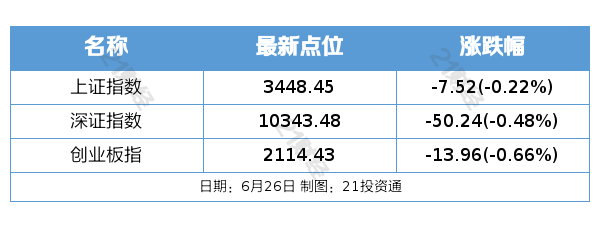
Market Overview - On June 26, A-shares experienced a collective decline, with the Shanghai Composite Index down 0.22% to 3448.45 points, the Shenzhen Component Index down 0.48% to 10343.48 points, and the ChiNext Index down 0.66% to 2114.43 points [1][2] - The total market turnover was 162.31 billion yuan, a decrease of 16.3 billion yuan from the previous day, with over 3600 stocks declining [1] - In sector performance, tourism and hotels, digital currency, oil and gas extraction, and banking sectors saw gains, while innovative drugs, complete automobiles, and photolithography concept stocks faced declines [1] International Market - The U.S. stock market saw gains on June 26, with the Dow Jones Industrial Average up 404.41 points (0.94%) to 43386.84 points, the S&P 500 up 48.86 points (0.80%) to 6141.02 points, and the Nasdaq Composite up 194.36 points (0.97%) to 20167.91 points [2][4] - European stock indices showed mixed results, with the UK FTSE 100 up 16.85 points (0.19%) to 8735.60 points, the French CAC 40 down 0.85 points (0.01%) to 7557.31 points, and the German DAX up 150.97 points (0.64%) to 23649.30 points [3] Commodity Prices - International oil prices increased on June 26, with WTI crude oil up 32 cents (0.49%) to $65.24 per barrel and Brent crude oil up 5 cents (0.07%) to $67.73 per barrel [3][4] Key Developments - A new generation of domestically developed general-purpose processors, the Longxin 3C6000, was released in Beijing, featuring a self-designed instruction system and achieving the highest level of security certification [4] - The semiconductor industry in China is accelerating its domestic production, with a focus on AI computing chips, CPUs, and advanced semiconductor equipment, as external restrictions increase [5] - Xiaomi launched its first SUV, the Xiaomi YU7, with a starting price of 253,500 yuan, achieving over 200,000 pre-orders within three minutes [6] - The Chinese government is advancing flood control infrastructure, including the construction of flood storage areas and enhancing the safety of existing reservoirs [7] Financial Sector Insights - The National Financial Supervision Administration and the People's Bank of China released a plan to establish a high-quality inclusive financial system over the next five years [7] - Tianfeng International Securities has upgraded its license to provide virtual asset trading services in Hong Kong, reflecting the growing interest in virtual assets [8] Institutional Perspectives - Fangzheng Securities suggests that after reaching new highs, sectors like brokerage, technology innovation, and the Hang Seng Tech Index may have short-term rebound opportunities [9] - CITIC Securities notes the growing demand for AI model training and inference, indicating a shift towards system-level solutions in AI computing [10] - Guotai Haitong predicts that the demand for inference computing power will reach 62.2% by 2026, highlighting liquid cooling and high-speed interconnect technologies as investment hotspots [10]
创业板人工智能ETF南方(159382)涨近2%,科创芯片ETF南方(588890)、双创ETF(159780)冲击4连涨,科技创新激发多产业发展新动能
Xin Lang Cai Jing· 2025-06-26 03:15
Group 1 - The A-share market experienced fluctuations on June 26, 2025, with the Sci-Tech Innovation Board leading the gains, particularly in the computer and semiconductor sectors, where stocks like Xinyi Sheng and Haiguang Information rose nearly 6% [1] - The China Securities Regulatory Commission (CSRC) announced support for AI and other cutting-edge technology companies to apply the fifth listing standard on the Sci-Tech Innovation Board, enhancing institutional inclusiveness [1] - The reform aims to serve high-quality tech companies with significant breakthroughs, broad commercial prospects, and continuous R&D investment, while also strengthening information disclosure and risk revelation [1] Group 2 - Domestic wafer manufacturers and memory manufacturers are increasingly motivated to procure domestic alternatives to ensure supply chain security and production capacity, benefiting companies in semiconductor equipment, materials, and EDA fields [2] - The Southern AI ETF (159382) closely tracks the AI index of the ChiNext, reflecting the stock price changes of listed companies related to the AI theme [2] - The top ten weighted stocks in the Southern AI ETF include Xinyi Sheng, Zhongji Xuchuang, Softcom Power, and others [2] Group 3 - The Southern Chip ETF (588890) tracks the Shanghai Sci-Tech Innovation Board Chip Index, which selects securities related to semiconductor materials, equipment, design, manufacturing, packaging, and testing [3] - The top ten weighted stocks in the Southern Chip ETF include SMIC, Haiguang Information, and Hanwha Technology [3] Group 4 - The Southern Double Innovation ETF (159780) tracks the CSI Sci-Tech Innovation 50 Index, which selects 50 large-cap emerging industry stocks from the Sci-Tech Innovation Board and ChiNext [3] - The top ten weighted stocks in the Southern Double Innovation ETF include CATL, SMIC, and Mindray Medical [3]

给两位创始人各发999万年薪后,这家公司要去港股再圈10亿美元?
阿尔法工场研究院· 2025-06-25 10:59
Core Viewpoint - Lanke Technology is planning to go public in Hong Kong, aiming to raise approximately $1 billion, despite having over 7 billion yuan in cash and cash equivalents, which raises questions about the necessity of this fundraising [3][6][10][19]. Group 1: Company Overview - Lanke Technology, an A-share listed IC design company, is preparing for an IPO in Hong Kong amid the domestic semiconductor localization trend [3]. - The company announced its plan to issue H-shares and list on the Hong Kong Stock Exchange on June 20 [4]. - As of the end of Q1 2025, Lanke Technology's cash and cash equivalents amounted to approximately 7.036 billion yuan [12]. Group 2: Financial Performance - In 2024, Lanke Technology achieved revenue of approximately 3.639 billion yuan, a year-on-year increase of 59.2%, and a net profit of 1.412 billion yuan, soaring by 213.1% [13]. - The interconnect chip product line generated sales revenue of 3.349 billion yuan, marking a historical high with a year-on-year growth of 53.31% [14]. - In Q1 2025, the company continued its high growth trajectory, reporting revenue of 1.222 billion yuan and a net profit of 525 million yuan, representing year-on-year increases of 65.78% and 135.14%, respectively [17]. Group 3: Strategic Intentions - The decision to pursue fundraising through a Hong Kong IPO is viewed as a strategic move rather than a necessity, aimed at enhancing brand recognition and trust with international clients, particularly in the cloud computing and AI sectors [20][21]. - The company has no controlling shareholder or actual controller, with the founders holding only 2.18 million shares each, which is insufficient for a controlling position [34][35]. Group 4: Management and Compensation - In 2024, the founders of Lanke Technology received a pre-tax salary of 9.99 million yuan each, while other executives received significantly lower compensation [37][38]. - The company invests heavily in its R&D personnel, with 74.65% of its workforce in R&D and an average annual salary nearing 1 million yuan, totaling approximately 533 million yuan in compensation [40][41]. Group 5: Market Context - The trend of A-share listed companies seeking to issue H-shares in Hong Kong is growing, with notable examples like CATL completing a $5.252 billion IPO recently [42][43]. - Lanke Technology's timing for entering the Hong Kong market appears strategic, aligning with broader market movements [44].


早盘直击 | 今日行情关注
申万宏源证券上海北京西路营业部· 2025-06-25 01:29
Group 1 - The recent tensions in the Middle East have led to a temporary impact on A-share market sentiment, but the market has rebounded, with the Shanghai Composite Index reaching a new high in nearly a month [1] - The market is expected to maintain a slow upward trend as it approaches the policy window period at the end of June, with potential for new policies aimed at stabilizing employment and promoting high-quality development [1] - Popular sectors such as banking and innovative pharmaceuticals may experience short-term fluctuations due to accumulated gains, while TMT and technology growth sectors are anticipated to see a rebound after sufficient adjustments [1] Group 2 - The outlook for July suggests a theme-driven market with high-low sector rotation, as popular sectors like innovative pharmaceuticals and banking have shown signs of correction, while TMT and advanced manufacturing sectors are beginning to rebound [2] - Key focus areas for 2025 include expanding domestic demand and consumption, with expectations for policies to support sectors like dairy products, IP consumption, leisure tourism, and medical aesthetics [2] - The trend towards domestic production of robotics is expected to continue, with opportunities arising in sensors, controllers, and functional robots [2] - The semiconductor industry is projected to see continued domestic growth, with attention on semiconductor equipment, wafer manufacturing, materials, and IC design [2] - The military industry is anticipated to experience a rebound in orders by 2025, with signs of recovery already visible in various sub-sectors [2] - The innovative pharmaceutical sector is expected to reach a turning point in fundamentals by 2025, following a period of adjustment [2] - The AI sector is poised for new catalysts, with significant updates expected from companies like MiniMax, indicating a resurgence in AI-related investments [2] Group 3 - The A-share market has ended a month-long period of consolidation, with the Shanghai Composite Index reaching a new high, supported by a broad-based rally among individual stocks [3] - The market saw a significant increase in the number of rising stocks, with over 4,700 stocks gaining, while only a few sectors like oil and coal experienced declines due to falling international oil prices [3] - Leading sectors included electric power equipment, non-bank financials, retail, automotive, and machinery [3]

集成电路ETF(159546)涨超1.8%,半导体国产化持续推进
Mei Ri Jing Ji Xin Wen· 2025-06-24 05:44
Group 1 - The semiconductor industry chain has collectively rebounded, with the integrated circuit ETF (159546) rising over 1.8% [1] - The high-tech manufacturing PMI has remained above the threshold line for four consecutive months, currently at 50.9%, indicating a sustained positive development trend [1] - The rapid development of new technologies such as AI is driving demand growth in automotive electronics, new energy, and the Internet of Things, becoming a significant growth driver for the semiconductor sector [1] Group 2 - The importance of supply chain security has been highlighted by the US-China trade friction, necessitating the accelerated development of domestic wafer manufacturing and supporting sectors [1] - Emerging technologies like solid-state batteries and composite current collectors are providing growth points for the lithium battery equipment industry, with 2025 expected to be a key year for the commercialization of solid-state batteries [1] - The ongoing push for domestic semiconductor equipment manufacturing is supported by government policies and tax incentives aimed at bolstering local semiconductor production [1] Group 3 - The integrated circuit ETF tracks the integrated circuit index, which is compiled by China Securities Index Co., Ltd., selecting listed companies from the A-share market involved in integrated circuit design, manufacturing, packaging, testing, and equipment materials [1] - The index focuses on the semiconductor and upstream/downstream industry chain, showcasing prominent technological growth characteristics [1]
华峰测控(688200):半导体ATE领军,从模拟到SoC,从中国走向世界
Shenwan Hongyuan Securities· 2025-06-23 08:43
Investment Rating - The report maintains a "Buy" rating for the company [2][8]. Core Insights - The company is a leading domestic semiconductor testing equipment brand, with a clear performance inflection point observed. The core technology and main product development have progressed through several stages, culminating in the recent launch of the STS8600 testing system for SoC testing [7][17][27]. - The semiconductor industry is experiencing a recovery in demand, with significant growth expected in the domestic market. The global semiconductor equipment market is projected to reach $117.1 billion in 2024, with China's market growing to $49.5 billion [7][8]. - The company has substantial growth potential compared to its peers, with a focus on transitioning from analog to SoC testing. The competitive landscape is dominated by two major players, Teradyne and Advantest, which together hold over 80% of the market share [7][8]. Financial Data and Profit Forecast - The company’s total revenue is expected to reach 1,146 million yuan in 2025, with a year-on-year growth rate of 26.6%. The net profit attributable to the parent company is projected to be 455 million yuan, reflecting a growth rate of 36.3% [6][8]. - The company’s earnings per share (EPS) is forecasted to be 3.36 yuan in 2025, with a price-to-earnings (P/E) ratio of 41 [6][8]. - The report highlights that the company’s current market valuation is below the average P/E ratio of comparable companies, indicating potential for growth [8]. Market Position and Competitive Landscape - The company has established a strong market presence with over 8,000 units of testing equipment installed globally. The product line includes the STS8200 and STS8300 series, with the STS8600 system currently undergoing customer validation [7][27]. - The report emphasizes the importance of testing equipment in the semiconductor production process, which is critical for ensuring quality and performance [42][45]. - The global market for semiconductor testing machines is expected to grow significantly, with the SoC testing machine segment projected to account for over 60% of the market by 2027 [68]. Research and Development - The company has significantly increased its R&D investment, reaching a historical high of 1.72 billion yuan in 2024, with a focus on enhancing product capabilities and expanding its patent portfolio [39][40]. - The R&D personnel count has grown to 379, representing nearly 49% of the total workforce, indicating a strong commitment to innovation [39][40]. Conclusion - The report concludes that the company is well-positioned for growth in the semiconductor testing equipment market, supported by a robust product pipeline and favorable industry trends. The maintained "Buy" rating reflects confidence in the company's future performance and market potential [8].
