
关税战

Search documents
美方宣布,针对中方采取的稀土等相关物项出口管制,将对中方加征100%关税,商务部:对于关税战,我们不愿打,但也不怕打
中国基金报· 2025-10-12 02:35
Core Viewpoint - The Chinese government has implemented export controls on rare earth materials to enhance its export control system, citing the importance of these materials in military applications and the need to maintain global peace and regional stability [2][4]. Group 1: Export Control Measures - The export control measures on rare earth materials are a legitimate action by the Chinese government based on legal regulations, aimed at maintaining national security and international safety [2][4]. - China emphasizes that the export controls are not a ban on exports; applications that meet regulations will be approved, and the government is open to facilitating compliant trade through various measures [3][4]. Group 2: Response to U.S. Actions - The U.S. has announced a 100% tariff on Chinese rare earth exports and additional export controls on key software, which China views as a double standard and a violation of fair trade principles [3][4]. - China has expressed strong opposition to the U.S. actions, highlighting that the U.S. has a much larger export control list compared to China, which undermines international trade order and stability [4][5]. Group 3: Maritime and Shipping Issues - The U.S. plans to impose port fees on Chinese vessels starting October 14, which China claims violates WTO rules and the principles of the China-U.S. maritime agreement [6]. - In response, China has decided to implement countermeasures, including special port fees on U.S. vessels, to protect its legitimate rights and maintain fair competition in the international shipping market [6].

最新回应!商务部:“对于关税战,中方的立场是一贯的,我们不愿打,但也不怕打”
Zheng Quan Shi Bao· 2025-10-12 02:31
Core Viewpoint - The Chinese government has implemented export controls on rare earth materials, citing national security and international obligations as key reasons for these measures [2][3]. Group 1: Export Control Measures - On October 9, the Ministry of Commerce and the General Administration of Customs announced export controls on certain rare earth items, emphasizing the importance of these materials in military applications [2]. - The export controls are not a ban; applications that meet regulations will be approved, and the government aims to facilitate compliant trade through various measures [3]. - The Chinese government has conducted thorough assessments of the potential impacts on supply chains and believes the effects will be minimal [3]. Group 2: U.S.-China Trade Relations - The U.S. announced a 100% tariff on Chinese rare earth exports in response to China's export controls, which China views as a double standard and an abuse of export control measures [3][4]. - China has expressed strong opposition to the U.S. actions, which it believes undermine the atmosphere for bilateral trade talks and harm mutual interests [4]. - The Chinese government has reiterated its unwillingness to engage in a trade war but is prepared to respond to U.S. actions to protect its legitimate rights [4]. Group 3: Maritime and Shipping Measures - Starting October 14, the U.S. will impose port fees on Chinese vessels, which China claims violates WTO rules and the principles of the China-U.S. maritime agreement [5]. - In response, China will implement countermeasures, including special port fees for U.S. vessels, to defend its rights and maintain fair competition in international shipping [5][6]. - The Chinese government hopes the U.S. will recognize its errors and return to dialogue and negotiation [5].
最新回应!商务部:“对于关税战,中方的立场是一贯的,我们不愿打,但也不怕打”
证券时报· 2025-10-12 02:26
Core Viewpoint - The Chinese government has implemented export controls on rare earth materials, emphasizing its role as a responsible major power in maintaining global peace and regional stability while ensuring compliance with international obligations [2][3]. Group 1: Export Control Measures - On October 9, the Ministry of Commerce and the General Administration of Customs announced export controls on certain rare earth items, citing their significant military applications [2]. - The export controls are not a ban; applications that meet regulations will be approved, and the government aims to facilitate compliant trade through various measures [3]. - China has conducted thorough assessments of the potential impacts on supply chains and believes the effects will be minimal [3]. Group 2: U.S. Response and Trade Tensions - Following China's announcement, the U.S. plans to impose a 100% tariff on Chinese rare earth items and implement export controls on key software, which China views as a double standard [3]. - The U.S. has expanded its list of export controls against China, affecting thousands of Chinese companies and undermining the atmosphere for bilateral trade talks [4]. - China has expressed strong opposition to the U.S. actions, emphasizing that high tariffs are not the correct approach to bilateral relations and reiterating its willingness to engage in dialogue [4]. Group 3: Maritime and Shipping Measures - The U.S. will impose port fees on Chinese vessels starting October 14, which China claims violates WTO rules and the principle of mutual benefit [5]. - In response, China has announced countermeasures, including special port fees for U.S. vessels, to protect its legitimate rights and maintain fair competition in the international shipping market [5][7].

突发!商务部就中方经贸政策发声
Wind万得· 2025-10-12 02:20
3 、有记者问:美东时间 10 月 10 日,美方宣布, 针对中方采取的稀土等相关物项出口管制,将对中方加征 100% 关税 ,并对所有关键软件实施出口管 制,请问商务部对此有何评论? 答:中方注意到有关情况。 10 月 9 日,中方发布了关于稀土等相关物项的出口管制措施,这是中国政府依据法律法规,完善自身出口管制体系的正常行 为。中国作为负责任大国,始终坚定维护自身国家安全和国际共同安全,始终秉持公正、合理、非歧视的原则立场,审慎适度实施出口管制措施。 美方 有关表态是典型的"双重标准"。 长期以来,美方泛化国家安全,滥用出口管制,对华采取歧视性做法,对半导体设备、芯片等众多产品实施单边长臂管 辖措施。美方管制清单物项超过 3000 项,而中方出口管制清单物项仅 900 余项。美方使用出口管制最低含量规则由来已久,低至 0% 。美方相关举措严 重损害企业正当合法权益,严重冲击国际经贸秩序,严重破坏全球产供链安全稳定。 特别是 9 月中美马德里经贸会谈以来,短短 20 多天时间,美方持续新增出台一系列对华限制措施,将多家中国实体列入出口管制实体清单和特别指定国 民清单;通过穿透性规则任意扩大受管制企业范围,影 ...
就近期中方相关经贸政策措施情况,商务部答记者问
财联社· 2025-10-12 02:19
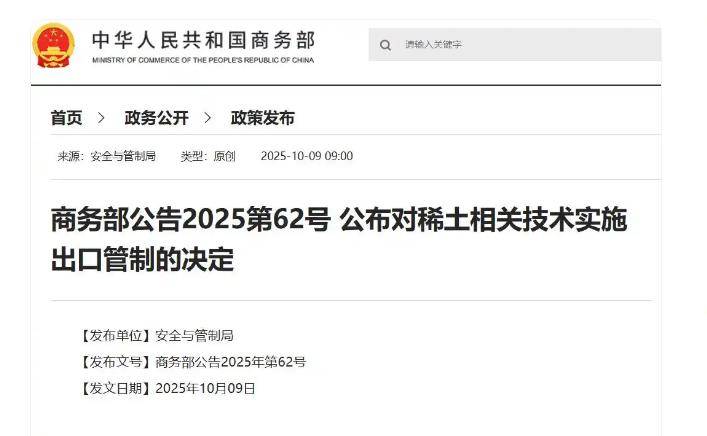
中国的出口管制不是禁止出口,对符合规定的申请将予以许可。在措施公布前,中方已通过双边出口管制对话机制向各有关国家和地区作了通报。 中方愿与各国加强出口管制对话交流,更好维护全球产业链供应链安全稳定。 2、有记者问:我们注意到,近日商务部发布公告加强稀土等相关物项出口管制,请问后续将如何实施? 答: 中国作为负责任大国,始终坚定维护自身国家安全和国际共同安全,始终秉持公正、合理原则立场,审慎适度实施出口管制措施。中方事先已 就措施可能对产供链产生的影响进行了充分评估,并确信相关影响非常有限。措施出台前,中方已通过双边出口管制对话机制向各有关国家和地区 进行了通报。 后续,中国政府将依法依规开展许可审查,对符合规定的申请予以许可,同时,积极考虑适用通用许可、许可豁免等多种便利化措施,有效促进合 规贸易。我想强调的是,中国的出口管制不是禁止出口,只要是用于民用用途的、合规的出口申请,都可以获得批准,相关企业无须担心。中国政 府将一如既往地与各国一道,坚定维护世界和平和周边地区稳定,共同保障全球产业链供应链稳定。 3、有记者问:美东时间10月10日,美方宣布,针对中方采取的稀土等相关物项出口管制,将对中方加征100% ...

黑五大洗盘与4月有何异同?短中长期的3个重要转机推演!
格隆汇APP· 2025-10-11 11:55
Core Viewpoint - The article discusses the recent escalation of trade tensions between the U.S. and China, particularly focusing on the implications of Trump's announcement to impose a 100% tariff on all Chinese imports starting November 1, which has triggered significant market reactions and a shift in investor sentiment compared to previous trade conflicts [3][14]. Group 1: Market Reactions and Changes - On October 10, the S&P 500 index dropped by 3.5%, resulting in a loss of $2.5 trillion in market value within six hours, while the cryptocurrency sector saw over $19.1 billion in liquidations, marking a record in the industry [3][14]. - The current market panic is notably less severe than in April, with the VIX fear index rising to only 22 compared to 60 in April, indicating a fundamental shift in investor perception regarding the U.S.-China trade dynamics [3][14]. Group 2: Strategic Shifts in U.S. and China - China has transitioned from a "passive defense" strategy to "active countermeasures," focusing on accelerating technological independence and implementing strict export controls on rare earth materials [5][9]. - The U.S. has intensified its technology restrictions, adding 23 Chinese semiconductor companies to its entity list and requiring licenses for exports of semiconductor manufacturing equipment, aiming to disrupt China's technological advancements [6][9]. Group 3: Key Observational Nodes - Four critical observation points are identified: the APEC summit on October 31-November 1, the implementation of U.S. tariffs on November 1, the full enforcement of China's rare earth controls in December, and U.S. soybean inventory data in mid-November [20][21]. - These nodes are expected to influence market sentiment and provide insights into potential negotiation outcomes between the two countries [20][21]. Group 4: Market Opportunities - Short-term opportunities focus on sectors like rare earths, semiconductors, and agricultural safety, with an emphasis on companies that can benefit from China's countermeasures [23]. - Mid-term strategies should consider companies aligned with the "14th Five-Year Plan" and those showing strong Q3 performance, particularly in AI and advanced technologies [24]. - Long-term investments should target AI infrastructure, robotics, and semiconductor equipment, as the ongoing trade tensions will continue to shape the technological landscape [25].

关税战风云再起,怎么看?
对冲研投· 2025-10-11 11:04
Core Viewpoint - The article discusses the significant impact of President Trump's sudden announcement to impose a 100% tariff on Chinese imports, which is expected to create substantial market volatility and uncertainty in trade negotiations between the U.S. and China [4][8]. Market Reaction - Following the announcement, U.S. stock markets experienced a sharp decline, with the S&P 500 dropping 2.71%, the Nasdaq falling 3.56%, and the Dow Jones decreasing by 1.9%. This marked the largest single-day drop since April [6]. - Investors shifted towards safe-haven assets, leading to a significant sell-off in risk assets such as oil and metals. Bitcoin saw a drop of over 10%, while WTI crude oil fell more than 5%, nearing its yearly low. Gold prices surged above $4000 per ounce, and the VIX index rose over 30% in a single day [6]. Interpretation of Events - The announcement of the 100% tariff is viewed as a "black swan" event that exceeded market expectations and is likely to have a profound short-term impact on the market. The future market dynamics will depend on the direction of subsequent negotiations [8]. Reasons for the Tariff Increase - The immediate reason for the tariff increase is China's stricter regulations on rare earths and related technologies. Additionally, it is seen as a strategy to strengthen the U.S. negotiating position ahead of the APEC meeting at the end of October [12]. Future Tariff War Outlook - The article suggests that the Trump administration's tariff policy aims to leverage tariffs to gain economic advantages. The likelihood of maintaining a complex tariff structure with rates of 30% or higher remains high, especially given the pressures from agricultural states and inflation concerns [14]. Industry-Specific Tariff Rates - Various industries will face different tariff rates, including: - Steel and aluminum products: 50% - Automotive parts: 25% - Kitchen cabinets and related products: 50% - Soft furniture: 30% - Brand and patented drugs: 100% [13]. Market Impact Analysis - The market is expected to react with a risk-averse trading style, with significant sell-offs in previously high-performing assets. The upcoming week may see continued volatility as investors digest the implications of the tariff announcement and await China's response [16]. - Two potential scenarios are outlined: 1. **Escalation of Tariffs (40%)**: This could lead to a global economic downturn, increased inflation, and a shift towards recessionary conditions, negatively impacting U.S. stocks and risk assets while benefiting safe-haven assets like gold [19]. 2. **Negotiation Easing (60%)**: If negotiations progress positively, market sentiment may shift back to a focus on interest rate cuts, benefiting risk assets and potentially stabilizing the domestic market [20].

美国又要打关税战,对华加征100%关税,稀土新规果然有效
Sou Hu Cai Jing· 2025-10-11 01:52
Group 1 - The U.S. government is facing a shutdown due to financial constraints, which has not occurred in decades, amidst a significant national debt of $37 trillion [1] - President Trump announced plans to impose a 100% tariff on goods imported from China, indicating an escalation in the trade war [3][6] - The U.S. is attempting to address its reliance on high-end chip manufacturing, which is hindered by a lack of EUV lithography machines, exclusively produced by ASML in the Netherlands [6][10] Group 2 - The U.S. has temporarily suspended a 145% tariff, while also seeking solutions for rare earth supply issues, including investments in domestic mining [8] - China holds a dominant position in rare earth processing technology, which is crucial for the U.S. to utilize its newly acquired rare earth resources [10] - The U.S. may take a decade or more to develop its own rare earth processing capabilities, as it lacks prior experience in this area [10][11]
美国联邦机构停摆,转移矛盾?白宫:对中国产品额外加征100%关税
Sou Hu Cai Jing· 2025-10-11 01:05
Group 1 - The U.S. Congress has failed to reach a consensus on the fiscal budget for the 2026 fiscal year, leading to a government shutdown that has lasted for 10 days, affecting federal agencies and military pay [1] - The budget impasse has created significant turmoil within the U.S. government, with the Republican Party struggling to find solutions to internal conflicts [1] - The White House announced on October 10 that it would impose an additional 100% tariff on products from China, drawing immediate attention and criticism [3][10] Group 2 - The U.S. has been engaged in a comprehensive trade war since April 2, 2025, imposing tariffs on all trade partners, with tariffs being used as a "cure-all" for various issues [5] - The U.S. has pressured India to reduce its purchase of Russian oil by imposing a 50% tariff, while also adopting aggressive stances towards Japan, South Korea, the EU, Canada, and Mexico [5] - The recent tariff increase on China is perceived as a reaction to China's restrictions on rare earth exports, which the U.S. views as a threat to its high-tech industries, particularly in the semiconductor sector [10]
多空因素交织 铜价料高位整理
Qi Huo Ri Bao· 2025-10-10 01:21
Core Viewpoint - Copper prices have shown a strong performance since September, supported by expectations of interest rate cuts by the Federal Reserve and disruptions in overseas copper mining operations [1][2]. Group 1: Market Dynamics - The market anticipates an 80% probability of a rate cut in October and a 74% probability in December, which may enhance the financial attributes of copper prices [2]. - Recent disruptions in overseas copper mining, such as the suspension of operations at Freeport's Grasberg mine due to a significant wet material surge, have impacted market sentiment [2]. - The processing fee for imported copper concentrate has decreased to -40.36 USD/ton as of late September, indicating deepening impacts from mining disruptions [2]. Group 2: Supply and Production - Domestic smelters are expected to conduct large-scale maintenance in October, affecting refined copper output by over 130,000 tons [3]. - The maintenance will lead to a temporary tightening of refined copper supply, coinciding with seasonal demand increases in downstream consumption [3]. Group 3: Consumption Trends - The cable industry has shown a stable recovery, with significant investments in distribution network construction by State Grid and Southern Power Grid, which are expected to boost demand in the fourth quarter [4]. - The air conditioning sector is anticipated to gradually ramp up production, positively impacting the copper tube industry starting in October [4]. - The automotive sector, particularly driven by the growth of new energy vehicles, is expected to continue its upward trend in production and sales [4]. Group 4: Price Outlook - Given the interplay of various factors, the short-term potential for further increases in copper prices appears limited, with expectations of a high-level consolidation phase [4].