
反垄断

Search documents
光伏股全线走低 市场监管总局约谈龙头企业及行业协会 光伏收储遭遇反垄断风暴
Zhi Tong Cai Jing· 2026-01-09 01:56
Core Viewpoint - The photovoltaic stocks have experienced a decline, influenced by regulatory scrutiny regarding potential monopolistic practices within the industry [1] Group 1: Stock Performance - New Special Energy (01799) fell by 3.23%, trading at 7.19 HKD [1] - Xinyi Solar (00968) decreased by 1.55%, trading at 3.18 HKD [1] - Flat Glass (601865) dropped by 1.35%, trading at 10.2 HKD [1] Group 2: Regulatory Actions - The Beijing Market Supervision Administration held discussions with several key players in the photovoltaic sector, including the China Photovoltaic Industry Association and companies like Tongwei Co., Ltd. (600438) and Xiexin Technology [1] - The meeting addressed concerns about monopolistic risks and outlined specific corrective actions that companies must undertake [1] - Companies are prohibited from agreeing on production capacity, utilization rates, sales volumes, and pricing, as well as from engaging in market division or profit allocation through any means [1] - A deadline of January 20 has been set for the submission of written corrective measures to the Market Supervision Administration [1]


港股异动 | 光伏股全线走低 市场监管总局约谈龙头企业及行业协会 光伏收储遭遇反垄断风暴
智通财经网· 2026-01-09 01:50
Core Viewpoint - The solar energy stocks have experienced a decline following a meeting held by the Beijing Market Supervision Administration, which addressed monopoly risks and required corrective actions from several key companies in the industry [1] Group 1: Stock Performance - New Special Energy (01799) fell by 3.23%, trading at 7.19 HKD [1] - Xinyi Solar (00968) decreased by 1.55%, trading at 3.18 HKD [1] - Flat Glass Group (06865) dropped by 1.35%, trading at 10.2 HKD [1] Group 2: Regulatory Actions - The Beijing Market Supervision Administration held discussions with the China Photovoltaic Industry Association and several companies, including Tongwei Co., Xiexin Technology, Daqo New Energy, New Special Energy, Asia Silicon, and Dongfang Hope [1] - The meeting focused on reporting monopoly risks and providing clear rectification opinions, requiring companies to implement corrective measures [1] - Companies are prohibited from agreeing on production capacity, utilization rates, sales volumes, and prices, as well as from engaging in market division or profit distribution through investment ratios [1] - A deadline of January 20 has been set for the submission of written corrective measures to the Market Supervision Administration [1]


银河期货每日早盘观察-20260109
Yin He Qi Huo· 2026-01-09 01:32
Report Industry Investment Rating There is no information provided in the report regarding industry investment ratings. Core Viewpoints of the Report - The stock index continues to show a differentiated pattern, with CSI 500 and CSI 1000 stock index futures expected to remain strong [19][20]. - The narrative of "re - inflation" in the domestic bond market has slightly changed, and there may be short - term long - trading opportunities in the bond market [23]. - In the agricultural products market, protein meal is expected to fluctuate, sugar prices are likely to oscillate, and the overall trend of the oil and fat sector is to move in a range [27][30][34]. - In the black metal market, steel prices will continue to oscillate, the coking coal and coke market should be cautious about callback risks, and iron ore prices are considered bearish at high levels [56][59][63]. - In the non - ferrous metal market, precious metals are experiencing wide - range fluctuations, copper prices are expected to rise in the long - term with short - term fluctuations, and the prices of other non - ferrous metals have their own characteristics and trends [69][78]. - In the shipping sector, the peak of spot freight rates for container shipping is gradually being established, and attention should be paid to the decline rate of spot prices [113]. - In the energy and chemical market, crude oil prices are expected to fluctuate widely, asphalt prices will oscillate at high levels, and the prices of other energy and chemical products also have their own trends [118][123]. Summary by Related Catalogs Financial Derivatives Stock Index Futures - **Core Viewpoint**: The stock index continues to be differentiated. The small - cap index performs prominently, and the CSI 500 and CSI 1000 stock index futures are expected to maintain a strong trend [19][20]. - **Trading Strategy**: Go long on IC and IM on dips; wait for the discount to widen for the cash - and - carry arbitrage of IM/IC long 2603 + short ETF; use a bull spread for options [20][21]. Bond Futures - **Core Viewpoint**: The narrative of "re - inflation" in the domestic bond market has slightly changed. Although there are factors restricting the strengthening of the bond market, there may be short - term long - trading opportunities [23]. - **Trading Strategy**: Go long on TF and T contracts on dips; stay on the sidelines for arbitrage [24]. Agricultural Products Protein Meal - **Core Viewpoint**: There is still supply pressure, and the overall price of the contract has declined. It is expected to move in a range [26][27]. - **Trading Strategy**: Stay on the sidelines for single - side trading; narrow the MRM spread for arbitrage; sell a wide - straddle strategy for options [27]. Sugar - **Core Viewpoint**: Commodity price fluctuations have increased, and both domestic and international sugar prices are oscillating. International sugar prices are expected to bottom - out and move in a range in the short term, while domestic sugar prices will face pressure near the upper oscillation platform [30]. - **Trading Strategy**: International sugar prices are expected to bottom - out and move in a range in the short term, and domestic sugar prices will oscillate. Stay on the sidelines for arbitrage; sell put options for options [31]. Oil and Fat Sector - **Core Viewpoint**: The overall trend is to move in a range. The inventory of palm oil is at a relatively high level, the inventory of soybean oil is gradually decreasing, and rapeseed oil is still greatly affected by policies [34]. - **Trading Strategy**: In the short term, the oil and fat market will move in a range with increased volatility. For palm oil, consider shorting at the upper edge of the range after a rebound, and soybean oil may follow the overall trend of the oil and fat market. Stay on the sidelines for arbitrage and options [34][35]. Corn/Corn Starch - **Core Viewpoint**: Wheat and corn are continuously being auctioned, and the spot price is stable. The U.S. corn price is at the bottom and oscillating, and the domestic corn price will face pressure in the later stage [38]. - **Trading Strategy**: For the foreign market, go long on the 03 corn contract on dips and stay on the sidelines for the 07 corn contract. Expand the spread between the 05 corn and starch contracts for arbitrage; stay on the sidelines for options [38]. Live Pigs - **Core Viewpoint**: There is still supply pressure, and the spot price is oscillating. The overall inventory of live pigs is relatively high, and the price is expected to face pressure [40]. - **Trading Strategy**: Adopt a short - selling strategy for single - side trading; stay on the sidelines for arbitrage; sell a wide - straddle strategy for options [40]. Peanuts - **Core Viewpoint**: The spot price of peanuts is stable, and the futures price is oscillating at the bottom. The supply of peanut kernels for oil is abundant, but the price is supported by factors such as cost [42]. - **Trading Strategy**: The 05 peanut contract is oscillating at the bottom. Go long on dips without chasing the rise. Stay on the sidelines for arbitrage; sell the pk603 - C - 8200 option for options [43][44]. Eggs - **Core Viewpoint**: Demand has improved, and the egg price has increased steadily. The supply pressure has been relieved, but the demand is average in the short term. The near - month contract is expected to oscillate weakly, and the May contract can be considered for long - position building on dips [47]. - **Trading Strategy**: The February contract is expected to oscillate in a range in the short term. Consider going long on the May contract on dips. Stay on the sidelines for arbitrage and options [47]. Apples - **Core Viewpoint**: The cold - storage inventory is low, and the fruit price is oscillating at a high level. The cost of apple warehouse receipts is high, and the demand is acceptable. If the demand remains normal, the May contract price is likely to rise [50]. - **Trading Strategy**: Hold the long position of the May contract and go short on the October contract on rallies. Long the May contract and short the October contract for arbitrage; stay on the sidelines for options [51]. Cotton - Cotton Yarn - **Core Viewpoint**: The planting area in the new year is expected to decline, and the cotton price is oscillating strongly. The sales progress of cotton is fast, and there are positive factors such as the expected expansion of textile factory capacity in Xinjiang [53]. - **Trading Strategy**: It is expected that the U.S. cotton will move in a range in the short term. Consider taking profits on the long position of the recent main contract of Zhengzhou cotton. Stay on the sidelines for arbitrage and options [54]. Black Metals Steel - **Core Viewpoint**: Steel has started to accumulate inventory, and the steel price will continue to oscillate. The supply of the five major steel products has increased, the inventory has started to accumulate, and the demand has weakened seasonally [56]. - **Trading Strategy**: Follow the coal and coke market and oscillate. Stay on the sidelines for single - side trading; short the hot - rolled coil to coal ratio on rallies and hold the short position of the hot - rolled coil to rebar spread; stay on the sidelines for options [57]. Coking Coal and Coke - **Core Viewpoint**: Market sentiment has cooled down, and attention should be paid to callback risks. The current supply and demand of coking coal are relatively balanced, and the price is mainly driven by macro - sentiment and funds [59]. - **Trading Strategy**: Be cautious about callback risks for single - side trading; stay on the sidelines for arbitrage and options [60]. Iron Ore - **Core Viewpoint**: Market expectations are fluctuating, and the iron ore price at a high level should be treated bearishly. The supply is abundant, and the domestic steel demand is expected to decline, limiting the upward space of the iron ore price [63]. - **Trading Strategy**: Go short on the iron ore contract at a high level with a light position [63]. Ferroalloys - **Core Viewpoint**: Market sentiment has generally cooled down, and it will move in a range in the short term. The supply and demand of ferrosilicon and ferromanganese silicon have their own characteristics, and the cost has a certain impact on the price [65][66]. - **Trading Strategy**: Move in a range in the short term for single - side trading; stay on the sidelines for arbitrage; sell out - of - the - money straddles for options [66]. Non - Ferrous Metals Gold and Silver - **Core Viewpoint**: The Bloomberg Index has started to adjust, and gold and silver are fluctuating widely. The adjustment of the Bloomberg Commodity Index has brought selling pressure to the gold and silver markets, and the impact on silver is more significant [69]. - **Trading Strategy**: Stay on the sidelines temporarily and wait for the market to stabilize. Stay on the sidelines for arbitrage and options [70]. Platinum and Palladium - **Core Viewpoint**: The BCOM has adjusted the weights, and precious metals are fluctuating widely. The supply and demand fundamentals of platinum and palladium are different, and the price is affected by factors such as index adjustment and macro - environment [73]. - **Trading Strategy**: Consider going long on platinum and short on palladium for arbitrage; stay on the sidelines for single - side trading and options [74]. Copper - **Core Viewpoint**: Short - term fluctuations have intensified. Buy after the price stabilizes after a callback. Trump's policies and factors such as supply - demand mismatch and financial attributes support the long - term rise of the copper price, but short - term fluctuations are affected by funds and sentiment [78]. - **Trading Strategy**: Pay attention to the support at 98000 - 99000 yuan/ton and buy in batches while controlling the position [78]. Alumina - **Core Viewpoint**: The expectation of an increase in warehouse receipts has led to a price callback. After the price increase, the import window has opened, and the expectation of an increase in warehouse receipts has put pressure on the price [81]. - **Trading Strategy**: The price will be under pressure [81]. Electrolytic Aluminum - **Core Viewpoint**: There is a short - term risk of a callback. After the price approaches the previous high, funds have taken profits, and the price has followed the sector to correct. However, the fundamentals still have support [83][86]. - **Trading Strategy**: After the price corrects due to capital outflows, maintain a bullish view after the price stabilizes. Stay on the sidelines for arbitrage and options [86]. Cast Aluminum Alloy - **Core Viewpoint**: It has corrected with the sector. The price has corrected with the non - ferrous metal sector, and the supply of scrap aluminum is tight, which supports the price, but the demand is weakening [87]. - **Trading Strategy**: The price will correct in the short term due to capital outflows and move with the sector. Stay on the sidelines for arbitrage and options [88]. Zinc - **Core Viewpoint**: Pay attention to the impact of the capital side. The shortage pattern of zinc ore is difficult to reverse, the supply of refined zinc may increase slightly, and the consumption has resilience. The price may be affected by capital withdrawal and inventory changes [91]. - **Trading Strategy**: Go short on the zinc contract at a high level with a light position and be vigilant about the pull - up of the zinc price by long - position funds. Stay on the sidelines for arbitrage and options [91]. Lead - **Core Viewpoint**: Buy on dips after the price stabilizes. The supply of lead ingots is difficult to increase significantly, the consumption has resilience, and low inventory and other factors may attract long - position funds [95]. - **Trading Strategy**: Maintain the idea of going long on dips after the price corrects. Stay on the sidelines for arbitrage; buy out - of - the - money call options in a timely manner for options [95]. Nickel - **Core Viewpoint**: After an over - rise and correction, it is ready to rise again. The supply of nickel is in surplus, but the price has risen due to factors such as geopolitical conflicts and inflation expectations. It is recommended to control the position and operate cautiously [97]. - **Trading Strategy**: Consider going long on dips after the price corrects and stabilizes. Stay on the sidelines for arbitrage and options [97][98]. Stainless Steel - **Core Viewpoint**: It moves following the nickel price. The price is supported by factors such as the expected reduction of nickel ore RKAB quotas, but the upward drive is weaker than that of nickel [100]. - **Trading Strategy**: Move following the nickel price. Stay on the sidelines for arbitrage [100]. Industrial Silicon - **Core Viewpoint**: Be bearish. The production of industrial silicon is difficult to reduce, the downstream demand may decline, and the inventory may continue to accumulate, so the price may fall [101]. - **Trading Strategy**: Hold existing short positions and go short on rallies for new strategies. There is no arbitrage opportunity; sell out - of - the - money call options for options [102]. Polysilicon - **Core Viewpoint**: The market trading of industry self - regulation falls short of expectations, and the futures price is weak. The futures price has fallen due to market rumors, and the industry needs to reach a new balance between "anti - involution" and "anti - monopoly" [104]. - **Trading Strategy**: The price is weak. Participate cautiously and control risks. There is no arbitrage and option strategy [105]. Lithium Carbonate - **Core Viewpoint**: A strong variety has corrected but is still running at a high level. Although there is a callback risk due to factors such as industry meetings, the long - term trend is good, and the price center will move up [107]. - **Trading Strategy**: Control the position and operate cautiously. Stay on the sidelines for arbitrage and options [107]. Tin - **Core Viewpoint**: Short - term fluctuations have intensified. Pay attention to the tariff ruling and non - farm payroll data. The import of tin concentrate has increased, the inventory has decreased, and the demand is in the off - season [109][110]. - **Trading Strategy**: Correct with the non - ferrous metal sector in the short term and pay attention to the non - farm payroll data on Friday. Stay on the sidelines for options [110]. Shipping Sector Container Shipping - **Core Viewpoint**: The peak of spot freight rates is gradually being established, and attention should be paid to the decline rate of spot prices. The demand growth has slowed down, and some shipping companies have started to lower their spot quotes [113]. - **Trading Strategy**: Stay on the sidelines and pay attention to the rate of shipping companies' price cuts. Look for opportunities to go long on the 6 - 10 spread on dips for arbitrage [114][115]. Energy and Chemicals Crude Oil - **Core Viewpoint**: Geopolitical risks in the Middle East have increased, and the oil price has rebounded significantly. The situation in Venezuela remains unchanged, and geopolitical risks in the Middle East have increased, leading to a significant rebound in the oil price. The oil price is expected to fluctuate widely [118]. - **Trading Strategy**: Fluctuate widely for single - side trading; the domestic gasoline is strong, the diesel is weak, and the crude oil calendar spread is strong for arbitrage; stay on the sidelines for options [118]. Asphalt - **Core Viewpoint**: The sharp rise in the crude oil price provides strong cost support. The cost support is obvious due to the rise in the crude oil price, and the asphalt price is expected to oscillate at a high level [123]. - **Trading Strategy**: Oscillate at a high level for single - side trading; stay on the sidelines for arbitrage and options [123]. Fuel Oil - **Core Viewpoint**: Geopolitical disturbances are frequent, and price fluctuations have intensified. The situation in Venezuela has an impact on fuel oil exports and production, and the supply and demand of high - sulfur and low - sulfur fuel oil have their own characteristics [127]. - **Trading Strategy**: Oscillate strongly in the short term and be vigilant about geopolitical risks for single - side trading; look for opportunities for the FU59 spread for arbitrage; stay on the sidelines for options [127]. Natural Gas - **Core Viewpoint**: TTF/JKM is oscillating at a low level, and HH is oscillating weakly. The demand in Europe and Asia is weak, and the supply in the United States is relatively loose. The price is expected to decline in the long term [130][131]. - **Trading Strategy**: Hold short positions in the third - quarter TTF or JKM contracts. Stay on the sidelines for arbitrage and options [131]. LPG - **Core Viewpoint**: There is a short - term geopolitical premium, but the expectation is still under pressure. The increase in the Saudi CP price provides support, but the continuous loss of PDH profits may lead to a decrease in the operating rate [135]. - **Trading Strategy**: Pay attention to the follow - up of the Iranian incident. Be bearish on the far - month contracts in the long term. Stay on the sidelines for arbitrage and options [135]. PX&PTA - **Core Viewpoint**: The news of polyester production cuts has fermented. The PX supply is relatively abundant, the PTA production rate has not changed much, and the downstream polyester production cuts have increased, but the cost is supported by the rise in the oil price [137]. - **Trading Strategy**: Oscillate
黑色建材日报-20260109
Wu Kuang Qi Huo· 2026-01-09 01:28
1. Report Industry Investment Rating No relevant content provided. 2. Core Viewpoints of the Report - The overall sentiment in the commodity market has significantly cooled, and the prices of finished steel products have slightly declined. The black - series is still in a bottom - range oscillation pattern and is sensitive to news changes. The actual terminal demand for steel is still weak, and in the short - term, the macro level is in a policy window period. Attention should be paid to the destocking of hot - rolled coils and the impact of "dual - carbon" policies on the supply - demand pattern of the steel industry [3]. - The iron ore price is expected to fluctuate. The upper space is restricted by high inventory and the expectation of loose supply, while the lower space is supported by restocking expectations. Follow - up attention should be paid to the steel mills' restocking and hot - metal production rhythm [6]. - The bullish sentiment in the commodity market may continue, but attention should be paid to the short - term impact and high - volatility risk of previous "sentiment leaders" such as silver, platinum, and lithium carbonate on the market sentiment. For manganese silicon and ferrosilicon, the future market is mainly affected by the overall market sentiment, cost - push factors of manganese ore, and supply - contraction issues due to losses [10][11]. - The fundamentals of industrial silicon are still weak, and the price is expected to be under pressure. For polysilicon, the demand is weak, and there is still inventory accumulation pressure. The price is affected by the price increase of the industrial chain and the antitrust news [15][17]. - The glass price has risen recently due to cost support and supply - contraction expectations, but the short - term upward space is limited due to weak terminal demand. The soda ash market is in a stage of intense game between weak fundamentals and external positive factors, and the disk volatility has increased significantly [20][22]. 3. Summary by Related Catalogs Steel Market Quotes - The closing price of the rebar main contract was 3168 yuan/ton, down 19 yuan/ton (-0.59%) from the previous trading day. The registered warehouse receipts decreased by 1211 tons to 55633 tons, and the position increased by 40419 hands to 1.7818 million hands. The Tianjin aggregated price of rebar increased by 30 yuan/ton to 3210 yuan/ton, and the Shanghai aggregated price remained unchanged at 3320 yuan/ton [2]. - The closing price of the hot - rolled coil main contract was 3317 yuan/ton, down 15 yuan/ton (-0.45%) from the previous trading day. The registered warehouse receipts increased by 4706 tons to 108701 tons, and the position increased by 63008 hands to 1.4409 million hands. The Lecong aggregated price of hot - rolled coils remained unchanged at 3300 yuan/ton, and the Shanghai aggregated price decreased by 10 yuan/ton to 3290 yuan/ton [2]. Strategy Views - The production of hot - rolled coils has increased slightly, demand has continued to weaken, and inventory has continued to decline slightly; the production of rebar has increased counter - seasonally, demand has declined, and inventory has slightly accumulated. The black - series is still in a bottom - range oscillation pattern, and attention should be paid to market rumors and information screening. Focus on the destocking of hot - rolled coils, the strengthening of "dual - carbon" policies, and their marginal impact on the supply - demand pattern of the steel industry [3]. Iron Ore Market Quotes - The main contract of iron ore (I2605) closed at 813.00 yuan/ton, with a change of - 1.81% (-15.00). The position decreased by 29907 hands to 636700 hands, and the weighted position was 962000 hands. The PB powder at Qingdao Port was 821 yuan/wet ton, with a basis of 59.89 yuan/ton and a basis rate of 6.86% [5]. Strategy Views - Supply: The year - end shipping rush of mines has ended, and the overseas iron ore shipping volume has decreased. Demand: The daily average hot - metal output has continued to rise, and the steel mill profitability has slightly declined. Inventory: The port inventory has continued to accumulate, and the steel mills' imported ore inventory has increased but is still at a low level. The iron ore price is expected to fluctuate, and attention should be paid to the steel mills' restocking and hot - metal production rhythm [6]. Manganese Silicon and Ferrosilicon Market Quotes - On January 8, the main contract of manganese silicon (SM603) closed down 1.80% at 5892 yuan/ton. The spot price of Tianjin 6517 manganese silicon was 5780 yuan/ton, with a basis of 78 yuan/ton. The main contract of ferrosilicon (SF603) closed down 3.28% at 5668 yuan/ton. The spot price of Tianjin 72 ferrosilicon was 5850 yuan/ton, with a basis of 182 yuan/ton [9]. Strategy Views - The bullish sentiment in the commodity market may continue, but attention should be paid to the short - term impact of previous "sentiment leaders" on the market sentiment. The supply - demand pattern of manganese silicon is still not ideal, but most factors have been priced in. The supply - demand structure of ferrosilicon is basically balanced. The future market is mainly affected by the overall market sentiment, cost - push factors of manganese ore, and supply - contraction issues due to losses [10][11]. Industrial Silicon and Polysilicon Market Quotes - The main contract of industrial silicon (SI2605) closed at 8535 yuan/ton, with a change of - 4.96% (-445). The weighted position increased by 13815 hands to 379966 hands. The spot price of East China non - oxygen 553 was 9200 yuan/ton, with a basis of 665 yuan/ton [13]. - The main contract of polysilicon (PS2605) closed at 53610 yuan/ton, with a change of - 8.04% (-4690). The weighted position decreased by 12083 hands to 116672 hands. The average price of SMM - caliber N - type granular silicon increased by 4 yuan/kg to 54.5 yuan/kg, and the basis was 1890 yuan/ton [16]. Strategy Views - Industrial silicon: The fundamentals are weak, and the price is expected to be under pressure. Attention should be paid to new supply - side disturbances in the northwest [15]. - Polysilicon: The demand is weak, and there is still inventory accumulation pressure. The price is affected by the price increase of the industrial chain and the antitrust news. Attention should be paid to the actual production reduction of enterprises and the actual spot transactions [17]. Glass and Soda Ash Market Quotes - The glass main contract closed at 1163 yuan/ton, up 1.31% (+15). The weekly inventory of float glass sample enterprises decreased by 1348000 boxes (-2.37%) to 55.518 million boxes. The top 20 long - position holders increased their positions by 75448 hands, and the top 20 short - position holders increased their positions by 28120 hands [19]. - The soda ash main contract closed at 1239 yuan/ton, down 2.52% (-32). The weekly inventory of soda ash sample enterprises increased by 164400 tons to 1.5727 million tons. The top 20 long - position holders increased their positions by 54910 hands, and the top 20 short - position holders increased their positions by 86643 hands [21]. Strategy Views - Glass: The price has risen recently due to cost support and supply - contraction expectations, but the short - term upward space is limited due to weak terminal demand [20]. - Soda ash: The market is in a stage of intense game between weak fundamentals and external positive factors, and the disk volatility has increased significantly [22].
知情人士:多晶硅龙头被约谈确有其事
21世纪经济报道· 2026-01-09 01:16
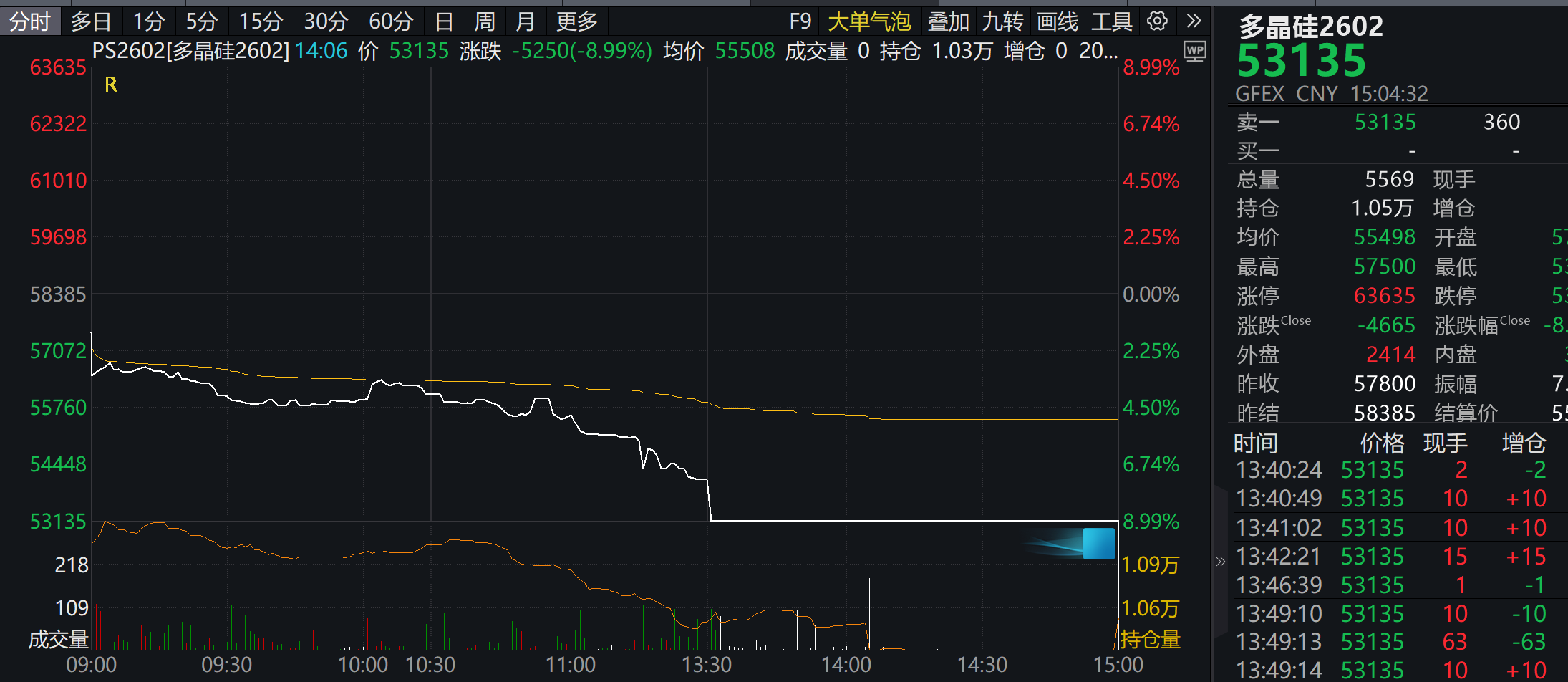
1月8日,一则消息冲击多晶硅期货市场。 有消息称,国家市场监督管理总局1月6日在北京约谈通威、协鑫、大全等多晶硅龙头企业以及中国光伏行业协会,通报有关垄断风险,并提出 整改意见。 据相关消息,国家市场监督管理总局先通报了一些情况: 自2025年7月以来,市场出现多起举报,以行业自律为名,推动多晶硅涨价;相关企业签订承诺函,制定行业整合方案,成立平台公司来 根据需求定产,动态调整,实现产销平衡,但有举报称上述行为名义调整产能,实际控制产销量,根据出资比例瓜分市场,挤压下游空 间;市场监督管理总局前期多次提示要依法依规,光伏行业协会未向总局反馈推进进度。 记者丨曹恩惠 编辑丨张伟贤 不过,该知情人士进一步向记者表示, 多晶硅企业以及光伏行业协会被约谈后,业内所关注的硅料收储平台公司的推进节奏或受到影响。 2025年12月9日,硅料收储平台公司"北京光和谦成科技有限责任公司"成立,注册资金为30亿元,由通威、协鑫、东方希望、大全能源等九大 硅料巨头与中国光伏行业协会共同出资。据另一位知情人士此前向21世纪经济报道记者确认:"光和谦成不存在谁是大股东,也无实控人。" 上述公司的设立,刺激着多晶硅期货市场走出了长达一周 ...


政策预期反复,多晶硅领跌新能源金属
Zhong Xin Qi Huo· 2026-01-09 01:00
Report Industry Investment Rating - Not provided in the content Core Viewpoints of the Report - In the short - to medium - term, due to the repeated policy expectations, the trends of new energy metals are diverging, with silicon materials experiencing a sharp decline. Long - term supply contraction of silicon is expected, and the long - term supply - demand situation of lithium carbonate needs to be re - evaluated [2] - The market sentiment for industrial silicon has cooled, and the silicon price has dropped significantly. The price of polysilicon continues to be highly volatile due to repeated policy expectations. The market sentiment for lithium carbonate has weakened, and the lithium price is oscillating at a high level [2][3] Summary by Relevant Catalogs 1.行情观点 Industrial Silicon - **Viewpoint**: Market sentiment has cooled, and the silicon price has dropped significantly, with an expected oscillating trend [3][6] - **Information Analysis**: As of January 8, the spot prices of industrial silicon were stable. The domestic inventory decreased by 1.3% month - on - month, with market inventory down 0.5% and factory inventory down 1.8%. In December 2025, domestic monthly production was 39.7 tons, down 1.2% month - on - month but up 19.8% year - on - year. From January to December, the cumulative production was 426.8 tons, down 12.9% year - on - year. In November, exports were 54,888 tons, up 21.8% month - on - month and 3.7% year - on - year. From January to November, cumulative exports were 660,000 tons, down 0.8% year - on - year. In November, new photovoltaic installations were 22GW, up 75% month - on - month but down 12% year - on - year. From January to November, cumulative new installations were 275GW, up 33% year - on - year. Shaanxi plans to implement a differential electricity price policy for industrial silicon enterprises from July 1, 2026 [6] - **Main Logic**: On the supply side, some northern silicon plants may stop production for maintenance in January, and the supply pressure from the northwest may ease slightly. The southwest is in a dry season, and the operating rates in Yunnan and Sichuan have dropped. On the demand side, the demand from polysilicon, organic silicon, and aluminum alloy industries is weak. The industry inventory has slightly increased, and the overall inventory is under pressure. The supply pressure has been partially relieved, but the demand has also weakened, and the fundamentals remain weak [6] Polysilicon - **Viewpoint**: Policy expectations are repeated, and the polysilicon price continues to be highly volatile, with an expected oscillating trend [3][6] - **Information Analysis**: In the week of January 8, the average transaction price of N - type re - feedstock was 59,200 yuan/ton, up 9.83% week - on - week. The number of polysilicon warehouse receipts on the Guangzhou Futures Exchange increased by 50 to 4,390. In November 2025, the export volume was about 3,230 tons, down 18% year - on - year; from January to November, the cumulative export volume was 23,445 tons, down 32% year - on - year. The import volume in November was about 1,055 tons, down 62% year - on - year; from January to November, the cumulative import volume was 17,178 tons, down 53% year - on - year. From January to November 2025, the new domestic photovoltaic installation capacity was 274.89GW, up 33% year - on - year. A polysilicon platform company was registered, and the Guangzhou Futures Exchange added new registered brands [6][7][8] - **Main Logic**: The concern about polysilicon antitrust has increased, and the price has dropped significantly. In the dry season, the production in the southwest has decreased. The photovoltaic installation growth rate was high in the first five months but declined in the second half of the year, and the demand for polysilicon has gradually weakened since November. The demand has declined marginally, and the weak fundamentals remain unchanged, so the price may be under pressure [10] Lithium Carbonate - **Viewpoint**: Market sentiment has weakened, and the lithium price is oscillating at a high level, with an expected slightly strong oscillating trend [3][6] - **Information Analysis**: On January 8, the closing price of the lithium carbonate main contract increased by 1.9% to 145,000 yuan/ton, and the total open interest increased by 25,949 to 989,870. The spot prices of battery - grade and industrial - grade lithium carbonate increased by 5,000 yuan/ton, and the average price of spodumene concentrate increased by 30 dollars/ton. The number of warehouse receipts increased by 590 to 25,770. The weekly production increased by 115 tons to 22,535 tons, and the inventory increased by 337 tons to 109,972 tons, with different changes in different links [11] - **Main Logic**: The current demand for lithium carbonate has weakened marginally, but the long - term demand expectation is strong, and the supply remains high. The market is optimistic about January's demand. The new policy may affect the short - term supply release, and geopolitical issues also pose challenges to supply. The fundamentals are slightly weak, but the long - term expectation is good, with frequent supply disturbances. The price is expected to be slightly strong in oscillation. It is not advisable to chase the high price, and it is recommended to buy on dips [12] 2.行情监测 - **Industrial Silicon**: Not provided with specific content - **Polysilicon**: Not provided with specific content - **Lithium Carbonate**: Not provided with specific content 3.中信期货商品指数 2026 - 01 - 08 - **Comprehensive Index**: The comprehensive index was 2,380.19, down 1.06%; the commodity 20 index was 2,717.76, down 1.00%; the industrial products index was 2,317.04, down 1.19% [54] - **New Energy Commodity Index**: On January 8, 2026, the index was 535.38, with a daily decline of 2.75%, a 5 - day increase of 5.04%, a one - month increase of 23.24%, and a year - to - date increase of 5.04% [56]
多晶硅期货跌停!知情人士:多晶硅龙头被约谈确有其事
2 1 Shi Ji Jing Ji Bao Dao· 2026-01-08 13:33
Core Viewpoint - The National Market Supervision Administration has raised concerns about potential monopoly risks in the polysilicon market, leading to a significant drop in polysilicon futures prices following a meeting with major industry players [3][4]. Group 1: Regulatory Actions - The National Market Supervision Administration held discussions with leading polysilicon companies and the China Photovoltaic Industry Association, addressing reports of price manipulation and monopolistic practices [3]. - The administration has mandated a comprehensive review of existing practices, requiring companies to submit detailed reports on their agreements and operational structures by January 20 [4]. - Specific corrective measures include prohibiting agreements on production capacity, sales prices, and market division based on investment ratios [4]. Group 2: Market Impact - Following the news, polysilicon futures experienced a significant decline, with prices reported at 53,100 CNY to 53,600 CNY per ton by the close of trading on January 8 [4]. - The establishment of the "Beijing Guanghe Qiancheng Technology Co., Ltd." as a polysilicon storage platform had previously stimulated a week-long price increase in the polysilicon market [5]. Group 3: Industry Dynamics - The polysilicon storage platform aims to address the issue of "involution" in the photovoltaic industry through a dual-track model of "debt acquisition + flexible capacity utilization" [5]. - Industry experts emphasize the need for the photovoltaic sector to avoid monopolistic practices while attempting to mitigate harmful price competition [6]. - Recent data indicates a rise in polysilicon prices, with average transaction prices for N-type polysilicon increasing by approximately 9.83% week-on-week [7].
传光伏行业自律全面叫停!市场监管总局约谈多晶硅龙头企业及光伏行业协会
Zheng Quan Shi Bao· 2026-01-08 11:15
1月8日,光伏行业流传出一份市场监管总局约谈了光伏协会、通威、协鑫、大全、新特、亚硅、东方希 望等单位的会议纪要。纪要显示,该会议就多晶硅及光伏行业近期推动的自律行动,通报有关垄断风 险、提出明确整改意见并对企业做好整改工作提出要求等。 纪要显示,会议主要内容包括: 反垄断通报有关垄断风险,主要存在于: 1、通报自2025年7月以来,市场多起举报,以行业自律为名,推动多晶硅涨价。 2、企业签订承诺函,制定行业整合方案,并在12月9日成立平台公司。平台公司根据需求决定动态调 整,实现产销平衡。上述行为名义调整产能,实际是控制产销量,根据出资比例瓜分市场,挤压下游空 间。 3、前期多次提示,要依法依规,协会未向总局反馈推进进度。 市场监管总局对上述行为提出了明确的整改意见,具体包括: 1、已经开展的行为,要求全面梳理,完成完整的情况说明,对出资协议、公司章程、股权收购协议、 备忘录、承诺函、会议纪要进行系统整理提供。 2、要求协会、企业制定整改方案: 不得约定产能、产能利用率、产销量以及销售价格; 不得通过出资比例,以任何形式进行市场划分、产量分配、利润分配; 不得当前、今后就价格、成本、产销量等信息开展沟通协调 ...
高官集体“懵圈”!特朗普再出“乱拳”,分析师锐评其像民主党人
Jin Shi Shu Ju· 2026-01-08 10:07
Group 1 - Trump's proposal to ban large institutional investors from purchasing single-family homes aims to address housing affordability issues, which are a significant concern for voters ahead of the midterm elections [3][4] - The housing market is currently facing a severe shortage of available homes, high mortgage rates, and historically high prices, contributing to public frustration with the economy [3] - The stock prices of real estate companies, such as Blackstone, fell sharply by 5.6% following Trump's announcement, indicating market reaction to the proposed policy [3] Group 2 - Trump's statements regarding defense contractors suggest a shift towards more progressive economic policies, as he criticized these companies for profiting from government contracts while rewarding shareholders instead of benefiting the public [4] - The defense sector experienced significant stock declines in response to Trump's demands for contractors to stop dividends and stock buybacks, as well as to limit executive compensation [4][5] - Investors are unsettled by the sudden and unexpected nature of Trump's policy announcements, which have historically led to significant market impacts [5]

反垄断执法后,有药品价格下降超95%
Xin Lang Cai Jing· 2026-01-08 03:31
Group 1 - The core viewpoint emphasizes the importance of antitrust measures in safeguarding public welfare and ensuring fair market competition, as highlighted by the recent achievements in the anti-monopoly sector [1][2] - In the past three years, the National Market Supervision Administration has handled 35 cases of monopoly agreements and 25 cases of abuse of market dominance, resulting in a total fine of 2.93 billion yuan [1] - Antitrust actions have led to significant price reductions in essential medicines, such as a more than 95% decrease in the price of a critical antibiotic, showcasing the direct impact on consumer welfare [1] Group 2 - The antitrust efforts in the public welfare sector serve as a benchmark for eliminating administrative barriers and local protectionism, particularly in industries characterized by natural monopolies [2] - A systematic governance approach is necessary for effective antitrust enforcement, which includes the implementation of fair competition review systems and innovative regulatory tools to address emerging issues [2] - The challenges of uncovering hidden monopolistic agreements and the complexities of market dominance require a strong commitment to reform and regulatory diligence to meet public expectations for a transparent market and fair pricing [2]