
商业航天

Search documents
融资破纪录,项目加速跑,“成都造”火箭基地年底亮相丨人勤春来早
Sou Hu Cai Jing· 2026-02-26 12:10
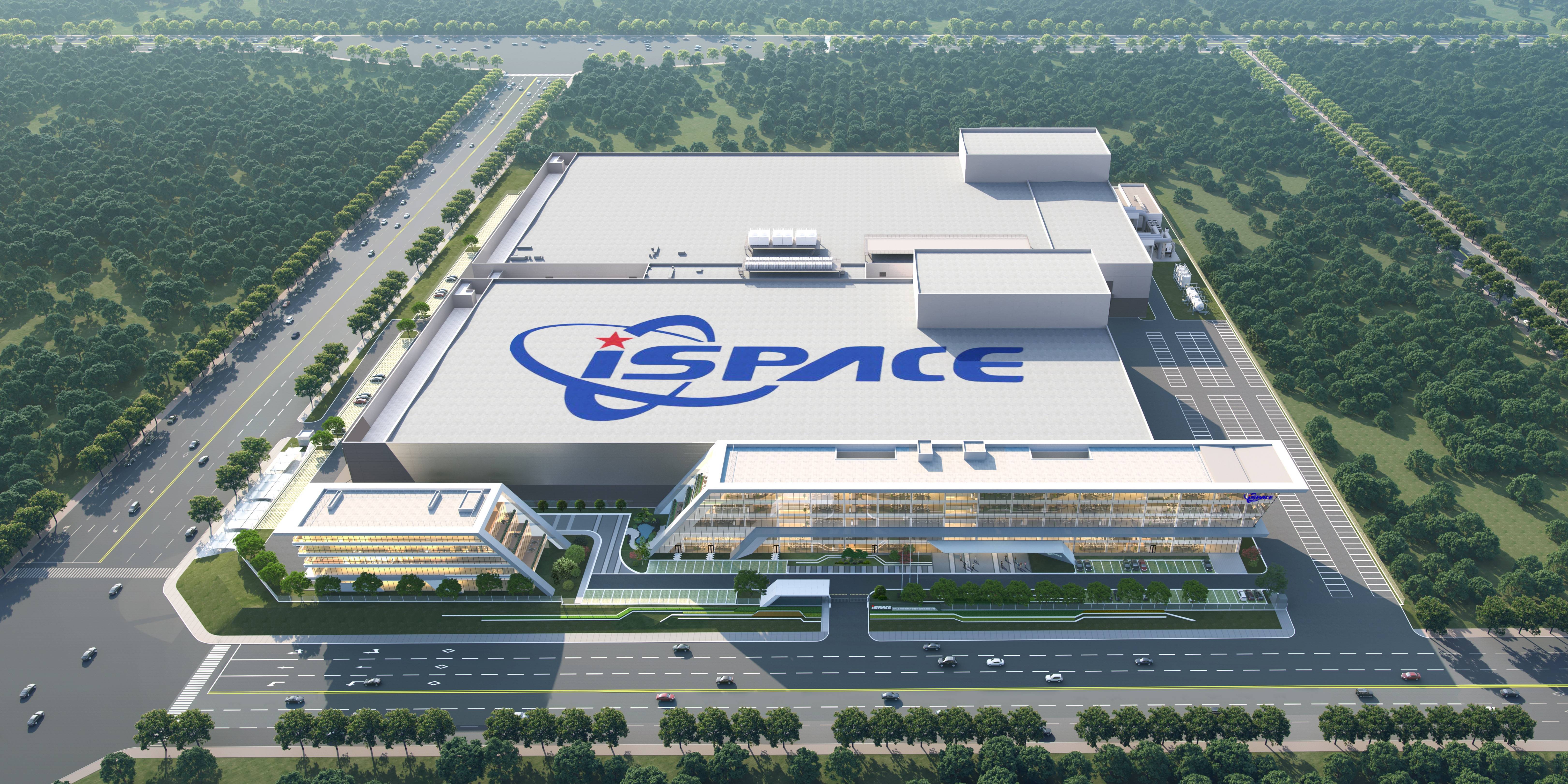
Core Insights - The article highlights the rapid progress of the reusable liquid rocket production headquarters project by Galactic Glory Aerospace Technology Group in Chengdu, which has resumed full operations after the holiday and is supported by a record-breaking financing round of 5.037 billion yuan [1][4][6]. Financing and Project Development - Galactic Glory has recently completed a D++ round of financing amounting to 5.037 billion yuan, setting a record for single financing in China's commercial rocket sector [1][6]. - The project, with a total investment of 3.3 billion yuan and covering an area of 200 acres, is expected to complete its civil construction by June and be fully operational by the end of the year [4][6]. - The facility will have an annual production capacity of 20 H-IIA rockets, which is anticipated to meet national satellite networking and commercial space needs within the next 3 to 5 years [6][12]. Strategic Importance and Policy Support - The project aligns with Chengdu's strategic goals to enhance its aerospace industry and is part of a broader initiative to develop key industrial chains for high-quality growth [1][12]. - Chengdu's strong industrial foundation, including a robust aerospace sector and supportive government policies, has been crucial for the project's rapid advancement [6][12]. - The city has over 1,000 aerospace-related enterprises, contributing to an industry scale of nearly 140 billion yuan, making the Galactic Glory project a key component in completing the local rocket assembly capabilities [12]. Future Goals and Industry Outlook - The company aims to achieve the first flight of its reusable rocket and sea recovery by 2026, while also accelerating production capacity in Chengdu [12]. - The favorable business environment and comprehensive support from local government are expected to enhance the company's growth prospects in the region [12].

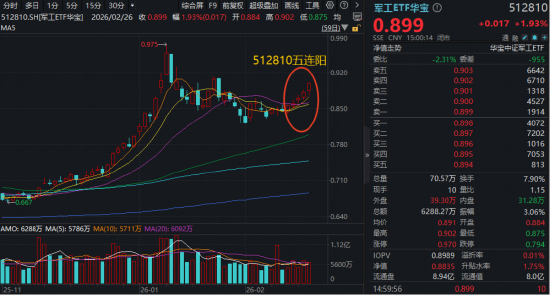
一马当先!军工股批量涨超10%,军工ETF华宝(512810)摸高2.27%豪取五连阳!行情催化剂有哪些?
Xin Lang Cai Jing· 2026-02-26 11:44
Core Viewpoint - The military industry sector continues to show strong growth, with significant gains in military ETFs and individual stocks, driven by various catalysts in commercial aerospace, large aircraft production, and low-altitude economy [1][3][6] Group 1: Market Performance - On February 26, the military sector saw a V-shaped recovery and continued to rise, with the popular military ETF Huabao (512810) peaking at 2.27% and closing up 1.93%, achieving a daily fluctuation of over 3% and marking five consecutive days of gains [1][6] - Among the 63 constituent stocks, 63 increased while 17 decreased, with Huafeng Technology and Gangyan High-tech leading the gains at 14.66% and 13.23% respectively, while several stocks including Hongyuan Electronics and Yingliu Co. reached their daily limit [1][6] Group 2: Catalysts for Growth - Key drivers for the military sector include advancements in commercial aerospace, large aircraft production, and the low-altitude economy, which have sparked increased investor enthusiasm [3][8] - In the commercial aerospace sector, the reusable rocket Zhuque-3 is set for recovery tests in Q2, and the reusable liquid rocket Lijian-2 is scheduled for its maiden flight in late March, carrying the prototype of the Light Boat-1 cargo spacecraft [3][8] - The large aircraft production capacity is expected to accelerate, with plans to produce 150 C919 aircraft annually within five years, potentially generating an annual output value of 100 billion yuan [3][8] - The low-altitude economy is receiving support from various provinces, including Guangdong, Anhui, and Hainan, which have outlined plans to promote industry development [3][8] Group 3: Investment Opportunities - Investment recommendations from Galaxy Securities suggest focusing on commercial aerospace, military trade, and intelligent equipment opportunities [3][8] - Dongfang Securities emphasizes the need to increase allocations in large aircraft production and military trade, particularly in new markets in the Middle East, as recent geopolitical events may enhance these prospects [3][8] - The Huabao military ETF (512810) covers various hot themes such as commercial aerospace, large aircraft, low-altitude economy, satellite navigation, military informationization, and controllable nuclear fusion, serving as an efficient tool for investing in core military assets [3][8]
运力紧张推升油轮运费 全球油轮费率续创六年新高丨A股明日线索
2 1 Shi Ji Jing Ji Bao Dao· 2026-02-26 11:22
Group 1: Oil Shipping Industry - The recent tensions between the US and Iran have led to a significant increase in daily rental rates for Very Large Crude Carriers (VLCC), surpassing $200,000 per day, marking a new high since 2020 [1] - The increase in oil shipping costs is attributed to a rise in crude oil exports from the Middle East as traders seek to secure shipping capacity before potential conflicts [1] - Huayuan Securities predicts that the strong performance of VLCC rates in Q1 2026 will be driven by favorable trends in fundamentals, supply-side restructuring, and geopolitical changes, suggesting a prolonged "oil shipping boom" [1] Group 2: Smartphone Industry - The Chinese smartphone market is expected to experience a comprehensive price increase starting in March 2026, marking the first time multiple brands and categories will raise prices simultaneously [2] - New smartphone models released after March are anticipated to see price hikes of over 1,000 yuan, with high-end flagship models potentially increasing by 2,000 to 3,000 yuan compared to previous generations [2] - The price increases are driven by a sustained rise in upstream component costs, particularly storage chips, which have seen an over 80% increase in procurement costs compared to the previous year [2] Group 3: Semiconductor Industry - The demand for storage components is being driven by AI, with TrendForce forecasting a 144% increase in DRAM market value to $404.3 billion and a 112% increase in NAND Flash value to $147.3 billion by 2026 [3] - The semiconductor sector is experiencing a broader price increase for passive components, with major manufacturers like Murata discussing price hikes for MLCCs due to rising raw material costs and increased demand from AI and automotive sectors [4] Group 4: AI and Cooling Technology - Akash Systems has delivered the first commercial AI servers utilizing Diamond Cooling technology to NxtGen AI, marking a significant innovation in the AI chip market [6] - The potential market for diamond cooling solutions in AI chips is estimated to range from 7.5 billion to 150 billion yuan by 2030, depending on the penetration rates of this technology [6] Group 5: Commercial Space Industry - The commercial space sector is seeing renewed interest with the upcoming launch of the recoverable liquid rocket "Li Jian No. 2" by China Aerospace, scheduled for late March [7] - The company plans multiple launches throughout the year, including satellite internet deployment and significant national missions, reinforcing its position in the commercial launch market [7][9]
紫光股份:公司始终高度关注国家战略发展需求及前沿技术演进
Zheng Quan Ri Bao Zhi Sheng· 2026-02-26 10:19
Core Viewpoint - The company emphasizes its role as a strategic partner in satellite internet, which is a crucial component of 6G technology, leveraging its strengths in ICT infrastructure and intelligent computing to provide comprehensive ICT services for 6G networks [1] Group 1: Company Initiatives - The company is involved in various ICT hardware and software service projects, including switches, security firewalls, and computing servers, which have already been delivered at scale [1] - The company has undertaken a series of cloud pool system constructions, showcasing its commitment to enhancing its service offerings in the ICT sector [1] Group 2: Strategic Focus - The company remains attentive to national strategic development needs and advancements in cutting-edge technologies, aligning its initiatives with market demands and policy directions [1] - The company aims to leverage its technological advantages in communication and security to create diverse value for high-quality development, while ensuring that its strategies are in line with overall corporate goals [1]

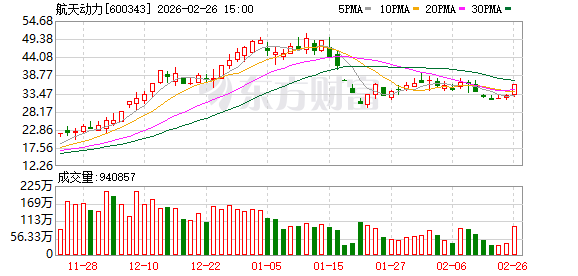
又现满屏涨停!商业航天板块狂欢,航天动力涨停
2 1 Shi Ji Jing Ji Bao Dao· 2026-02-26 08:53
Group 1 - The core viewpoint of the article highlights the mixed performance of the three major indices, with the ChiNext Index experiencing a drop of over 1% at one point, while the commercial aerospace sector saw significant gains, with stocks like Chunhui Zhikong and Zhongke Environmental Protection hitting the daily limit of 20% [2] - The commercial aerospace sector is identified as a market leader, driven by four key factors: collaboration between central and local governments, a surge in financing and IPOs, the onset of high-frequency launches, and technological breakthroughs leading to a new era of high-capacity operations [2] - Huolong Securities indicates that China's commercial rocket launches are entering a phase of scale, with policies continuously supporting growth, and the market size expected to exceed 2.5 trillion yuan by the end of 2025 [2] Group 2 - By the end of 2025, China is projected to have a cumulative total of 95 commercial rocket launches, marking the beginning of large-scale launch operations for national satellite constellations [2] - The primary investment areas in the commercial aerospace market are identified as rocket and satellite manufacturing, with a focus on the development of various reusable rockets entering the recovery verification phase by the end of 2025 [2]





2025商业航天报告:中国商业航天行业发展研究报告
Sou Hu Cai Jing· 2026-02-26 08:28
Core Insights - The report highlights that China's commercial space industry is entering a period of rapid development, driven by accelerated construction of space-based networks and the rise of private enterprises as key engines of growth [1][2]. Group 1: Industry Overview - The global space economy is projected to reach $415 billion by 2024, with commercial space contributing approximately 70% of this revenue, establishing itself as the dominant force in the industry [1]. - The emergence of private companies, exemplified by SpaceX, has led to a significant transformation in the space sector, shifting from government-led initiatives to market-driven activities [1][12]. Group 2: Policy Support - China's commercial space development has been significantly bolstered by clear and robust policy guidance since 2014, encouraging private capital participation and designating commercial space as a "strategic emerging industry" [2][23]. - Multiple provinces, including Beijing, Shanghai, and Guangdong, have introduced specialized action plans to foster regional commercial space industry clusters, enhancing the overall ecosystem [2][25]. Group 3: Technological Advancements - Key technological breakthroughs, particularly in reusable rocket technology, are essential for reducing launch costs and expanding market opportunities [3]. - Companies like Blue Arrow Aerospace and Galactic Glory are making significant progress in critical technology areas, such as liquid oxygen-methane engines and vertical landing recovery systems [3]. Group 4: Future Trends - The integration of commercial space with cutting-edge information technologies is expanding application boundaries, with AI models being utilized for satellite image analysis, enhancing data processing efficiency [4]. - A vision for a seamless information network integrating air, space, land, and sea is emerging, with satellite communication playing a crucial role in bridging the digital divide [4]. Group 5: Challenges Ahead - Despite the promising outlook, challenges remain, including the need for reliable rocket recovery, management of large satellite constellations, and addressing space debris [5]. - The commercial space sector faces high investment costs and long cycles, with economies of scale yet to fully materialize, placing ongoing pressure on companies [5].


通信行业专题报告:商业航天快速发展,火箭及卫星制造率先受益
CHINA DRAGON SECURITIES· 2026-02-26 07:45
Investment Rating - The report maintains a "Recommended" investment rating for the commercial aerospace industry [1]. Core Insights - The commercial aerospace sector is experiencing rapid development, particularly benefiting rocket and satellite manufacturing. The market size is expected to exceed 25 trillion yuan by 2025, with a compound annual growth rate of 20.84% from 2015 to 2025 [6][54]. - The competition for frequency and orbital resources is intensifying globally, with the number of satellites in orbit reaching 16,881 by the end of 2025, nearly four times that of 2021. The U.S. and China dominate satellite launches, accounting for 83% of global launches [6][25][71]. - China's commercial rocket launches have entered a phase of scale, with 95 launches completed by the end of 2025, marking a significant increase in market activity and policy support [6][38][71]. Summary by Sections 1. Intense Competition for Frequency and Orbital Resources - The Earth can safely accommodate approximately 60,000 to 100,000 satellites in low Earth orbit. By the end of 2025, the number of satellites in orbit reached 16,881, a significant increase from previous years. The competition for satellite frequency and orbital resources is becoming increasingly fierce, with over 1.29 million satellites proposed by major constellations in China and the U.S. [6][19][71]. 2. Accelerated Global Satellite Deployment, Dominated by the U.S. and China - The global satellite landscape remains concentrated among a few key players, with the U.S., Russia, and China leading. In 2025, there were 329 rocket launches globally, with a success rate of 97.5%. The U.S. led with 181 launches, followed by China with 92 [6][25][71]. 3. China's Commercial Aerospace Enters a Phase of Scale - By the end of 2025, China had completed 95 commercial rocket launches, indicating a shift towards large-scale launches. The market size for commercial aerospace in China surpassed 25 trillion yuan, with significant investments in rocket and satellite manufacturing [6][38][54][71]. 4. Rockets Determine Capacity, Satellites Determine Capability, Applications and Services Determine Scale - The report emphasizes that rockets are foundational to the aerospace industry, with the market expected to reach a scale of hundreds of billions. Satellite manufacturing is identified as the core value of commercial aerospace, with significant growth anticipated in related industries [58][61][67]. 5. Investment Recommendations - The report suggests focusing on specific companies within the commercial aerospace sector, including: - Rocket Launch: Chaojie Co., Ltd. (301005.SZ), Srey New Materials (688102.SH), Plittech (688333.SH), and Zhongtian Rocket (003009.SZ) - Satellite Manufacturing: China Satellite (600118.SH), Zhenlei Technology (688270.SH), and Aerospace Electronics (600879.SH) - Satellite Applications: Zhongke Xingtou (688568.SH) and Huace Navigation (300627.SZ) [6][71].




广东博众|机械行业 2026 年锚定三大高成长赛道 结构性机遇显现
Cai Fu Zai Xian· 2026-02-26 07:34
Core Viewpoint - The mechanical industry has shown strong performance in December 2025, with a focus on three high-growth areas: AI infrastructure, humanoid robots, and commercial aerospace, while also highlighting structural opportunities in engineering machinery recovery, self-sufficiency, and export chains [1][7]. Group 1: Industry Performance - In December 2025, the mechanical industry performed exceptionally well, with the Shenwan Mechanical Index rising by 8.59%, significantly outperforming the CSI 300 Index by 6.31 percentage points [1]. - Key sub-sectors such as photovoltaic equipment, semiconductor equipment, and coal machinery saw substantial gains, with increases of 22.20%, 13.63%, and 13.30% respectively [1]. - Individual stocks also performed well, with Haozhi Electromechanical leading the industry with a 117.85% increase, and several other companies exceeding 50% growth [1]. Group 2: Valuation and Macro Data - As of December 31, 2025, the mechanical industry's TTM price-to-earnings ratio was 39.31 times, and the price-to-book ratio was 3.18 times, indicating a valuation in the upper-middle range over the past five years [2]. - The manufacturing PMI rose to 50.10%, marking the first expansion since April, while the equipment manufacturing PMI reached 50.40%, and the high-tech manufacturing PMI remained high at 52.50% [2]. - Industrial robots showed significant growth, with a cumulative production of 673,800 units from January to November 2025, representing a year-on-year increase of 29.20% [2]. Group 3: Industry Opportunities - The mechanical industry is currently experiencing three major opportunities: domestic industrial upgrading, self-sufficiency, and accelerated overseas expansion [3]. - High-end equipment self-sufficiency is becoming a cornerstone of industry development, with ongoing breakthroughs in core components and high-end equipment [3]. - The industry is transitioning from "Made in China" to "Created in China," driven by the deep application of industrial interconnectivity and AI [3]. Group 4: Investment Focus - The investment strategy for January 2026 emphasizes three high-growth areas: AI infrastructure, humanoid robots, and commercial aerospace, each with clear driving logic and growth potential [4][5]. - In the AI infrastructure sector, the demand for AI computing power is driving upgrades in the infrastructure supply chain, with gas turbines and liquid cooling becoming key focus areas [4]. - Humanoid robots are moving towards commercial mass production, with several manufacturers receiving large orders, indicating significant long-term growth potential [5]. Group 5: Structural Opportunities - Beyond the three high-growth areas, other structural opportunities in the mechanical industry are also worth exploring, such as the recovery of the engineering machinery sector and the focus on low domestic localization rates in core segments [6]. - The detection services industry is stable with strong cash flow, and current valuations are at historical lows, presenting potential investment opportunities [6]. - Companies in the tool and kitchen equipment sectors are benefiting from overseas replenishment cycles, while engineering machinery and injection molding machines continue to expand into emerging markets [6].
收评:三大股指涨跌不一 算力芯片概念爆发
Xin Lang Cai Jing· 2026-02-26 07:15
Market Overview - The market experienced a mixed performance with the three major indices showing varied results. The Shanghai Composite Index closed at 4146.63 points, down 0.01%, while the Shenzhen Component Index rose 0.19% to 14503.79 points, and the ChiNext Index fell 0.29% to 3344.98 points. Overall, more than 2800 stocks declined across the two markets [2][13]. Key Sectors Computing Power Chips - The computing power chip sector saw significant gains, with stocks like Cambrian rising nearly 10%, and companies such as Jufei Optoelectronics and Jepter hitting the daily limit. Haiguang Information, a leading domestic computing power chip company, announced an expected net profit of 620 million to 720 million yuan for Q1, representing a year-on-year growth of 22.56% to 42.32% [4][15]. Power Grid Equipment - The power grid equipment sector also performed well, with stocks like Beijing Keri, Shenneng Co., and Hangdian Co. reaching their daily limits. A report indicated that North America faces a 30% supply gap for power transformers and a 6% gap for distribution transformers, with import dependency rates at 80% and 50%, respectively. By 2025, China's transformer export value is projected to grow by 36%, with an average price of $20,800 per unit [5][16]. Corporate Responses Lithium Mining in Zimbabwe - Several listed companies, including Shengxin Lithium Energy and Zhongmin Resources, responded to Zimbabwe's recent suspension of lithium ore and concentrate exports. Zhongmin Resources confirmed that all exports of lithium concentrate from Chinese companies in Zimbabwe have halted pending further policy details. Other companies like Huayou Cobalt and Yahua Group indicated that they are either unaffected or have already shipped their products prior to the ban [7][17]. Longcheng High-tech's New Drug Development - Longcheng High-tech addressed rumors regarding its investigational product GenSci141, clarifying that it is currently only approved for clinical trials and that the indications must strictly follow the approved documentation. The product is in the transition phase from preclinical to clinical stages, with a minimum of three years required for market approval [7][17]. Policy Impacts Real Estate Market - Recent policies in Shanghai aimed at reducing the threshold for home purchases are expected to stimulate demand in the real estate market. Analysts believe that these measures will help stabilize the market and support a gradual recovery, particularly benefiting leading real estate companies with lower financing costs and high market shares in core areas [9][19]. Industry Developments Horse Industry in Guangzhou - Guangzhou is planning to establish a 10 square kilometer deep cooperation zone for the horse industry, aiming to create a world-class horse industry hub. The Hong Kong Jockey Club's horse racing venue in Conghua is set to host international standard races, enhancing the region's appeal in the horse industry [8][18].


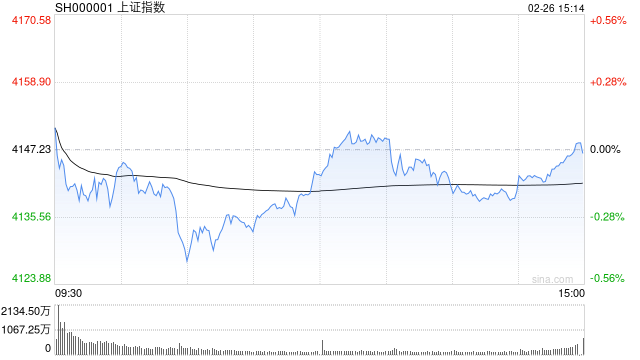
A股收评:沪指微跌0.01%、创业板指跌0.29%,算力硬件、电力及燃气轮机概念股普涨,小金属概念股活跃、影视院线概念股继续调整
Jin Rong Jie· 2026-02-26 07:11
Market Overview - The A-share market exhibited a weak oscillation pattern on February 26, with the Shanghai Composite Index closing at 4146.63 points, down 0.01%, while the Shenzhen Component Index rose 0.19% to 14503.79 points. The ChiNext Index fell 0.29% to 3344.98 points, and the STAR Market 50 Index increased by 0.85% to 1485.86 points. The total trading volume in the Shanghai and Shenzhen markets reached 2.54 trillion yuan, an increase of 759 billion yuan from the previous trading day, with over 2800 stocks declining [1]. Key Sectors Computing Power Sector - The computing power sector saw significant activity, driven by Nvidia's impressive earnings report, which boosted global market confidence in AI computing power. Nvidia's CEO highlighted the arrival of an "AI inflection point," further energizing the market. Stocks in the computing power hardware sector, including optical fiber cables, PCBs, and liquid-cooled servers, experienced strong performance, with companies like Huadian Technology and ShenNan Circuit hitting their daily limits [2]. Power Sector - The power and power grid equipment stocks showed a clear upward trend, with companies like Shima Power and Huayin Power reaching their daily limits. The National Energy Administration's recent announcement regarding the addition of 45.2 million kilowatts of renewable energy generation capacity by 2025, a 21% year-on-year increase, provided solid support for the rise in power stocks [3]. Commercial Aerospace Sector - The commercial aerospace sector continued to gain momentum, with stocks like Fushun Special Steel and Aerospace Power hitting their daily limits. The upcoming launch of the reusable liquid-fueled rocket by China Aerospace is expected to enhance the sector's investment appeal, with analysts predicting significant growth potential by 2026 [4]. Minor Metals Sector - The minor metals sector was active, with Yunnan Zhenye and Zhangyuan Tungsten both reaching their daily limits. The U.S. government's plan to establish reference prices for critical minerals, including germanium and tungsten, has stimulated interest in this sector [5]. Underperforming Sectors - The film and cinema sector faced ongoing adjustments, with Bona Film Group experiencing a nearly 9% drop. The real estate sector also saw declines, with companies like Hualian Holdings and Chengdu Investment falling over 5%. Other sectors, including oil services and insurance, also faced downward pressure, indicating a market divergence across different industries [6]. Institutional Insights - JPMorgan's chief strategist indicated that the A-share market has entered a "slow bull" phase, characterized by a focus on earnings rather than just liquidity. The market is expected to see sustainable returns if net profit margins improve [8]. - According to a report from Lianbo Fund, the A-share market is anticipated to shift from "valuation recovery" to "profit-driven" by 2026, with corporate profitability being the key driver for market sustainability [9]. - CITIC Securities highlighted that Zimbabwe's lithium export ban could lead to a short-term supply shortage of lithium carbonate in China, potentially driving up lithium prices and suggesting a focus on unaffected stocks [11].
