
情绪价值

Search documents
“自然之约”缘何成假日新宠?
Xin Hua She· 2025-10-10 09:05
Core Viewpoint - The article highlights a shift in tourism preferences towards nature-based experiences, emphasizing emotional value and a desire for personal rejuvenation in the context of high-pressure urban life [1][2]. Group 1: Changing Tourist Preferences - Tourists are moving away from "service-oriented" travel to "experience-integrated" travel, seeking authentic encounters with nature, such as witnessing sunrises and camping under clear starry skies [2]. - The popularity of nature-related activities like hiking, stargazing, and river tracing is rising on social media, reflecting a growing trend towards immersive experiences in natural settings [1]. Group 2: Infrastructure and Capacity Challenges - Emerging nature travel destinations are struggling with inadequate reception capacity and infrastructure, necessitating comprehensive upgrades to meet increasing tourist demand [2]. - Issues such as insufficient restroom facilities and poor waste management are prevalent, detracting from the overall experience in natural areas [2]. - Transportation challenges, including narrow roads and traffic congestion, significantly impact tourists' enjoyment and travel plans [2]. Group 3: Safety and Environmental Considerations - There are shortcomings in safety and emergency response systems at nature destinations, particularly for inexperienced tourists lacking essential safety knowledge and equipment [2]. - The relationship between tourists and nature should be reciprocal, with visitors respecting the environment while destinations provide necessary infrastructure and safety measures [2][3].
“东湖库里南”的野心:岚图泰山如何用47万定义“中式豪华”?
2 1 Shi Ji Jing Ji Bao Dao· 2025-10-10 08:42
Core Viewpoint - Dongfeng Lantu Automotive is attempting to achieve brand breakthrough through a differentiation strategy in the increasingly competitive Chinese electric vehicle market, focusing on integrating Chinese culture and art into automotive design [1][2]. Group 1: Brand Strategy - Lantu is transforming from functional value to emotional value, aiming to enhance user understanding of Chinese culture through its products [1][2]. - The design language of Lantu is based on the concept of "harmony between heaven and man," drawing inspiration from classic Chinese texts [1][2]. - The naming of Lantu's products, such as "Chasing Light," "Dreamer," and "Taishan," reflects a commitment to Chinese cultural elements [1][2]. Group 2: Product Development - Lantu is refining its high-end product matrix with three flagship models targeting different market segments, including the Lantu Chasing Light L and the Lantu Taishan [2][3]. - The Lantu Taishan, developed over four years, aims to maximize internal space and functionality while providing top-tier safety features [2][3]. - The pricing strategy for the Taishan is tentatively set around 470,000 yuan, focusing on emotional value and social attributes rather than just configuration [2][3]. Group 3: Market Positioning - Lantu aims to compete directly with traditional luxury brands, with the Chasing Light L positioned to challenge established players in the luxury sedan market [2][3]. - The company is adopting a strategy of cultural commonality and localization for international markets, adjusting products based on local driving conditions and preferences [3]. - Lantu is accelerating channel development, planning to expand its number of stores significantly by the end of the year [3]. Group 4: Industry Challenges - The electric vehicle industry is shifting focus from configuration and functionality to social attributes, indicating a more complex competitive landscape [3][4]. - Lantu acknowledges the challenges of creating products with Chinese characteristics in the smart and electric vehicle era, emphasizing the need for innovation [4].
十一黄金周 :一场旅游消费的静悄悄革命
Sou Hu Cai Jing· 2025-10-10 05:03
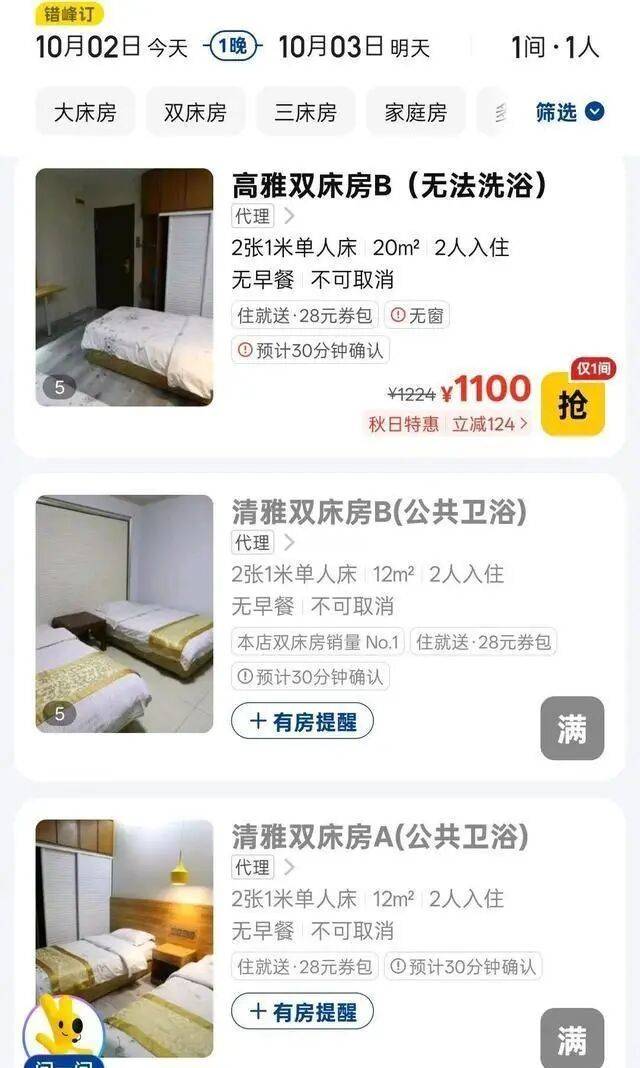
Core Insights - The Chinese tourism market during the 2025 National Day holiday shows a stark contrast, with high-end hotel occupancy rates in places like Lijiang and Dali dropping below 30%, while camping gear searches surged by 470% and rental orders tripled, indicating a shift in consumer preferences driven by younger travelers [1][3] Price Dynamics - The traditional pricing strategy of increasing prices during holidays is failing, as evidenced by the backlash against high hotel prices, with consumers opting for camping instead [1][3] - The "Zibo Effect," where reasonable pricing led to increased tourism revenue, highlights that over 70% of post-95 consumers believe hotel prices exceeding a 30% premium are not worth it, showcasing their adeptness at using alternative strategies to avoid price gouging [3][4] Consumer Empowerment - Today's tourists are no longer passive consumers; social media has made price traps visible, and topics like "National Day Pitfall Guide" have garnered billions of views, empowering consumers to hold businesses accountable [4][5] - Consumers are redefining tourism value, prioritizing unique experiences over traditional luxury offerings, with 41% of post-90s willing to spend significantly on high-end camping gear, but only for experiences that resonate with their values [4][5] Value Evolution - The rise of the camping economy reflects a shift from functional satisfaction to emotional fulfillment in travel, with positive emotional value now surpassing scenic views and culinary experiences as the primary travel goal [5][6] - The unique experiences offered by camping, such as relaxation and authenticity, are more appealing than standardized hotel services, indicating a demand for emotional value in tourism [5][6] Industry Reconstruction and Future Outlook - The revolution in tourism indicates a need for industry integration, with hotels evolving from closed sleeping spaces to open experience hubs, and hybrid models like "hotel + camping" proving successful [6] - The tourism economy is entering a "trust economy" phase, where businesses must prioritize integrity and long-term relationships to build reputation and retain consumers [6] - Future competition will center around the ability to provide emotional experiences that resonate with tourists, signaling the arrival of a "user era" in the tourism industry, where transparency and authenticity are paramount [6]

2025年三季度广州零售市场回顾与展望
Sou Hu Cai Jing· 2025-10-09 13:50
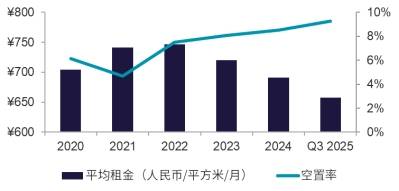
Group 1 - The core viewpoint of the articles highlights the continuous upgrade of experiential consumption and the pet economy in Guangzhou, driven by the upcoming 15th National Games and supportive policies like visa-free transit [1][8] - The retail market in Guangzhou is experiencing a multi-core development trend, with new projects like K11 Select contributing to an increase in the total stock of quality shopping centers to 6.16 million square meters [2][5] - The demand for consumption is steadily released due to the summer peak season and the influx of tourists, leading to a notable increase in family, student, and foreign visitor numbers [2][5] Group 2 - The average rent for quality shopping centers in Guangzhou has decreased by 2.3% to 657.3 yuan per square meter, as landlords adopt more favorable rental strategies to retain tenants [2] - The vacancy rate for quality shopping centers remains relatively stable, with a slight increase of 0.1 percentage points to 9.3% [2] - The rise of experiential consumption is exemplified by the opening of Miniso Land, which integrates retail, experiential zones, and cultural exhibitions, reflecting a shift towards providing emotional value in consumer experiences [7][8] Group 3 - The pet economy is expanding, with new pet-related businesses and services emerging, such as pet-friendly shopping spaces and specialized offerings from brands like Starbucks [7][8] - The upcoming National Games is expected to stimulate consumption and accommodation demand, further enhancing the business environment in Guangzhou [8] - The report indicates that 46.1% of new brands entering the market are in the food and beverage sector, while 41.8% are in retail, showcasing a strong focus on these categories [5]
年轻人热衷“情绪旅游” 激活假日经济
Zhong Guo Xin Wen Wang· 2025-10-09 07:53
Core Insights - The rise of "emotional tourism" during the National Day and Mid-Autumn Festival holidays reflects a shift in young people's travel preferences towards experiences that prioritize emotional value and local culture [1][2][3] Group 1: Emotional Tourism Trends - Young travelers are increasingly seeking experiences that allow them to immerse themselves in local culture, such as tasting local delicacies and engaging with local residents [1] - The concept of "emotional tourism" emphasizes comfort, relaxation, and self-worth, leading travelers to prefer less crowded destinations and unique experiences over traditional sightseeing [1][2] - The popularity of themed travel routes, such as "48-hour treasure village exploration" and "slow travel ceiling," caters to the diverse emotional needs of tourists [1] Group 2: Market Impact and Data - The demand for "emotional tourism" has significantly boosted local tourism markets, as evidenced by a nearly 70% increase in orders for Jingdezhen on Douyin during the first three days of the holiday [2] - Meituan Travel reported over a 30% increase in travel orders during the extended National Day and Mid-Autumn Festival holiday compared to the previous year [2] - The popularity of complex travel products that combine "scene + culture + experience" has surged, with unique offerings like "watching the sunrise from a hotel bed" and "forest villa experiences" gaining traction [2][3]
情绪消费正流行,Soul创始人张璐团队推出《2025 Z世代情绪消费报告》
Sou Hu Cai Jing· 2025-10-09 07:15
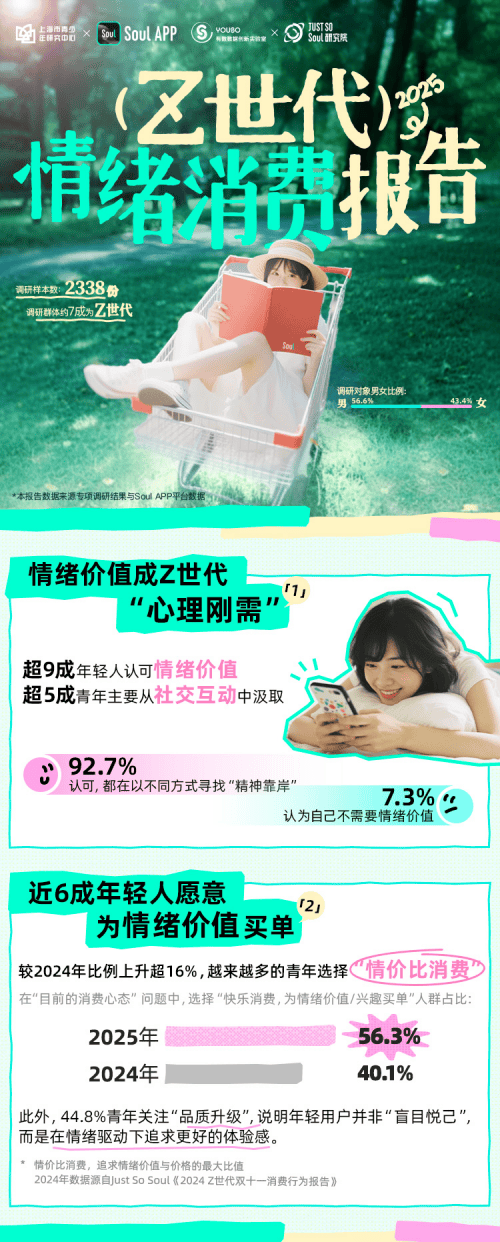
Core Insights - The report titled "2025 Z Generation Emotional Consumption Report" reveals the rising trend of emotional consumption among Generation Z, highlighting the importance of "emotional value" in their purchasing decisions [1][13] Group 1: Emotional Value Recognition - Over 90% of young people recognize "emotional value" and seek "emotional anchoring" in various ways [4] - Nearly 60% of youth are willing to pay for emotional value, marking a 16.2% increase from 2024 [4] - 44.8% of young people focus on "quality upgrades" driven by emotional needs rather than mere self-indulgence [4] Group 2: Spending Patterns - The average monthly spending on emotional consumption among young people is 949 yuan [7] - 37.6% of youth are willing to pay for value resonance, while 34.2% seek self-healing and 32.3% appreciate the significance of rituals in their purchases [7] Group 3: Age-Related Consumption Trends - Younger individuals (post-2005) spend the most on social relationships/services, while those born after 2000 focus more on digital consumption [9] - The trend indicates a growing preference for paying for social relationships and digital experiences among younger demographics [5] Group 4: AI Companionship Innovations - Soul App has developed an AI virtual companionship system, creating highly personalized "AI virtual humans" capable of real-time interaction through various media [10] - The engagement with AI companionship has surged, with related post volume increasing by 6.2 times and search volume by 12 times year-on-year in Q2 2025 [10] Group 5: Consumption Timing and Rationality - Emotional consumption peaks during specific times, notably after 10 PM and during work breaks, with over 50% of youth showing time-dependent consumption patterns [13] - More than 70% of young people believe the threshold for obtaining emotional value through consumption is rising, with 35.7% stating that ordinary products no longer satisfy them [13]
福建90后,又要拿下一个百亿IPO
投中网· 2025-10-09 06:47
Core Viewpoint - The article discusses the transformation of Wancheng Group from a mushroom cultivation company to a leading snack retail empire, highlighting its upcoming IPO on the Hong Kong Stock Exchange and the role of the new generation of leadership in driving this change [3][4][10]. Company Overview - Wancheng Group, founded in 2011 in Fujian, initially focused on mushroom cultivation and became a stable supplier for major retailers like Walmart and Carrefour [5]. - The company went public on the ChiNext board in 2021, achieving a revenue of over 400 million yuan in 2020 and earning the title of "the first stock in edible fungi" [6]. Market Dynamics - The edible fungi market faced saturation and increased competition, leading to a 15%-20% year-on-year price drop, prompting Wancheng Group to pivot towards the snack retail sector [6][7]. - The snack retail market is experiencing rapid growth, with a projected market size of approximately 1.04 trillion yuan in 2024, reflecting a year-on-year growth of 28.6% [10]. Strategic Expansion - Wancheng Group launched its snack brand "Liu Xiaochan" in August 2022 and subsequently acquired several brands to form a dual-brand matrix with "Haoxianglai" and "Wife Daren" [8][10]. - By June 2025, the number of snack stores exceeded 15,365, with "Haoxianglai" accounting for 14,334 of these locations [8]. Competitive Landscape - The main competitor for Wancheng Group is the merged entity "Mingming Hen Mang," which has a projected GMV of 55.5 billion yuan in 2024 and over 14,394 stores nationwide [10]. - Wancheng Group's GMV for 2024 is estimated at 32.33 billion yuan, with a net profit of 611 million yuan [10]. Leadership Transition - The leadership of Wancheng Group is transitioning to the next generation, with Wang Zening, born in 1993, taking over as general manager after his father stepped down [13][14]. - Wang Zening has a strong educational background, holding degrees from the University of Michigan and Columbia University, and has been instrumental in expanding the company's snack retail business [14]. Branding and Marketing Strategy - Wancheng Group is shifting from a price-focused strategy to a brand-oriented approach, leveraging popular IP collaborations to enhance customer engagement and brand appeal [11][12]. - The company aims to create a unique shopping experience that combines affordability with entertainment, similar to the strategy employed by MINISO [12][11]. Financial Performance - The company reported a significant increase in revenue and net profit, with revenue growing by 106% and net profit increasing by 503 times in the first half of 2025 [15]. - The stock price of Wancheng Group was around 173 yuan prior to the National Day holiday, with a market capitalization of approximately 32.5 billion yuan [14].

“鸡排哥”黄金周流量变“留量”,情绪经济是下一个万亿赛道?
3 6 Ke· 2025-10-08 23:48
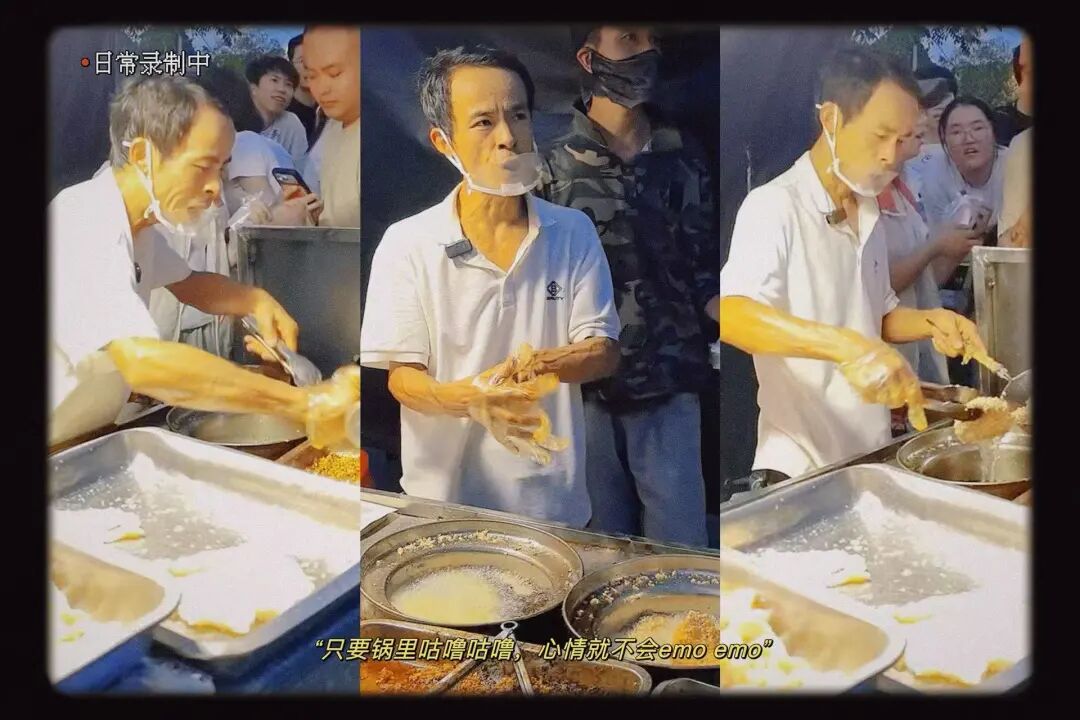
Core Insights - The rise of "Chicken Chop Brother" as a tourism ambassador for Jingdezhen highlights a shift in the tourism industry from hardware competition to emotional economy [1][9] - The National Day holiday saw a significant increase in tourism, with over 330 million trips taken, reflecting a strong recovery in consumer confidence [3][9] - The emotional connection and unique experiences provided by local figures like "Chicken Chop Brother" are becoming key drivers of tourism growth [9][14] Group 1: Impact of "Chicken Chop Brother" - "Chicken Chop Brother" has transformed from a traditional vendor to a cultural icon, attracting visitors not just for food but for the emotional experience [1][5] - His popularity led to a 60% increase in orders for Jingdezhen during the National Day holiday compared to the previous year [7] - The emotional value he provides has turned casual visitors into repeat customers, contributing to a new growth space for local tourism [8][18] Group 2: Emotional Economy in Tourism - The concept of emotional value is becoming a critical factor in tourism decision-making, as consumers seek emotional connections during their travels [14][21] - Similar cases, such as the popularity of Zibo barbecue and Harbin Ice Festival, demonstrate how emotional experiences can drive significant economic growth in tourism [9][12] - Social media plays a crucial role in amplifying emotional value, with platforms like Douyin and Xiaohongshu facilitating the rapid spread of engaging content [14][15][17] Group 3: Future of Tourism - Experts predict that the future of tourism will focus on emotional experiences, with destinations that understand and meet emotional needs likely to dominate the market [21] - The success of "Chicken Chop Brother" illustrates the market's demand for authenticity and genuine emotional engagement over traditional marketing strategies [17][21] - The emotional consumption market is projected to grow significantly, indicating a shift in how tourism experiences are valued [14][15]
“双节”长假新变化:为情绪买单为体验付费
Shang Hai Zheng Quan Bao· 2025-10-08 17:54
Core Insights - The dual holiday period of National Day and Mid-Autumn Festival has led to a significant increase in domestic tourism, with a focus on emotional value and experiential offerings becoming key competitive factors in the cultural tourism industry [1][6]. Domestic Tourism Trends - The National Day and Mid-Autumn Festival holiday lasted 8 days, leading to a 31% year-on-year increase in tourism orders for Xinjiang on the Ctrip platform [1]. - Popular destinations for long-distance travel include Beijing, Chengdu, Shanghai, and others, with orders for cities like Urumqi and Hohhot seeing nearly a 30% increase [2]. - Night tourism has surged, with a 200% increase in search interest on Ctrip during the holiday, and various night activities were organized across Hubei province [2][3]. Cross-Border Travel Growth - There was a nearly 100% year-on-year increase in long-distance group tours for outbound travel during the holiday, particularly from non-first-tier cities [4]. - The demographic for outbound travel is predominantly young adults and families, with 39% of outbound flight purchasers aged 23-30 [4]. - Inbound tourism also saw growth, with Chengdu receiving 2.86 million visitors, a 5.3% increase year-on-year, and a 32% increase in inbound tourists [4]. Industry Evolution - The cultural tourism industry is transitioning from scale expansion to quality enhancement, with a shift in consumer preferences towards deeper, more immersive experiences [6]. - The competition is evolving from resource-based advantages to content innovation centered around cultural IP and technology [6]. - The growth of cultural creative products, particularly in the realm of tourism souvenirs, is expected to be a new growth point for the industry [7].
“情绪价值”成假日文旅新密码
Zhong Guo Xin Wen Wang· 2025-10-08 04:09
Core Insights - The rise of "Chicken Chop Brother" and "Fried Noodle Brother" reflects a new trend in cultural tourism consumption, emphasizing emotional value and personal connection in the market [1][6][8] Group 1: "Chicken Chop Brother" - "Chicken Chop Brother" gained popularity due to his unique marketing approach, offering free chicken while charging for plastic bags, and engaging customers with humorous phrases [2][3] - The stall became a hotspot during the National Day holiday, with long queues forming daily, leading to a significant increase in local tourism and related business sales [2][4] - The emotional connection created by "Chicken Chop Brother" is highlighted by his dedication to quality and customer service, which resonates more with customers than the product itself [3][5] Group 2: "Fried Noodle Brother" - "Fried Noodle Brother" became famous through a heartfelt video where he delivered fried noodles to a friend recovering from an accident, showcasing genuine care and connection [4][5] - The video went viral, accumulating nearly 3.5 million likes and leading to long queues at his stall, indicating a strong emotional response from the public [4][6] - The character of "Fried Noodle Brother" is portrayed as relatable and sincere, which enhances his appeal and fosters a sense of community [4][6] Group 3: Emotional Economy in Cultural Tourism - The stories of "Chicken Chop Brother" and "Fried Noodle Brother" illustrate the shift towards an emotional economy in cultural tourism, where personal stories and connections drive consumer interest [5][6] - The trend indicates that modern travelers are seeking personalized and meaningful experiences rather than traditional sightseeing [7][8] - The success of these individuals highlights the potential for ordinary people to become significant cultural icons, contributing to the local tourism narrative [6][8]