不可能三角

Search documents
货币政策最新定调:如何理解“以我为主”、“支持性”和“Data Based”?
Xin Lang Cai Jing· 2025-09-22 13:57
Core Viewpoint - The People's Bank of China (PBOC) emphasizes a monetary policy framework that is primarily domestic-focused, supportive, and data-driven, distinguishing it from the inflation-targeting approaches of major developed economies [1][2][3]. Group 1: Monetary Policy Principles - The principle of "taking the initiative" in monetary policy means that adjustments will be based on domestic economic conditions rather than merely following global trends [1][2]. - The supportive stance of monetary policy indicates a low interest rate environment, similar to a phase of moderate easing [1][4]. - The "data-based" approach signifies that monetary policy adjustments will rely heavily on economic data, making it more complex due to multiple targets [1][6][7]. Group 2: Economic Context and Expectations - Following the Federal Reserve's interest rate cuts, the PBOC has more room to maneuver its monetary policy, with some market participants anticipating potential rate cuts within the year [3][8]. - Recent economic data from July and August shows signs of weakness, prompting discussions about the likelihood of further rate cuts [8][10]. - Key economic indicators, such as retail sales and fixed asset investment, have shown a slowdown, reinforcing the need for supportive monetary measures [8][10]. Group 3: Future Policy Tools - The PBOC plans to utilize various monetary policy tools to ensure liquidity and support economic recovery, with a focus on reducing financing costs [8][9]. - The potential for new structural monetary policy tools has been highlighted, which could leverage commercial bank funding to stimulate investment [11].
不讲AI的iPhone 17卖爆了,前苹果员工做的AI明星产品又死一个
3 6 Ke· 2025-09-12 07:31
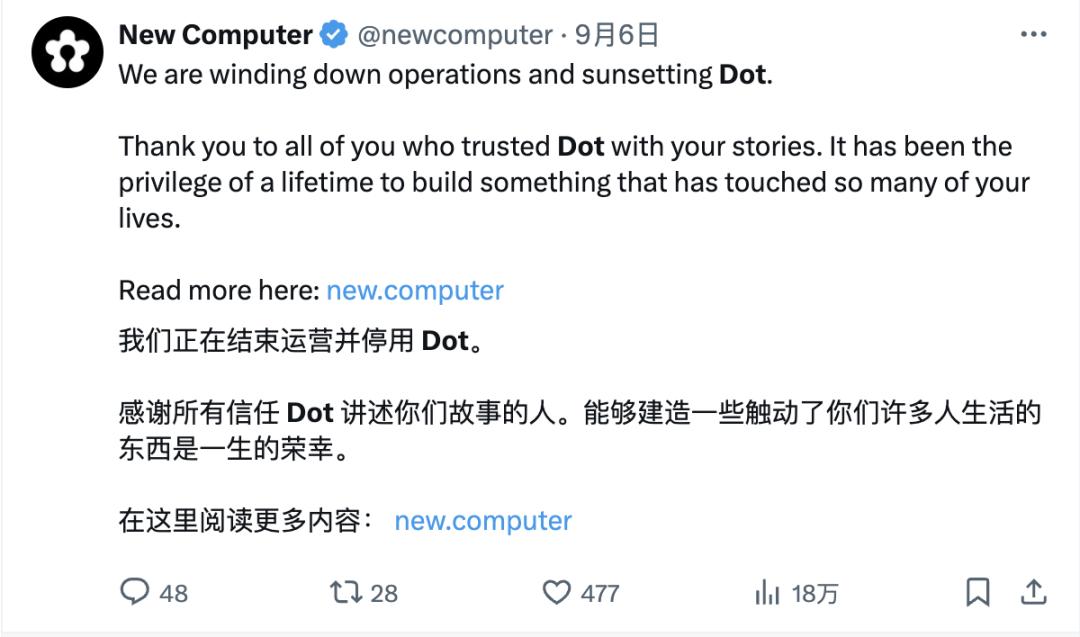
Core Insights - The recent Apple event showcased the iPhone 17 and iPhone Air, generating significant market interest despite a lack of emphasis on AI features, with over 2 million reservations for the iPhone 17 on JD.com [1] - The emotional companion app Dot, founded by former Apple designer Jason Yuan, announced it will cease operations on October 5, 2024, highlighting the emotional bond between AI products and users [3][5] Summary by Sections Apple Event - The Apple event was described as a "technology gala," with the iPhone 17 and iPhone Air being highly anticipated products [1] - The iPhone 17 standard version has seen over 2 million reservations on JD.com, indicating strong consumer interest [1] Dot App - Dot was designed to be an AI friend that learns user interests and provides emotional support, described as a "living mirror of the inner self" [5] - Despite initial interest and a unique interface, Dot failed to gain mainstream traction, with only about 20,000 downloads on iOS since its launch in June 2024 [7] Challenges in AI Companionship - The rise and fall of AI companionship apps like Dot reflect broader challenges in the industry, characterized by a "impossible triangle" of emotional stickiness, cost, and regulatory pressures [8][10][12] - Emotional stickiness is crucial for user retention, while costs associated with multi-modal reasoning and memory storage are significant challenges [10][12] - Regulatory pressures have increased due to concerns over youth addiction to AI, impacting both emotional stickiness and operational costs [12][14] User Experience and Emotional Connection - The closure of Dot is framed as a significant emotional event for users, who expressed sadness and appreciation for the app's companionship [17][18] - The emotional value of AI companionship is emphasized, with users often forming deep connections that transcend mere utility [20][32] - The article suggests that the relationship between users and AI products warrants a ritualistic farewell, marking the end of a shared experience [33]


2025年数字资产系列研究-中银国际
Sou Hu Cai Jing· 2025-09-10 11:21
Core Insights - The report titled "2025 Digital Asset Series Research - CCB International" analyzes the differences between the real world and the virtual/digital world, emphasizing the concepts of "centralization" and "decentralization" [1] - It highlights stablecoins as a crucial bridge connecting virtual and real value, with a projected trading volume of approximately $37 trillion in 2024, surpassing Bitcoin [1] - The report discusses the implications of stablecoins on monetary supply, the U.S. Treasury market, and the dominance of the U.S. dollar, as well as the differences in digital currency strategies between China and the U.S. [1] Summary by Sections Historical and Technical Analysis - The report examines the historical, cultural, and technical aspects of digital assets, focusing on the fundamental differences between centralized and decentralized systems [1] - It identifies fiat currencies and cryptocurrencies (excluding Bitcoin) as two incentive carriers within these systems, with their value dependent on ecosystem activity, integrity, and consensus [1] Focus on Stablecoins - Stablecoins are defined as digital currencies pegged to specific assets to maintain value stability, with the top two stablecoins (USDT and USDC) accounting for 60% and 23% of the market, respectively [1] - The report categorizes stablecoins based on their collateralization methods and discusses the "impossible trinity" challenge of achieving price stability, capital efficiency, and decentralization simultaneously [1] Macroeconomic Implications - The report analyzes the macroeconomic impact of stablecoins on monetary supply and the U.S. Treasury market, as well as the implications for U.S. dollar hegemony [1] - It contrasts China's approach to digital currency (promoting the digital yuan) with the U.S. focus on dollar stablecoin tokenization [1] Hong Kong's Stablecoin Development - The report explores the reasons behind Hong Kong's development of stablecoins, including the aim to establish a digital asset hub and activate the RMB ecosystem [1] - It discusses the coexistence of stablecoins with central bank digital currencies (CBDCs) and outlines the differences in regulatory frameworks between Hong Kong and the U.S./Europe [1] Applications and Infrastructure - Stablecoins are examined in various applications, including retail payments, cross-border transfers, virtual asset trading, RWA, and DeFi [1] - The report introduces the stablecoin economic ecosystem in Hong Kong and the business models of key service providers, as well as the impact of stablecoins on traditional financial institutions and the necessary infrastructure for expanding specific use cases [1]

满帮营收创新高背后:一边抽佣,一边放贷
凤凰网财经· 2025-09-03 23:57
Core Viewpoint - Manbang Group's Q2 2025 financial report shows record revenue of 3.239 billion yuan and a net profit increase of 50.5% to 1.265 billion yuan, interpreted as a victory for freight digitization, but the company warns of a significant drop in Q3 revenue growth to 1.3%-4.6% due to rising costs and loss of shippers [1][2] Group 1: Tax Rebate Decline - The freight brokerage service, contributing 36.3% of total revenue, saw only a 1.1% increase in Q2 2025 revenue to 1.178 billion yuan, revealing its vulnerability tied to tax rebates [1][2] - In Q1 2023, tax rebates accounted for 66.92% of freight brokerage revenue, indicating a heavy reliance on government subsidies [2] - As local government financial pressures increase, the growth of tax rebates is slowing, forcing Manbang to pass costs onto shippers [2][5] Group 2: High Interest Rates and Driver Trust Crisis - Manbang's financial products, such as "Driver Loans" and "Manbang Loans," have led to high profits but also significant driver debt issues, with 62% of loan disputes showing actual annual interest rates exceeding 36% [6][8] - Complaints regarding high-interest loans and account suspensions have surged, indicating a growing trust crisis among drivers [8] - Regulatory scrutiny is increasing, with penalties imposed for failing to disclose loan information, highlighting the risks associated with the company's financial practices [8][10] Group 3: Competitive Pressures and User Retention - Despite a marketing spend of 120 million yuan in Q2 2025, new user growth has plummeted from 35% to 12%, and driver order acceptance rates have dropped from 68% to 52% [9] - Competitors like Huolala and Didi Freight are gaining market share, exacerbating Manbang's challenges in maintaining user retention and pricing stability [9][10] - Manbang is attempting to pivot by reducing R&D spending and investing in autonomous driving technology to restructure its cost base [9][10] Group 4: Financial Model and Market Response - Manbang's non-subsidy gross margin is only 15.2%, significantly below the industry expectation of 25%, indicating a need for a sustainable profit model [12] - Following the financial report, the stock price rose by 9.81%, but institutional ratings diverged, reflecting concerns over policy risks and user attrition [12] - The company's reliance on fiscal subsidies and financial arbitrage raises questions about the sustainability of its profit growth [12]


“中国电算龙头”山高控股开始加速奔跑
阿尔法工场研究院· 2025-09-02 00:03
Core Viewpoint - The article discusses the "AI Energy Paradox," highlighting the dual nature of AI technology that improves energy efficiency while increasing power consumption due to high computational demands. It emphasizes the challenges of achieving a balance between computational power, cost control, and low carbon emissions, referred to as the "impossible triangle" [1][2]. Group 1: Company Overview - Shandong Gaohigh Technology (山高控股) is recognized as a leader in the Chinese computing power sector, successfully addressing the industry's challenges with its "green electricity + computing power" dual-drive model, resulting in a remarkable 506% year-on-year increase in net profit [2][6]. - The company has established a unique ecosystem by integrating power generation, grid management, load balancing, and energy storage, which is essential for providing reliable and efficient computing power [5][6]. Group 2: Market Dynamics - By 2028, the demand for inference computing power is expected to surpass training computing power, making it a critical resource for AI operations. The Chinese intelligent computing market is projected to grow 2.5 times, with an annual growth rate of nearly 40% [3][4]. - The integration of the "source-network-load-storage" project in Ulanqab City, which aims to create an innovative mechanism for local power generation and consumption, is a significant step towards solving the "impossible triangle" [3][4]. Group 3: Financial Performance - In the first half of 2025, Shandong Gaohigh Technology reported revenues of 2.503 billion yuan, with 96% coming from emerging industries, and a net profit of 476 million yuan, reflecting a 506% increase year-on-year [6][7]. - The collaboration with Century Internet has led to significant growth in operational metrics, with Century Internet's revenue reaching 2.43 billion yuan in Q2, a 22% increase, and base business revenue growing by 112.5% [6][7]. Group 4: Strategic Initiatives - The company is expanding its green energy assets, having secured over 4 GW of new energy development indicators, which will support the replication of the Ulanqab model across other regions rich in clean energy resources [11][12]. - Strategic partnerships, such as the one with Huawei, enhance the company's capabilities in providing computing infrastructure and green energy solutions, particularly in zero-carbon parks and smart transportation projects [14][15]. Group 5: Future Growth Potential - The "electricity-computing integration" model is not merely a static asset combination but a dynamic ecosystem with significant growth potential, driven by three engines: replication, collaboration, and digital asset management [10][11][15]. - The issuance of tokenized products for real-world assets (RWA) positions the company to capitalize on the growing global RWA market, expected to reach $16.1 trillion by 2030, thereby opening new financing channels and revenue models [15][20].

公链行业的核心挑战与选择决策框架:破局之道与未来展望—科普视角
Sou Hu Cai Jing· 2025-08-29 03:07
Core Insights - Blockchain technology is regarded as the "cornerstone of the next-generation internet," with public chains being essential for decentralized applications (DApps) and value transfer [1] - The public chain industry faces significant challenges, including the balance of performance, security, and decentralization, ecological fragmentation, regulatory uncertainty, and high user experience barriers [3][4][5][6] Group 1: Challenges in Public Chains - The "impossible triangle" of balancing performance, security, and decentralization remains a fundamental challenge for public chains, with examples like Bitcoin, Ethereum, and Solana illustrating the trade-offs involved [3] - Ecological fragmentation leads to "chain islands," where assets and data cannot flow freely between different public chains, hindering collaborative development [4] - Regulatory uncertainty poses compliance risks, with varying attitudes towards cryptocurrencies across countries, impacting the operation of public chain projects [5] - High user experience barriers, such as complex private key management and high transaction fees, hinder the widespread adoption of Web3 applications [6] Group 2: Decision-Making Framework - Developers should prioritize public chains that support mainstream programming languages and have robust ecological tools, such as Ethereum and BNB Chain [7][8] - Investors should assess the activity level of ecosystems, focusing on metrics like Total Value Locked (TVL), DApp count, and user engagement, with Ethereum Layer 2 and Solana showing rapid growth [8] - Investors are advised to select deflationary tokens or those with broad application scenarios, such as BTC, ETH, and BNB [9] - Enterprises should prioritize compliance and cross-chain capabilities, selecting public chains with strong regulatory adherence [11] Group 3: Innovative Solutions - Akashi public chain aims to create a "cross-chain highway," enabling seamless asset and data flow between different public chains, enhancing interoperability [14] - Messiah Exchange serves as a cross-chain trading platform, integrating multi-chain assets and providing one-click exchange services, with a focus on compliance and liquidity [15][16] - Technological advancements, such as zero-knowledge proofs and sharding, are expected to enhance public chain performance, while standardized cross-chain protocols will accelerate ecosystem integration [18] Group 4: Future Outlook - The public chain industry, despite its challenges, shows signs of breakthrough with Akashi's cross-chain technology and Messiah's compliance practices, emphasizing the dual importance of "connection" and "compliance" [19] - The future vision for public chains is a connected, secure, and trustworthy blockchain "continent," moving away from isolated "digital castles" [20] - Understanding challenges, making rational choices, and embracing innovation will be key for participants to seize opportunities in the blockchain era [21]

00后,还有什么时代红利吗?
虎嗅APP· 2025-08-28 00:25
Core Viewpoint - The article discusses the concept of "era dividends" and emphasizes that while there are development opportunities, one must also consider the challenges and limitations faced by the younger generation, particularly the post-2000s cohort in China [6][12]. Group 1: The Context of Development Opportunities - The notion of "era dividends" is often equated with "development opportunities," but it is crucial to recognize that survival and quality of life are also significant factors [6][12]. - The past was not without its difficulties, as evidenced by the low acceptance rates in higher education during the 1980s and 1990s, which were around 30% [9]. - Today's job market offers more options for employment, such as delivery services, compared to the past when job loss could lead to dire circumstances [11][12]. Group 2: The Challenges Faced by the Post-2000s Generation - The post-2000s generation is characterized by a material abundance but also faces a significant reduction in development space compared to previous generations [36]. - The pressure on this generation is reflected in their increased participation in extracurricular classes, which is three times that of the 1990s generation [26]. - The high costs of tutoring classes, often hundreds to thousands of yuan per session, reflect the intense competition and expectations placed on students [27]. Group 3: Employment and Economic Realities - Many graduates from prestigious universities are struggling to find suitable employment, with some resorting to further education or low-paying jobs [27][29]. - The oversupply of graduates in the job market has led to a decrease in job opportunities, making it challenging for young people to achieve their aspirations [29][31]. - The traditional pathway of education leading to stable employment is becoming less viable for the post-2000s generation, leading to a reevaluation of their life choices [36][37]. Group 4: Shifts in Consumer Behavior and Values - The post-2000s generation is likely to prioritize experiences and personal fulfillment over traditional milestones like homeownership and marriage [42][43]. - This generation is expected to influence various industries, particularly those related to entertainment, lifestyle, and consumer goods, as they seek joy and satisfaction in their purchases [44]. - The shift in values indicates a departure from the previous generations' focus on material success and stability, suggesting a new approach to life and consumption [41][44].

破解普惠保险“不可能三角”,大咖来支招!
Bei Jing Shang Bao· 2025-08-22 03:08
Core Viewpoint - Inclusive insurance is becoming increasingly important in China's multi-level social security system and is a key tool for achieving common prosperity [1][2] Group 1: Product Development - Inclusive insurance products have expanded from agricultural and critical illness insurance to include urban customized commercial medical insurance ("Hui Min Bao"), inclusive family property insurance, and more [1][2] - The service targets of inclusive insurance now encompass small and micro enterprises, the elderly, farmers, new citizens, low-income populations, and people with disabilities [2] - Despite being the second-largest insurance market globally, China still lags behind the world average in insurance depth and density [2] Group 2: Challenges and Opportunities - Current challenges for inclusive insurance include a lack of indicator systems, single innovation models, and insufficient sustainability [1][2] - Public awareness and trust in inclusive insurance need to be strengthened, and the precision and accessibility of certain products and services require improvement [2] - The balance between low premium levels, high coverage, and profitability for insurance companies is difficult to achieve [2][3] Group 3: Sustainable Development - Experts agree that maintaining the commercial nature of inclusive insurance is essential for sustainable development, requiring scientific pricing and effective risk management [3][4] - Recommendations include enhancing product supply, increasing service coverage and affordability, and allowing consumers to make informed choices through market behavior [3][4] - Government involvement is crucial in the early stages of inclusive insurance development, with a collaborative effort needed from government, commercial insurance, and social forces [3][4] Group 4: Regulatory Measures - Future regulatory efforts will focus on encouraging insurance companies to diversify inclusive insurance products and improve service quality through data utilization and risk prevention [5] - Emphasizing a people-centered approach and fostering innovation and collaboration will drive high-quality development in inclusive insurance [5]
普京特朗普会谈近3小时,啥也没谈成
Di Yi Cai Jing· 2025-08-21 05:30
Core Points - The meeting between US President Trump and Russian President Putin on August 15 marked the first face-to-face encounter since 2019, highlighting the ongoing ceremonial diplomacy between the two nations [1] - Despite positive signals during the joint press conference, the meeting ended without any agreements, revealing the persistent structural contradictions in US-Russia relations [1] Group 1: Key Issues - The core topic of the meeting focused on the Ukraine crisis, particularly territorial exchange, with Trump stating that Ukraine would decide on negotiations, indicating limited US acknowledgment of Ukraine's sovereignty [2] - Russia's firm stance, emphasizing constitutional territorial integrity and military advantages, created a "impossible triangle" of Ukraine's sovereignty, Russian security concerns, and US strategic interests [2] - The divergent perceptions of the crisis were evident, with Russia viewing it as a geopolitical security issue while the US framed it as a struggle between democracy and authoritarianism [2] Group 2: Negotiation Dynamics - The change from a one-on-one to a three-on-three negotiation format reflected both sides' cautious strategies, with Trump aiming to avoid domestic political risks and Putin seeking to reinforce a unified diplomatic stance [3] - Trump's metaphor of chess during the talks suggested a strategic probing approach, while Putin's pragmatic response indicated a focus on the potential for future agreements [3] - The combination of positive signals and warnings from Russia illustrated a dual approach of negotiation sincerity and dissatisfaction with third-party interventions [3] Group 3: External Constraints - Ukraine and European positions imposed external constraints on the negotiations, with Ukrainian President Zelensky emphasizing the need for Ukraine's involvement in any decisions regarding its future [4] - The unified stance of European nations, advocating for Ukraine's direct participation and potential sanctions against Russia, complicated US negotiations [4] - Economic cooperation discussions were limited by domestic US sanctions against Russia, highlighting structural barriers to normalizing US-Russia relations [4] Group 4: Historical Trust Deficit - The failure of the talks underscored a long-standing trust deficit between the US and Russia, exacerbated by ongoing conflicts since the 2014 Crimea crisis [6] - The dynamics of battlefield developments influencing negotiation positions indicated a hardening of Russia's stance on territorial issues [6] - The deterioration of arms control agreements further complicated the mutual trust environment, with both sides focusing on short-term geopolitical interests rather than long-term cooperation [6] Group 5: Future Negotiation Prospects - Although the meeting did not yield substantial results, both parties left room for future negotiations, with potential involvement of Ukraine in subsequent discussions [7] - The symbolic significance of the meeting was noted, as it provided a platform for Trump to address domestic political pressures and for Putin to break Western diplomatic isolation [7] - The continuation of ceremonial diplomacy may become a new norm in US-Russia relations, but the complexity of the Ukraine crisis and structural contradictions suggest a long and challenging negotiation process ahead [7]
打探清楚了!那些领先的AI创企,都选择了这朵云
Sou Hu Cai Jing· 2025-08-13 12:48
Core Viewpoint - The event "AI DAY" hosted by Baidu showcased its "AI Venture Acceleration Program," which provides substantial support to AI startups, including billion-level computing subsidies, exclusive financing channels, and policy support, helping 20 companies secure over 100 million yuan in funding in the past year [1][23]. Group 1: AI Venture Acceleration Program - The program aims to assist AI startups by offering tailored solutions and resources, addressing the challenges of technology depth, iteration speed, and cost control, which are often referred to as the "impossible triangle" [5][6][10]. - Baidu's intelligent cloud provides a full-stack AI infrastructure, including self-developed Kunlun chips and various platforms, enabling startups to reduce costs and accelerate development [10][22]. - The program has successfully helped startups in various sectors, including e-commerce, gaming, and online education, by providing essential tools and resources for rapid product validation and market entry [12][20][22]. Group 2: Industry Applications and Success Stories - In the gaming sector, Baidu's collaboration with startups has led to innovative products that enhance user experience through AI-driven interactions and personalized guidance [16]. - For wearable devices, Baidu's solutions have enabled companies to create smart products that integrate AI capabilities, enhancing user engagement and functionality [18]. - In e-commerce, Baidu's AI technologies have streamlined business processes, improving efficiency and effectiveness in product selection and supply chain management [20]. Group 3: Competitive Advantage and Market Position - Baidu's intelligent cloud has maintained the leading position in the AI public cloud market for five consecutive years, attributed to its robust technology and comprehensive service capabilities [22]. - The success of the "AI Venture Acceleration Program" reflects Baidu's strong support for AI startups, contributing to their growth and establishing Baidu as a preferred partner in the industry [23][25].