大宗商品价格波动

Search documents
思源电气接待17家机构调研,包括淡水泉投资、高盛、安本投资、Eastspring Investments等
Jin Rong Jie· 2026-01-19 09:18
Core Viewpoint - The company is actively managing the impact of commodity price fluctuations, particularly copper prices, on its product costs through hedging strategies and is expanding its production capacity to meet increasing demand in the domestic and international markets. Group 1: Commodity Price Impact - Fluctuations in commodity prices, especially copper, do affect the company's product costs, but the overall impact is currently manageable [2] - The company employs copper futures hedging to mitigate the effects of copper price volatility and is reviewing its hedging strategies to better align with business needs [2] Group 2: Production Capacity and Orders - The new transformer workshop and equipment are being installed, tested, and gradually entering mass production, with the ability to meet customer delivery requirements [3] - The company will regularly review its production capacity based on expected order volumes and delivery timelines to determine if further expansion is necessary [4] Group 3: Market Demand and Expansion - The State Grid's investment plan during the "14th Five-Year Plan" period is set to reach a historical high, indicating strong demand in the domestic market, particularly for renewable energy [6] - The joint venture with Al Sharhan Energy in Saudi Arabia is a strategic move to address local customer needs, and the company maintains a cautious yet open approach to overseas factory investments [6] Group 4: Goodwill Assessment - The company has engaged a qualified assessment agency to evaluate potential goodwill impairment related to Xincheng Carbon Energy, with results to be disclosed in the annual report [8]

从银价波动看“变乱交织、动荡加剧”
工银国际· 2026-01-14 08:23
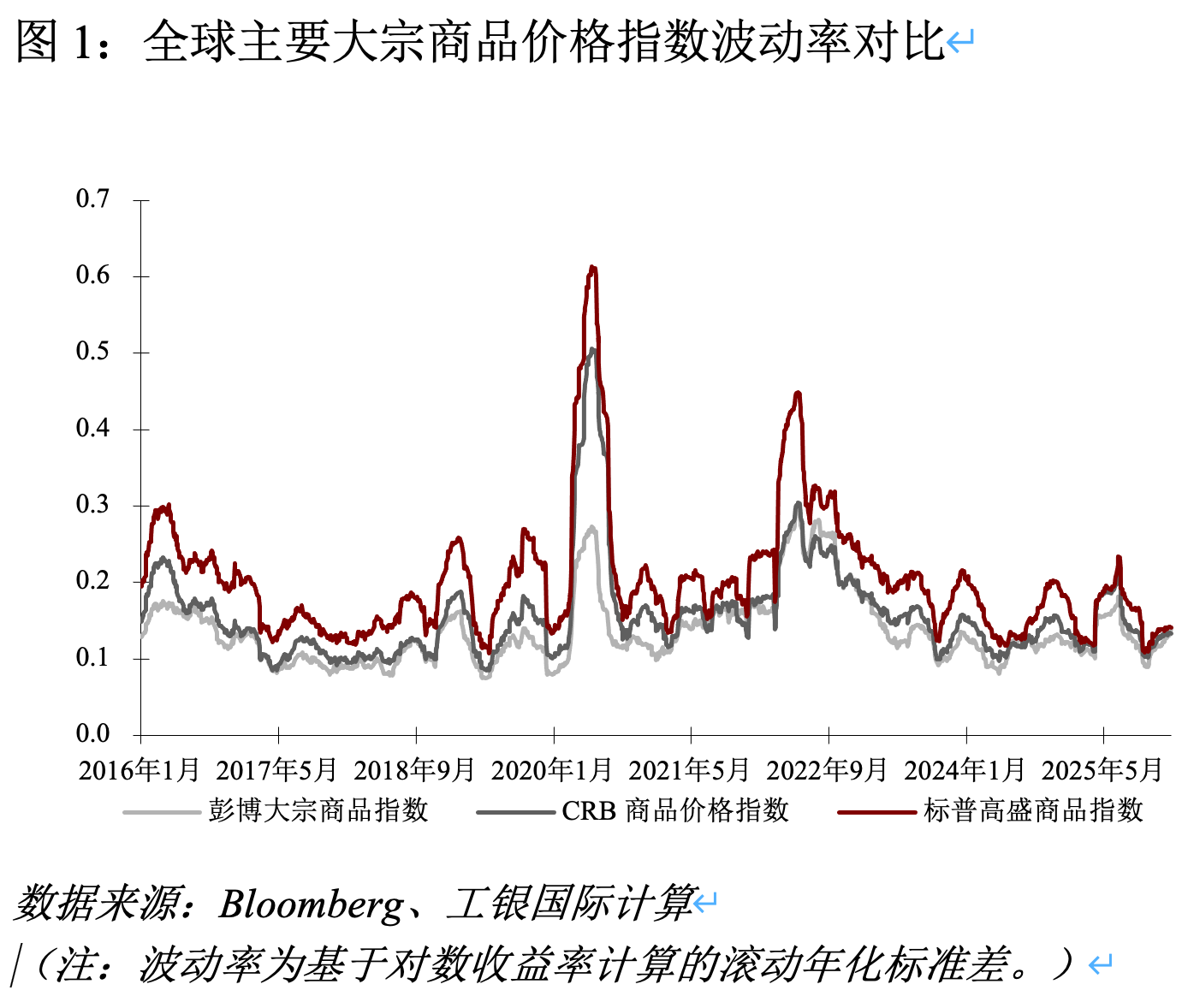
Group 1: Market Trends - Recent silver price fluctuations indicate increased volatility and a lack of single-factor explanations for price movements[1] - Major commodity prices are experiencing frequent adjustments, reflecting a transition from old equilibrium to a new, unstable state[1] - The price adjustment frequency has increased, suggesting that the market is still calibrating its long-term structure[1] Group 2: Structural Changes - Since 2016, the volatility of major commodity price indices has shown a synchronized increase, particularly around 2020 and 2022[2] - The global manufacturing system is undergoing restructuring, with new energy transitions and digital expansions affecting demand for industrial materials[3] - The cost structure is changing due to decreased elasticity in traditional energy supply and the sensitivity of energy prices to geopolitical and policy expectations[3] Group 3: Pricing Dynamics - Supply constraints and demand differentiation have led to more pronounced price jumps in the commodity market[7] - The relationship between inventory levels and price changes has shown instability, indicating that single supply-demand signals are insufficient for price explanations[7] - Financial participation in the market has intensified, altering pricing mechanisms and increasing sensitivity to marginal changes[8]
银价震荡曲线揭示 全球变局进行时
Sou Hu Cai Jing· 2026-01-13 16:19
Core Viewpoint - The commodity market is experiencing a transitional phase where old equilibria are loosening, and new equilibria have yet to stabilize, leading to increased volatility in prices, particularly in silver and other commodities [1][6]. Group 1: Commodity Price Dynamics - Recent fluctuations in silver prices reflect a broader trend where multiple commodities are undergoing significant price changes without a clear, consistent driving factor [1]. - Since 2016, the volatility of major commodity price indices has shown a synchronized increase, particularly around 2020 and 2022, indicating a high level of uncertainty across various commodities [1][2]. - The current state of the commodity market is characterized by simultaneous high uncertainty across different types of commodities, influenced by various underlying factors [1][2]. Group 2: Structural Changes in Demand and Supply - The restructuring of the global manufacturing system, driven by energy transition, digital expansion, and infrastructure updates, has led to resilient demand for certain industrial raw materials [2]. - Traditional investment and real estate-related demand are entering an adjustment phase, revealing structural differentiation in demand [2]. - The supply side has been constrained due to weak capital expenditure in the commodity sector over the past decade, leading to reduced supply elasticity and increased sensitivity to geopolitical and climatic disruptions [4][5]. Group 3: Financial Participation and Pricing Mechanisms - Increased financial participation in commodity markets has altered pricing dynamics, making prices more sensitive to short-term information and leading to more frequent adjustments [3][5]. - The relationship between inventory levels and prices has become unstable, with prices often adjusting through jumps rather than gradual changes, reflecting the complexities introduced by multiple structural changes [5][6]. Group 4: Macroeconomic Implications - The current pricing behavior of commodities mirrors the broader macroeconomic environment, where traditional growth models are losing effectiveness, and new technologies and policies are reshaping demand and cost structures [6][7]. - The high frequency of price adjustments indicates that the market is continuously recalibrating its expectations in response to new information, reflecting a transitional phase in the global economy [6][8]. - The ongoing volatility in commodity prices serves as a micro-level representation of the macroeconomic shifts, highlighting the need for dynamic coordination in forming macroeconomic equilibria [7][8].
程实:银价震荡曲线揭示全球变局进行时
Di Yi Cai Jing· 2026-01-13 12:11
Core Insights - The article discusses the recent volatility in commodity prices, particularly silver, indicating that while some commodities have reached new price levels, the sustainability of these trends remains uncertain [1][10]. Group 1: Commodity Price Trends - Silver prices have shown significant fluctuations, with frequent changes in direction, suggesting that single factors are insufficient to explain price movements [1]. - The overall commodity market is experiencing a transitional state where old equilibria are loosening, and new equilibria have yet to stabilize [1][10]. - Since 2016, major commodity price indices have exhibited synchronized volatility, particularly around 2020 and 2022, indicating a high level of uncertainty across various commodities [2]. Group 2: Structural Changes - The restructuring of the global manufacturing system, driven by energy transition, digital expansion, and infrastructure updates, has led to resilient demand for certain industrial materials [2]. - Traditional investment and real estate-related demand are undergoing adjustments, resulting in structural differentiation in demand [2][6]. - The changes in the cost structure, particularly due to energy transition, have significantly impacted pricing logic across the commodity sector [3]. Group 3: Supply and Demand Dynamics - Supply constraints, demand differentiation, and financial behaviors have contributed to the tendency for commodity prices to exhibit phase jumps [6]. - The correlation between inventory levels and price changes has shown instability, indicating that single supply-demand signals are insufficient to explain price movements [6][7]. - The demand for industrial metals is supported by emerging industries and infrastructure investments, while traditional manufacturing cycles have become more volatile [6]. Group 4: Financial Participation and Pricing - Increased financial participation has altered pricing mechanisms, particularly in actively traded industrial metals like copper, leading to more frequent price adjustments [7]. - The relationship between inventory and price has become unstable, reflecting the complexities introduced by simultaneous structural changes [7][14]. - Prices are now more sensitive to marginal changes due to supply-demand mismatches and heightened financial involvement, resulting in a tendency for prices to adjust in a jump-like manner [7]. Group 5: Macroeconomic Implications - The current state of commodity prices reflects broader macroeconomic conditions, where traditional growth models are losing effectiveness, and new technologies and policies are reshaping demand and cost structures [10][11]. - The high frequency of price adjustments indicates that the market is still calibrating its long-term structural judgments [10][14]. - The ongoing volatility in commodity prices serves as a lens through which to understand the increasing complexity and turmoil in the global economic landscape [11][14].

大宗商品综述:伊朗风险推高油价 金银价格创新高 铜冲高回落
Xin Lang Cai Jing· 2026-01-12 22:19
Oil Market - Oil prices rose to their highest level since early December due to concerns over supply disruptions from Iran, with WTI crude closing above $59 per barrel, marking a cumulative increase of over 6% in the previous three trading days [2][9] - Iran's political and military unrest poses a threat to its oil production of approximately 3.3 million barrels per day, with potential military action from the U.S. being a significant concern [10][2] Base Metals - Copper prices initially surged by 2.5% to $13,323 per ton but later retraced some gains, influenced by a weaker dollar and supply concerns [4][13] - Other base metals like aluminum and tin reached their highest levels since 2022, although they also experienced a pullback due to market volatility and a rebalancing of a benchmark commodity index [5][14] - As of the London market close, LME copper was up 1.6% at $13,209.5 per ton, while LME aluminum rose 1.6% to $3,184.5 per ton [15] Precious Metals - Gold and silver prices reached record highs amid concerns regarding the independence of the Federal Reserve, with gold surpassing $4,600 per ounce and silver rising by up to 8% to over $86 [7][16] - The potential for increased intervention by the Federal Reserve is seen as a key factor that could positively influence the precious metals market in the coming years [16] - As of 3:15 PM EST, gold was up 2.1% at $4,603.22 per ounce, and silver was up 6.6% at $85.1554 per ounce [17]
白银又暴涨,金价拉升!周生生一款项链一夜涨了15200元
Mei Ri Jing Ji Xin Wen· 2026-01-09 22:50
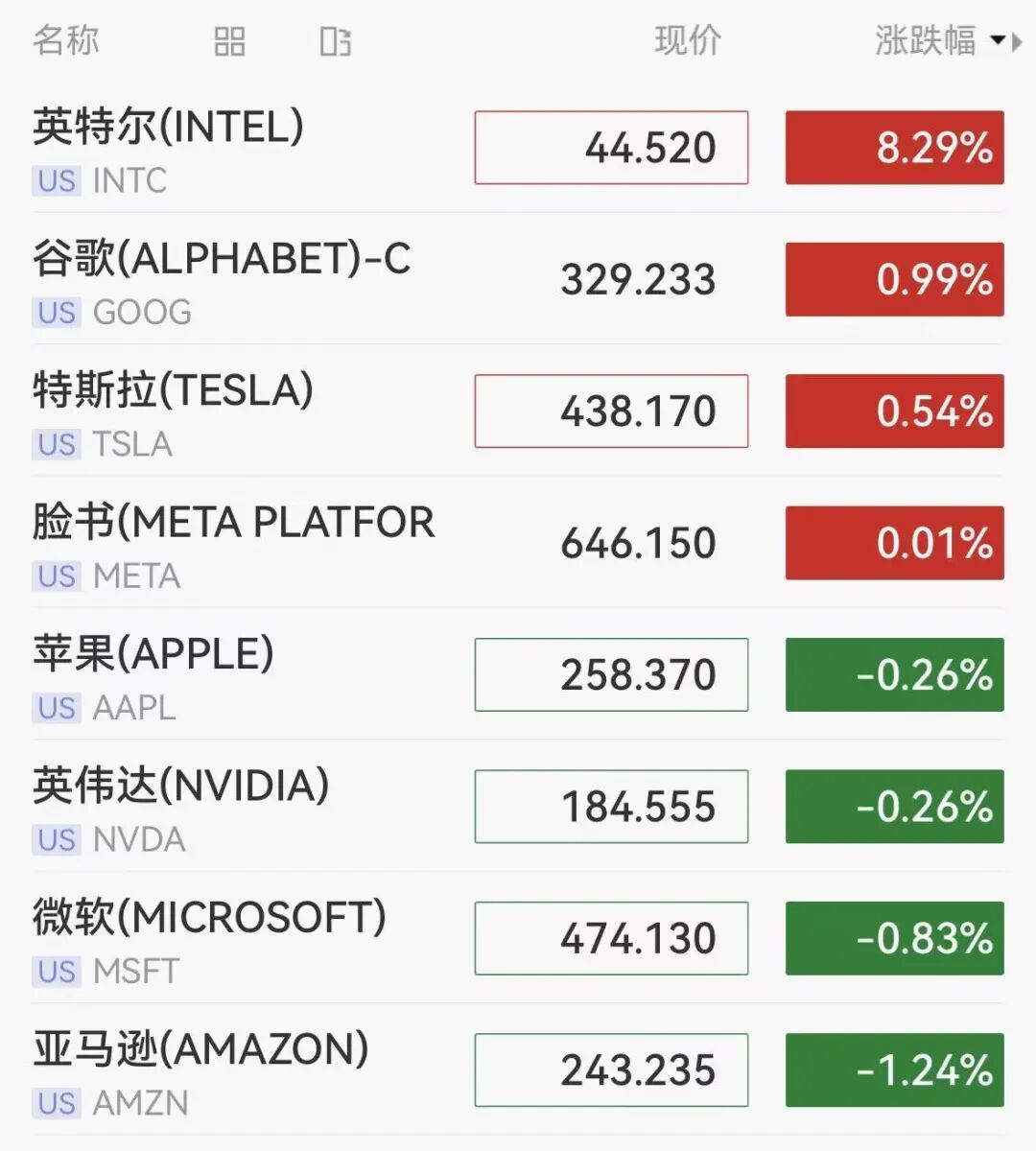
Market Overview - US stock indices opened higher on January 9, with the Dow Jones up 0.41%, S&P 500 up 0.56%, and Nasdaq up 0.72% as of early January 10 [1] - By the close, the Dow increased by 237.96 points (0.48%) to 49,504.07, Nasdaq rose by 191.33 points (0.81%) to 23,671.35, and S&P 500 gained 44.82 points (0.65%) to 6,966.28 [1] Technology Sector - Major tech stocks showed mixed performance, with Intel rising over 8%, reaching a new intraday high since April 2024 [1] - The Philadelphia Semiconductor Index increased by over 2%, with ASML up more than 5% and Micron Technology up over 3% [1] Chinese Stocks - Chinese stocks listed in the US experienced declines, with the Nasdaq Golden Dragon China Index falling nearly 1.4% [2] - Alibaba, Manbang Group, and Xpeng Motors each dropped over 3%, while Vipshop and Li Auto fell over 2% [2] Commodity Market - International gold prices saw a short-term increase, with spot gold rising by 0.6% to $4,504.76 per ounce [3] - The price of a specific gold necklace from Chow Sang Sang on Tmall increased from 120,800 yuan to 136,000 yuan overnight, reflecting a surge of 15,200 yuan [3][8] - Gold jewelry prices from major brands approached 1,400 yuan per gram, with Chow Sang Sang's price at 1,392 yuan per gram, up 16 yuan from January 5 [11] - Silver prices also surged, with spot silver rising by 3.88% to $79.88 per ounce and COMEX silver increasing by 6.66% [11][12] Energy Sector - International oil prices rose, with WTI crude oil increasing by 2.94% to $59.46 per barrel and Brent crude oil up by 2.56% to $63.58 per barrel [12]

百利好丨2026年全球经济展望
Sou Hu Cai Jing· 2026-01-09 08:24
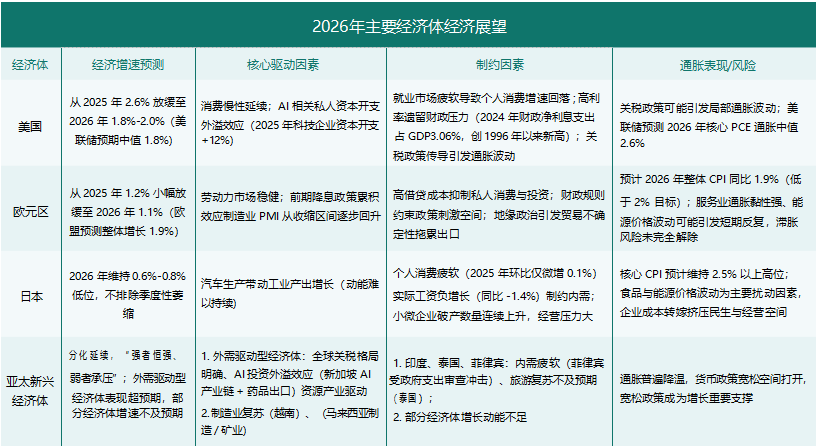
Global Economic Outlook - In 2026, the global economy is expected to continue developing under a moderate slowdown, with emerging markets gradually replacing developed economies as the key growth drivers [1] - The monetary policy will shift from accommodative to a wait-and-see approach, focusing on structural differentiation, policy window management, and tail risk control as the main strategies for 2026 [1] Economic Projections for Major Economies - The US economy is projected to slow down from 2.6% in 2025 to a range of 1.8%-2.0% in 2026, driven by chronic consumption issues and AI-related private capital expenditure [2] - The Eurozone is expected to grow at 1.1% in 2026, with manufacturing PMI gradually recovering but facing challenges from geopolitical tensions and weak personal consumption [2] - Japan's growth is anticipated to remain low, with potential quarterly fluctuations, as real wages decline and small businesses face increasing operational pressures [2] - Emerging economies in the Asia-Pacific region are showing mixed performance, with some exceeding expectations while others struggle with weak domestic demand and external pressures [2] Global Central Bank Monetary Policy Outlook - The Federal Reserve is likely to implement three rate cuts of 25 basis points each, bringing the benchmark rate down to 3.00%-3.25% [3] - The European Central Bank is expected to maintain a stable interest rate policy, with no clear plans for rate adjustments, while monitoring inflation close to the 2% target [3] - The Bank of Japan is likely to keep the benchmark rate at a low level of 0.5%, facing challenges in balancing inflation control and economic growth [3] - Emerging market central banks will continue a high-accommodation cycle, with varying policy rhythms based on local economic conditions [3] Investment Bank Perspectives - The IMF reports that global economic growth will continue to slow down moderately in 2026, with structural differentiation intensifying due to weakened growth momentum in developed economies [4] - OECD forecasts a decline in global economic growth from 3.2% in 2025 to 2.9% in 2026, with the US economy expected to slow to 1.7% [5] - The Eurozone is projected to grow only 1%, indicating a relatively weak performance compared to other regions [5] Core Risk Overview - Geopolitical and trade risks include uncertainties from global tariff restructuring and regional conflicts that could disrupt supply chains and commodity prices [6] - Financial vulnerabilities are high in the Eurozone, with rising debt levels in emerging markets potentially leading to localized financial risks during interest rate adjustments [6] - Commodity price volatility, particularly in energy and food sectors, may disrupt central bank policy rhythms due to external factors like geopolitical conflicts and extreme weather [6] Summary - Globalization is significantly impacted by tariff conflicts, leading to disruptions in global trade chains and a high probability of economic slowdown [7] - The Federal Reserve is expected to maintain a loose monetary policy, but the interplay between the Fed and the US government may heighten global financial risks [7] - Precious metals, particularly gold, are likely to benefit, with potential prices reaching between $5000-$5200, while the dollar index may decline below 90 [7] - Commodity markets show mixed signals, with energy prices struggling but potential rebounds in the second half of the year, while non-ferrous metals may rise due to increased global electricity demand and AI development [7]
瓶片短纤数据日报-20251231
Guo Mao Qi Huo· 2025-12-31 03:51
Report Summary 1. Report Industry Investment Rating - No information provided 2. Core View of the Report - PX market sentiment is supported by the expectation of tight supply in Q1 2026, with the PX-naphtha spread widening to $360 and the PX-mixed xylene spread rising to $244, which encourages PX producers to actively purchase MX for conversion [2] - Demand remains robust, with domestic PTA maintaining high operation rates, benefiting from stable domestic demand and the resumption of exports to India since the end of November [2] - High gasoline spreads support aromatics. The commissioning of new polyester plants keeps the polyester load at a high level, with PTA consumption remaining high and market hoarding intentions increasing, leading to a rapid strengthening of the basis [2] - Although polyester demand weakens seasonally in the domestic market, the production cuts by polyester factories are insufficient to form a negative feedback. PTA prices are significantly boosted by the enthusiastic sentiment in the commodity market, and the costs of bottle chips and short fibers follow suit [2] 3. Summary by Relevant Indicators Spot Prices - PTA spot price increased from 5065 to 5100, a change of 35 [2] - MEG domestic price increased from 3687 to 3694, a change of 7 [2] Futures Closing Prices - PTA closing price increased from 5122 to 5144, a change of 22 [2] - MEG closing price increased from 3817 to 3847, a change of 30 [2] Short Fiber Indicators - 1.4D direct-spun polyester staple fiber price increased from 6620 to 6640, a change of 20 [2] - Short fiber basis decreased from 120 to 86, a change of -34 [2] - 2 - 3 spread increased from 6 to 8, a change of 2 [2] - Polyester staple fiber cash flow increased from 240 to 246, a change of 6 [2] - 1.4D direct-spun and imitation large chemical fiber price difference increased from 1345 to 1365, a change of 20 [2] Bottle Chip Indicators - Polyester bottle chip prices in the Jiangsu and Zhejiang markets remained stable, with the average price unchanged from the previous working day [2] - PTA and bottle chip futures fluctuated narrowly, with most supply offers remaining unchanged, and the market negotiation atmosphere was cautious [2] - Downstream terminal demand was relatively stable, and the market negotiation focus remained temporarily stable [2] Other Product Indicators - T32S pure polyester yarn price increased from 10380 to 10400, a change of 20 [2] - T32S pure polyester yarn processing fee remained unchanged at 3760 [2] - Polyester-cotton yarn 65/35 45S price remained unchanged at 16370 [2] - Cotton 328 price increased from 15240 to 15280, a change of 40 [2] - Polyester-cotton yarn profit decreased from 1220 to 1192, a change of -28 [2] - Primary three-dimensional hollow (with silicon) price decreased from 7216 to 7215, a change of -1 [2] - Hollow short fiber 6 - 15D cash flow decreased from 450 to 417, a change of -33 [2] - Primary low-melting short fiber price remained unchanged at 7775 [2] Operating Rates and Sales Ratios - Direct-spun short fiber week-on-week load increased from 88.37% to 89.32%, a change of 0.95% [3] - Polyester staple fiber sales ratio increased from 54.00% to 55.00%, a change of 1.00% [3] - Polyester yarn week-on-week startup rate remained unchanged at 66.00% [3] - Recycled cotton-type week-on-week load index remained unchanged at 51.10% [3]
国际银钯价格继续飙升
Sou Hu Cai Jing· 2025-12-29 07:58
Group 1: Oil Prices - International crude oil prices experienced a decline, with West Texas Intermediate (WTI) closing at $56.92 per barrel, down 2.52% [1] - Brent crude oil closed at $60.27 per barrel, down 2.54% [1] Group 2: Metal Prices - Uranium (U3O8) price increased to $81.4 per pound, up 0.18% [2] - 62% iron ore fines remained stable at $107.15 per ton, while 58% iron ore fines also held steady at $94.45 per ton [3] - Gold prices on the New York Mercantile Exchange rose to $4531.5 per ounce, up 1.13% [3] - Silver surged to $79.11 per ounce, increasing by 5.89% [3] - Platinum reached $2467.7 per ounce, up 10.05% [3] - Palladium climbed to $1985.0 per ounce, up 12.37% [3]
油价探底 金铜狂飙 需求端生变 大宗商品价格演绎“冰火两重天”
Zhong Guo Neng Yuan Wang· 2025-12-23 00:06
Group 1: Oil Market Dynamics - The international oil price has dropped significantly due to weak demand and geopolitical factors, with a total decline of approximately 20% this year, reaching its lowest level since February 2021 [2] - The commodity trading giant Trafigura warns of a "super surplus" in the oil market next year due to a combination of supply surge and declining global demand [2] - Analysts predict that the peak of supply surplus will occur in the first quarter of 2026, with expectations of continued inventory growth throughout the year, putting further pressure on oil prices [3] Group 2: Gold Market Trends - International gold prices have surged from $2,650 per ounce at the beginning of the year to over $4,000 per ounce, marking a significant bull market with a year-to-date increase of approximately 60% [4] - Central banks have shown strong demand for gold, with net purchases reaching 254 tons from January to October, providing substantial support for gold prices [4] - The International Clearing Bank (BIS) warns of potential bubble signs in the gold market due to excessive optimism and rising valuations, which could lead to a price correction of 5% to 20% [5] Group 3: Copper Market Outlook - The price of copper is expected to remain robust due to global industrial transformation, particularly in the electric vehicle sector, with a projected demand increase of around 3% in 2026 [7] - Supply constraints, exacerbated by incidents such as the collapse of a copper mine in Chile, have led to reduced production forecasts, supporting copper prices [7] - Goldman Sachs predicts that over 60% of copper demand growth by 2030 will be driven by investments in power infrastructure, indicating strong long-term prospects for copper [8]