
市场估值

Search documents
牛市中后期,有哪些信号要注意?|第425期直播回放
银行螺丝钉· 2025-12-30 14:00
Core Viewpoint - The article discusses the performance of A-shares and Hong Kong stocks over the past year, indicating that they have experienced significant growth and are currently in a bull market phase, although signs suggest it may be in the later stages [3][4][8]. Group 1: Market Performance - Over the past year, A-shares and Hong Kong stocks have seen substantial increases, with the Hang Seng Index rising by 52.52% and the CSI All Share Index increasing by 60.43% [6]. - From the lowest point in September 2024 to the highest point in October 2025, the CSI All Share Index rose by 61.93%, indicating a technical bull market [8]. - As of December 26, 2025, the market has experienced a correction of approximately -6.47%, which is less severe than previous corrections in 2024 and early 2025, suggesting that A-shares remain in a bull market [8]. Group 2: Market Characteristics - The current bull market has been characterized by significant gains in small-cap and growth stocks, with some reaching overvaluation levels, indicating that the latter part of the bull market may have been reached [10]. - Dividend stocks have not seen substantial gains and may have potential for future rallies, as they have underperformed compared to broader indices [12]. - By the end of December 2025, many stocks are considered not cheap, with the market rating around 4.1 stars, indicating that while some undervalued stocks exist, many are at or above normal valuation levels [14][23]. Group 3: Market Signals - Key signals to watch in the later stages of a bull market include market valuations, with the valuation table updated daily indicating the overall market's status [16][18]. - The "Screw Star Rating" system is used to assess whether the market is cheap or expensive, with a rating of 4 stars indicating a late bull market phase where most stocks are overvalued [20][23]. - As of December 2025, the market is rated at 4.1 stars, with most stocks returning to normal valuations and very few considered overvalued [23].


雷军前脚刚增持小米,小米副董后脚就宣布套现140亿!还说看好小米未来!网友:刚添了根柴又被泼一盆水
Xin Lang Cai Jing· 2025-12-29 13:39
Core Viewpoint - The contrasting actions of Xiaomi's founders, Lei Jun's recent stock purchase and Lin Bin's planned stock sell-off, raise questions about the company's internal outlook and potential market implications [3][19]. Group 1: Announcement Details - On December 28, Xiaomi announced that Lin Bin plans to sell up to $2 billion (approximately 140 billion RMB) of company stock over four years starting December 2026, with a maximum of $500 million per year [3][21]. - In contrast, on November 24, Lei Jun purchased 2.6 million shares for 10 million HKD, which positively impacted the stock price the following day [3][21]. - Lin Bin stated he is confident in Xiaomi's business prospects and intends to use the proceeds for an investment fund focused on emerging technologies and sports [3][21]. Group 2: Background on Lin Bin - Lin Bin, born in 1968 in Guangzhou, is a core founder of Xiaomi and has a background in technology, having worked at Microsoft and Google before co-founding Xiaomi in 2010 [4][24]. - His previous stock sales include 3.7 billion HKD in 2019 and 80 billion HKD in 2020, indicating a history of planned sell-offs rather than sudden exits [4][24]. Group 3: Market Reaction and Analysis - The planned sell-off is structured to minimize market impact, with the annual reduction being less than 5% of Xiaomi's daily trading volume [7][25]. - Following the announcement, Xiaomi's stock initially dropped 3% but recovered to a final decline of 1.63%, suggesting the market's ability to absorb the news [7][25]. - Analysts are divided on the implications of Lin Bin's sell-off, with some viewing it as a potential negative signal for stock prices, while others see it as a normal part of capital market operations [30]. Group 4: Business Context - Xiaomi faces challenges in its smartphone business due to rising component costs and declining margins, while its automotive sector has shown record deliveries but faces future profitability concerns [11][29]. - The IoT business is experiencing slowed growth, with some segments reporting negative growth, adding to the pressure on the company's overall performance [11][29]. - The differing roles of Lei Jun and Lin Bin highlight the transition from a startup phase to a more stable operational phase, where partial sell-offs by founders can be seen as a sign of maturity rather than a lack of confidence [37].

多少人卖车被宰了还不知道?
半佛仙人· 2025-12-29 04:08
Core Viewpoint - The article emphasizes the importance of understanding market dynamics and having access to accurate information when making decisions about buying or selling assets, particularly in the used car market [3][13][19]. Group 1: Market Awareness - Regularly checking the market value of assets, such as used cars, is crucial for making informed decisions, even if there is no immediate intention to sell [3][5]. - The used car market is characterized by significant information asymmetry, where sellers and buyers often operate under different assumptions about value [8][10]. - Understanding the supply and demand dynamics, as well as regional variations, is essential for determining the true value of a vehicle [10][15]. Group 2: Data Reliability - Reliable market data should come from actual transactions rather than speculative estimates or unverified quotes [11][13]. - Dynamic data that reflects current market conditions is necessary for making informed decisions, as the market can change rapidly due to various factors [12][13]. - Platforms that provide comprehensive and accurate data on vehicle transactions can help users understand the true market value and trends [13][16]. Group 3: Decision-Making - Knowing the market value of an asset allows individuals to negotiate better and avoid being taken advantage of in transactions [8][19]. - The article draws parallels between the used car market and job markets, highlighting the need for individuals to be aware of their worth in both contexts [5][19]. - Ultimately, understanding one's position in the market is crucial for making strategic decisions about selling or retaining assets [17][19].

AI热潮掩盖了华尔街“老登交易”的大年:多元化回报创多年新高
美股IPO· 2025-12-20 04:18
Core Insights - The traditional stock-bond balanced portfolio has recorded double-digit gains this year, marking its best performance since 2019, yet funds continue to flow into concentrated large-cap tech stocks and thematic trades [1][2] - Despite the strong performance of diversified strategies in 2025, investor focus remains on AI-driven narratives, leading to a neglect of balanced investment strategies [3][4] Diversification Strategy Performance - In 2025, diversified investment strategies achieved their strongest performance in years, but this success has largely gone unnoticed amid the AI hype [3][7] - BCA Research's chief strategist Marko Papic emphasizes that the key to success in 2025 lies in global diversification rather than solely focusing on stocks [4] Fund Flows and Market Trends - According to JPMorgan data, balanced and multi-asset fund categories, including public risk parity funds and 60/40 portfolios, have experienced capital outflows for 13 consecutive quarters until a mild rebound this fall [5] - Funds are increasingly moving towards concentrated large-cap tech exposures and thematic trades, as well as direct hedging tools like gold [6] Market Rotation and Stock Performance - This year has seen a market rotation, with value-oriented stock ETFs attracting over $56 billion in inflows, marking the second-largest annual inflow since 2000 [9] - International stocks have rebounded due to favorable fiscal reforms and a weaker dollar, with small-cap stocks outperforming large-cap stocks in the fourth quarter [10] Future Outlook - Some strategists believe this shift will continue into 2026, with expectations of expanding U.S. corporate earnings and strong performance from small-cap and international stocks [11] - JPMorgan's David Lebovitz is leaning towards emerging market bonds and UK government bonds while maintaining selective exposure to U.S. stocks and AI stocks [12] Cautionary Signals - There are indications of potential bubbles, with Bank of America noting a strong buying impulse in 2025, the second strongest in nearly a century [13] - Manulife John Hancock Investments' Emily Roland warns of increasing disconnection between market performance and fundamentals, suggesting that this year has been a dream year for short-term investors [14]


美联储威廉姆斯:市场估值“偏高”,但定价存在合理理由。
Jin Rong Jie· 2025-12-15 17:51
本文源自:金融界AI电报 美联储威廉姆斯:市场估值"偏高",但定价存在合理理由。 ...
Worthington Steel, Inc. (NYSE: WS) Quarterly Earnings and Financial Health Overview
Financial Modeling Prep· 2025-12-11 12:00
Core Insights - Worthington Steel, Inc. is set to release its quarterly earnings on December 17, 2025, with anticipated earnings per share of $0.48 and revenue of approximately $797.25 million, which are critical for assessing the company's financial health [1][6] Group 1: Company Recognition - Worthington Steel has been recognized as one of the best places to work in IT, highlighting its commitment to a positive work environment that can enhance employee satisfaction and productivity [2][6] Group 2: Financial Metrics - The company has a price-to-earnings (P/E) ratio of 15.15, indicating reasonable market valuation in terms of earnings [3][6] - Worthington Steel's price-to-sales ratio is 0.59, suggesting that its market value is relatively low compared to its sales, which may attract value-seeking investors [3] - The enterprise value to sales ratio stands at 0.67, reflecting the company's total valuation in relation to its revenue [4] - An enterprise value to operating cash flow ratio of 12.28 indicates how the market values the company's cash flow and overall operations [4] Group 3: Financial Stability - The debt-to-equity ratio of 0.30 indicates a low level of debt compared to equity, suggesting that the company is not overly reliant on borrowing [5][6] - A current ratio of 1.66 reflects good liquidity, allowing the company to cover its short-term liabilities effectively [5]


Five Below, Inc. (NASDAQ:FIVE) Surpasses Q3 Fiscal 2025 Estimates
Financial Modeling Prep· 2025-12-04 04:00
Core Insights - Five Below, Inc. reported strong financial results for Q3 of fiscal 2025, with an EPS of $0.68, significantly surpassing the estimated $0.22 [2][6] - The company achieved a 23.1% increase in net sales, reaching $1.038 billion, compared to $843.7 million in the same quarter of fiscal 2024 [2][3][6] - Comparable sales grew by 14.3%, indicating effective customer attraction and sales growth [3][6] Financial Performance - Five Below's revenue of approximately $1.038 billion exceeded the estimated $983.5 million, showcasing its strong market position [3] - Operating income improved to $43.3 million, a significant turnaround from an operating loss of $0.6 million in the previous year [3] - The company's price-to-earnings (P/E) ratio stands at 29.23, indicating a premium valuation by investors [4] Market Valuation - The price-to-sales ratio is 2.03, and the enterprise value to sales ratio is 2.40, reflecting the company's market value relative to its revenue and total value [4] - A debt-to-equity ratio of 1.03 indicates balanced financial leverage, while a current ratio of 1.60 suggests the company can comfortably cover its short-term liabilities [5] - The enterprise value to operating cash flow ratio is 19.05, and the earnings yield is 3.42%, providing insights into cash flow valuation and earnings generation [5]


公募基金12月月报:市场震荡下行,私募规模创三年新高-20251203
BOHAI SECURITIES· 2025-12-03 07:34
1. Report Industry Investment Rating No industry investment rating information is provided in the report. 2. Core Viewpoints - In November, the main indices of the Shanghai and Shenzhen markets fluctuated and declined. The Sci - Tech Innovation 50 Index had the largest decline of 6.24%, while the SSE 50 Index was relatively resilient with a decline of 1.39%. Thirteen out of 31 Shenwan primary industries rose, with the top 5 gainers being comprehensive, banking, textile and apparel, petroleum and petrochemicals, and light manufacturing. The top 5 decliners were computer, automobile, electronics, non - bank finance, and pharmaceutical biology [1][14]. - In October 2025, the number of newly opened accounts for individual and institutional investors decreased significantly after continuous monthly increases. The private securities investment fund market continued its moderate recovery. The newly -备案 scale in October rebounded to 42.92 billion yuan, and the existing scale expanded significantly to 22.05 trillion yuan, reaching a new high in nearly three years [2][21]. - In November, 65 new funds were issued with a scale of 5.3052 billion yuan. The issuance shares of active and passive equity funds both declined month - on - month, and the equity fund issuance market continued to cool slightly. Except for commodity - type funds, all types of funds declined to varying degrees, with equity - biased funds having the largest average decline of 2.43%. Value style outperformed growth style, and large - cap style outperformed small - cap style [3]. - Through the calculation of the industry positions of active equity funds, in November, the industries with the highest increase in positions were household appliances, non - ferrous metals, and food and beverages; the industries with the highest reduction in positions were national defense and military industry, computer, and electronics. The overall position of active equity funds on November 28, 2025, was 81.96%, up 2.12 pct from the previous month [4]. - In November, the net inflow of funds into the ETF market was 120.526 billion yuan, slowing down from the previous month. Many broad - based indices such as the CSI 300 experienced capital outflows, while ETFs related to gold, Hong Kong technology, non - bank finance, and innovative drugs had the highest net inflows. Among the most actively traded targets, some ETFs had significant gains or losses, and specific funds had large net inflows or outflows [5]. - In November, the risk - parity model declined by 0.14%, and the risk - budget model declined by 0.34% [6]. 3. Summary by Relevant Catalogs 3.1 Last Month's Market Review 3.1.1 Domestic Market Situation - In November, the main indices of the Shanghai and Shenzhen markets fluctuated and declined. The Sci - Tech Innovation 50 Index had the largest decline of 6.24%, and the SSE 50 Index was relatively resilient with a decline of 1.39%. Thirteen out of 31 Shenwan primary industries rose, with the top 5 gainers and decliners as mentioned above. The ChinaBond Composite Full - Price Index declined by 0.26%, and the total full - price indices of ChinaBond treasury bonds, financial bonds, and credit bonds declined between 0.10% and 0.60%. The CSI Convertible Bond Index declined by 0.69%, and the Nanhua Commodity Index rose by 0.53% [14]. 3.1.2欧美及亚太市场情况 - In November, the main indices of the European, American, and Asia - Pacific markets showed mixed performance. In the US stock market, the S&P 500 rose by 0.37%, the Dow Jones Industrial Average rose by 0.32%, and the Nasdaq declined by 1.51%. In the European market, the French CAC40 rose by 0.02%, and the German DAX declined by 0.51%. In the Asia - Pacific market, the Hang Seng Index declined by 0.18%, and the Nikkei 225 declined by 4.12% [26]. 3.1.3 Market Valuation Situation - In November, the valuations of most main market indices were adjusted downward. The growth - technology indices represented by the Sci - Tech Innovation 50 Index and the ChiNext Index were under pressure. The historical quantile of the price - to - earnings ratio of the former decreased significantly, and the latter was already at a relatively low historical level. The historical quantile of the price - to - book ratio of the CSI 1000 Index also declined significantly. Among industries, the top 5 industries with the highest historical quantiles of the price - to - earnings ratio of the Shenwan primary index were banking, real estate, electronics, commercial trade, and coal. The historical quantile of the price - to - earnings ratio of the banking industry was at a high level, and that of the real estate industry reached 94.8%. The bottom 5 industries with the lowest historical quantiles were non - bank finance, agriculture, forestry, animal husbandry and fishery, food and beverages, beauty care, and non - ferrous metals, with the non - bank finance industry's valuation approaching its historical low since 2013 [30]. 3.2 Overall Situation of Public Funds 3.2.1 Fund Issuance Situation - In November, 65 new funds were issued with a scale of 5.3052 billion yuan, and the issuance speed slowed down significantly compared with the previous month. Among them, 31 equity funds, 17 hybrid funds, 8 bond funds, 8 FOF funds, and 1 REITs fund were issued. The issuance shares of active and passive equity funds both declined month - on - month, and the equity fund issuance market continued to cool slightly [39]. 3.2.2 Fund Market Return Situation - In November, except for commodity - type funds, all types of funds declined to varying degrees. Equity - biased funds had the largest average decline of 2.43%. From the perspective of fund style indices, the market showed a broad - based decline, with significant differentiation in the performance of different - style funds. Value style outperformed growth style, and large - cap style outperformed small - cap style. Among different - sized equity - biased public funds, the mini - funds with a scale of 50 million - 100 million had the smallest average decline of 2.26% and a positive - return ratio of 13.22%, while the large - scale funds with a scale of 4 billion - 10 billion had the largest average decline of 2.56% and a positive - return ratio of 10.98% [3][47][51]. 3.2.3 Active Equity Fund Position Situation - In November, the industries with the highest increase in positions of active equity funds were household appliances, non - ferrous metals, and food and beverages; the industries with the highest reduction in positions were national defense and military industry, computer, and electronics. The overall position of active equity funds on November 28, 2025, was 81.96%, up 2.12 pct from the previous month [4][54][55]. 3.3 ETF Fund Situation - In November, the net inflow of funds into the ETF market was 120.526 billion yuan, slowing down from the previous month. Cross - border ETFs had a net inflow of 54.892 billion yuan, bond - type ETFs had a net inflow of 17.884 billion yuan, and stock - type ETFs had a net inflow of 13.017 billion yuan. The average daily trading volume of the overall ETF market was 455.931 billion yuan, the average daily trading volume was 164.867 billion shares, and the average daily turnover rate was 7.94%, a decrease of 1.72 pct from October. Many broad - based indices such as the CSI 300 experienced capital outflows, while ETFs related to gold, Hong Kong technology, non - bank finance, and innovative drugs had the highest net inflows. Some ETFs had significant gains or losses, and specific funds had large net inflows or outflows [5][58][62]. 3.4 Model Operation Situation - In November, the risk - parity model declined by 0.14%, and the risk - budget model declined by 0.34%. Since 2015, the annualized return of the risk - parity model was 4.74% with a maximum drawdown of 2.31%, and the annualized return of the risk - budget model was 4.90% with a maximum drawdown of 9.80%. The asset allocation weights of the models will remain unchanged next month. For the risk - parity model, the weights of stocks, bonds, commodities, and QDII are 6%, 66%, 14%, and 14% respectively; for the risk - budget model, the weights are 13%, 48%, 10%, and 30% respectively [6][74][75].
讲真!年底市场还能大涨吗?(周报323期)
Sou Hu Cai Jing· 2025-11-29 14:02
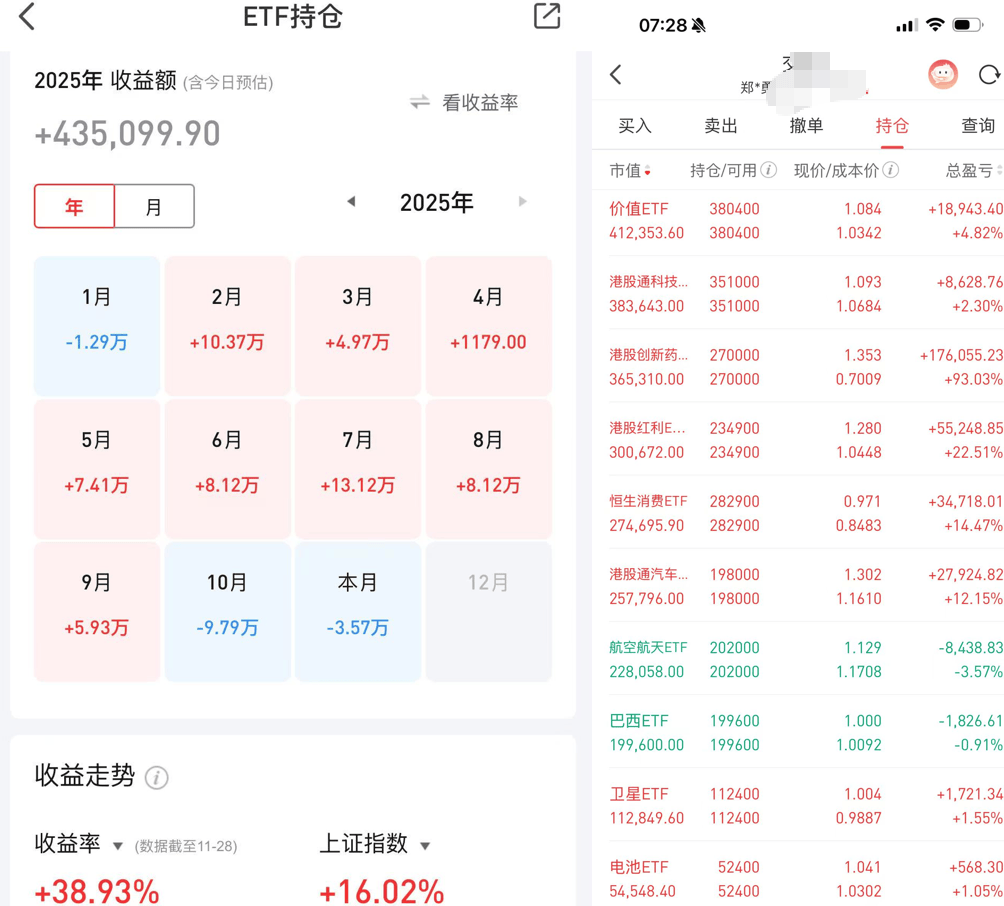
Group 1 - The company has three main accounts with total assets exceeding 10 million yuan, consisting of 2.6 million yuan in an ETF account, 5.5 million yuan in an off-market fund account, and 1.1 million yuan in an advisory portfolio [1] - The ETF account has shown strong performance with a cumulative profit of 435,000 yuan this year, despite a recent decline of 130,000 yuan over two months [1] - The off-market fund account has a diversified portfolio and has been profitable for seven out of the first nine months of the year, with a total profit of 1.238 million yuan and a return rate of 31.68% [2][3] Group 2 - The market experienced a significant net inflow of over 50 billion yuan during a recent downturn, followed by a net outflow of the same amount as the market stabilized [4][5] - Southbound capital has flowed into Hong Kong stocks, totaling nearly 14 billion Hong Kong dollars this year, indicating a complex dynamic where foreign capital may be selling while local investors are buying [5] - The current valuation of the CSI All Share Index is at a price-to-earnings ratio of 20.98, which is high compared to historical levels, suggesting limited market upside potential towards the end of the year [7][10] Group 3 - The company has made strategic adjustments in its portfolio, including reducing positions in value ETFs and increasing investments in Brazilian ETFs and technology ETFs focused on Hong Kong [10] - The outlook for the market towards the end of the year appears cautious, with expectations of limited significant movements based on both funding and valuation perspectives [10]
Financial Performance of Mitchells & Butlers PLC (MBPFF)
Financial Modeling Prep· 2025-11-28 20:00
Financial Performance of MBPFF - MBPFF reported an earnings per share (EPS) of $0.1655, slightly above the estimated $0.1653 [1][6] - The company's revenue was approximately $1.69 billion, surpassing estimates, indicating a positive financial standing [1][6] - The price-to-earnings (P/E) ratio of 9.29 suggests a low valuation relative to its earnings [1][6] Financial Performance of Mitchells & Butlers PLC - Mitchells & Butlers PLC experienced an 11% increase in share price, reaching 284p, following the release of its full-year results [2] - The company reported a 6% increase in adjusted EBIT to £330 million, slightly above consensus estimates [2][3] - Adjusted profit before tax rose by 17% to £246 million, exceeding expectations by about 4% [3][4] - Revenue grew by 4% to £2.7 billion, reflecting a robust performance [3] - In the first eight weeks of the new financial year, like-for-like sales increased by 3.8%, compared to a 3.1% rise in the final quarter of 2025 [3] Cost and Profitability Insights - Operating profit for Mitchells & Butlers reached £330 million, surpassing expectations by £5 million [4] - Earnings per share rose by approximately 17% to 31p, slightly exceeding forecasts [4] - The company anticipates an additional £130 million in cost inflation for the year, equating to around 6% [4]
