
日元套息交易

Search documents
日本央行加息至30年来最高点 专家警示“危险一跃”
Sou Hu Cai Jing· 2025-12-19 23:28
Group 1: Monetary Policy Changes - The Bank of Japan raised its policy interest rate by 25 basis points from 0.5% to 0.75%, marking the highest level in 30 years [1] - This increase follows a long period of loose monetary policy, including negative interest rates, which were in place since September 1995 [1] - The decision to raise rates is influenced by inflation data exceeding the 2% target for 44 consecutive months and ongoing depreciation of the yen, leading to imported inflation pressures [1] Group 2: Economic Implications - The revised GDP data indicates a contraction of 0.6% in Q3, with an annualized decline of 2.3%, surpassing previous market expectations of 2.0% [2] - Continuous negative growth could lead Japan into a technical recession, raising concerns about the effectiveness of the current monetary tightening combined with expansive fiscal policies [2] - Experts warn that the contradiction between tight monetary policy and loose fiscal policy may increase government debt financing costs and exacerbate fiscal risks [2] Group 3: Currency and Market Reactions - The interest rate hike may challenge the yen's status as a safe-haven currency, potentially weakening its appeal due to increased volatility in exchange rates [3] - The normalization of Japan's monetary policy could undermine the profitability of yen carry trades, which are based on borrowing in low-interest currencies to invest in higher-yielding assets [3] - Analysts suggest that the impact of the rate hike on global liquidity will be limited, with more focus needed on the future trajectory of interest rate adjustments [3][4] Group 4: Global Context - The divergence in monetary policy between the Federal Reserve and the Bank of Japan is seen as a key factor influencing global liquidity and the pricing of dollar assets [4] - Despite potential short-term volatility from Japan's rate hike, the long-term trend of global monetary easing is expected to continue [4] - Changes in China's export surplus and potential rate cuts by the Federal Reserve may lead to a long-term appreciation trend for the Chinese yuan [4]
加息难改日债日元弱势 日本央行陷入抗通胀与稳经济两难处境
Xin Lang Cai Jing· 2025-12-19 23:25
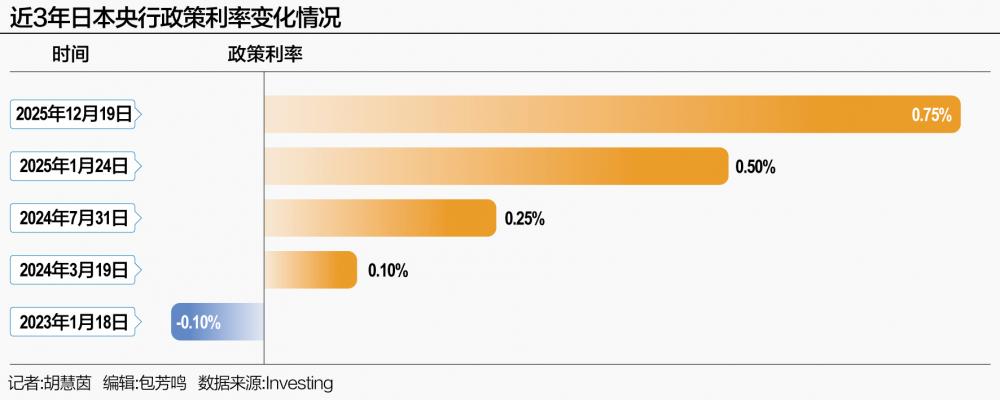
Core Viewpoint - The Bank of Japan (BOJ) raised its policy interest rate by 25 basis points to 0.75% on December 19, marking the highest level in 30 years, amidst ongoing tensions between the government and the central bank regarding monetary policy direction [1][4]. Group 1: Interest Rate Decision - The BOJ's decision to raise rates was anticipated, but there remains a divergence in views between the government, which is increasing fiscal deficits, and the BOJ, which aims to tighten monetary policy [4]. - The last rate hike prior to this was in January, when the rate was increased from 0.25% to 0.5%, indicating a significant shift in Japan's monetary policy landscape [1][4]. - BOJ Governor Kazuo Ueda indicated that there is still room for further rate increases, depending on economic and inflation trends, despite not providing a clear timeline for future hikes [1][4]. Group 2: Market Reactions - Following the rate hike, the Japanese stock, bond, and currency markets experienced notable volatility, with the yen initially rising before falling again [2][7]. - The long-term Japanese government bond yields surged, with the 10-year yield rising by 2.86% to 2.017%, reflecting market concerns about the BOJ's ability to manage inflation [8]. - The Nikkei 225 index has seen a decline of 1.49% since early December, indicating a complex relationship between the yen and Japanese equities [9]. Group 3: Economic Context - Japan's economy contracted by 2.3% year-on-year in the third quarter, highlighting ongoing economic challenges, while inflation remains above the BOJ's target, with core CPI rising by 3.0% in November [5][6]. - The BOJ's rate hike is seen as a necessary step to combat persistent inflation and to create room for future policy adjustments [5][6]. Group 4: Global Implications - The BOJ's actions are viewed as a defensive move ahead of potential significant rate cuts by the Federal Reserve, with concerns that a stronger yen could limit the BOJ's future rate hike capabilities [5]. - Experts suggest that the current market environment is different from previous instances of volatility, as the market had already priced in the BOJ's rate hike, reducing the likelihood of sudden market disruptions [10][11].

日本央行上调利率至30年新高,但短期或难改日元颓势
Sou Hu Cai Jing· 2025-12-19 11:37
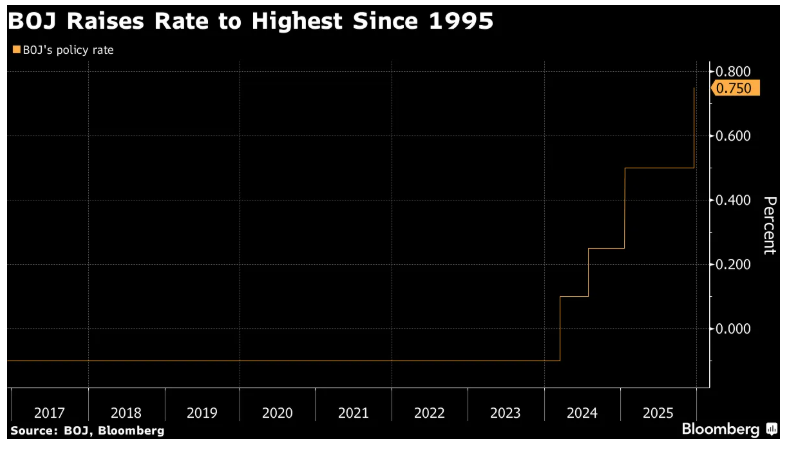
Core Viewpoint - The Bank of Japan raised its policy interest rate by 25 basis points to 0.75%, the highest level since 1995, indicating a commitment to continue tightening monetary policy if conditions allow [1][2]. Group 1: Interest Rate Decision - The interest rate hike was approved with a unanimous 9-0 vote, reflecting the Bank of Japan's determination to normalize rates amid inflationary pressures [2]. - The latest data shows that Japan's core Consumer Price Index (CPI) rose by 3% year-on-year in November, remaining above the Bank of Japan's 2% target [1]. Group 2: Currency and Economic Factors - Analysts suggest that the primary pressure for the rate hike stems from the exchange rate rather than inflation, as the yen has been weak, prompting discussions of potential market intervention [4]. - Japan's GDP contracted at an annualized rate of 1.8% in the third quarter, indicating economic weakness, which has raised concerns about government debt due to a significant stimulus plan of 18.3 trillion yen [4]. Group 3: Future Rate Expectations - Analysts predict that further rate hikes are likely in 2024, with expectations of 1-2 additional increases, contingent on inflation and economic performance [6][7]. - The outlook for 2026 suggests that only one rate hike may occur, influenced by factors such as real wage trends, government debt burdens, and overall economic weakness [7]. Group 4: Market Reactions - Following the rate hike announcement, the yen did not appreciate as expected, and the Nikkei 225 index rose by 1.0%, indicating a stable market response [7].
每日看盘|全球流动性出现新变化,A股或面临新机遇
Xin Lang Cai Jing· 2025-12-19 10:11
Group 1 - The A-share market experienced a broad rebound on Friday, with the Shanghai Composite Index showing two clear waves of upward movement, although it faced resistance and retraced later in the day [1] - The commercial aerospace sector and other technology-oriented assets remained strong, indicating that short-term momentum funds are actively buying [1] - Major indices in the Asia-Pacific markets, including the A-share market and the Hang Seng Index, exhibited a common characteristic of limited rebound strength, suggesting that capital is reassessing future liquidity expectations [2] Group 2 - The U.S. Federal Reserve's CPI data exceeded expectations, opening up possibilities for further interest rate cuts, which may lead to increased global liquidity and a more favorable environment for A-shares and other RMB assets [2][4] - The Bank of Japan's recent interest rate hike has significantly impacted the long-standing yen carry trade, potentially leading to a reallocation of global assets and affecting the performance of A-shares and other indices [3] - The anticipated return of new investment opportunities in A-shares is supported by the Fed's expected balance sheet expansion, which may strengthen the RMB and enhance the attractiveness of the Hang Seng Tech Index [4] Group 3 - The competition among economies is increasingly focused on technological advancements, as highlighted by U.S. initiatives to maintain its "space advantage," which is driving activity in sectors like commercial aerospace and smart driving [5] - The current dynamics of global liquidity and technological vitality suggest a positive outlook for A-shares in the short to medium term, with specific sectors such as biomedicine, smart driving, and commercial aerospace being actively monitored for investment opportunities [5]
12月19日金市晚评:三大央行政策角力 黄金短期震荡后择向
Jin Tou Wang· 2025-12-19 09:30
Core Viewpoint - The article discusses the recent fluctuations in gold prices and the potential impact of the Bank of Japan's monetary policy decisions on the gold market, highlighting the interplay between currency movements and gold as a safe-haven asset. Group 1: Gold Price Movements - As of December 19, the spot gold price is trading at $4326.22 per ounce, with a slight decline of 0.11% from the previous day, reaching a high of $4336.33 and a low of $4308.59 [1][2] - The market is closely watching the Bank of Japan's interest rate decision, which could signal the start of a rate hike cycle, potentially leading to increased volatility in the gold market [1][3] Group 2: Economic Indicators - The U.S. Consumer Price Index (CPI) for November has decreased to 2.7%, which is below the market expectation of 3.1% [2] - President Trump has indicated that the next Federal Reserve chair will be someone who supports significant rate cuts, which may influence market expectations regarding future monetary policy [2] Group 3: Market Sentiment and Predictions - Analysts suggest that if negotiations between the U.S. and Russia regarding the Ukraine conflict progress, gold prices may experience a significant drop next week [3] - The potential for a rate hike by the Bank of Japan could lead to a withdrawal of funds from various asset classes, putting additional pressure on gold prices [3] Group 4: Long-term Outlook - In the medium term, the normalization of Japan's monetary policy is expected to strengthen the yen, which may weaken the dollar and benefit gold as a dollar-denominated asset [4] - The long-term trajectory of gold prices will continue to be influenced by the Federal Reserve's monetary policy cycle, central bank reserve demands, and geopolitical uncertainties [4] Group 5: Technical Analysis - The daily chart indicates a positive outlook for precious metals, with prices forming higher highs and lows while remaining above the key 100-period moving average [5] - The first resistance level for gold is at $4353, and a decisive breakout above this level could lead to a rise towards historical highs of $4381 and a psychological target of $4400 [6] - Conversely, if bearish signals emerge and prices fall below $4300, sellers may gain momentum, potentially driving gold towards lower support levels [6]
日本央行宣布加息!高市早苗推18.3万亿日元财政刺激 “渡边太太”提前撤离
Sou Hu Cai Jing· 2025-12-19 07:23
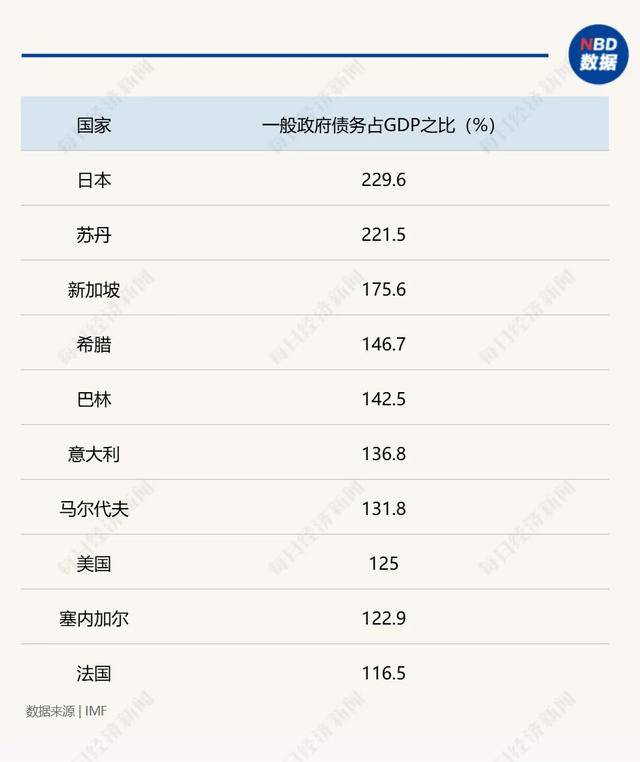
Group 1 - The Bank of Japan raised its policy interest rate by 0.25 percentage points to 0.75%, marking the highest level since September 1995, signaling the end of the ultra-loose monetary policy era [1][2] - This decision is aimed at breaking the long-standing cycle of low interest rates, low inflation, and low growth, driven by inflation exceeding the central bank's target for 44 consecutive months and the depreciation of the yen causing imported inflation [1][3][4] - The contradiction between the central bank's tightening monetary policy and the government's substantial fiscal stimulus plan of 18.3 trillion yen raises concerns about the effectiveness of the rate hike and increases the government's debt financing costs [1][5][6] Group 2 - Japan's core consumer price index (CPI) has been above the 2% target for 44 months, with a year-on-year increase of 3.0% in October and a slight decrease to 2.9% in November, indicating persistent inflationary pressures [3][4] - The depreciation of the yen, hovering around 155 against the dollar, has contributed to rising import costs, prompting the central bank to raise rates to alleviate exchange rate pressures and support the yen [4][6] - The government's fiscal stimulus plan, which relies heavily on new bond issuance, is expected to exacerbate the already high debt burden, with government debt projected to reach 229.6% of GDP by 2025, the highest among developed countries [6][7][8] Group 3 - The combination of tightening monetary policy and expanding fiscal policy is viewed as a "dangerous leap," potentially leading to increased liquidity pressure in the bond market and undermining the credibility of monetary policy [8][10] - Japan's economy is showing signs of fatigue, with the third quarter GDP contracting by 2.3% on an annualized basis, raising concerns about a potential technical recession if negative growth continues [10][11] - The low unemployment rate is causing labor shortages, leading to a wage-price spiral that could further complicate the inflation situation and necessitate additional rate hikes [11][12] Group 4 - The shift in Japan's monetary policy is expected to impact global capital markets, particularly concerning the risks associated with the unwinding of yen carry trades, which have been a significant source of global liquidity [13][15] - Speculative funds have begun to withdraw rapidly, with net positions in the yen shrinking by over 60% in a two-week period, indicating market sensitivity to the rate hike [17][18] - Future capital flows may transition from carry trades to a focus on domestic reallocation within Japan, leading to structural adjustments in global capital markets [18]
创30年来最高水平,日本央行宣布加息!高市早苗推18.3万亿日元财政刺激,“渡边太太”提前撤离
Xin Lang Cai Jing· 2025-12-19 05:45
Group 1 - The Bank of Japan raised its policy interest rate by 0.25 percentage points to 0.75%, marking the highest level since September 1995 and signaling the end of the ultra-loose monetary policy era [1][21][25] - This decision is aimed at breaking the long-standing cycle of low interest rates, low inflation, and low growth in Japan [1][21] - Japan's inflation has exceeded the central bank's target of 2% for 44 consecutive months, with the core consumer price index (CPI) rising by 3.0% in October and decreasing to 2.9% in November [4][27] Group 2 - The depreciation of the yen has contributed to inflationary pressures, with the yen trading around 155 against the dollar, close to levels that previously prompted government intervention [6][29] - The government, led by Prime Minister Fumio Kishida, has announced a fiscal stimulus plan amounting to 18.3 trillion yen, which raises concerns about the mismatch between tight monetary policy and expansive fiscal policy [3][31] - The yield on 10-year Japanese government bonds reached 2%, the highest since May 2006, indicating rising borrowing costs for the government [8][31] Group 3 - The International Monetary Fund (IMF) projects that Japan's government debt will reach 229.6% of GDP by 2025, the highest among developed countries [9][31] - The combination of tightening monetary policy and expanding fiscal policy is viewed as a "dangerous leap," potentially leading to increased liquidity pressure in the bond market and undermining the credibility of monetary policy [9][32] - The Japanese economy has shown signs of fatigue, with the real GDP contracting by 2.3% in the third quarter, indicating a return to recession after six quarters of growth [11][34] Group 4 - The shift in Japan's monetary policy is expected to impact global capital markets, particularly concerning the risks associated with yen carry trades, which have been a significant source of global liquidity [12][35] - Speculative funds have begun to withdraw, with net positions in yen contracts shrinking by over 60% from December 2 to December 16 [18][41] - Analysts suggest that the current environment may lead to a "low carry, high allocation" phase in global capital flows, as the attractiveness of carry trades diminishes [19][42]
?日本央行加息靴子落地! 基准利率来到1995年以来最高 市场开始押注“每半年加息一次”
Zhi Tong Cai Jing· 2025-12-19 04:52
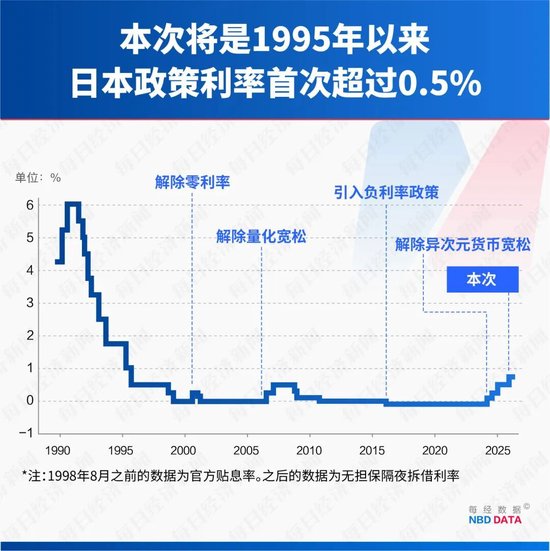
智通财经APP获悉,日本央行如市场所预期的那样宣布加息,一举将基准利率上调至30年来最高水平, 并表示如果条件允许,未来还会进一步加息。这一最新动态表明日本央行日益确信能够实现其十多年来 一直追求的长期稳定通胀与薪资稳定增速目标,日本央行将借贷成本提升至1995年以来最高,以及货币 政策声明透露出加息路径未完结,令金融市场押注日本央行将以每半年一次的步伐进行加息,直至达到 1.5%附近。 根据日本央行周五的声明,日本央行行长植田和男领导的日本央行货币政策委员会以一致决定(9:0全票 通过)将利率上调25个基点至0.75%,与华尔街经济学家们普遍预期完全一致。日本央行表示,其经济展 望得以实现的可能性正在显著上升。 值得注意的是,日本央行在最新发布的货币政策声明中明确表示加息周期将持续,称如果其经济展望持 续得以实现,该央行打算继续提高借贷成本。日本央行还表示,潜在通胀正在继续以温和态势良性上 升。 声明发布后不久,日元汇率反而走弱,美元兑日元在156附近趋于上行交易态势,通常来说加息将促进 本国主权货币汇率上行,本次日元反而继续贬值主要因此次加息已被市场充分定价,且日本央行声明呈 现出中性立场,并未像去年8月 ...
日本央行加息靴子落地! 基准利率来到1995年以来最高 市场开始押注“每半年加息一次”
Zhi Tong Cai Jing· 2025-12-19 04:45
日本央行如市场所预期的那样宣布加息,一举将基准利率上调至30年来最高水平,并表示如果条件允许,未来 还会进一步加息。这一最新动态表明日本央行日益确信能够实现其十多年来一直追求的长期稳定通胀与薪资稳 定增速目标,日本央行将借贷成本提升至1995年以来最高,以及货币政策声明透露出加息路径未完结,令金融 市场押注日本央行将以每半年一次的步伐进行加息,直至达到1.5%附近。 根据日本央行周五的声明,日本央行行长植田和男领导的日本央行货币政策委员会以一致决定(9:0全票通过)将 利率上调25个基点至0.75%,与华尔街经济学家们普遍预期完全一致。日本央行表示,其经济展望得以实现的可 能性正在显著上升。 值得注意的是,日本央行在最新发布的货币政策声明中明确表示加息周期将持续,称如果其经济展望持续得以 实现,该央行打算继续提高借贷成本。日本央行还表示,潜在通胀正在继续以温和态势良性上升。 声明发布后不久,日元汇率反而走弱,美元兑日元在156附近趋于上行交易态势,通常来说加息将促进本国主权 货币汇率上行,本次日元反而继续贬值主要因此次加息已被市场充分定价,且日本央行声明呈现出中性立场, 并未像去年8月日本股市暴跌前夕那样释放 ...
期货日报:基本面和情绪面共振 铂、钯期价再度大涨
Qi Huo Ri Bao· 2025-12-19 00:58
Core Viewpoint - The recent surge in platinum and palladium futures prices is attributed to a combination of fundamental supply shortages and heightened market sentiment, with prices increasing over 20% since December 12 [1][2]. Group 1: Price Movements - As of December 18, platinum futures (PT2606) closed at 542.65 CNY/gram, up 5.32%, while palladium futures (PD2606) closed at 476.6 CNY/gram, up 6.99% [1]. - The price of platinum and palladium has risen over 20% since December 12 [1]. Group 2: Market Dynamics - Analysts suggest that the price increase is driven by a combination of overseas supply shortages and a bullish sentiment in the metal sector [2]. - The World Platinum Investment Council indicates that the platinum market is expected to experience a supply shortage for the third consecutive year in 2025, with a projected supply-demand gap exceeding 20 tons [3]. Group 3: Supply and Demand Factors - Approximately 70% of global platinum production comes from South Africa, where production is constrained by long-term investment shortages, power shortages, aging infrastructure, and extreme weather [3]. - Domestic investment demand for platinum is expected to surge by 100% year-on-year in 2025, making it the largest retail investment market globally [3]. Group 4: Future Outlook - Analysts believe that while platinum prices may have strong support due to structural demand expansion, there are potential risks of price corrections if gold prices decline significantly [4]. - For palladium, the supply-demand balance has shifted from long-term shortages to potential oversupply, with forecasts indicating a surplus of 16.9 tons by 2026 [3][4].