科技牛

Search documents
量化交易颠覆市场?热点一日游时代,这样操作避免被收割
Sou Hu Cai Jing· 2026-01-07 20:55
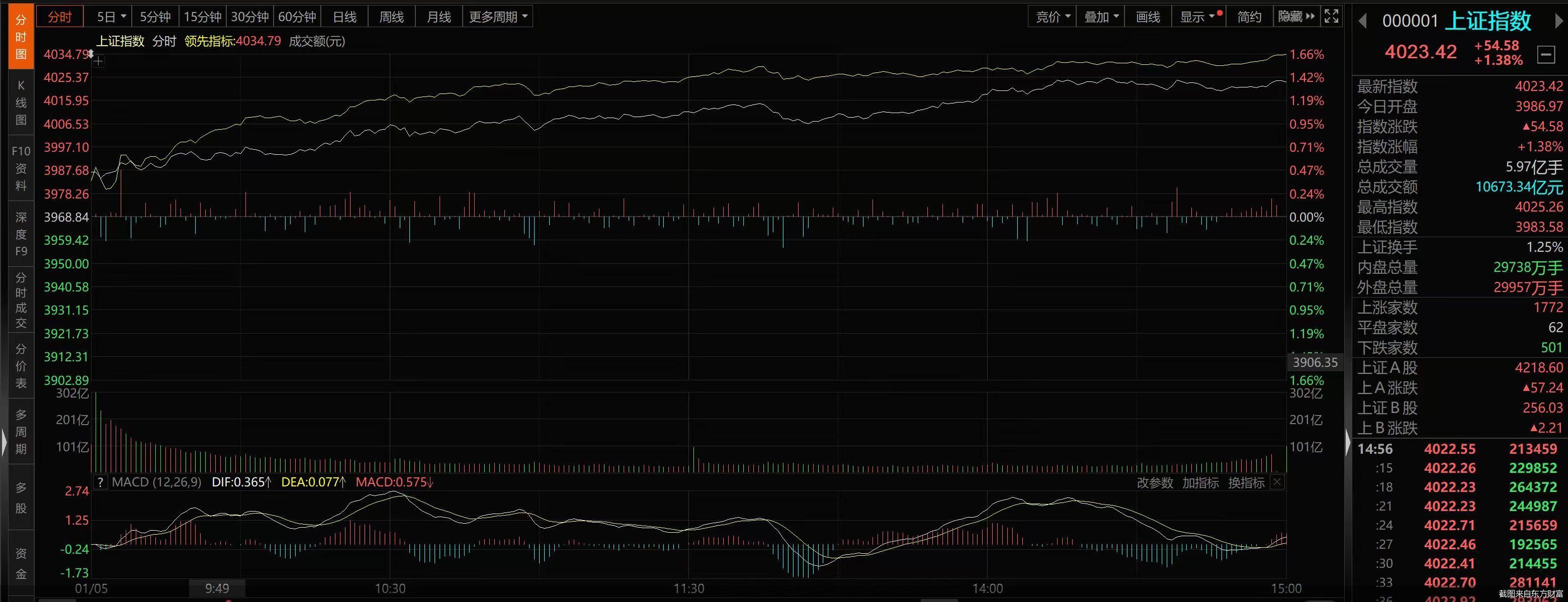
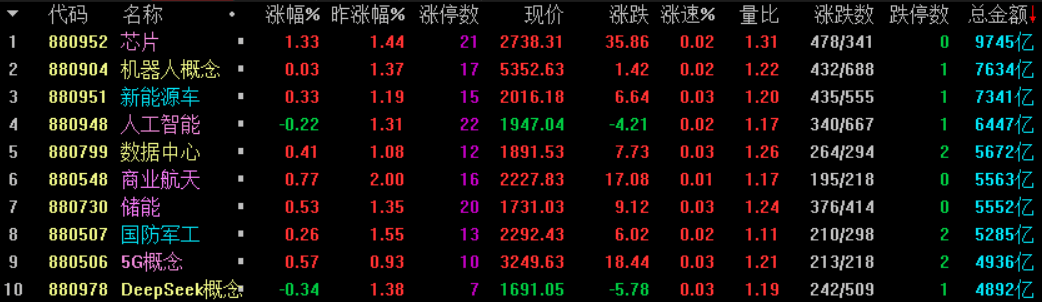
Group 1 - The core market trend shows a strong upward movement, with the Shanghai Composite Index experiencing a 14-day consecutive rise, approaching the 4100-point mark, indicating a prevailing bullish trend despite short-term fluctuations [1][2] - The market structure has fundamentally changed, with trading volumes consistently exceeding 2 trillion, leading to a multi-line approach rather than focusing on one or two core themes [2][3] - The market's behavior has shifted from an A-V structure to an N-shaped structure, where adjustments after a rise are seen as opportunities for further gains rather than declines [2][3] Group 2 - The analysis emphasizes the importance of understanding the overall market dynamics, including the top-level index trends, which indicate that 90% of sectors are in a primary upward trend [2][3] - The focus should be on identifying strong sectors that lead the market, such as the Fujian sector post-National Day and the commercial aerospace sector starting in December, which are examples of strong thematic movements [2][3] - Daily leading sectors are now more varied, and the previous reliance on a single leading stock to drive market sentiment has diminished, resulting in a more chaotic but potentially rewarding trading environment [3][4] Group 3 - The current market requires a shift in trading strategies, moving away from traditional metrics like daily gain percentages and the number of stocks hitting the limit up, as these indicators are less reliable in the current environment [4][5] - The market's decentralization is influenced by factors such as differential price limits across exchanges, regulatory constraints, and the impact of quantitative trading, which has led to a faster-paced and more fragmented trading landscape [4][5] - In a long-term bullish market with short-term chaos, the recommended approach is to focus on a few key sectors, particularly technology stocks, and to track them consistently for opportunities [5][6] Group 4 - The strategy involves concentrating on five key sectors: chips, robotics, new energy vehicles, artificial intelligence, and commercial aerospace, which are expected to experience significant movements throughout the year [5][6] - The approach includes using sector-specific ETFs or selecting 3-5 core stocks within each sector, ensuring alignment between stock performance and sector trends [6][7] - The overall strategy should integrate index analysis with sector and stock selection, using index movements to guide specific trading decisions [6][7]

国泰海通晨报-20260107
GUOTAI HAITONG SECURITIES· 2026-01-07 06:35
Group 1: Strategy Research - The current overseas computing power valuation is reasonable, and subsequent performance upgrades are key; domestic computing power awaits performance realization and is catalyzed by the decline in risk-free interest rates; AI application valuations are cost-effective, with a focus on internet and media sectors [2][3][6] Group 2: Dairy Industry Research - The ruling on import beef safeguard measures has been implemented, with a nearly 6% reduction in quotas for major supplying countries in 2026, and an additional 55% tariff on beef imported outside the quota, which is expected to boost domestic beef demand and sustain the upward trend in the beef cattle industry [7][8][9] - The price of raw milk is stabilizing and is expected to rise in 2026 due to the reduction in supply-side expansion and decreased replenishment, along with the release of processing capacity on the demand side [7][9] Group 3: Non-Metallic Building Materials Research - China Jushi has announced a restricted stock incentive plan, which reflects the company's confidence in future operations, covering a wide range of employees including executives and core middle management [3][10][11] Group 4: Fixed Income Research - The January 2026 convertible bond portfolio is biased towards aggressive and elastic sectors, supplemented by a balanced combination of relatively low-priced and undervalued industries [2][14][16] - The convertible bond market is expected to experience a "New Year rally" due to policy expectations and seasonal capital inflows, with a focus on technology innovation and expanding domestic demand as key investment themes [29][30][31]


国泰海通 · 深度|策略:从历次科技牛规律,定位当下AI产业链投资阶段
国泰海通证券研究· 2026-01-06 14:27
Core Viewpoint - The current overseas computing power valuation is reasonable with potential for upward revision, while domestic computing power has significant long-term growth potential and performance expectations are being met [1] Historical Analysis of Technology Bull Markets - The article reviews past technology bull markets (2009-2010 consumer electronics, 2013-2015 gaming, and 2019-2021 lithium battery) to analyze the price performance characteristics during valuation expansion and profit-driven phases, providing a historical reference for the current AI industry chain [2][8] Valuation Expansion Phase Characteristics - During this phase, new technologies emerge without profit support, and industry and policy catalysts create imagination space, driving up valuations. Historical data shows that: - High levels of industry crowding are common, but short-term trading crowding does not affect the overall trend [3][15] - Risk premium effectively measures valuation boundaries, with significant reactions to positive news diminishing when the risk premium falls below a certain threshold [18] - High valuation ranges are sensitive to liquidity changes, with tightening liquidity potentially triggering adjustments [3][18] Profit-Driven Phase Characteristics - In this phase, exceeding profit expectations drives market performance, with historical examples showing: - The need to be cautious of competitive pressures and valuation constraints under endgame thinking [4][21] - Overcapitalization during profit upturns can lead to increased competition and excess capacity, negatively impacting profitability [22][25] Investment Recommendations - Overseas Computing Power: Currently in the profit-driven phase, with ROIC expected to continue rising until Q3 2025, and leading companies' valuations (PE-FY3) are reasonable at 20-30 times, indicating no bubble [5][26] - Domestic Computing Power: Significant long-term growth potential exists, with performance expectations being met and a systemic decline in risk-free rates acting as a catalyst for the next market phase [5][28] - AI Applications: Valuation is attractive, particularly in the internet and media sectors, although the timing and areas for breakout applications are uncertain [5][29]

沪指再创本轮牛市新高,市场期待“慢牛”成型
Di Yi Cai Jing· 2026-01-06 10:26
Group 1 - The current bull market is characterized by long-term capital leading the way, differing from previous bull markets that were primarily driven by liquidity [1][4][5] - The Shanghai Composite Index reached a new high of 4083 points on January 6, 2024, following a 1.5% increase, with total trading volume across Shanghai, Shenzhen, and Beijing reaching 2.83 trillion yuan [1] - Analysts expect this bull market to evolve into a "slow bull" or "long bull" due to sustained liquidity, historically low domestic interest rates, and a focus on technological innovation [1][4] Group 2 - The current bull market is primarily driven by sectors such as artificial intelligence and non-ferrous metals, with companies like Jiangxi Copper and Zijin Mining reaching new highs [2] - The average duration of previous bull markets since 2008 has been between 23.5 to 25.5 months, with the current market showing similar duration but with significant changes in market structure and logic [3][4] - The market is experiencing a structural characteristic where funds are concentrated in sectors aligned with national strategies and global technological trends, such as AI and semiconductors [5][6] Group 3 - The margin financing balance in the current bull market is not significantly high, indicating that leverage has not expanded notably, with long-term funds like insurance and pensions continuing to flow into the market [7] - The current market is expected to transition from a valuation recovery phase to a profit-driven phase, with a focus on sectors like artificial intelligence, semiconductor localization, and new energy technologies [7][8] - The market is anticipated to maintain a "slow bull" characteristic, with structured increases in the index and a focus on technology and innovation as key drivers [7][8]
13连阳!沪指创十年新高
Huan Qiu Lao Hu Cai Jing· 2026-01-06 10:25
1月6日,三大指数集体收涨,两市成交额高达2.81万亿。其中,上证指数高开高走,收涨1.50%,报 4083.67点,刷新2015年7月底以来新高。并实现日线13连阳,创史上最长连阳记录。 回顾A股历史,上证指数10连阳以上的行情十分罕见。仅在1992年2月25日至3月11日实现12连阳,以及 分别在1992年5月、2006年6月、2017年12月至2018年1月录得三次11连阳。 梳理发现,指数连阳行情往往伴随后续趋势性上涨。上证指数曾在2006年6月实现11连阳后,便开始持 续攀升,最终在2007年10月突破6000点大关,期间累计涨幅超260%。 从板块表现来看,6日市场热点板块全面开花。脑机接口概念涨幅居前,三博脑科、美好医疗、创新医 疗2连板;商业航天概念持续爆发,十余只成分股涨停,鲁信创投8天6板,北斗星通、中国卫通6天4 板。分析指出,科技牛是2025年贯穿全年的一个重要特征,2026年科技牛行情有望继续延续。 而本轮上证指数的强势表现早有端倪。2025年全年,上证指数累计上涨18.41%,深证成指上涨 29.87%,创业板指更是大涨近50%。 2026年第一个交易日,上证指数延续涨势收涨1.3 ...
A股喜迎开门红
Sou Hu Cai Jing· 2026-01-05 16:08
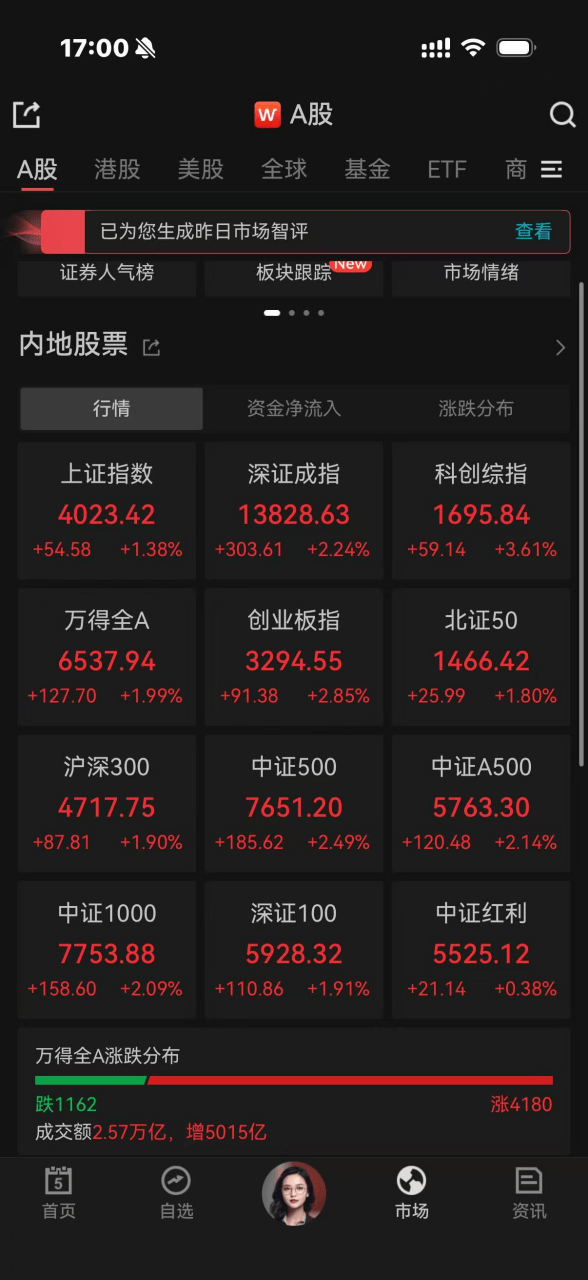
Core Viewpoint - The A-share market experienced a strong opening on January 5, 2026, with all three major indices rising significantly, indicating a bullish sentiment among investors and a potential continuation of the upward trend in 2026 [1][3]. Market Performance - The Shanghai Composite Index closed up 1.38% at 4023.42 points, marking a 12-day consecutive rise, the longest in over 30 years [3]. - The Shenzhen Component Index and the ChiNext Index rose by 2.24% and 2.85%, closing at 13828.63 points and 3294.55 points, respectively [3]. - The STAR 50 Index saw a notable increase of 4.4%, closing at 1403.41 points [3]. Trading Activity - The total trading volume on January 5 reached approximately 2.55 trillion yuan, with the Shanghai Stock Exchange contributing 1.067 trillion yuan and the Shenzhen Stock Exchange 1.479 trillion yuan [3][4]. - A total of 4185 stocks rose, with 127 stocks hitting the daily limit up, indicating a strong profit-taking environment for investors [4]. Sector Performance - The brain engineering sector led the gains, with several stocks hitting the daily limit up, including Sanbo Brain Science and Botao Biology [3]. - Other active sectors included insurance, fourth-generation semiconductors, medical devices, and AI pharmaceuticals, all showing significant upward movement [3]. Future Outlook - Analysts predict a continued inflow of capital into the A-share market, potentially reaching 1.56 trillion yuan, which would support a slow bull market [4]. - The core logic supporting the current bull market remains unchanged, driven by ongoing policy support, a significant shift in household savings, and advancements in technological innovation [4]. - The current market is characterized as a slow bull market, which could last from 3 to 10 years, marking a golden investment period for the Chinese capital market [4].



近4200股上涨 沪指重回4000点
Bei Jing Shang Bao· 2026-01-05 15:43
Core Viewpoint - The A-share market experienced a strong opening on January 5, 2026, with all three major indices rising significantly, marking a notable bullish trend and a potential continuation of the "slow bull" market phase for the coming years [1][3][5]. Market Performance - On January 5, the Shanghai Composite Index rose by 1.38% to close at 4023.42 points, achieving a "12 consecutive days of gains" record, the longest in over 30 years [3]. - The Shenzhen Component Index and the ChiNext Index increased by 2.24% and 2.85%, closing at 13828.63 points and 3294.55 points, respectively [3]. - The STAR 50 Index saw a remarkable increase of 4.4%, closing at 1403.41 points [3]. Trading Activity - The trading atmosphere was robust, with a total trading volume of approximately 2.55 trillion yuan across both the Shanghai and Shenzhen markets [1][3]. - The Shanghai Stock Exchange recorded a trading volume of 1.0673 trillion yuan, while the Shenzhen Stock Exchange had 1.4790 trillion yuan [3]. Sector Performance - The human brain engineering sector led the gains, with several stocks hitting the daily limit up, including Sanbo Brain Science and Botao Biology [3]. - Other active sectors included insurance, fourth-generation semiconductors, medical devices, and AI pharmaceuticals, all showing significant upward movement [3]. Individual Stock Highlights - China Satellite topped the individual stock trading volume with 19.454 billion yuan, followed closely by Sanhua Intelligent Control at 19.212 billion yuan [4]. - A total of 4185 stocks rose, with 127 hitting the daily limit up, indicating a strong profit-making effect for investors [4]. Future Outlook - According to a report from招商证券, A-share market is expected to see a net inflow of approximately 1.56 trillion yuan, providing liquidity support for a "slow bull" market [4]. - The core logic supporting the current bull market remains unchanged, driven by continuous policy support, a significant shift in household savings, and advancements in technological innovation [4]. - The current market phase is characterized as a "slow bull" or "long bull" market, potentially lasting 3-10 years, marking a significant investment period for Chinese assets [5].
A股新年开门红!上证指数创11年最佳开局,全天成交额超2.5万亿元
Hua Xia Shi Bao· 2026-01-05 12:16
Market Performance - On the first trading day of 2026, A-shares saw all three major indices rise, with the Shanghai Composite Index increasing by 1.38% to close above 4000 points for the first time since mid-November 2025 [2][3] - The total trading volume for the day exceeded 2.5 trillion yuan, marking a significant increase of over 500 billion yuan compared to the last trading day of 2025 [3][4] - The Shenzhen Component Index and the ChiNext Index also recorded their best opening performances since 2022, with increases of 2.24% and 2.85% respectively [2][3] Sector Performance - The insurance sector saw significant gains, with stocks like New China Life Insurance rising nearly 9%, China Pacific Insurance up over 7%, and China Life Insurance increasing by over 6% [6] - Among the 31 sectors, media, pharmaceuticals, and electronics led the gains, while oil, banking, and transportation sectors experienced declines [3][4] Capital Flow - The top three sectors for net inflows were semiconductors, electronic components, and batteries, with net inflows of 5.448 billion yuan, 5.281 billion yuan, and 2.178 billion yuan respectively [4] - Conversely, the aerospace, telecommunications, and general equipment sectors faced the highest net outflows [4] Economic Outlook - Analysts predict that the technology bull market, which characterized 2025, is likely to continue into 2026, supported by ongoing policy support and breakthroughs in technological innovation [2][8] - The first month of the year is typically when credit issuance peaks, which could provide significant support for the capital market [9] Investment Strategy - Analysts suggest focusing on two main lines: the acceleration of global changes and the optimization of supply-demand structures in manufacturing and resources, alongside two auxiliary lines related to consumer policies and international expansion [10] - The current market environment is seen as favorable for equity assets, with expectations of increased investment opportunities as more industries enter a performance release phase [9]

A股迎“开门红”!上证指数重返4000点 沪深北成交额2.57万亿
Sou Hu Cai Jing· 2026-01-05 11:36
元旦假期后的首个交易日,A股市场迎"开门红",上证指数收复4000点。 1月5日,上证指数高开高走,盘中突破4000点大关,截至收盘,上证指数报4023.42,涨1.38%。Wind 数据显示,A股4180只股票上涨,全市场成交额2.57万亿元,较前一交易日增量5015亿元。 "2026年的行情有望延续自2024年9月份开启的这轮慢牛、长牛行情。"前海开源基金首席经济学家、基 金经理杨德龙指出,2025年大盘一度站上4000点,确立了这轮牛市的走势,在四季度出现了一定回调, 而在元旦之前市场走出11连阳,重新开始上攻,节后延续了上攻走势,大盘再次站上4000点关口,并实 现12连阳,牛市氛围愈发浓厚。 三大指数大幅上涨 "科技牛"行情有望延续 1月5日,A股三大指数均高开高走。截至收盘,沪指涨1.38%报4023点,深证成指涨2.24%,创业板指涨 2.85%。板块方面,脑机接口、创新药、保险、存储芯片、AI应用、军工装备、有色金属板块涨幅靠 前。 1月5日,A股三大指数均大幅上涨。Wind数据截图 盘面上,脑机接口板块全线大涨,创新医疗、岩山科技、三博脑科、南京熊猫、塞力医疗、爱朋医疗、 国际医学、伟思医疗 ...
A股喜迎开门红!沪指“12连阳”重回4000点,近4200股上涨
Bei Jing Shang Bao· 2026-01-05 09:01
Core Viewpoint - The A-share market experienced a strong opening on January 5, 2026, with all three major indices rising significantly, marking a notable recovery and investor enthusiasm in the market [1][3]. Market Performance - The Shanghai Composite Index rose by 1.38% to close at 4023.42 points, achieving a "12 consecutive days of gains," the longest streak in over 30 years [3]. - The Shenzhen Component Index and the ChiNext Index increased by 2.24% and 2.85%, closing at 13828.63 points and 3294.55 points, respectively [3]. - The STAR 50 Index performed exceptionally well, rising by 4.4% to 1403.41 points [3]. Sector Performance - The brain engineering sector led the gains, with several stocks hitting the daily limit of 20% increase, including Sanbo Brain Science and Botao Biology [3]. - The insurance sector was active, with all major stocks in the sector showing positive performance [3]. - Other sectors with notable gains included fourth-generation semiconductors, medical devices, and AI pharmaceuticals [3]. Trading Volume - The total trading volume on January 5 was approximately 2.55 trillion yuan, with the Shanghai Stock Exchange contributing 1.067 trillion yuan and the Shenzhen Stock Exchange 1.479 trillion yuan [3]. - The Beijing Stock Exchange recorded a trading volume of 21.14 billion yuan [3]. Individual Stock Performance - China Satellite topped the individual stock trading volume with 19.454 billion yuan, followed closely by Sanhua Intelligent Control at 19.212 billion yuan [4]. - A total of 4185 stocks rose, with 127 stocks hitting the daily limit, indicating a strong profit-making environment for investors [5]. Market Outlook - According to a report from招商证券, A-share market is expected to see a continued net inflow of funds, potentially reaching 1.56 trillion yuan, supporting a slow bull market [5]. - The core logic supporting the current bull market remains unchanged, including ongoing policy support, a significant shift in household savings, and continuous breakthroughs in technological innovation [5]. - The current bull market is characterized as a slow and long-term trend, potentially lasting 3 to 10 years, marking a golden investment period for the Chinese capital market [5].