程序化交易

Search documents
每日债市速递 | 银行间市场资金面稳中有松
Wind万得· 2026-01-28 23:01
1. 公开市场操作 央行 公告称, 1 月 28 日以固定利率、数量招标方式开展了 3775 亿元 7 天期逆回购操作,操作利率 1.40% ,投标量 3775 亿元,中标量 3775 亿元。 Wind 数据显示,当日 3635 亿元 逆回购到期 ,据此计算,单日净投放 140 亿元。 (*数据来源:Wind-央行动态PBOC) 2. 资金面 银行间市场资金面稳中有松但价格变化不大, D R001 加权平均利率微降并停留于 1.36% 附近。匿名点击( X-repo )系统上,隔夜报价在 1.35% ,持平 上日,供给数百亿。非银机构以质押存单及信用债借入隔夜,最新报价在 1.55% 左右,持平上日。 海外方面,最新美国隔夜融资担保利率为 3.66% 。 (IMM) (*数据来源:Wind-同业存单-发行结果) 4. 银行间主要利率债收益率 | | 1Y | | 2Y | | 34 | | 54 | | 74 | | 10Y | | 超长债 | | --- | --- | --- | --- | --- | --- | --- | --- | --- | --- | --- | --- | --- | --- ...


随着期货大涨,韩国暂停KOSDAQ市场程序化交易
Mei Ri Jing Ji Xin Wen· 2026-01-26 01:07
Group 1 - The core point of the article is that South Korea has suspended program trading on the KOSDAQ market due to a significant rise in futures prices [1] Group 2 - The decision to halt program trading indicates a response to market volatility and aims to stabilize trading conditions [1] - The suspension reflects the regulatory measures taken by the authorities to manage excessive market fluctuations [1] - The KOSDAQ market's reaction to futures price movements highlights the interconnectedness of different financial markets [1]
黄金又跌价了,26年1月22日金条降价,国内黄金、金条新价格
Sou Hu Cai Jing· 2026-01-23 18:39
Core Viewpoint - International gold prices have experienced a pullback after reaching a high in mid-January, leading to a cooling effect in the domestic market, with noticeable pricing discrepancies across different channels [1][2]. Group 1: International and Domestic Pricing - International gold prices peaked at $4,636 per ounce on January 14, then retreated to around $4,595, with a brief spike to $4,690 around January 19 [2]. - In the Shanghai market, as of January 22, 2026, spot gold prices fell to 1,084 RMB per gram, with futures around 1,090 RMB per gram and base gold prices at approximately 1,093 RMB per gram [2]. - Retail gold prices in major stores ranged from 1,247 to 1,506 RMB per gram, with mainstream brands priced around 1,493 to 1,498 RMB per gram [2]. Group 2: Factors Influencing Price Movements - The recent price pullback is attributed to multiple factors, including profit-taking at historical highs and programmed trading mechanisms that trigger sell orders at key price levels [4]. - Macro factors exerting pressure on gold prices include the Federal Reserve's signals of not rushing to cut interest rates, which strengthens the dollar and suppresses gold prices, while geopolitical risks provide support for safe-haven demand [4]. Group 3: Domestic Market Pricing Discrepancies - Domestic gold price reductions do not equate to uniform consumer costs due to three main reasons: differences in processing fees, brand premiums, and regional price variations [6]. - Processing fees for complex designs can add 300 to 500 RMB per gram, significantly impacting total costs even when gold prices decline [6]. - Regional price differences can be as high as 300 RMB per gram, influenced by logistics, policies, and competition [6]. Group 4: Technical Signals and Central Bank Purchases - Key technical levels to monitor include support around $4,575 per ounce and the psychological barrier at $4,600, with potential for amplified volatility due to leveraged funds adjusting positions [8]. - The People's Bank of China has been increasing its gold reserves, with a reported total of 74.15 million ounces as of December 2025, indicating a continued strategy to enhance financial security amid uncertainty [8]. Group 5: Strategies for Investors - Investors are advised to separate investment decisions from consumption, focusing on gold bars or ETFs to minimize costs associated with processing fees and brand premiums [10]. - For those looking to purchase for personal use, it is recommended to buy during price corrections and to compare prices across different stores and channels [10]. - When planning to liquidate gold, it is crucial to understand weighing methods, discount rules, and quality assessment processes to avoid unexpected costs [10].

金价1月20日:大家提前做好准备,明后两天,金价或迎来重大转向
Sou Hu Cai Jing· 2026-01-21 17:20
Core Viewpoint - The domestic gold market has experienced a price adjustment after a period of continuous increase, with international gold prices retreating from a historical high of $4636 per ounce to around $4595, indicating a significant market shift [1][3]. Price Adjustments - The prices of brand jewelry gold have adjusted, with notable reductions: Chow Tai Fook's price for 999 gold dropped to 1315 CNY per gram, Lao Feng Xiang to 1312 CNY, and Chow Sang Sang to 1308 CNY [3]. - Investment gold bar prices are more directly affected, with Industrial and Commercial Bank of China quoting 1047.57 CNY per gram, Construction Bank at 1046 CNY, and Agricultural Bank at 1048.63 CNY [3]. Market Dynamics - The market correction is attributed to profit-taking by investors at historical highs, leading to selling pressure. The prevalence of algorithmic trading has intensified price volatility, triggering stop-loss orders when gold prices breach key technical levels [3]. - The recent surge in gold prices was driven by geopolitical risks, particularly U.S. President Trump's threats regarding tariffs on European countries, which heightened global market risk aversion and increased demand for safe-haven assets like gold [3][4]. Long-term Support Factors - The Federal Reserve's policy expectations provide long-term support for gold prices, with market consensus anticipating at least two interest rate cuts within the year, enhancing gold's investment appeal [4]. - Gold prices have seen a cumulative increase of over 64% in 2025, with further gains expected in 2026 due to ongoing geopolitical tensions and economic uncertainties [4]. Regional Price Variations - Despite a general decline in base gold prices, the final prices consumers pay vary significantly due to "processing fees," which can account for 20% to 30% of the total price depending on the complexity of the jewelry design [6]. - There are notable geographical price disparities, with first-tier cities maintaining higher prices (1300-1315 CNY per gram) compared to lower prices in second and third-tier cities. In Hainan, prices can drop to 1180-1185 CNY per gram due to tax policies, while in Lhasa, prices can soar to 1470-1475 CNY per gram [7]. Market Sentiment and Future Outlook - The market is currently experiencing uncertainty, with gold prices seeking support around $4575 per ounce. The upcoming statements from Federal Reserve officials and any new geopolitical developments could significantly impact market sentiment and gold prices [8][10]. - The Chicago Mercantile Exchange has raised margin requirements for gold futures, which may force leveraged traders to liquidate positions, potentially amplifying short-term price declines [10]. - Central banks globally have been increasing gold reserves, with a reported net purchase of 297 tons from January to November 2025, reinforcing long-term demand for gold and supporting its price [10]. Investment Considerations - The recent surge in gold prices has raised questions about its status as a safe haven in the context of rising digital currencies and evolving asset forms. The historical bull market in gold has been fueled by various economic challenges and shifts in global confidence [11]. - Some institutions have raised concerns about current gold price valuations, indicating that the price has reached historically high levels relative to M2 money supply, suggesting potential overvaluation [13]. - Technically, gold is currently testing the critical support level at $4600, with the historical peak of $4720 serving as a resistance point. The market is poised for potential volatility as it awaits key signals that could drive significant price movements [13].

金银集体重挫!国际金价失守,2026年1月17日国内金价分化显著
Sou Hu Cai Jing· 2026-01-18 08:45
Core Viewpoint - The domestic gold market continues to operate at high levels, while international gold prices have experienced significant declines due to forced selling from passive funds and a stronger US dollar [1][3][5]. Group 1: Domestic Gold Market - As of January 17, 2026, domestic gold prices range from 992.48 to 1002.50 CNY per gram, with major brands like Chow Tai Fook and Lao Feng Xiang priced at 1413 CNY per gram [1]. - The price of 999 gold jewelry remains high, while the wholesale market in Shenzhen has seen prices drop to 1158-1218 CNY per gram, creating a price gap of over 200 CNY [5]. - Brand gold jewelry has seen price increases of up to 20% in early January, driven by processing fees and brand premiums, contrasting with the falling wholesale prices [5]. Group 2: International Gold Market - On January 17, 2026, international gold prices fell significantly, with spot gold dropping 1.67% to below 4540 USD per ounce, and New York futures down 1.82% [3]. - The decline began with a forced sell-off of approximately 6.5 billion USD in gold due to the Bloomberg Commodity Index's annual rebalancing, triggering a "stop-loss" effect [3]. - The Chicago Mercantile Exchange raised margin requirements for gold futures, leading to further market volatility as leveraged traders were forced to liquidate positions [3]. Group 3: Economic Factors - The strengthening US dollar, with the index rising 0.28% to 99.18, has reduced the attractiveness of gold priced in dollars, despite lower-than-expected core CPI figures [5]. - The Chinese central bank has increased its gold reserves for 14 consecutive months, reaching 7415 million ounces by the end of December 2025, providing some underlying support to the market [7]. - Geopolitical risks, such as increased tariffs on Iran and military actions in Ukraine, have not been sufficient to counteract the downward pressure on gold prices [7]. Group 4: Market Behavior - The recovery market remains stable, with national average buyback prices for 999 gold at 958-966 CNY per gram, reflecting differing valuations among market participants [7]. - The international gold price is still in an upward channel on a daily level, with 4650 USD as a key resistance level and 4550 USD as a support level [7].

黄金时间·每日论金:金价多头形态完好 仍需警惕高位波动风险
Xin Hua Cai Jing· 2026-01-13 06:30
Core Viewpoint - International gold prices have shown a strong upward trend, with significant fluctuations influenced by geopolitical tensions and economic data, highlighting gold's role as a safe-haven asset [1][2][3] Group 1: Market Performance - On January 12, gold prices opened above $4600 per ounce, reaching a high of $4640.5 and closing up 2% at $4608.8, while spot gold hit a record high of $4630 per ounce [1] - Following a strong performance, gold prices experienced a mild retreat on January 13 due to margin adjustments by the CME and comments from Federal Reserve officials, indicating short-term profit-taking pressure [1] Group 2: Driving Factors - Key drivers for the current gold price surge include ongoing geopolitical tensions leading to increased safe-haven demand, disappointing U.S. economic data (e.g., December non-farm payrolls adding only 50,000 jobs), and the continuous accumulation of gold by the People's Bank of China [1][2] - The Federal Reserve's potential shift towards easing monetary policy, especially in light of the investigation into Powell, has weakened the dollar and further supported gold prices [2] Group 3: Technical Analysis - From a technical perspective, gold prices are above the 5-week and 10-week moving averages, with a bullish trend indicated by the upward extension of the Bollinger Bands [2] - Short-term support is identified in the $4540-$4550 range, while resistance is focused on $4640 and historical highs, with RSI indicators suggesting overbought conditions [2] Group 4: Long-term Outlook - The long-term bullish trend for gold remains intact, with core support logic strengthening; potential for gold prices to reach $5100 exists if geopolitical risks escalate or if rate cuts exceed expectations [2][3] Group 5: Investment Strategy - In the current macro environment characterized by "monetary credit turmoil and geopolitical uncertainty," gold's value as a safe-haven asset is emphasized, though short-term volatility risks should be monitored [3] - Investors are advised to adopt a strategy of "buying on dips and controlling positions" while closely tracking signals such as easing geopolitical tensions, shifts in Federal Reserve policy, and changes in global central bank gold purchasing patterns [3]
量化爆发+AI重塑!2025私募行业八大关键词全景复盘
券商中国· 2026-01-01 23:32
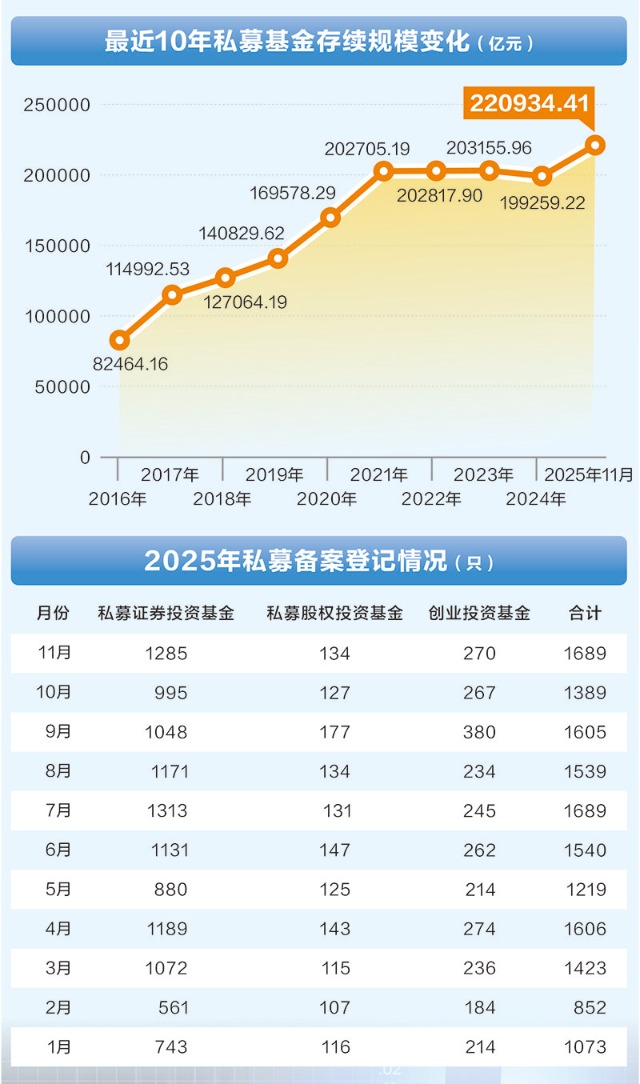
Core Viewpoint - The private equity industry in 2025 experienced a recovery and restructuring phase, marked by a significant rebound in fund management scale, regulatory tightening, and a shift in investment strategies towards quantitative and AI-driven approaches [1]. Group 1: Fund Management Scale - The private equity fund management scale surpassed 22 trillion yuan, reaching 22.09 trillion yuan by the end of November 2025, marking a net increase of over 2 trillion yuan within the year [2][3]. - The private securities investment funds emerged as the core driver of this growth, with their scale increasing from 5.21 trillion yuan at the beginning of the year to 7.04 trillion yuan by November, a total increase of 1.83 trillion yuan [2]. Group 2: Market Dynamics - The recovery in private equity scale was driven by a rebound in the stock market and a shift in investor risk preferences from defensive to selective active allocation, making private equity products a key option for asset allocation [3]. - The number of private equity firms with over 10 billion yuan in assets reached 113 by the end of October, indicating a return to the "double hundred" era, with 18 new firms joining in a single month [4]. Group 3: Fundraising Trends - Fundraising activities showed a significant recovery in the second half of 2025, with new private fund registrations reaching 1,689 and a total scale of 1,074.27 billion yuan in July, the highest monthly figure in nearly four years [6]. - The head effect in fundraising became more pronounced, with top quantitative firms significantly outperforming mid-tier and lower-tier managers in both product registration and new fundraising [6]. Group 4: Quantitative Strategies - Quantitative strategies, particularly index enhancement strategies, gained prominence in 2025, with products linked to small-cap indices like the CSI 1000 and CSI 2000 showing annual returns exceeding 50% [7][8]. - The favorable market conditions and increased volatility provided opportunities for quantitative models to capture mispricing and generate alpha [7]. Group 5: Regulatory Developments - 2025 saw the implementation of new regulations for algorithmic trading, which aimed to enhance market fairness and transparency, shifting the focus from speed competition to strategy depth [9][10]. - The regulatory environment is expected to foster a more compliant and sustainable development of the quantitative investment sector, with clearer boundaries for operations [11]. Group 6: AI Integration - The introduction of AI technologies in quantitative investment processes marked a significant shift, with AI moving from a supportive role to a foundational one, enhancing data processing, feature extraction, and risk management [12]. - The competition in the quantitative sector is increasingly driven by the speed of model and algorithm iteration, with AI becoming a central element in strategy development [12][13]. Group 7: Global Expansion - The number of mainland private equity firms obtaining licenses in Hong Kong surpassed 100 in 2025, indicating a significant step towards global expansion and cross-border operations [14]. - The motivations for this international push include risk diversification, broadening investment opportunities, and enhancing client service capabilities [14]. Group 8: Industry Cleanup - The regulatory environment led to the cancellation of 1,118 private equity managers by November 2025, with a notable increase in voluntary cancellations, indicating a trend towards industry consolidation and compliance [15][16]. - The focus on compliance and long-term viability is expected to enhance the overall competitiveness of the private equity sector, shifting the emphasis from quantity to quality [16].
八大关键词见证 2025私募业规模、质量双升
Zheng Quan Shi Bao· 2025-12-30 18:20
Core Insights - The private equity industry in 2025 experienced a recovery and restructuring phase, with the total management scale surpassing 22 trillion yuan, marking a significant rebound from previous downturns [5][6] - The industry is witnessing a concentration effect, with leading firms gaining more market share amid stricter regulations and a more rational investor base [5][10] Group 1: Industry Growth and Scale - By the end of November 2025, the private equity fund scale reached 22.09 trillion yuan, up from 19.91 trillion yuan at the beginning of the year, indicating a net increase of over 2 trillion yuan within the year [6][7] - The private securities investment funds have been the primary driver of this growth, with their scale increasing from 5.21 trillion yuan at the start of the year to 7.04 trillion yuan by November [6][7] Group 2: Market Dynamics and Investor Behavior - The recovery in private equity scale is attributed to a rebound in the stock market, leading to improved performance of private equity funds, which in turn has shifted investor risk preferences towards more selective and proactive asset allocation [7][10] - The number of private equity firms with over 100 billion yuan in assets has increased significantly, with 113 firms reported by the end of October 2025, indicating a return to the "double hundred" era [8][10] Group 3: Fundraising Trends - The number of newly registered private equity funds showed a notable increase, with 1,689 new funds registered in July 2025, marking the highest monthly registration in nearly four years [10][11] - There is a pronounced disparity in fundraising, with top-tier quantitative firms significantly outperforming mid-tier and lower-tier managers, reflecting a stronger "Matthew effect" in fundraising dynamics [10][11] Group 4: Quantitative Strategies and AI Integration - Quantitative strategies have gained prominence, particularly in small-cap indices, with some products achieving over 50% returns in 2025, driven by favorable market conditions [11][12] - AI technology is increasingly integrated into the quantitative investment process, enhancing data analysis and decision-making capabilities, thus reshaping the competitive landscape of the industry [15][16] Group 5: Regulatory Environment and Industry Consolidation - The regulatory framework for algorithmic trading has been strengthened, promoting transparency and fair competition within the market, which is expected to lead to a healthier long-term development of the capital market [13][14] - The number of private equity managers that have been deregistered reached 1,118 in 2025, indicating a significant industry cleanup and a shift towards compliance and sustainable operations [17][18]
股票和ETF基金可以自动日内回转交易了!申万宏源【智能增强】程序化交易隆重上线,用AI赋能投资!
申万宏源证券上海北京西路营业部· 2025-12-24 03:08
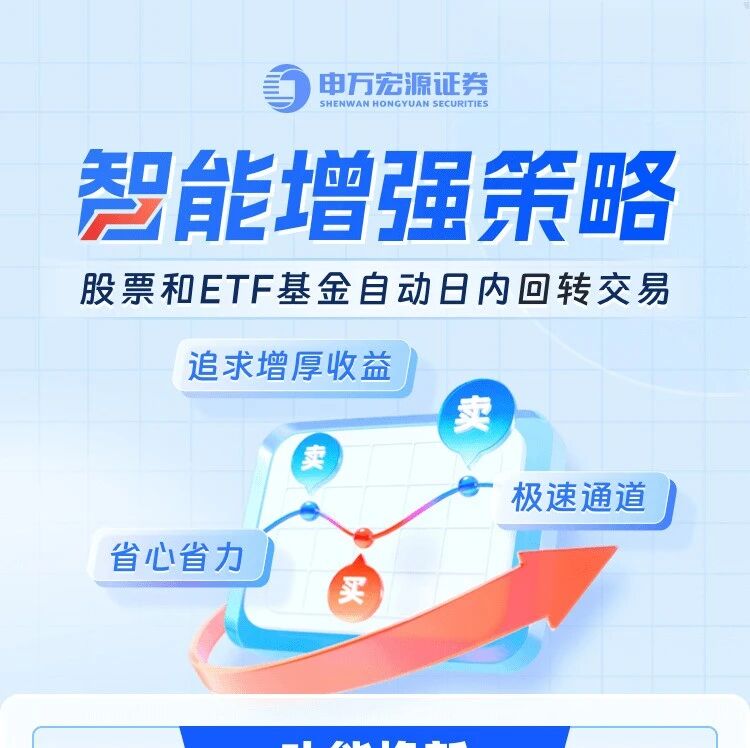
Core Viewpoint - The article discusses the introduction of an intelligent enhancement strategy for trading stocks and ETFs, which aims to improve investment returns through automated intraday trading and cost reduction. Group 1: Intelligent Enhancement Strategy - The intelligent enhancement strategy utilizes machine learning algorithms based on users' existing stock holdings to capture price fluctuations through automated buy and sell transactions, thereby reducing costs and increasing returns while maintaining overall positions [3][5]. - The strategy is designed for ease of use, allowing for a one-time setup that remains effective over the long term, with all processes conducted online [4]. - The strategy supports various intraday trading methods, automatically matching optimal execution strategies based on different holdings [4][5]. Group 2: Operational Features - The system operates through a high-speed trading platform, ensuring quick order execution and high efficiency in capturing market opportunities [6]. - It supports both Shanghai and Shenzhen A-shares and ETFs, catering to diverse trading preferences across devices such as computers and mobile phones [6]. - The strategy includes multiple layers of risk control to ensure efficient and secure operation [6].
资深评论员董少鹏指出,盲目叫停量化交易是错误的,监管重拳已至,操纵市场者难再隐身
Sou Hu Cai Jing· 2025-12-22 19:11
Core Viewpoint - Recent extreme stock price movements in the market have led many investors to blame quantitative trading for significant losses, with some suggesting a complete halt to such trading practices. However, seasoned financial commentator Dong Shaopeng argues that this approach is misguided and that a more nuanced understanding of quantitative trading's role in the market is necessary [1][3]. Group 1: Market Reactions and Opinions - Investors have experienced daily losses of up to 20% due to sudden stock price drops, particularly during the market's closing hours [1][3]. - There are two main opinions regarding quantitative trading: one advocates for a separate market for quantitative trading, while the other calls for a complete suspension of such trading [3]. - Dong Shaopeng emphasizes that halting quantitative trading would not necessarily benefit retail investors but would instead transfer speculative opportunities to other market participants [4]. Group 2: Causes of Market Volatility - The primary creators of "high volatility" in the market are various "stock manipulators," with retail investors often being collateral damage [5][7]. - Manipulative practices by these "stock manipulators" include spreading false information and artificially inflating or deflating stock prices, which misleads retail investors [7]. Group 3: Regulatory Developments - The implementation of new regulatory guidelines for algorithmic trading in China, effective from July 2025, marks a significant step in managing high-frequency trading [8][9]. - These guidelines include specific standards for high-frequency trading, such as a maximum of 300 order submissions or cancellations per second per account, and a daily cap of 20,000 submissions or cancellations [9]. - The new regulations aim to prevent excessive trading frequency and to address manipulative practices, thereby promoting a more stable trading environment [11][13]. Group 4: Future Directions - Dong Shaopeng advocates for a balanced approach to regulating quantitative trading, suggesting that it should not be outright banned but rather guided towards enhancing market stability [13]. - The goal is to transform quantitative trading from a "market volatility amplifier" into a "market liquidity stabilizer" through effective regulatory frameworks [13].