财政改革

Search documents
欧洲新“意大利”?法国陷入“恶性循环”困局
Hua Er Jie Jian Wen· 2025-09-01 14:00
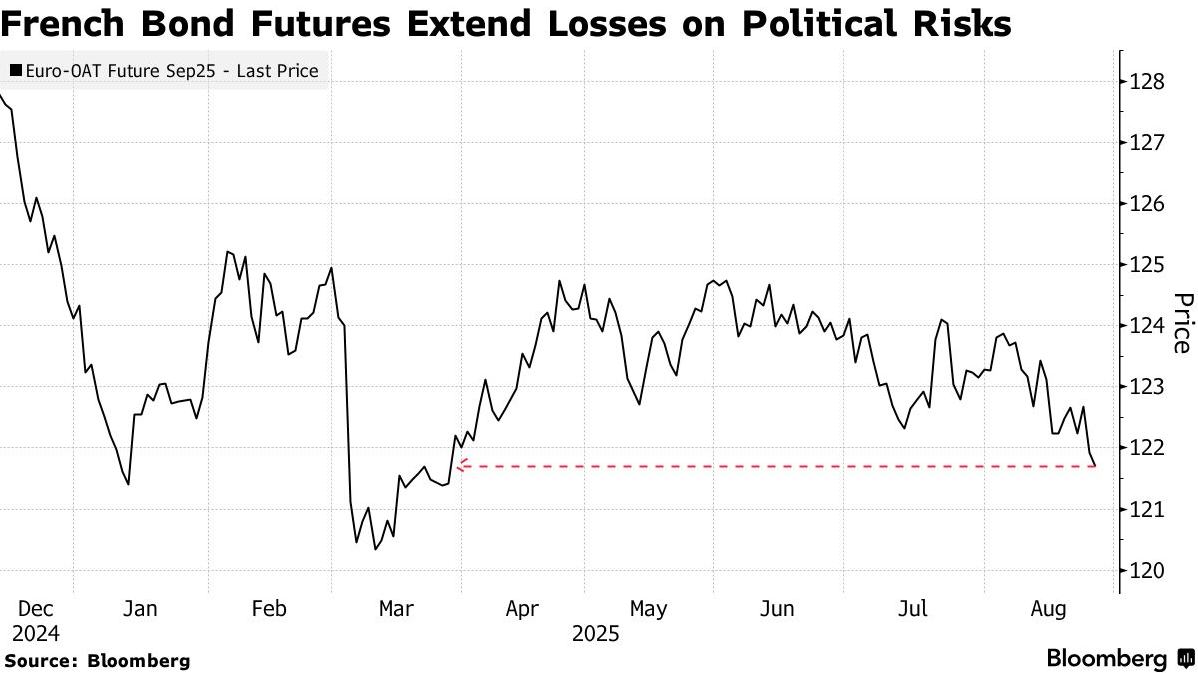
Group 1: Political Instability - France is experiencing unprecedented political and fiscal crises, with Prime Minister Borne facing a confidence vote that could lead to her being the fourth government head to resign in 18 months [1][2] - The frequent changes in leadership have raised concerns about governance and policy continuity, increasing market uncertainty [2][3] - The fragmentation of the National Assembly complicates fiscal reforms, as various factions disagree on welfare cuts and tax increases [3] Group 2: Fiscal Challenges - France's national debt has surged from €2.2 trillion to €3.3 trillion since President Macron took office, with the 2023 deficit rate revised to 5.5%, exceeding government expectations [2] - The S&P has downgraded France's credit rating, reflecting investor concerns over fiscal sustainability, as the 10-year government bond yield has surpassed that of Greece and is on par with Italy [1][2] - High welfare spending accounts for 65% of the public budget, and there is significant disagreement among political factions on how to address the fiscal shortfall [2][3] Group 3: Economic Outlook - The lack of strong political consensus and reform momentum raises the risk of France facing "Italianization," where fiscal discipline deteriorates without effective measures [3] - The potential inability to break the current deadlock and restore fiscal sustainability could have direct implications for both France's economy and the overall stability of the Eurozone [3]
【环球财经】国际货币基金组织评估塞内加尔财政透明度和改革计划
Xin Hua Cai Jing· 2025-08-27 14:57
Group 1 - The International Monetary Fund (IMF) delegation, led by Edward Jemeier, concluded a visit to Senegal focusing on addressing discrepancies in the country's financial data from 2019 to 2023 as disclosed by the audit court [1] - The IMF's visit from August 19 to 26 assessed Senegal's current debt situation and the government's proposed fiscal reform plans, highlighting efforts in fiscal transparency and accountability [1] - The audit firm Mazars revised Senegal's government debt level to 111% of GDP by the end of 2023, significantly higher than the previously reported 74.4%, with projections indicating an increase to 118.8% by the end of 2024 [1] Group 2 - Senegal's economy showed resilience in the first quarter of this year, with a growth rate of 12.1%, primarily driven by the expansion of the oil and gas sector, while non-oil and gas growth remained moderate [1] - Key corrective measures discussed include centralized debt management, clearing outstanding payments, establishing a debt database, and consolidating treasury accounts, with ongoing discussions to be submitted for IMF executive board review [1] - Senegal aims to seek a new round of IMF support aligned with its "Vision 2050," focusing on fiscal transparency, inclusive growth, human capital, and climate resilience [2]
法国政治信任投票前夕 日本资金“抄底”法国债券
智通财经网· 2025-08-26 06:47
Group 1 - The French bond market is experiencing a sell-off due to a government trust crisis, which is seen as an opportunity for Japanese institutions to invest [1] - Fivestar Asset Management and Nissay Asset Management highlight that the current drop in French bonds may provide a chance for Japanese funds to allocate assets in France, as the yield spread between French and German 10-year bonds has reached a peak since April [1][4] - The French government is facing strong opposition to a €44 billion (approximately $51 billion) austerity plan, which is considered crucial to avoid a public finance crisis [7] Group 2 - Japanese investors are attracted to French bonds due to significantly higher yields compared to the domestic market, with the yield on French 10-year bonds exceeding Japanese bonds by nearly 200 basis points [7] - The upcoming trust vote on September 8, initiated by French Prime Minister François Bérou, is seen as a potential turning point for political stability, with some analysts suggesting a compromise may be reached [4][8] - There are differing opinions in the market, with some analysts warning that political uncertainty could lead Japanese investors to adjust their positions in French bonds [8]

摆脱石油依赖见成效,沙特首次非石油收入与石油收入持平
Sou Hu Cai Jing· 2025-08-01 09:07
Core Insights - Saudi Arabia's non-oil revenue has reached nearly half of the government's total revenue for the first time, reflecting the success of fiscal reforms under the "Vision 2030" initiative aimed at reducing oil dependency [1][3]. Revenue Breakdown - In Q2 2025, Saudi Arabia's total revenue increased by approximately 14.4% to 301.595 billion riyals, with non-oil revenue contributing 149.861 billion riyals (about 39.9 billion USD), marking a 7% year-on-year growth [1][3]. - Non-oil revenue accounted for 49.7% of total revenue, nearly equal to oil revenue, which was recorded at 151.7 billion riyals (about 40.4 billion USD), showing a significant year-on-year decline of 29% [3][5]. Budget and Deficit - The Saudi government reported a budget deficit of 9.2 billion USD in Q2 2025, which has narrowed by 41.1% compared to Q1 2025 [3][5]. - Oil revenue showed a slight quarter-on-quarter increase of 1.28% due to OPEC+ production adjustments, indicating some recovery [3]. Economic Transformation - The transformation of Saudi Arabia's economy is driven by the Public Investment Fund (PIF), which has evolved from a domestic entity to a global sovereign wealth fund, investing in sectors aligned with future economic trends [5]. - The PIF's investment portfolio includes sectors such as artificial intelligence, global startups, and partnerships in autonomous driving technology, as well as stakes in major companies like Starbucks, Disney, Boeing, and Citigroup [5]. External Economic Factors - The decline in oil prices has exerted pressure on Saudi Arabia's revenues, with an expected fiscal deficit of approximately 27 billion USD for the year [5]. - The International Monetary Fund (IMF) has raised Saudi Arabia's GDP growth forecast for 2025 to 3.5%, driven by strong demand for government-led large projects and support from the gradual easing of oil production cuts by OPEC+ [5].

【财经分析】欧洲市场投资信心复苏,法国缘何“落单”
Xin Hua Cai Jing· 2025-07-10 17:51
Group 1 - The core viewpoint of the article highlights that despite a general recovery in European financial markets, France is experiencing a decline in investor confidence due to structural political and economic challenges [1][4][6] - France's bond and stock markets are underperforming compared to other European countries, with the CAC40 index showing a return of approximately 6.7% year-to-date, lagging behind the European Stoxx 600's 8.3% and Germany's DAX index's 23.3% [3][4] - The yield spread between French and German 10-year bonds remains around 70 basis points, significantly higher than the 50 basis points before the political turmoil in June 2022, indicating a lack of investor confidence in French assets [2][4] Group 2 - France's public debt reached €3.3 trillion last year, surpassing Italy's by approximately €300 billion, with projections indicating it could rise to about €3.35 trillion by Q1 2025, leading to a debt-to-GDP ratio of 114% [4][5] - The political fragmentation in France has hindered effective fiscal policy, with the government unable to secure a majority in parliament, resulting in a lack of decisive action to address budget deficits [6][7] - Analysts suggest that unless France can implement significant fiscal reforms, investor confidence is unlikely to improve, with some indicating the possibility of needing assistance from the International Monetary Fund if fiscal control is not established [7]
惠誉:从长期来看,与老龄化相关的支出将对日本财政赤字构成持续压力,这主要体现在医疗成本上升方面。不过,财政改革可能会减轻这种影响。
news flash· 2025-07-07 07:35
Core Viewpoint - Long-term spending related to aging will exert continuous pressure on Japan's fiscal deficit, primarily reflected in rising healthcare costs. However, fiscal reforms may alleviate this impact [1]. Group 1 - Aging-related expenditures are expected to significantly increase, leading to sustained fiscal challenges for Japan [1]. - The primary area of concern is the escalation of medical costs associated with an aging population [1]. - Potential fiscal reforms could mitigate some of the financial pressures stemming from these rising costs [1].
【环球财经】巴西国会废止金融交易税增税 政府寻求替代措施填补财政缺口
Xin Hua Cai Jing· 2025-06-26 08:59
Group 1 - The Brazilian Congress has officially repealed the federal government's decree to increase the financial transaction tax (IOF), which is expected to result in a revenue loss of approximately 10 billion reais for the federal budget in 2025 [1] - The House of Representatives passed the repeal with 383 votes in favor and 98 against, followed by a symbolic vote in the Senate, indicating a swift legislative process [1] - The federal government is exploring alternative measures to compensate for the budgetary pressure, including utilizing oil revenues and special dividends, as well as further expenditure freezes [1][2] Group 2 - The current fiscal framework has already frozen 31 billion reais in federal spending for 2025, with potential increases in the freeze to 41 billion reais if new fiscal gaps are not filled [2] - The adjustment of the financial transaction tax rate announced in May 2024 faced strong backlash from the market and some congressional members, leading to a political struggle over fiscal reforms [2]
后关税交易:宏观叙事和市场方向的重定位
Orient Securities· 2025-06-16 14:22
Group 1: Macroeconomic Overview - The market narrative has shifted from focusing solely on the White House's policy impacts to a broader consideration of fundamental economic conditions and the Federal Reserve's monetary policy[6] - Inflation risks are entering a critical observation phase, with year-to-date inflation unexpectedly declining, yet this has not significantly influenced asset pricing[6][20] - Economic growth indicators show a historical divergence between soft (miss) and hard (beat) data, with expectations of convergence in the future[28] Group 2: Inflation and Consumer Behavior - The average tariff rate increase of approximately 10% could lead to a corresponding 1% rise in inflation, with potential significant impacts on consumer prices following tariff implementations[20] - Despite resilient income growth, consumer spending has declined, with disposable income growth at 5.2% and consumption growth falling to 5.4%[40] - The consumer confidence decline is leading to a significant disparity between income resilience and spending weakness, indicating potential future consumption slowdowns[40] Group 3: Employment and Economic Trends - The employment market is showing signs of cooling, with non-farm payrolls adding only 139,000 jobs in May, primarily in the service sector, while manufacturing jobs have decreased[34] - The NFIB small business optimism index indicates a downward trend in hiring plans, suggesting a potential decline in job vacancies and overall employment data[37] - The economic slowdown is expected to manifest more clearly post-tariff implementation, with rising inflation eroding income and accelerating demand decline[47] Group 4: Policy and Fiscal Reform - The new fiscal reform, termed the "Big Beautiful Bill," is projected to increase the deficit by approximately $3 trillion over the next decade, with significant implications for market dynamics[51] - The anticipated fiscal reform is expected to influence asset pricing, similar to the 2017 tax reform, which saw rising bond yields and a strengthening dollar during its legislative phase[51] - The current macroeconomic environment does not support overly optimistic forecasts regarding the economic impact of fiscal reforms due to high interest rates and ongoing policy uncertainties[49]
陆挺:二季度GDP增速在4.8%左右,用有效的财政改革来改变市场预期
Jing Ji Guan Cha Bao· 2025-06-08 09:33
Core Viewpoint - The expected GDP growth rate for the second quarter is around 4.8%, influenced by factors such as export fluctuations, the diminishing impact of trade-in policies on consumption, and ongoing adjustments in the real estate sector [1][2]. Economic Analysis - The economic situation in China is projected to remain relatively stable in the short term, primarily due to a backlog of export orders and the positive effects of trade-in policies on retail [2]. - Export growth is expected to maintain a high level in May and June, potentially close to April's 8% growth rate, but challenges may arise in the second half of the year [2]. - The increase in tariffs on Chinese goods by the U.S. has significantly impacted exports, particularly with a 54% tariff on small packages, which may lead to a substantial decline in exports after the initial surge [3]. - The positive effects of trade-in policies for durable goods are expected to wane, with potential negative impacts on consumer demand in the latter half of the year [3][4]. - The real estate sector is experiencing a prolonged downturn, with a 10% annual decline and a 22% drop in new housing starts, complicating efforts to stabilize domestic demand [4]. Policy Recommendations - Maintaining the stability of the RMB exchange rate is crucial for economic stability, especially given the current challenges in the real estate market and capital outflow concerns [5][6]. - Accelerating fiscal spending and exploring additional stimulus measures are necessary to stabilize the economy in the second half of the year [6]. - The stability of the real estate market is critical, requiring measures such as interest rate cuts and debt resolution for developers to prevent further economic decline [7]. - Structural reforms in the social security system are needed to enhance consumer spending, particularly by increasing pension levels for rural elderly populations [8]. - Fiscal reform is essential to improve local government finances and create independent revenue sources beyond real estate, which is vital for enhancing the business environment [9].
陆挺:对中国经济形势的中短期分析与政策建议 | 政策与监管
清华金融评论· 2025-06-03 10:35
Core Viewpoint - The Chinese economy is expected to maintain a relatively good performance in the short term, primarily due to backlog orders in the export sector and the positive impact of the "trade-in" policy on retail [2][3][5]. Short-term Economic Analysis - In the next couple of months, China's export growth is likely to remain high, potentially close to April's 8% growth, driven by backlog orders and the upcoming trade negotiations [3][5]. - The GDP growth for the second quarter is projected to be around 4.8%, but challenges are anticipated in the second half of the year due to several factors [3][5]. - The increase in tariffs on Chinese products by the U.S. has risen by approximately 35 percentage points, significantly impacting exports, especially with the tariff on small packages rising to about 54% [5][6]. - The positive effects of the "trade-in" policies for durable goods are expected to diminish in the latter half of the year, leading to potential negative effects on consumption [6]. - The real estate sector, crucial for domestic demand, is in its fifth year of decline, with new housing starts down by 22% year-on-year, complicating efforts to stabilize domestic demand [6]. Policy Recommendations - The Chinese government has effectively intervened in the stock market and maintained the stability of the RMB against the USD, which is crucial for economic stability [9][10]. - Further fiscal policies should be considered to accelerate spending and debt issuance, especially in light of anticipated declines in export growth [10]. - Stabilizing the real estate market is critical, requiring measures beyond traditional tools like interest rate cuts, including allowing necessary bankruptcies and ensuring the completion of pre-sold properties [10][11]. - Structural reforms in the social security system are needed to enhance the income levels of the elderly, which could improve consumption capacity and alleviate burdens on migrant workers [11]. - Fiscal reform is essential to improve local government finances and create independent revenue sources beyond real estate, which is vital for enhancing the business environment and stimulating domestic demand [12].