
通胀黏性

Search documents
通胀黏性限制澳联储降息
Jin Tou Wang· 2025-12-03 03:27
Core Viewpoint - The Australian dollar (AUD) is experiencing a strengthening trend against the US dollar (USD), supported by improvements in employment and persistent inflation, while facing challenges from commodity price volatility and uncertainties in iron ore demand [1][2]. Group 1: Economic Indicators - Australia's Q3 CPI rose to 3.2% year-on-year, with trimmed mean inflation at 3% [1] - The unemployment rate fell to 4.3% in October, with an increase of 42,200 jobs, including a significant rise of 55,000 full-time positions [1] - The Reserve Bank of Australia (RBA) is unlikely to lower interest rates in the short term due to resilient inflation and employment data [1] Group 2: Monetary Policy Expectations - The Federal Reserve's shift towards a more accommodative stance is providing an advantage to the AUD, with an 82.9% probability of a 25 basis point rate cut in December [1] - Goldman Sachs predicts three additional rate cuts by the Federal Reserve in 2025, although Chairman Powell indicated that rate cuts are not guaranteed, which may create policy expectation volatility [1] Group 3: Commodity Market Dynamics - China's iron ore imports exceeded 100 million tons in October, marking the fifth consecutive month above this threshold, while Brent crude oil prices are declining, partially offsetting the AUD's commodity-related support [1][2] - Structural contradictions in the Australian economy and fluctuations in external demand are constraining the AUD's upward movement, with rising inflation driven by housing and electricity costs potentially suppressing consumer spending [2] Group 4: Market Sentiment and Technical Analysis - There is a notable divergence among institutions regarding the future of the AUD, with Oxford Economics predicting a potential rate cut by the RBA in 2026, while Capital Economics believes faster rate cuts by the Fed will support the AUD [2] - Technical indicators show that the AUD has formed a consolidation platform around 0.6550, with a bullish signal emerging from the 5-day and 10-day moving averages [2] - Key resistance levels are identified at 0.6580-0.6600, with support levels at 0.6550-0.6560, and future movements will depend on upcoming data releases from the Fed and Australian inflation figures [2]
英镑企稳英国央行内部决策分歧
Jin Tou Wang· 2025-12-03 03:27
Core Viewpoint - The GBP/USD exchange rate is stabilizing around the 1.32 mark, influenced by the contrasting monetary policies of the Bank of England (BoE) and the Federal Reserve (Fed), alongside internal divisions within the BoE [1][2][3] Group 1: Bank of England's Policy and Inflation - The BoE's cautious stance is a key support for the GBP, with the latest CPI data showing a rise to 2.6% in November, the highest in eight months, and core CPI increasing from 3.3% to 3.5%, exceeding market expectations [1] - The BoE maintained its benchmark interest rate at 4.75% with a 6:3 vote, indicating that discussions on rate cuts are premature despite some members advocating for a 25 basis point reduction [1][3] Group 2: Federal Reserve's Shift to Easing - In contrast to the BoE, the Fed is moving towards a more accommodative policy, with the unemployment rate rising to 4.2% in November, signaling a cooling labor market [2] - Market expectations for a 25 basis point rate cut in December have surged to 71%, with some institutions estimating the probability at 87% [2] Group 3: Economic Outlook and Risks - The BoE has downgraded its economic growth forecast for Q4 2024 from 0.3% to zero growth, highlighting concerns over high interest rates impacting consumption and investment [2] - Internal divisions within the BoE reflect a heated debate between prioritizing economic growth and controlling inflation, with potential trade risks from U.S. tariff policies posing further inflationary pressures [3] Group 4: Technical Analysis - The GBP/USD has formed a support level at 1.3150, with multiple tests of this level followed by rebounds, indicating active buying interest [4] - Key resistance is identified in the 1.3250-1.3280 range, while support is anchored at 1.3150-1.3180, with critical upcoming events including the Fed's December meeting and UK inflation data [4]
美股三大指数收涨,科技芯片股走强,阿特斯太阳能涨8%,比特币升破90000美元
21世纪经济报道· 2025-11-26 23:12
Market Performance - On November 26, US stock indices closed higher, with the Dow Jones up 0.67%, S&P 500 up 0.69%, and Nasdaq up 0.82% [1] - The Dow Jones closed at 47,427.12, S&P 500 at 6,812.61, and Nasdaq at 23,214.69 [2] Sector Performance - Technology and semiconductor stocks mostly rose, with the Philadelphia Semiconductor Index increasing by 2.76% [2] - Notable stock performances included Micron Technology rising over 5%, Oracle up over 4%, and AMD up nearly 4% [2] Chinese Stocks - The Nasdaq Golden Dragon China Index fell by 0.03%, with notable gainers like Canadian Solar up over 8% and Vipshop up over 2% [2] - However, companies like Hesai Technology and iQIYI saw declines of over 7% and 3%, respectively [2] Commodity Prices - Spot gold rose by 0.80%, closing at $4,163.78 per ounce, while COMEX gold futures increased by 0.46% to $4,158.90 [2] Oil Prices - WTI crude oil futures for January rose over 1%, closing at $58.65 per barrel, while Brent crude oil futures closed at $63.13 per barrel [3] Cryptocurrency Market - The cryptocurrency market saw a collective rise, with Bitcoin surpassing $90,000, increasing by 3.68% to $90,282 [3][4] - Other cryptocurrencies like Ethereum and Solana also experienced gains of 3.32% and 4.37%, respectively [4] Market Expectations - According to CME data, the probability of a 25 basis point rate cut by the Federal Reserve in December is 84.9%, with a 15.1% chance of maintaining the current rate [5] - The market anticipates a cumulative rate cut of 100-150 basis points by 2026, although this expectation may overlook risks such as persistent inflation and economic resilience [6]


英伟达股价反弹 甲骨文涨超4% 中概股多数上涨 理想汽车、唯品会涨超3%
2 1 Shi Ji Jing Ji Bao Dao· 2025-11-26 15:58
Group 1 - Major US tech stocks showed mixed performance, with Nvidia rebounding over 1% after a previous drop of over 2%, while Facebook and Tesla saw slight declines, and Google fell over 1% [2] - Nvidia responded positively to competition from Google, asserting its continued supply to Google and claiming to be a generation ahead in the industry [2] - Oracle's stock rose over 4%, with Deutsche Bank analyst Brad Zelnick maintaining a buy rating and raising the target price from $335 to $375 [3] Group 2 - Cryptocurrency-related stocks in the US strengthened, with Robinhood rising nearly 8%, Cipher Mining up over 5%, and Coinbase increasing by nearly 2% [4] - Chinese concept stocks mostly rose, with Li Auto and Vipshop both gaining over 3%, while Pinduoduo and Miniso increased by over 2.7% [4] - Li Auto reported third-quarter revenue of 27.4 billion yuan and a net loss of 620 million yuan, attributing losses to the MEGA recall event, which caused approximately 1.113 billion yuan in losses [4] Group 3 - Spot gold prices showed strong performance, reaching a daily high of nearly 1% at $4,170 before retreating to around $4,140 [5] - Initial jobless claims in the US were reported at 216,000, lower than the expected 225,000 and the previous value of 220,000 [6]

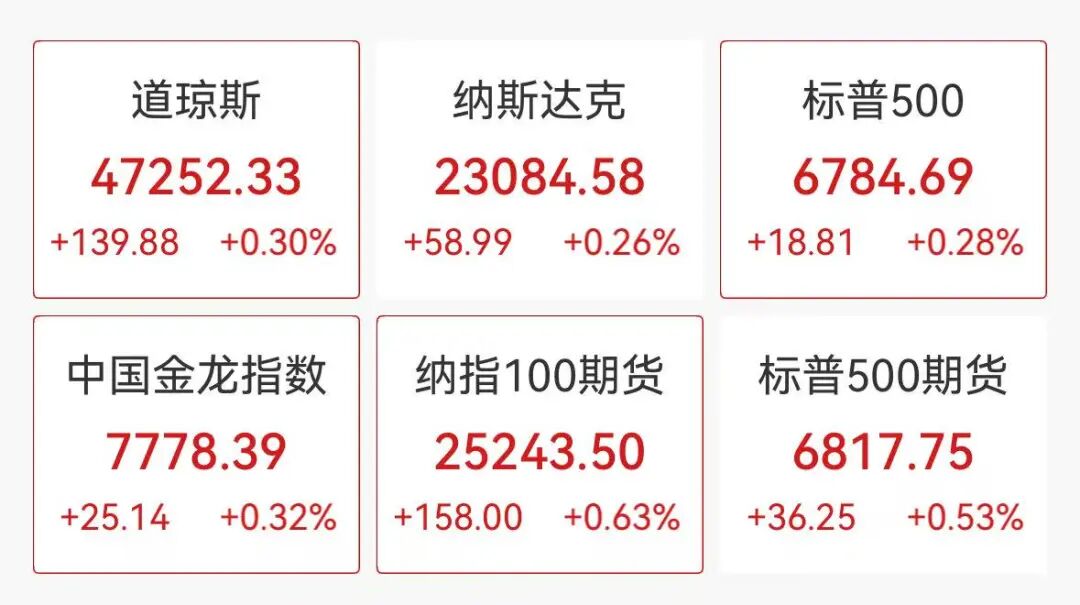
英伟达股价反弹,甲骨文涨超4%,中概股多数上涨,理想、唯品会涨超3%
2 1 Shi Ji Jing Ji Bao Dao· 2025-11-26 15:41
Market Overview - US stock market opened higher on November 26, with the Dow Jones up 0.30%, S&P 500 up 0.28%, and Nasdaq Composite up 0.26% [1] Technology Sector - Major US tech stocks showed mixed performance, with Nvidia rebounding over 1% after a previous drop of over 2%. Facebook and Tesla saw slight declines, while Google dropped over 1% [3] - Nvidia confirmed it will continue supplying Google despite competition, asserting its industry leadership [3] Company Performance - Oracle's stock rose over 4%, with Deutsche Bank analyst Brad Zelnick maintaining a "buy" rating and raising the target price from $335 to $375 [4] - In the cryptocurrency sector, Robinhood surged nearly 8%, Cipher Mining increased over 5%, and Coinbase rose nearly 2% [5] - Chinese concept stocks mostly rose, with Li Auto and Vipshop up over 3%, and Pinduoduo and Miniso up over 2.7% [5] - Li Auto reported Q3 revenue of 27.4 billion yuan and a net loss of 620 million yuan, attributed to the MEGA recall event causing a loss of approximately 1.113 billion yuan [5] Economic Indicators - Initial jobless claims in the US were reported at 216,000, lower than the expected 225,000 and previous value of 220,000 [9] - Market pricing indicates a high probability of a 25 basis point rate cut by the Federal Reserve in December, with cumulative cuts expected to reach 100-150 basis points by 2026 [9][10] - The potential nomination of Kevin Hassett as the next Fed Chair has increased market bets on significant rate cuts in the coming year [9][10]

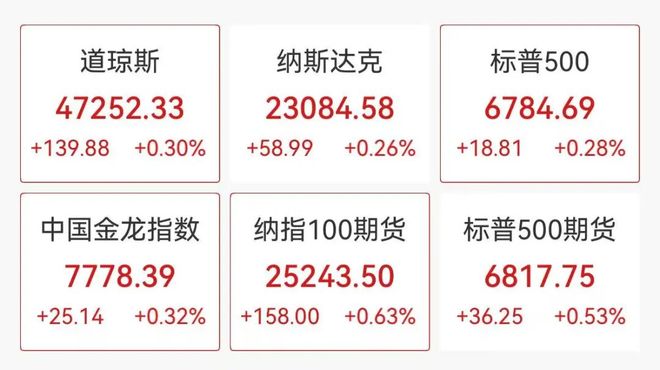
英伟达股价反弹,甲骨文涨超4%,中概股多数上涨,理想、唯品会涨超3%
21世纪经济报道· 2025-11-26 15:35
Market Overview - US stock market opened higher on November 26, with the Dow Jones up 0.30%, S&P 500 up 0.28%, and Nasdaq up 0.26% [1] - Major tech stocks showed mixed performance, with Nvidia rebounding over 1% after a previous drop of over 2%, while Google fell over 1% [3] Company Performance - Oracle's stock rose over 4%, with Deutsche Bank analyst Brad Zelnick maintaining a "buy" rating and raising the target price from $335 to $375 [4] - Li Auto reported Q3 revenue of 27.4 billion yuan and a net loss of 620 million yuan, with a total revenue of 83.5 billion yuan for the first three quarters [5] Cryptocurrency and Chinese Stocks - Cryptocurrency-related stocks performed well, with Robinhood up nearly 8% and Coinbase up nearly 2% [5] - Most popular Chinese stocks saw gains, with Li Auto and Vipshop rising over 3% [5] Economic Indicators - Initial jobless claims in the US were reported at 216,000, lower than the expected 225,000 [9] - Market pricing indicates a high probability of a 25 basis point rate cut by the Federal Reserve in December, with expectations of cumulative cuts of 100-150 basis points by 2026 [9][11] Federal Reserve Outlook - The potential appointment of Kevin Hassett as the next Fed Chair has increased market bets on significant rate cuts in the coming year [11] - The Fed may implement rate cuts in December, March, and June, ultimately lowering the rate to a range of 3.00%-3.25% [11]

美债收益率能否回落至3.9%?北欧斯安银行最新预测引发关注,一文读懂其背后逻辑
Sou Hu Cai Jing· 2025-11-21 09:15
Core Viewpoint - The report from SEB indicates that the U.S. 10-year Treasury yield is expected to decline to approximately 3.9% by Q1 2026, although current market conditions present challenges to this forecast [2][3] Group 1: Market Conditions and Predictions - The key to achieving the 3.9% yield target lies in the market's re-establishment of confidence in the Federal Reserve's interest rate cut path [2] - Recent hawkish comments from Federal Reserve officials have made investors more cautious about future monetary policy directions, keeping yields at relatively high levels [2][3] - The U.S. 10-year Treasury yield is a crucial benchmark rate that reflects investor expectations regarding the U.S. economy and policy, influencing global financing costs and asset pricing [2] Group 2: Economic Indicators and Federal Reserve Actions - SEB maintains a baseline scenario of a shift to a more accommodative policy stance within the next three to four months, driven by declining inflation, moderate job growth, and slowing economic activity [3] - A downward adjustment in interest rate expectations typically leads to a more relaxed financial environment, increasing demand for long-term bonds and pushing yields lower [3] - The resilience of the U.S. economy suggests that any adjustments in yields may occur gradually rather than abruptly [3] Group 3: Future Influences on Yield - Key factors influencing the U.S. Treasury yield in the coming months will include Federal Reserve statements, inflation data, and economic activity indicators [3] - The ability of yields to decline to the anticipated 3.9% will depend on the clarity of policy signals and the market's confidence in the future interest rate path [3]
美联储12月不降息概率飙升,华尔街为何仍在疯狂押注?
Sou Hu Cai Jing· 2025-11-19 03:47
Group 1 - The Federal Reserve's interest rate cut expectations for December have dramatically reversed, with the probability of a cut falling below 50% in the interest rate swap market, while the options market shows a significant number of bets on a rate cut with 863,000 open SOFR contracts [1][2][4] - There is a notable internal division within the Federal Reserve, with differing opinions among officials: Waller supports a rate cut, Logan opposes it, and Schmid advocates for maintaining the current rates, leading to increased market uncertainty [1][6] - The recent economic data has been inconsistent, with rising unemployment claims and job losses in the private sector indicating a weakening labor market, while core inflation remains sticky, complicating the Fed's decision-making process [2][4][9] Group 2 - The options market's heavy betting on a rate cut contrasts sharply with the warnings from Dallas Fed President Logan, who stated that a cut would be difficult to support unless there is a significant drop in inflation or a collapse in employment [4][6] - The market's reaction to the upcoming economic data, particularly the non-farm payrolls report, is critical; a weak jobs report could bolster dovish sentiments, while strong data could reinforce hawkish views [9] - The current situation reflects a broader market anxiety, with traders employing strategies reminiscent of 2019, anticipating that the Fed may ultimately compromise in response to market expectations [9]
美股重挫叠加政府停摆余波:美国经济陷 “政策迷雾” 与市场动荡双重考验
Sou Hu Cai Jing· 2025-11-14 13:44
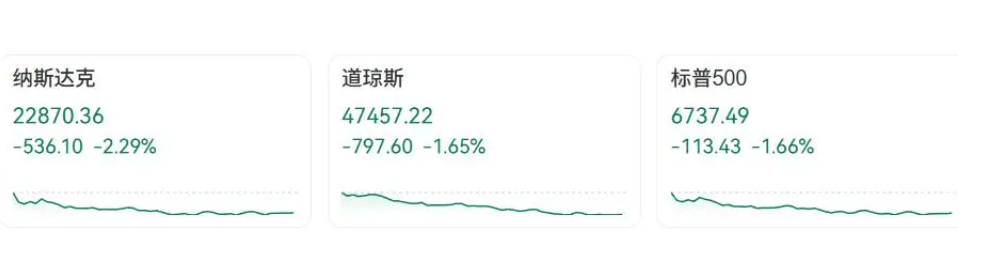
Market Overview - On November 13, U.S. stock markets experienced their largest single-day decline in over a month, with the Dow Jones Industrial Average dropping nearly 800 points, reflecting a 1.65% decrease [2] - The S&P 500 index fell by 1.66%, while the Nasdaq Composite index, heavily impacted by technology stocks, plummeted by 2.29% [2] - The decline was attributed to persistent inflation concerns, fluctuating Federal Reserve policies, and the aftermath of a government shutdown [2] Sector Performance - The technology sector, particularly the "Big Seven" tech companies, led the market downturn, with notable declines including Tesla down 6.64%, Nvidia down 3.58%, and Amazon down 2.71% [2] - In contrast, defensive value stocks saw an uptick, with the value stock index rising approximately 1% this week, while growth stocks fell by 0.6% [2] Individual Stock Movements - Cisco saw a 4.6% increase due to an upward revision of its revenue and profit forecasts, benefiting from increased demand for networking equipment [3] - Disney, however, faced a significant drop of 7.8% as concerns grew over a prolonged distribution dispute with YouTube TV, raising uncertainties about its traditional television business [3] Economic Impact of Government Shutdown - The recent government shutdown, lasting 43 days, resulted in an estimated economic loss of $1.5 trillion, significantly exceeding previous estimates [4] - Key social programs, such as the Supplemental Nutrition Assistance Program, were affected, leading to disruptions for 42 million Americans [4] - The aviation sector was particularly hard hit, with a 10% reduction in flight volumes at 40 major airports due to increased absenteeism among air traffic controllers [4] Policy and Data Concerns - The shutdown has created a "data vacuum," with critical economic reports like the Consumer Price Index and employment data potentially never being released, complicating Federal Reserve policy decisions [5] - Market expectations for a 25 basis point rate cut in December have decreased from 70% to approximately 47% due to the uncertainty surrounding inflation and labor market resilience [5] Global and Domestic Implications - The turmoil in U.S. markets has had global repercussions, with concerns about slowing U.S. economic growth impacting oil prices and causing disruptions in transatlantic flight schedules [6] - The temporary resolution of the government shutdown does not address underlying governance issues, with significant budgetary disagreements remaining unresolved [7] - The potential for another government shutdown looms as only three of the twelve annual appropriations bills have been passed, indicating ongoing political instability [7]
从降息预期调整的驱动因素来看
Sou Hu Cai Jing· 2025-11-12 09:05
Core Viewpoint - The adjustment in interest rate cut expectations is primarily driven by the resilience of recent U.S. economic data and persistent inflation [1] Economic Indicators - The U.S. labor market remains robust, with non-farm payrolls consistently exceeding market expectations and the unemployment rate staying low, indicating a tight supply-demand relationship in the labor market [1] - This labor market strength supports consumer spending and alleviates concerns about a short-term economic recession [1] Inflation Metrics - Key inflation indicators, such as the core PCE price index, have shown a decline, but the decrease is less than anticipated, leaving a gap to the Federal Reserve's 2% inflation target [1] Federal Reserve Stance - Recent statements from Federal Reserve officials have leaned towards a "hawkish" tone, emphasizing the need to maintain a restrictive monetary policy to ensure sustained inflation decline [1] - This shift in sentiment has directly weakened market bets on a rate cut in December, with the probability dropping from over 50% at the beginning of the month to below 30% [1] Market Impact - The rapid change in interest rate expectations has triggered a revaluation of global assets [1]