红利策略

Search documents
超30亿,跑了!
中国基金报· 2025-08-13 06:02
Core Viewpoint - The stock ETF market experienced a net outflow of over 3 billion yuan, despite a strong performance in the A-share market, indicating a trend where some investors are selling as prices rise [2][4][11]. Group 1: Stock ETF Market Overview - On August 12, the total scale of 1,168 stock ETFs reached 3.85 trillion yuan, with a net outflow of 30.77 billion yuan during the market's upward trend [4]. - The ChiNext 50 Index saw the largest net outflow, amounting to 36.84 billion yuan, with the ChiNext 50 ETF alone experiencing over 25 billion yuan in outflows [11][12]. - In contrast, the Hang Seng Technology Index and the Hong Kong Stock Connect Internet Index attracted significant inflows, with the former seeing a net inflow of 11.64 billion yuan [5][11]. Group 2: Fund Inflows and Outflows - The top inflowing ETFs included the Hang Seng Internet ETF (9.36 billion yuan), Hong Kong Stock Connect Internet ETF (6.51 billion yuan), and Military Industry Leaders ETF (4.31 billion yuan) [6][9]. - Conversely, the top outflowing ETFs were the ChiNext 50 ETF (-25.15 billion yuan), ChiNext 50 H ETF (-12.81 billion yuan), and the Microchip ETF (-8 billion yuan) [13]. Group 3: Market Sentiment and Future Outlook - Fund companies like Guotai Fund and Huashan Fund expressed optimism regarding the Hong Kong stock market's dividend strategy, citing a favorable low-interest environment and strong dividend capabilities of state-owned enterprises [7][8]. - Despite some sectors experiencing outflows, institutions remain optimistic about the A-share market's future performance, anticipating a gradual increase in the index's central tendency due to abundant liquidity and ongoing capital market reforms [14].


港股通+央企+红利,港股通央企红利ETF天弘(159281)火热发行中,机构:看好港股红利的长期配置价值
2 1 Shi Ji Jing Ji Bao Dao· 2025-08-13 03:12
Core Viewpoint - The Hong Kong stock market is experiencing active trading, particularly in the dividend concept, with the Hong Kong Stock Connect Central Enterprise Dividend Index showing slight fluctuations and a minor decline of 0.12% as of the latest update [1]. Group 1: Index and ETF Information - The Hong Kong Stock Connect Central Enterprise Dividend ETF Tianhong (159281) is currently in a hot issuance phase, with public sales scheduled from August 6 to August 15, 2025, featuring a management fee of 0.5% and a custody fee of 0.1% per year [2]. - The index selects listed companies controlled by central enterprises with stable dividend levels and high dividend yields, reflecting the overall performance of high-dividend central enterprise stocks within the Hong Kong Stock Connect framework [2][3]. Group 2: Index Characteristics and Performance - The index includes only those companies that have paid dividends continuously for the past three years, with a payout ratio greater than 0 and less than 1, to avoid "one-off dividends" [3]. - The index has achieved an annualized total return of 16.92% over the past five years, with an annualized volatility of 21.88%, and the latest dividend yield stands at 5.67% [3]. Group 3: Component Stocks and Market Outlook - The top ten component stocks of the index include major companies such as COSCO Shipping Holdings, Orient Overseas International, and China Petroleum, with a cumulative weight of 30.87% [4]. - The dividend assets have shown excellent resilience amid market volatility, and the current high dividend yield of Hong Kong stocks is more attractive compared to A-shares, especially in a declining interest rate environment [4].
年内实施中期分红上市公司数量突破370家,国企红利ETF早盘小幅上涨
Zheng Quan Zhi Xing· 2025-08-12 06:32
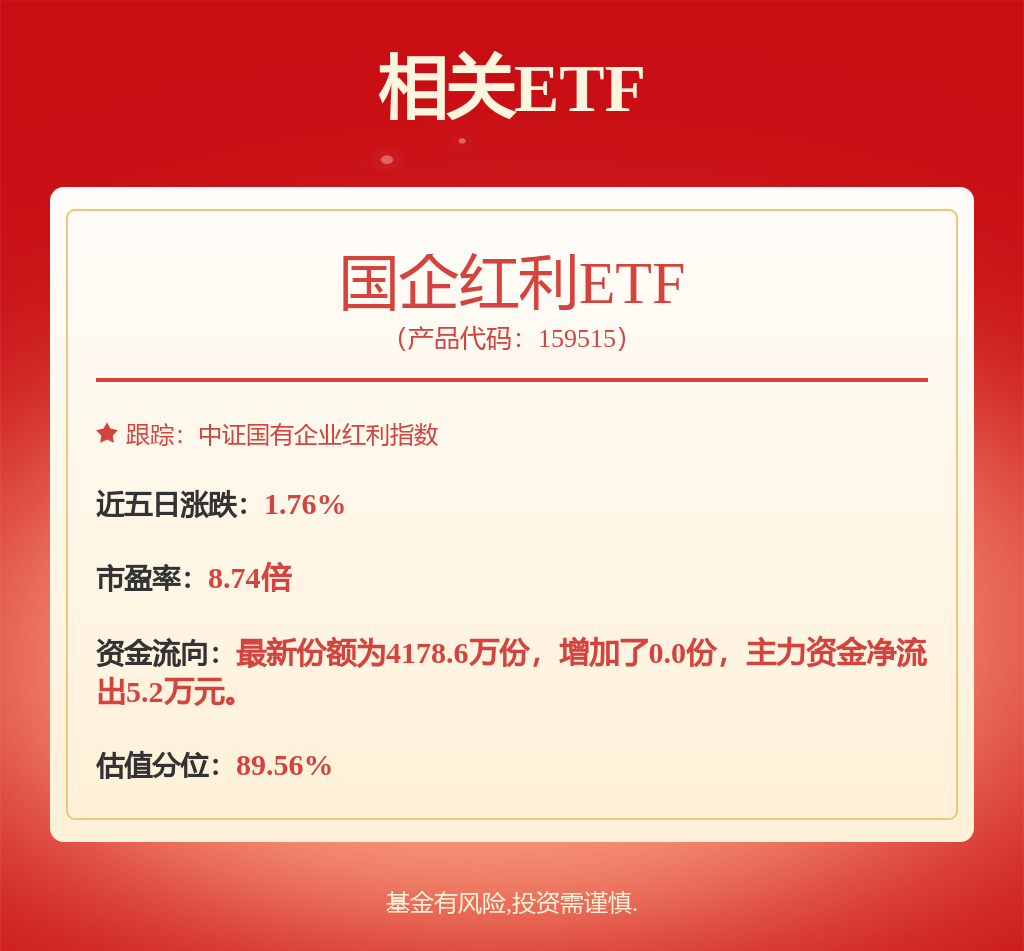
Group 1 - The core viewpoint of the articles highlights the increasing trend of mid-term dividends among listed companies, with a total of 370 companies disclosing mid-term dividend plans and a proposed total dividend amount of 79.193 billion yuan as of August 10 [1] - The "New National Nine Articles" policy is driving the expansion of mid-term dividends, emphasizing stability and frequency, leading to a multi-track dividend model becoming the norm [1] - The dividend-paying stocks, particularly in the state-owned enterprise sector, are seen as attractive investments due to their high dividend yields and stable policy environment, especially in a weak economic cycle [2] Group 2 - The National State-Owned Enterprise Dividend Index combines the themes of state-owned enterprises and dividend strategies, enhancing the effectiveness of investment strategies [2] - The recent decline in the manufacturing PMI to 49.3% indicates weak demand, which further highlights the defensive value of high-dividend assets during economic downturns [2] - The ongoing reforms in state-owned enterprises are expected to improve profitability and operational efficiency, making the National State-Owned Enterprise Dividend ETF a focus for investors [2]
最新规模突破新高!红利低波ETF泰康(560150)近10日“吸金”近3300万元,稳定分红的高息股备受市场关注
Xin Lang Cai Jing· 2025-08-11 05:53
Group 1 - The core viewpoint of the news highlights the performance and growth of the Dividend Low Volatility ETF Taikang (560150), which has seen significant inflows and a rise in its scale to 917 million yuan, marking a new high since its inception [1][2] - The Dividend Low Volatility ETF Taikang closely tracks the CSI Dividend Low Volatility Index, which selects 50 securities based on liquidity, continuous dividends, moderate dividend payout ratios, positive growth in earnings per share, and low volatility [2] - The ETF has experienced a substantial increase in shares, with a growth of 28 million shares in the past two weeks, and has attracted a total of 32.97 million yuan in inflows over the last ten trading days [1] Group 2 - The current market environment has led to a shift in investment strategies, with a focus on a "barbell strategy" that combines high-dividend defensive assets with high-growth sectors, reflecting a unique resilience in the market [1] - There is a noted divergence in market performance, with the banking sector reaching new highs while cyclical sectors like coal have adjusted, indicating a shift in the market's demand for high-dividend assets towards sustainability of earnings [2]
保险行业周报(20250804-20250808):2024年分红落地,当前哪只保险股更契合“高股息”标签?-20250810
Huachuang Securities· 2025-08-10 06:01
Investment Rating - The report maintains a "Recommended" rating for the insurance sector, indicating an expectation of the industry index outperforming the benchmark index by more than 5% in the next 3-6 months [20]. Core Insights - The total cash dividends for the five major listed insurance companies in 2024 reached CNY 90.789 billion, reflecting a year-on-year increase of 20.2% [2]. - The report highlights that the dividend growth for listed insurance companies in 2024 varies, with New China Life Insurance showing the highest growth rate at 197%, driven by a 201% increase in net profit attributable to shareholders [3]. - The report notes a general decline in the dividend payout ratio among listed insurance companies in 2024, attributed to the inclusion of significant unrealized gains in net profit, leading to a cautious adjustment of dividend ratios [3]. - The report emphasizes that the investment performance of the insurance sector in 2024 will largely depend on equity market performance and the expected adjustments in interest rates [4]. Summary by Sections Market Performance - The insurance index increased by 0.46% during the week, underperforming the broader market by 0.77 percentage points [1]. - Individual stock performances varied, with AIA up by 3.15% and ZhongAn down by 3.61% [1]. Dividend Policies - The report discusses the dividend policies of listed insurance companies, noting that Ping An and China Pacific Insurance base their dividends on operating profit, excluding short-term investment fluctuations [3]. - The estimated dividend payout ratios for Ping An and China Pacific Insurance are 41.6% and 33%, respectively, based on their operating profits [3]. Valuation Metrics - The report provides price-to-earnings (PE) and price-to-book (PB) ratios for major insurance companies, with China Ping An rated as "Strong Buy" and China Life Insurance, New China Life, and China Property & Casualty rated as "Recommended" [9]. - The report lists the highest dividend yields among A and H shares, with New China Life leading at over 5% [4]. Future Outlook - The report anticipates that the overall performance of the insurance sector in 2024 will be influenced by equity market trends and the growth of new business value (NBV) [4]. - The report suggests that investment strategies may favor Ping An, China Pacific Insurance, and China Property & Casualty due to their stable dividend policies [4].



科技板块回调,原因何在?后市关注这两件大事!
天天基金网· 2025-08-08 12:28
Core Viewpoint - The A-share market experienced fluctuations with all three major indices closing lower, driven by a rally in the cement and infrastructure sectors while the technology sector faced a pullback [1][3]. Group 1: Market Overview - The total trading volume in the two markets reached 1.71 trillion yuan, with sectors like cement, infrastructure, and energy metals rising against the trend, while software, semiconductors, and AI technology sectors collectively retreated [3]. - Analysts suggest that the Shanghai Composite Index is near previous high points, indicating potential selling pressure above, and caution is advised regarding high-level fluctuations [3]. - Despite short-term volatility, the medium-term outlook for the A-share market remains positive, with expectations of a gradual upward shift in index levels supported by capital and fundamental recovery [3]. Group 2: Technology Sector Analysis - The technology sector's decline is attributed to disappointing earnings from SMIC and profit-taking following the launch of GPT-5 by OpenAI [5][6]. - SMIC's stock fell over 8% in Hong Kong and more than 4% in A-shares due to underwhelming second-quarter financial results and a cautious outlook for the fourth quarter, raising doubts about the semiconductor recovery cycle [6][7]. - The announcement of GPT-5, which significantly improves capabilities, did not boost the tech sector as expected, leading to some investors cashing out [7]. Group 3: Future Opportunities - Institutions believe that short-term emotional disturbances do not undermine the long-term industrial logic, and a mid-term investment window is opening, particularly in policy-driven and performance-oriented segments [8]. - Key upcoming events, such as the World Robot Conference and Apple's fall event, are expected to provide catalysts for the AI market and domestic computing power applications [9]. - Recommendations for investment strategies include cautious risk management in the short term while gradually positioning in domestic computing power and AI applications [11].

宽基ETF成交持续活跃 固收类ETF成“吸金”主力
Zhong Guo Zheng Quan Bao· 2025-08-08 07:18
Market Overview - A-shares exhibited a volatile consolidation trend from May 12 to May 16, with major indices showing slight increases [1] - The beauty care, automotive, transportation, and non-bank financial sectors led the gains, while the computer, electronics, media, and real estate sectors underperformed [1] Fund Flow - Overall, the ETF market experienced a net outflow of 31.83 billion yuan during the same period, with stock ETFs contributing a net outflow of 28.29 billion yuan [3] - Fixed income ETFs emerged as the main beneficiaries, attracting a net inflow of 7.245 billion yuan, with short-term bond ETFs alone bringing in 3.387 billion yuan [3] - The top ten ETFs by net inflow included five fixed income ETFs, indicating a shift in investor preference towards safer assets [3] ETF Performance - Over 65% of all ETFs achieved positive returns, with the S&P Consumer ETF leading the market with a gain of 13.15% [2] - Several cross-border ETFs, including the S&P 500 ETF and Hong Kong automotive ETFs, recorded gains exceeding 6% [2] - Despite high returns, many of the top-performing cross-border ETFs experienced net outflows, suggesting speculative trading activity [2] Trading Activity - The trading volume for ETFs tracking the CSI A500, Hang Seng Technology, and SGE Gold 9999 indices remained active, with weekly trading volumes of 92.833 billion yuan, 71.858 billion yuan, and 51.360 billion yuan, respectively [3] - The CSI 300 index ETF also surpassed a trading volume of 30 billion yuan [3] Investment Strategy - Emerging technology is identified as a key investment theme, with core assets and dividend strategies recommended for stability in a volatile market [5] - Financial cycles are viewed as potential "dark horses" in the market, with expectations of a systematic decline in risk premiums for Chinese equities [6] - The AI industry chain is anticipated to be a market focal point, with significant capital expenditure from major Chinese internet companies expected to drive performance in 2025 [6]
聚焦优质现金流资产 富国中证800自由现金流ETF联接今日发行
Zhong Guo Jing Ji Wang· 2025-08-08 07:15
Core Viewpoint - The launch of the WFG CSI 800 Free Cash Flow ETF Linked Fund highlights the increasing importance of free cash flow as a measure of a company's true profitability and financial health in the context of economic transformation [1][2]. Group 1: Free Cash Flow Importance - Free cash flow is defined as the cash generated from operating activities minus capital expenditures, reflecting a company's ability to distribute cash to investors or for strategic decisions [1]. - Companies with higher free cash flow typically exhibit better profitability quality and stronger risk resilience, making free cash flow a critical indicator for sustainable dividends [1]. Group 2: Fund Structure and Investment Strategy - The WFG CSI 800 Free Cash Flow ETF Linked Fund focuses on the 50 "cash cow" companies within the CSI 800 index, excluding financial and real estate sectors, which have sufficient free cash flow rates [2]. - The index is characterized by a significant large-cap style, with over 60% of its constituents being companies with a market capitalization exceeding 100 billion [2]. Group 3: Sector and Performance Analysis - The index emphasizes cyclical sectors, with the top five industries being transportation, non-ferrous metals, food and beverage, oil and petrochemicals, and home appliances, collectively accounting for over 60% of the index weight [2]. - Historical performance indicates that the 800 Free Cash Flow Total Return Index has shown positive returns in six consecutive years since 2019, with a historical win rate exceeding 90% [2]. Group 4: Current Market Position - The current economic environment presents a favorable configuration window for the fund, as the 800 cash flow index is expected to benefit from policies aimed at expanding domestic demand [3]. - The current price-to-earnings ratio (TTM) of the 800 cash flow index is 10.31, which is relatively low compared to historical levels, indicating a substantial margin of safety for investors [3].
红利策略领跑!有产品近一年收益率超20%夺混合类第一
2 1 Shi Ji Jing Ji Bao Dao· 2025-08-07 11:20
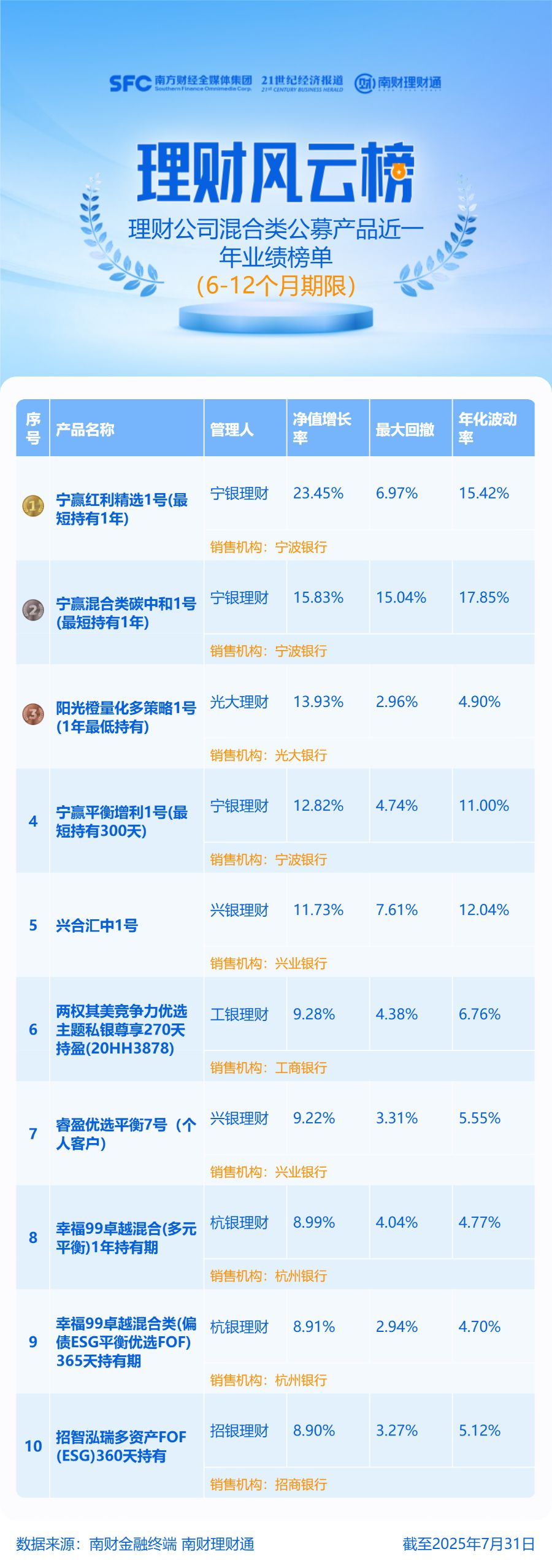
Overall Performance - The average net value growth rate and maximum drawdown for mixed public wealth management products with a duration of 6-12 months over the past year are 4.3% and 1.53% respectively [5] - 71.17% of the products have a net value growth rate exceeding 3% over the past year [5] - There is significant performance differentiation among products, with Ningyin Wealth Management's "Ningyin Hongli Selected No. 1" leading at 23.45% net value growth, while Zhaoyin Wealth Management's product is at the bottom with -1.05% [5] - Overall, Ningyin Wealth Management has performed well, with three products achieving over 10% net value growth in the past year [5] Highlighted Product Analysis - Ningyin Wealth Management's "Ningyin Hongli Selected No. 1" is an equity-mixed product with a risk rating of four (medium-high risk) and a performance benchmark of 3.5% to 9.5% [6] - The product is open for subscription and redemption every working day, allowing investors to redeem after holding for 365 calendar days [6] - The investment strategy focuses on long-term valuable listed companies, prioritizing stable performance, high dividend willingness, and reasonable valuation [6] - As of mid-year, the product's asset management net value is approximately 115 million, with equity investments accounting for 66.41% [6] - Major holdings include China Hongqiao, Yongxin Co., and Midea Group [6]
2025年半年报披露:A股上市公司中期分红热情逐渐升温
Yang Shi Wang· 2025-08-07 08:56
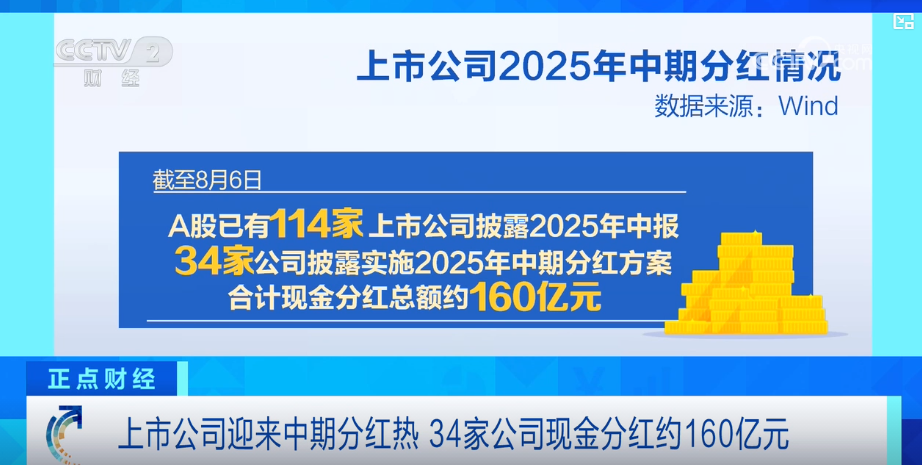
Group 1 - As of August 6, 114 listed companies in A-shares have disclosed their mid-term reports for 2025, with 34 companies announcing mid-term dividend plans, totaling approximately 16 billion yuan in cash dividends [2] - The food and beverage industry leads with 6 companies announcing dividends, followed by the pharmaceutical and chemical sectors with 4 companies each. Additionally, industries such as electrical equipment and auto parts are also actively participating [2] - Over 300 listed companies have released announcements regarding plans for mid-term dividends in 2025, indicating a positive signal for stable shareholder returns [2] Group 2 - According to Yang Chao, Chief Strategy Analyst at China Galaxy Securities, the dividend strategy is expected to evolve from a short-term opportunity to a core medium-to-long-term allocation approach [4] - As more listed companies establish stable dividend mechanisms, dividend assets will shift from "valuation repair" logic to "fundamental premium" logic, reshaping the market's risk-return profile [4]