谷子经济

Search documents
2025年谷子经济行业简析报告-嘉世咨询
Sou Hu Cai Jing· 2025-05-29 11:35
Core Insights - The report highlights the rapid growth of the "Goods Economy" driven by secondary IP derivatives, transitioning from niche markets to mainstream appeal, with a projected market size exceeding 2000 billion yuan by 2025 [1][2][47]. Industry Definition - "Goods" refers to secondary products related to two-dimensional culture, including badges, paper products, and standees, with the term "eating goods" denoting the purchase of these items [7]. Industry Development - The "Goods Economy" in China showcases a blend of cultural consumption and industrial upgrading, with a significant shift from overseas IP derivatives to domestic production, particularly in the last decade [10][11][12]. Product Types - Badges are the most popular product type, accounting for 64% of the second-hand market sales, followed by standees and other merchandise [13][15]. Market Size - The market size for the "Goods Economy" is expected to reach approximately 1689 billion yuan in 2024, reflecting a year-on-year growth of over 40% [47]. Industry Outlook - The domestic IP derivative market is currently underdeveloped, with only 10% of film revenues coming from merchandise, indicating significant growth potential compared to mature markets like the US and Japan [22][48]. User Demographics - The core audience for the "Goods Economy" is primarily the Z generation, with a user base projected to reach 5 billion, and a notable increase in female consumers from 67% in 2023 to 78% in early 2025 [23][42]. Industry Chain - The industry chain consists of three main segments: upstream IP development, midstream production and design, and downstream sales channels, which include online platforms and physical stores [26][32][36]. Challenges and Opportunities - The industry faces challenges such as homogenization, weak copyright protection, and dependency on IP, but also benefits from rapid market expansion and the rise of domestic IPs [2][45].


A股放量上涨,这一板块成为新热点
新华网财经· 2025-05-29 09:34
Group 1 - The A-share market shows a significant phenomenon of localized stock gathering, with sectors like controllable nuclear fusion, innovative drugs, and "unmanned vehicle" concepts gaining recent market attention [1] - The digital currency sector has surged, becoming a new hotspot in the A-share market, with the digital currency index rising by 7.66%, ranking third among Wind concept indices [1] - The overall market saw a rise, with the Shanghai Composite Index up by 0.7%, the Shenzhen Component Index up by 1.24%, and the ChiNext Index up by 1.37%, with over 4,400 stocks rising and a total market turnover of 1.21 trillion yuan [1] Group 2 - The Hong Kong stock market saw a significant increase in digital currency concept stocks, with Zhong An Online rising by 31.56% at the close, after peaking at over 36% during the day [3] - The Hong Kong Legislative Council passed the "Stablecoin Regulation Draft" on May 21, establishing a licensing system for fiat-backed stablecoin issuers, which aims to enhance the regulatory framework for virtual asset activities and promote financial innovation [5] - UBS reported that the Hong Kong Monetary Authority has launched a regulatory "sandbox" for stablecoin issuers, with RD InnoTech, in which Zhong An Online holds an 8.7% stake, being one of the three participating institutions [5] Group 3 - The card game and trendy toy sectors are experiencing high levels of prosperity, with companies expanding their operations and focusing on IP development and commercialization [8] - Companies are increasingly paying attention to the "grain economy" and enhancing its integration with their products, leading to continuous expansion in the related industrial chain [8]

新消费+谷子经济+潮玩IP最正宗的五大龙头,实力碾压中毅达和王子新材
Sou Hu Cai Jing· 2025-05-29 06:14
Group 1 - The "Guzi Economy" is rapidly gaining traction in the consumer market, becoming one of the most explosive sectors in the new consumption wave [1] - By 2029, the scale of China's ACG (Animation, Comic, and Game) industry is expected to exceed 590 billion yuan, with the Guzi Economy growing at an astonishing annual rate of 13% [2] - Only five leading companies have established strong competitive barriers through unique advantages in IP operation, technology integration, and channel expansion, achieving significant growth [2] Group 2 - The first leading company is Shifeng Culture (002862), which has exclusive Pokémon electric toy series and is actively utilizing generative AI technology to upgrade smart toys [3] - The second company, Guangbo Shares (002103), has a strong IP portfolio, including over 15 top IPs like Detective Conan and Mo Dao Zu Shi, with the highest cross-border e-commerce channel coverage in the industry [3] - The third company, Aofei Entertainment (002292), is set to launch a new electric toy in Q3 2024, with monthly sales expected to exceed 100 million yuan [3] - The fourth company, Huali Technology (301011), has a unique position as the only listed company in China with production qualifications for both Ultraman and Pokémon cards [3] - The fifth company, Yuanlong Yatu (002878), has a projected 67% year-on-year growth in its trendy toy business for Q1 2025 [3]







快倒闭的老商场,被二次元盘活
Hu Xiu· 2025-05-29 01:05
Core Insights - The revival of the once-declining Diwang Plaza in Guangzhou is attributed to the emergence of the "Guzi" market, which focuses on selling merchandise related to the ACG (Anime, Comic, and Game) culture, particularly appealing to the younger demographic [6][11][12] - The "Guzi" economy is experiencing significant growth, with projections indicating a market size of 1.689 billion yuan in 2024, reflecting a 40.63% increase from 2023, and expected to surpass 3 trillion yuan by 2029 [13] - Despite the initial success of the Guzi market, concerns about sustainability and market saturation are emerging, as many vendors rely on selling second-hand items and face challenges in maintaining customer interest [67][70][77] Group 1: Market Dynamics - The Guzi market has transformed Diwang Plaza from a once-popular shopping destination into a vibrant hub for ACG enthusiasts, with over 100 stalls operating during peak times [18][11] - The market features a diverse range of vendors, including older individuals and students, creating a community atmosphere where shared interests in anime and related merchandise foster social interactions [8][9][40] - The pricing strategy in the Guzi market is notably competitive, with stall fees ranging from 13 yuan to 30 yuan per day, making it accessible for many vendors [20][22] Group 2: Consumer Behavior - The demographic of the Guzi market has shifted, with a significant increase in female consumers, indicating a broader appeal beyond traditional male collectors [60] - Consumers are increasingly seeking affordable merchandise, leading to a preference for smaller, less expensive items over traditional collectibles, which has resulted in a decline in sales for higher-priced goods [61][64] - The market's atmosphere encourages price comparison and negotiation, with customers often using their phones to check prices online, reflecting a savvy consumer base [23][69] Group 3: Challenges and Concerns - The initial excitement surrounding the Guzi market is waning, with vendors reporting decreased sales compared to the previous year, raising questions about the long-term viability of the market [68][69] - The increasing homogeneity of products offered by vendors is contributing to a decline in consumer interest, as many stalls feature similar items week after week [70] - The commercial space for vendors is becoming more limited, with reports of increased competition for stalls and the potential for larger retailers to dominate the market, threatening the grassroots nature of the Guzi economy [76][77]
两位70后大叔,在北京打造下一个“泡泡玛特”,年营收超6亿
创业邦· 2025-05-29 00:04
Core Viewpoint - 52TOYS, a Chinese IP toy company, is preparing to go public on the Hong Kong Stock Exchange, aiming to replicate the success of companies like Pop Mart and Blokus [1]. Group 1 - 52TOYS has a market capitalization exceeding 2 billion HKD and annual revenue surpassing 600 million HKD [1].

经济第一大省,渴望下一个“爆款”
Mei Ri Jing Ji Xin Wen· 2025-05-28 15:41
Core Insights - The journey of "Tianmingren" has ended, but the impact of "Black Myth: Wukong" on the industry continues [1] - Guangdong has released specific policy measures to enhance the innovation capability and international competitiveness of its gaming industry [1] - The gaming industry in Guangdong is facing strong competition from emerging challengers as it enters a new development phase [1] Industry Overview - Guangdong's gaming industry revenue reached 260.43 billion yuan in the previous year, with a year-on-year growth of 6.26%, but its national market share decreased from 80.9% in 2023 to 79.94% in 2024 [1] - The decline in market share is attributed to fewer new game launches in Guangdong compared to other regions [1] Challenges and Opportunities - The core task of the new policy measures is to address the issue of a lack of blockbuster games and to support the production of original high-quality online games [4] - The gaming industry in Guangdong has historically been a center for blockbuster games, but it now faces challenges in maintaining its leading position [4][9] Competitive Landscape - "Honor of Kings" remains one of the highest-grossing games globally, with an estimated total revenue of 1.87 billion USD (approximately 13.53 billion yuan) last year [6] - New competitors like "Love and Producer" and "Honkai: Star Rail" are emerging, indicating a shift in the gaming landscape [6][7] - The rise of "ACG" (Anime, Comic, and Game) culture has led to the emergence of a new wave of games, particularly in Shanghai, which is becoming a hub for "二次元" (two-dimensional) games [7][8] Historical Context - Guangdong has historically been a trendsetter in the gaming industry, with significant contributions to the development of various game genres [9] - The province's gaming revenue reached 134.52 billion yuan by 2016, accounting for over 70% of the national market share [9] Future Directions - Guangdong is accelerating its efforts to catch up with emerging trends, particularly in the "二次元" gaming sector [12] - The emphasis on "mini-program games" in the new policy measures highlights a potential growth area, with mini-game revenue reaching 26.29 billion yuan last year, a 119.1% increase [19]



寻找消费力 | 潮玩:IP与内容“双驱动”
Bei Jing Shang Bao· 2025-05-28 08:24
Core Insights - The潮玩 industry is transitioning from a focus on figurines to a broader range of products, driven by consumer demand for emotional connection and social value [1][11] - Companies are diversifying their product offerings and pricing strategies to cater to a wider audience, moving beyond traditional toy categories [4][10] Category Expansion - The潮玩 market has expanded from primarily figurines to include plush toys, building blocks, jewelry, and card games, creating differentiated competitive advantages [3] - The plush category is expected to perform particularly well by 2025, as evidenced by the successful global launch of泡泡玛特's LABUBU series, which topped the App Store shopping charts in the U.S. [3][4] Financial Performance - 泡泡玛特's latest financial report indicates an increasing revenue share from the plush category, reflecting a shift in consumer interest towards diverse product experiences [4] - The company is implementing differentiated pricing strategies to cover various consumer segments, enhancing market penetration [4] Cross-Industry Collaboration - The collaboration between潮玩 brands and popular IPs, such as the film《哪吒之魔童闹海》, has proven to enhance product value and market reach [6][7] - Cross-industry partnerships are seen as a growth engine, allowing潮玩 brands to tap into new consumer demographics and cultural experiences [7] Content Ecosystem - The潮玩 industry is evolving from mere visual appeal to a focus on storytelling and cultural significance, with IP-driven content ecosystems becoming essential for consumer loyalty [8][10] - Companies are investing in both internal IP development and external collaborations to enrich their content offerings and enhance brand engagement [10] Emotional and Cultural Transformation -潮玩 products are increasingly viewed as cultural symbols that allow consumers to express individuality and seek community recognition [11] - The industry is exploring interactive experiences, such as theme parks and social events, to strengthen emotional ties between consumers and IPs [11]

万达押注、冲刺港股的52TOYS,收入不及泡泡玛特5%、市占仅1.2%
Xin Lang Cai Jing· 2025-05-27 16:52
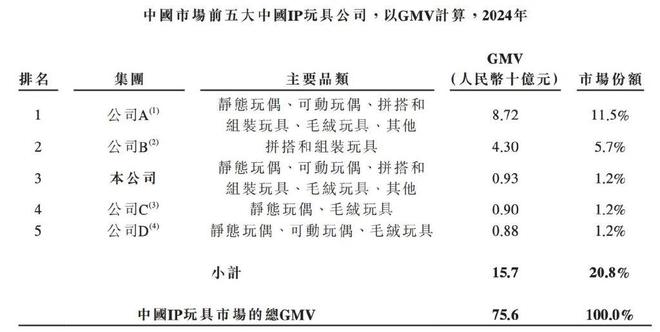
Core Viewpoint - The company Lezi Tiancheng is seeking to go public on the Hong Kong Stock Exchange, with its main brand 52TOYS being a leading player in the Chinese IP toy market, which is rapidly growing due to the "Guzi Economy" trend [1][3]. Market Position - According to the prospectus, 52TOYS is the third-largest IP toy company in China by GMV, with a projected GMV of 0.93 billion RMB for 2024, which is significantly lower than the leading companies, Pop Mart and Blok, whose GMVs are 8.72 billion RMB and 4.30 billion RMB respectively [2][3]. - The overall Chinese IP toy market is expected to grow from 48.6 billion RMB in 2020 to 75.6 billion RMB in 2024, with 52TOYS currently holding a market share of 1.2% [3][4]. Financial Performance - 52TOYS's revenue from 2022 to 2024 is projected to be 463 million RMB, 482 million RMB, and 630 million RMB respectively, which is less than 5% of Pop Mart's revenue in 2024 [3][4]. - The adjusted net profit for 52TOYS is expected to be -57 million RMB in 2022, 19 million RMB in 2023, and 32 million RMB in 2024, indicating a struggle to achieve significant profitability [4][5]. Profitability and Cost Structure - The gross margin for 52TOYS is relatively low, at 28.9% in 2022, 40.5% in 2023, and 39.9% in 2024, compared to competitors like Pop Mart and Blok, which have gross margins of 66.8% and 52.6% respectively [5][6]. - A significant portion of 52TOYS's revenue comes from licensed IP, which accounted for 50.2% in 2022 and is expected to rise to 64.5% by 2024, leading to high IP licensing costs [5][6]. Investment and Future Prospects - Despite its current performance, the company has attracted significant investment, including a recent 144 million RMB investment from Wanda Film and China Ruyi, indicating confidence in its future growth potential [7][9]. - The company plans to expand its self-operated stores in China and overseas, aiming to reduce reliance on distributors and improve profit margins [14][15]. International Expansion - 52TOYS has been expanding its international presence, with overseas revenue growing from 35.4 million RMB in 2022 to 147.4 million RMB in 2024, representing a growth rate of 149.15% year-on-year [15][16]. - The company aims to leverage partnerships with major film and gaming IPs to enhance its product offerings and market reach [12][14].
利润降回2年前,名创优品财报裂缝中的“生长痛”
Hua Er Jie Jian Wen· 2025-05-27 15:18
Core Viewpoint - Miniso's high gross profit margin is showing signs of strain as the company faces challenges in maintaining profitability despite revenue growth [1][2][3] Financial Performance - In Q1, Miniso reported revenue of 4.427 billion yuan, an 18.9% year-on-year increase, but net profit fell by 4.8% to 587 million yuan, leading to a net profit margin decline of 3.3 percentage points to 13.3% [2] - The company's revenue has grown 1.5 times over the past two years, with 2,200 new stores opened, and overseas store growth consistently outpacing domestic growth [9] Market Position and Strategy - Miniso's optimistic outlook on same-store sales contrasts with market skepticism, as the company aims for a revenue growth acceleration in the latter half of the year [4] - The company is transitioning from a low-cost brand to a "global IP co-branded store," which has raised expectations for international expansion [7][8] Operational Challenges - The increase in revenue without corresponding profit growth is seen as a potential warning sign, with significant investments in IP licensing and a shift in business strategy [5][6] - The company has adopted a three-pronged store opening strategy: partner model, direct operation model, and agency model in overseas markets [10] International Expansion - Miniso's overseas direct stores have increased to 548, more than doubling in two years, with a focus on the North American market [11] - However, the rapid expansion of overseas direct stores has led to increased upfront costs, impacting short-term profitability [12] Domestic Market Dynamics - The domestic market is showing signs of saturation, particularly in first- and second-tier cities, with a projected store penetration rate of 66% [15] - Same-store sales growth is declining, with a shift from a 30-35% growth rate in 2023 to an expected 8-9% decline in 2024 [16] IP Strategy and Risks - Miniso's reliance on IP products has increased, with IP product sales contributing significantly to revenue, but the associated costs are rising [23][26] - The company faces challenges in balancing the cost of IP licensing with consumer price sensitivity, especially in a competitive market [25][27] Capital Management - Financial costs have nearly doubled year-on-year, with the company issuing $550 million in convertible bonds and facing increased debt levels [32][42] - Miniso's acquisition of Yonghui Superstores has raised questions about its impact on profitability, despite the stock price increase since the acquisition [40][41] Future Outlook - The potential IPO of TOP TOY could alleviate some financial pressures on Miniso while expanding its market presence [43][46] - The company aims to maintain double-digit growth in the domestic market, focusing on same-store sales rather than aggressive new store openings [17][19]
张居正诞辰500年,网易这款糊游正在做一些赚钱之外的事?
Guan Cha Zhe Wang· 2025-05-27 08:54
Core Viewpoint - The 500th anniversary of Zhang Juzheng's birth is being commemorated through a song titled "For Yue," which has gained popularity among players of the game "Wang Chuan Feng Hua Lu," highlighting a unique intersection of history and modern culture [1][4][7]. Group 1: Cultural Impact - The song "For Yue," performed by the virtual singer Yan He, uses various historical imagery to narrate Zhang Juzheng's reforms during the Ming Dynasty, aiming to engage younger audiences with historical figures [4][7]. - The song has received significant engagement, with comments and interactions exceeding thousands shortly after its release, indicating a successful cultural outreach [4][5]. Group 2: Game Performance and Strategy - "Wang Chuan Feng Hua Lu," despite being labeled a "failed" game in terms of revenue, has carved out a niche in cultural collaboration, leveraging its historical themes to attract attention [4][8]. - The game has struggled with low player retention and revenue, reportedly generating only millions monthly, which places it outside the top 50 games in its category [7][8]. Group 3: Marketing and User Engagement - The game has initiated collaborations with various cultural and tourism departments, creating opportunities for players to engage with historical content through in-game events and real-world interactions [20][21]. - The concept of "Guzi Economy" is being explored, where the game aims to connect young consumers with cultural heritage, potentially enhancing interest in local tourism [21][23]. Group 4: Historical Context and Narrative - The game features historical figures and narratives, allowing players to interact with characters like Zhang Juzheng in a fictional setting, which appeals to history enthusiasts [8][10]. - The narrative structure of the game has been designed to satisfy the fantasies of history fans, providing a unique blend of education and entertainment [10][12]. Group 5: Future Prospects - The ongoing efforts to improve the game's cultural relevance and user engagement may lead to a revival of interest, despite its current financial struggles [18][23]. - The integration of educational elements and partnerships with museums suggests a strategic pivot towards enhancing the game's cultural significance rather than solely focusing on profitability [20][23].