
美联储政策

Search documents
11月22日金价:大家要提前做好准备,下周起,金价可能这样走
Sou Hu Cai Jing· 2025-11-22 16:30
Core Viewpoint - The recent volatility in the gold market, highlighted by a significant drop in gold prices, is primarily driven by the Russian central bank's unexpected sale of gold reserves to address fiscal challenges, alongside changing market expectations regarding the Federal Reserve's interest rate policies [1][5][11]. Market Dynamics - On November 21, gold prices experienced a dramatic fluctuation, peaking at $4088 per ounce before plummeting to a low of $4025.38, marking a single-day movement exceeding $50 [3]. - The London gold price as of November 22 was $4063.94 per ounce, reflecting a slight decline of 0.35% from the previous trading day, while the Shanghai gold market showed an increase of 0.49% to 932.03 yuan per gram, indicating a divergence in market behavior [3][5]. Influencing Factors - The market's reaction to the Federal Reserve's policy changes is crucial, with expectations for a December rate cut dropping from over 90% to 32.8%, while the probability of maintaining current rates rose to 60.4% [3]. - Geopolitical tensions, particularly in the Middle East and the ongoing Russia-Ukraine conflict, continue to create uncertainty, impacting gold's appeal as a safe-haven asset [5][11]. Technical Analysis - Current gold prices are at a critical juncture, with short-term traders' positions concentrated around $4050. A breakout in either direction could trigger significant market reactions [7]. - Analysts predict three potential scenarios for gold prices: a rebound towards $4200, a range-bound movement between $3950 and $4150, or a slight pullback testing support at $3850 to $3900 [9][11]. Institutional Perspectives - Major financial institutions have differing forecasts for gold prices, with UBS raising its mid-2026 target from $4200 to $4500 per ounce, while JPMorgan anticipates an average price of $5055 by the end of 2026 [11]. - The global central bank's gold purchases have provided essential support for gold prices, with China increasing its reserves for 12 consecutive months and a total of 634 tons purchased globally in the first three quarters [5][11]. Investment Strategies - For long-term investors, the focus remains on the ongoing trend of de-dollarization and central bank purchases, suggesting a strategy of accumulating gold during price dips [13]. - Short-term traders should closely monitor Federal Reserve signals and geopolitical developments, establishing clear stop-loss and take-profit levels [13][15]. Market Sentiment - The recent outflow of $1 billion from the largest gold ETF indicates shifting investor sentiment, with some reallocating funds towards equities, particularly in the tech sector [13][20]. - The gold market's volatility reflects broader economic uncertainties, with gold maintaining its status as a traditional safe-haven asset amidst fluctuating market conditions [21].


美联储"三号人物"一开口,全球市场就震动?他凭啥这么牛!
Sou Hu Cai Jing· 2025-11-22 16:17
Group 1 - The article highlights the significant influence of the New York Federal Reserve President, who holds three key privileges: permanent voting rights in FOMC meetings, leading the agenda and economic forecasts, and overseeing the largest bond trading desk globally [2] - The President's statements have a substantial impact on the market, with past comments leading to notable stock market movements, such as a 2% surge in the stock market following a statement about interest rates not harming the economy [2] - Investors are advised to pay close attention to the nuances of the President's speeches, as they often contain critical insights that can guide investment decisions, emphasizing the importance of understanding the underlying messages [2] Group 2 - The context in which the President speaks, such as congressional hearings, is deemed significantly more important than academic forums, indicating that the setting can influence the weight of the statements made [2] - A critical 48-hour window following the President's speeches is identified as a key period for making investment decisions in gold and U.S. stocks, suggesting that timing is crucial for capitalizing on market movements [2]

全球资产罕见集体暴跌,现在该恐慌还是贪婪?
Sou Hu Cai Jing· 2025-11-22 13:46
Group 1 - The global financial markets experienced a rare simultaneous decline across various asset classes in 2025, characterized by significant drops in stock indices and cryptocurrencies, with the S&P 500 falling 1.97% and the total cryptocurrency market cap decreasing by 25% [1][2] - The Japanese Government Pension Investment Fund reported a loss of $611 billion in Q1 2025, with overseas stocks down 6% and domestic stocks down 3.5%, indicating widespread asset pressure [2][3] - The correlation between risk assets and traditional safe-haven assets like gold has weakened, with gold prices dropping below $4,000 and U.S. 10-year Treasury yields remaining high, reflecting a unique market condition where both risk and safe-haven assets declined simultaneously [5][6] Group 2 - The U.S. stock market led the declines, with the S&P 500 and Nasdaq indices experiencing significant drops, particularly in the technology sector, which contributed over 60% of the declines on "Black Friday" [3][4] - The cryptocurrency market saw extreme volatility, with Bitcoin's price dropping from $84,000 to $81,500 in a short period, and a total of 17,000 investors liquidated positions during the November downturn, resulting in a loss of $5.7 billion [4][11] - The tightening liquidity environment has led to a vicious cycle of asset sell-offs, exacerbated by the Federal Reserve's high-interest rate policies, which increased the opportunity cost of holding gold and pressured bond prices [6][10] Group 3 - The market's decline is attributed to a chain reaction of policy uncertainty, rising inflation expectations, and a hawkish shift in Federal Reserve policy, leading to liquidity contraction and a reassessment of risk assets [7][8] - The AI sector, particularly companies like Nvidia, faced significant valuation corrections, with Nvidia's dynamic P/E ratio dropping from 120 to 78, indicating a market reassessment of growth expectations [9][30] - The overall market valuation has shifted from a bubble to a more reasonable level, with the Nasdaq 100's dynamic P/E ratio falling to near its five-year average, suggesting potential investment opportunities in undervalued sectors [30][31]


跌麻了,鬼扯的英伟达小作文
佩妮Penny的世界· 2025-11-21 10:14
Market Overview - Recent market volatility has been significant, with major declines in both U.S. stocks and cryptocurrencies, notably Bitcoin dropping from 120,000 to 85,000 in just over a month [1] - The A-share market has also experienced declines, with a notable drop from 4000 to 200 [1] Reasons for Market Decline - The market downturn can be analyzed through three main lenses: fundamentals, liquidity, and sentiment [5] - Discrepancies in the recently released non-farm payroll data have raised concerns about inflation, leading to a hawkish stance from the Federal Reserve and diminishing expectations for a rate cut in December [5] - The ongoing debate about an "AI bubble" has been fueled by Nvidia's recent earnings report, which has led to skepticism regarding the sustainability of AI-related growth [5][6] Nvidia's Financial Performance - Nvidia reported a significant revenue increase of 62%, with a projected future revenue of 350 billion over the next 14 months, supported by contracts with major clients like Saudi Arabia [7] - The company's cash flow for the third quarter was reported at 64 billion, with a net profit of 73 billion, indicating a cash flow conversion rate of 88%, which is considered healthy [6] - Despite strong financials, market reactions can be unpredictable, often moving contrary to positive earnings reports [9] AI Industry Outlook - Nvidia's CEO believes there is no bubble in the AI sector, citing ongoing paradigm shifts in the information industry that will drive infrastructure investments [12] - Reports suggest that AI-related stocks could contribute 70-80% of the S&P's gains by 2025, indicating a strong market sentiment towards AI despite concerns about overvaluation [12] Fund Strategy Adjustments - Many overseas funds have been adjusting their strategies since Q2, reducing exposure to tech growth stocks and reallocating to value sectors or broad market indices [13] - There is a trend of reallocating investments towards emerging markets, including Europe and Japan, as U.S. markets face volatility [13] Investor Sentiment - The recent market corrections have led to a sense of discomfort among investors, particularly those who may have celebrated earlier gains [15] - Maintaining a long-term investment perspective and confidence in holdings is emphasized as a strategy to navigate market fluctuations [15]

分析师:AI泡沫与美联储态度改变,股市波动或仍持续
Sou Hu Cai Jing· 2025-11-21 09:25
科普来看,K线图是投资分析中常用的工具,用于观察股票或指数的价格波动及趋势。长上影线或长下影线可能反映市场多空力量的不均衡。而股价占 指数 比重较大的公司,其价格波动往往对指数整体产生较大影响。另一方面,AI行业的发展与芯片供应密切相关,但技术突破可能改变行业格局,从而影响相 关公司的盈利能力和市场估值。 Button总结认为,美联储政策变化虽值得关注,但对整体市场的短期影响有限;相比之下,AI板块的波动性仍然较高,存在"高估值泡沫被修正"的可能性。 在这种背景下,市场仍可能维持一定波动,投资者需关注行业技术发展和宏观政策信号,以理解股市背后的逻辑。 原因在于,谷歌展示了无需依赖英伟达芯片也能打造出高性能的LLM,这意味着其他公司同样有能力进入该市场,从而可能降低英伟达未来的利润预期。 值得注意的是,英伟达在标普500指数中的权重约为8%,如果其股价大幅下跌,将直接对指数造成显著拖累。此外,AI相关股票整体估值偏高,也存在一定 的调整风险。 在宏观政策方面,美联储态度的变化也影响了市场情绪。此前市场几乎确定12月将降息,但美联储主席鲍威尔明确表示反对降息,使市场对降息的概率预期 从接近确定降至约36%。But ...

香港第一金:黄金跌破关键支撑,可能引发连锁反应
Sou Hu Cai Jing· 2025-11-21 07:57
Core Viewpoint - The recent strong U.S. non-farm payroll data has significantly reduced the expectations for a Federal Reserve rate cut in December, leading to a stronger dollar and downward pressure on gold prices [2][3] Group 1: Market Influences - Strong U.S. non-farm payroll data for September showed an increase of 119,000 jobs, far exceeding the expected 50,000 [2] - The probability of a Federal Reserve rate cut in December has dropped from approximately 45% to around 30%-40% [2] - The global tech stock market crash has triggered risk-averse sentiment, which may support gold prices in the long term [2] Group 2: Key Price Levels - Resistance levels for gold are identified at $4,110 and the $4,130-$4,140 range; a failure to sustain upward momentum near these levels may warrant short positions [2] - A critical support level to watch is $4,020; if gold stabilizes here and shows bullish candlestick patterns, it may present a buying opportunity [3] - If gold breaks below the $4,020 support, it could open up further downside potential, while a strong breakout above $4,140 could lead to additional upward movement, though the current fundamentals do not strongly support this scenario [3] Group 3: Future Monitoring - The Federal Reserve's policy signals are crucial for the gold market; attention should be paid to speeches from Fed officials leading up to the December FOMC meeting, as any hints regarding interest rate paths could cause market fluctuations [4] - Key economic data, including upcoming inflation figures (CPI, PCE) and the combined non-farm employment report for October and November, will be critical in assessing the U.S. economic condition and inflation trends [5] - The ability of gold to maintain the $4,000 psychological and technical support level is essential; a breach could lead to further declines [6]
数字资产双周报(2025.11.6-2025.11.21):宏观逆风下加密市场续跌-20251121
Bank of China Securities· 2025-11-21 06:58
Market Overview - The cryptocurrency market has seen a significant decline in November, with the overall market cap dropping by $750 billion to within $3 trillion[2] - Bitcoin has fluctuated below $90,000, currently at $86,500, marking a nearly 30% drop from its peak on October 6[2] - Altcoins have experienced even greater declines, with most altcoin/BTC trading pairs showing weak performance[2] Economic Factors - The current downturn is attributed more to macroeconomic factors and profit-taking rather than structural risks within the industry, unlike the extreme bear market of 2022[3] - Recent comments from multiple Federal Reserve officials have shifted market sentiment towards a cautious stance ahead of the December meeting, with a 32% implied probability of a rate cut[4][5] Bitcoin Technical Analysis - Bitcoin has not shown signs of a bottoming out, with support levels moving down after breaking below $94,000[8] - Long-term holders are continuing to reduce their positions, while short-term holders are facing ongoing losses[8] Market Sentiment - The cryptocurrency and stock market fear and greed indices remain in the extreme fear zone, indicating a bearish sentiment among investors[13] ETF Trends - Bitcoin and Ethereum ETFs have recorded continuous net outflows since early November, with significant redemptions from major funds like BlackRock's Bitcoin ETF[8][18] Key Metrics - Major cryptocurrencies have seen substantial declines, with Bitcoin down 16.3% bi-weekly and 21.6% monthly, while Ethereum has dropped 17.7% bi-weekly and 27.9% monthly[16] Regulatory Developments - The Hong Kong Securities and Futures Commission has issued new guidelines allowing licensed platforms to share liquidity with overseas platforms, marking a shift towards more integrated regulation[24] Institutional Movements - Coinbase has launched a savings account in the UK offering a 3.75% interest rate, while Block reported $1.97 billion in Bitcoin-related revenue for Q3, accounting for nearly one-third of total revenue[19] Future Outlook - The market is expected to remain under pressure until new capital inflows or clear macro catalysts emerge, with Bitcoin potentially testing the $84,000 to $85,000 range[13]
11月21今日币圈:比特币、以太坊、山寨币行情分析及操作建议!
Sou Hu Cai Jing· 2025-11-21 06:05
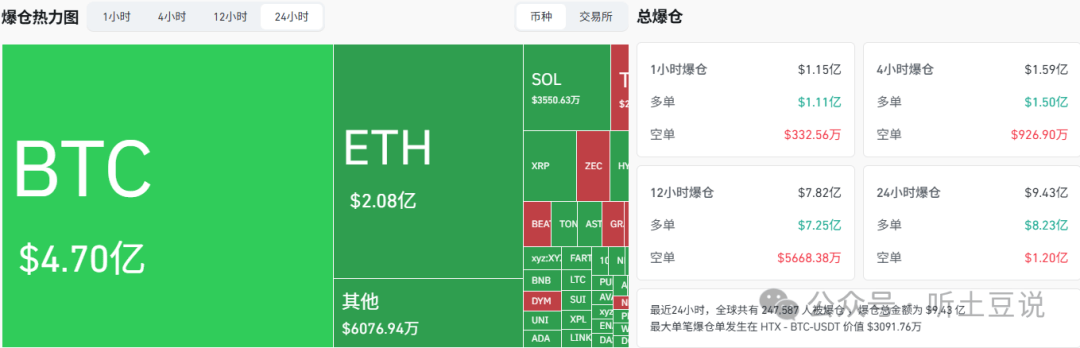
Core Insights - The cryptocurrency market has experienced a 6.22% decline in market capitalization over the past 24 hours due to rising global market risk aversion and weakened expectations for Federal Reserve interest rate cuts [1] Group 1: Market Trends - The correlation with Nasdaq has negatively impacted cryptocurrencies, with a 4% drop attributed to concerns over an AI bubble [1] - Uncertainty surrounding Federal Reserve policies, driven by strong employment data and signals of tightening monetary policy, has suppressed rate cut expectations [2] - Deleveraging has occurred as Bitcoin fell below the $87,000 support level, triggering over $1 billion in liquidations [3] Group 2: Liquidation Alerts - A total of 247,587 individuals were liquidated across the network in the last 24 hours, amounting to $943 million, with long positions suffering the most at $823 million [4] Group 3: Major Cryptocurrency Performance - Bitcoin (BTC) is priced at approximately $85,633, down 7.44% in 24 hours, with a critical resistance level at $86,780 [6] - Ethereum (ETH) is priced at around $2,798, down 8.115%, with a key resistance level at $2,840 [6] - BNB is priced at about $860, down 5.50%, with a resistance level at $873 [6] - Solana (SOL) is priced at approximately $132, down 7.58%, with a resistance level at $133 [7] Group 4: Market Sentiment - The total cryptocurrency market capitalization is approximately $2.94 trillion, with a 24-hour trading volume of about $210.89 billion [7] - Current market sentiment is at 15, indicating extreme fear, with the total market cap down 24% compared to the 30-day moving average, marking the most oversold level since April 2025 [7] Group 5: Price Movements of Other Cryptocurrencies - Top gainers include TNSR, up 140%, DYM, up 66%, and XAI, up 35% [9] - Top losers include ZK, down 19%, STRK, down 19%, and CYBEER, down 17% [9] - Other notable cryptocurrencies include Dogecoin (DOGE) down 6.58%, Cardano (ADA) down 7.33%, and Litecoin (LTC) down 6.13% [9]
新能源及有色金属日报:弱势不改,沪镍不锈钢震荡下行-20251121
Hua Tai Qi Huo· 2025-11-21 02:37
Report Industry Investment Rating No relevant information provided. Core View of the Report - The nickel market is in a situation of high inventory and oversupply, and the nickel price is expected to remain in a low - level oscillation. The stainless - steel market faces low demand, high inventory, and a continuous downward shift in cost, and it is expected to maintain a low - level oscillation as well [1][3][5]. Summary by Related Contents Nickel Variety Market Analysis - **Futures**: On November 20, 2025, the main contract of Shanghai nickel 2601 opened at 115,750 yuan/ton and closed at 115,380 yuan/ton, a change of - 0.23% from the previous trading day's close. The trading volume was 124,692 (+42,129) lots, and the open interest was 152,848 (12,764) lots. It showed a weak and oscillating downward trend. The uncertainty of the Fed's policy increased, the probability of a December interest rate cut was less than 50%, the US dollar strengthened, and the supply - demand relationship became looser with rising inventory, leading to a clear short - term downward trend [1]. - **Nickel Ore**: The nickel ore market was mainly in a wait - and - see state, and the price remained stable. In the Philippines, the 1.4% nickel ore tender of Eramen landed at $42/wet ton, and the 1.25% nickel ore tender of Benguet had no deal. The nickel - iron tender price of downstream mainstream steel mills reached a new low of 880 yuan/nickel (including tax at the hatch bottom), and iron plants were not very motivated to produce and mostly adopted a wait - and - see attitude towards raw material procurement. In Indonesia, the second - phase domestic trade benchmark price in November dropped by $0.12 - 0.2/ton, and the mainstream premium was +26, with the premium range mostly between +25 - 26 [1]. - **Spot**: Jinchuan Group's sales price in the Shanghai market was 119,800 yuan/ton, an increase of 300 yuan/ton from the previous trading day. Downstream buyers made purchases mainly for rigid demand, and the overall spot transaction was okay. The premiums of Jinchuan nickel, imported nickel, and nickel beans were 4,100 yuan/ton, 500 yuan/ton, and 2,450 yuan/ton respectively. The previous trading day's Shanghai nickel warehouse receipt volume was 34,631 (- 793) tons, and the LME nickel inventory was 254,172 (-1,674) tons [2]. Strategy - It is recommended to mainly conduct range operations for single - side trading, and there are no suggestions for cross - period, cross - variety, spot - futures, and options trading [3]. Stainless - Steel Variety Market Analysis - **Futures**: On November 20, 2025, the main contract of stainless steel 2601 opened at 12,330 yuan/ton and closed at 12,285 yuan/ton. The trading volume was 119,724 (+31,045) lots, and the open interest was 192,398 (-4,171) lots. The price basically followed the trend of Shanghai nickel, showing an oscillating downward trend. Due to weak downstream demand, high inventory, and the continuous decline of nickel price, there was still no sign of price rebound [3]. - **Spot**: The price continued to decline and reached a historical low, the market sentiment was even more sluggish, and the transaction was light. The stainless - steel price in the Wuxi market was 12,675 (+0) yuan/ton, and that in the Foshan market was 12,700 (+0) yuan/ton. The SMM data showed that the ex - factory tax - included average price of high - nickel pig iron changed by - 2.50 yuan/nickel point to 894.5 yuan/nickel point [3]. Strategy - A neutral stance is recommended for single - side trading, and there are no suggestions for cross - period, cross - variety, spot - futures, and options trading [5].
中期支撑仍在 沪铜重心有望逐步抬升
Qi Huo Ri Bao· 2025-11-21 01:16
Group 1 - Recent copper price movements have been influenced by supply-side production cuts and the Federal Reserve's monetary policy, leading to a strong rally followed by a pullback due to hawkish signals from the Fed [1] - The macroeconomic environment remains marginally loose, but its positive impact on the market is limited, with expectations for a rate cut in December now below 50% [1] - Supply uncertainties persist, with a decrease in refined copper production and imports in September, while global copper markets may face a supply gap of approximately 150,000 tons by 2026 [1][2] Group 2 - The inventory structure shows regional mismatches, with high Comex copper inventories and slight accumulations in SHFE, while LME inventories are declining [2] - The TC (treatment charge) remains at historically low levels, indicating ongoing tightness in copper ore supply, with upcoming negotiations expected to influence TC levels for 2026 [2] - As the fourth quarter progresses, copper prices are likely to be driven by supply and demand dynamics, with macroeconomic stimuli failing to create a sustained trend [3]