
创新驱动

Search documents
信用评级行业要加快转变发展模式
Zheng Quan Ri Bao· 2025-12-13 01:41
12月10日至11日在北京举行的中央经济工作会议明确提出"坚持创新驱动,加紧培育壮大新动能",为资 本市场如何更好服务科技创新指明了清晰路径。 远东资信研究院副院长张林在接受《证券日报》记者专访时表示,信用评级机构作为金融市场的重要基 础设施之一,长期以来承担着信用风险"看门人"的重要角色。在新发展机遇面前,信用评级行业的展业 理念和技术手段需要与时俱进,不断优化。 在张林看来,通过更加前瞻性而非历史性的评级技术,信用评级机构可以推动长期资本与耐心资本的形 成,主动服务于长期主义投融资体系的构建过程。这也意味着评级方法需要更加注重企业的创新能力、 技术储备、市场前景等前瞻性指标。 会议指出,坚持创新驱动,加紧培育壮大新动能。今年以来,债券市场"科技板"落地生效,精准激活科 技金融新动能。在此过程中,信用评级行业及时优化科创债评级体系,将专利储备、研发能力、团队治 理等非财务指标纳入评级技术体系。"未来,信用评级机构需要苦练内功,加强围绕股、债、贷联动的 信用体系开发并创新信用评级技术。"张林说。 张林表示,信用评级机构需要科学有序地将大数据、人工智能等金融科技纳入到评级技术体系中,不断 提升服务科技金融大文章 ...
成都 “十五五”:发展有力度,幸福有温度
2 1 Shi Ji Jing Ji Bao Dao· 2025-12-13 01:12
Core Points - Chengdu aims to exceed a GDP of 3.2 trillion yuan by the end of the 15th Five-Year Plan, indicating a need for annual GDP growth of over 1.4 billion yuan during this period [2][4][5] - The development strategy for the 15th Five-Year Plan focuses on "innovation-driven, open leadership, integration of science and industry, and strong counties and active districts" to address the city's development challenges [4][5] - Chengdu's positioning includes becoming a national economic center, technology innovation center, international consumption center, and cultural creative center, while also establishing itself as a key base for advanced manufacturing and digital cultural industries [5][10] Economic Development - Chengdu's industrial revenue has crossed three trillion yuan during the 14th Five-Year Plan, with significant growth in electronic information and equipment manufacturing sectors [6][7] - The city plans to build a modern industrial system centered on advanced manufacturing, enhancing the global competitiveness of its existing industries while developing new sectors like artificial intelligence and low-altitude economy [7][9] Regional Integration - Chengdu will enhance its role in the Chengdu-Chongqing economic circle by promoting collaborative development through five key initiatives, including building an international transportation hub and a world-class advanced manufacturing cluster [9] - The "strong counties and active districts" strategy aims to foster differentiated development across urban and rural areas, enhancing overall regional balance and support for the Chengdu metropolitan area [9] Digital Cultural Industry - Chengdu is prioritizing the development of the digital cultural industry, with plans to exceed 410 billion yuan in total scale by 2025 and 600 billion yuan by 2030, positioning itself as a national leader in this sector [11][12] - The city has implemented a comprehensive policy package to support the digital cultural industry, including the establishment of a 3 billion yuan fund for sci-fi and future industries [11] Quality of Life - Chengdu has been recognized as the "most livable city" for 17 consecutive years, with initiatives aimed at enhancing quality of life through employment, education, healthcare, and environmental improvements [13][14] - The city plans to implement policies that promote happiness and well-being, focusing on sustainable urban development and ecological quality [13][14]


成都 “十五五”:发展有力度,幸福有温度
21世纪经济报道· 2025-12-13 00:54
Core Viewpoint - Chengdu aims to exceed a GDP of 3.2 trillion yuan by the end of the 15th Five-Year Plan, building on the foundation of the 14th Five-Year Plan, which requires an annual increase of over 1.4 trillion yuan during this period [1][3]. Group 1: Development Strategy - The development strategy for the 15th Five-Year Plan includes "innovation-driven, open leadership, integration of science and industry, and strong counties and active regions," addressing the constraints on high-quality development [5]. - Chengdu's development positioning includes building five centers: economic, technological innovation, international exchange, international consumption, and cultural creativity centers, along with five key areas: a major carrier for national strategic technology, an advanced manufacturing base, a digital cultural and creative industry hub, a new high ground for reform and opening up, and a high-quality livable area [5][9]. Group 2: Industrial Development - Chengdu's industrial revenue is expected to cross three trillion yuan during the 14th Five-Year Plan, with the goal of establishing a modern industrial system centered on advanced manufacturing [7]. - The city plans to enhance the resilience, advantages, and vitality of its industrial chains, focusing on global competitiveness in existing industries and developing new sectors like artificial intelligence and quantum technology [7]. Group 3: Regional Integration - Chengdu will enhance its role in the Chengdu-Chongqing economic circle and urban agglomeration, promoting collaborative development through five key initiatives, including building an international transportation hub and a world-class advanced manufacturing cluster [9]. Group 4: Digital Cultural and Creative Industry - The digital cultural and creative industry is highlighted as a new urban development focus, with plans to elevate its total scale to over 600 billion yuan by 2030, supported by a comprehensive policy framework and significant investment in related projects [11][12]. Group 5: Quality of Life and Happiness - The city emphasizes improving the quality of life, focusing on employment, education, healthcare, and social security, while also enhancing environmental quality to maintain its reputation as a "most livable city" [13].

视频|主要目标将顺利完成 中国经济今年有哪些亮眼表现?专家解读
Yang Shi Xin Wen Ke Hu Duan· 2025-12-13 00:20
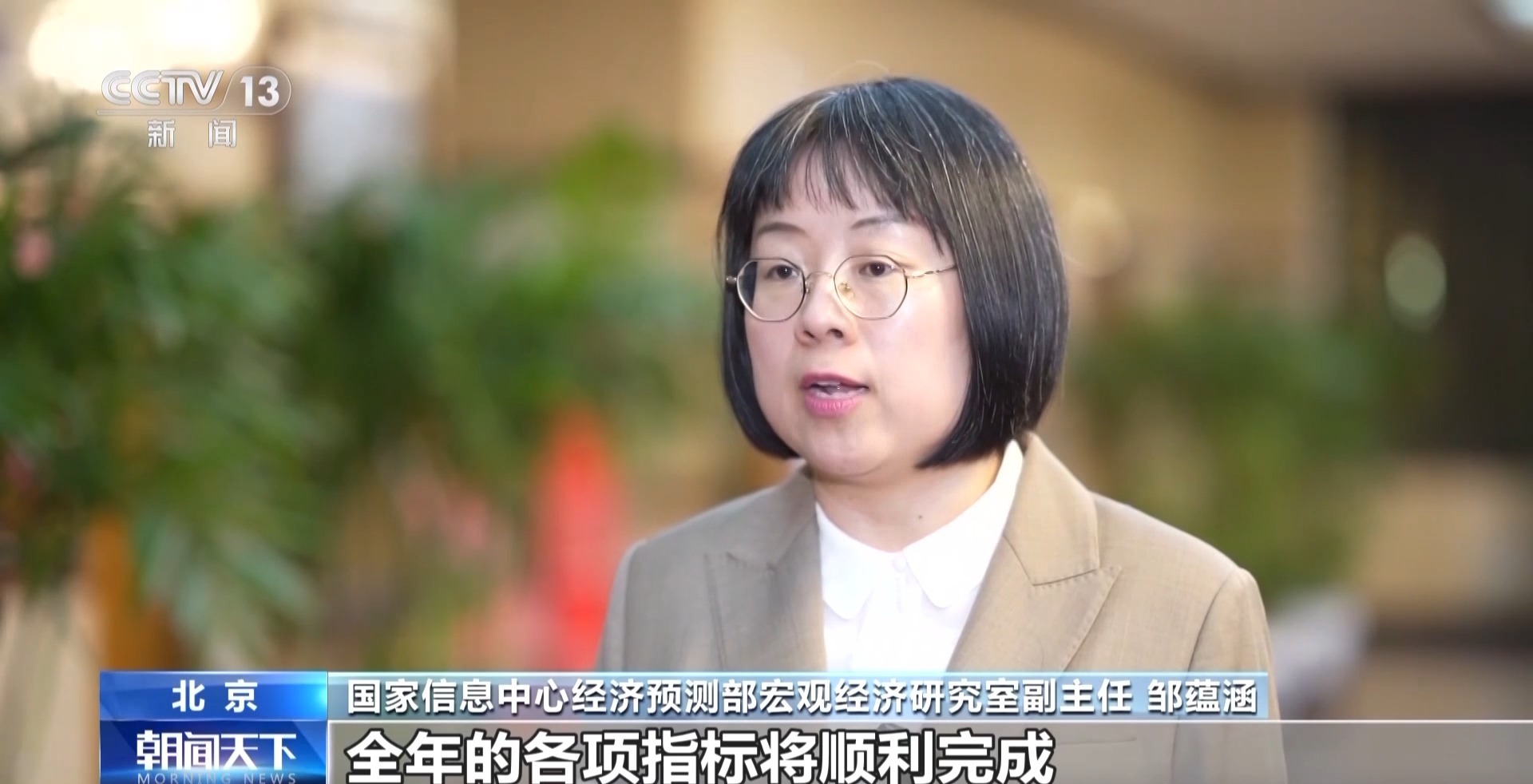
会议用"五个必须"科学总结了做好新形势下经济工作新的认识和体会,并提出我国经济长期向好的支撑条件和基本趋势没有改变,要坚定信心、用好优 势、应对挑战,不断巩固拓展经济稳中向好势头。 中央经济工作会议12月10日至11日在北京举行。会议指出今年我国经济社会发展主要目标将顺利完成。这一年,中国经济有哪些亮眼表现?如何看待当 前经济形势?专家对此进行了解读。 今年我国经济社会发展 主要目标将顺利完成 0:00 / 1:22 中央经济工作会议指出,今年是很不平凡的一年,我国经济顶压前行,向新向优发展,现代化产业体系建设持续推进,改革开放迈出新步伐,重点领域 风险化解取得积极进展,民生保障更加有力。 国家信息中心经济预测部宏观经济研究室副主任 邹蕴涵:今年以来,全球经济增长持续放缓,我国经济总体保持了平稳的发展态势,各方的积极性、 主动性充分调动,各类宏观政策持续加力显效,共同推动经济的内生增长动力不断壮大,全年的各项指标将顺利完成,我国的经济高质量发展迈出了坚实的 步伐。 国家信息中心经济预测部宏观经济研究室副主任邹蕴涵:会议实际上毫不讳言地直面我们当前面对的非常突出的矛盾,比如说我们经济里边供强虚弱的 问题,并且对 ...
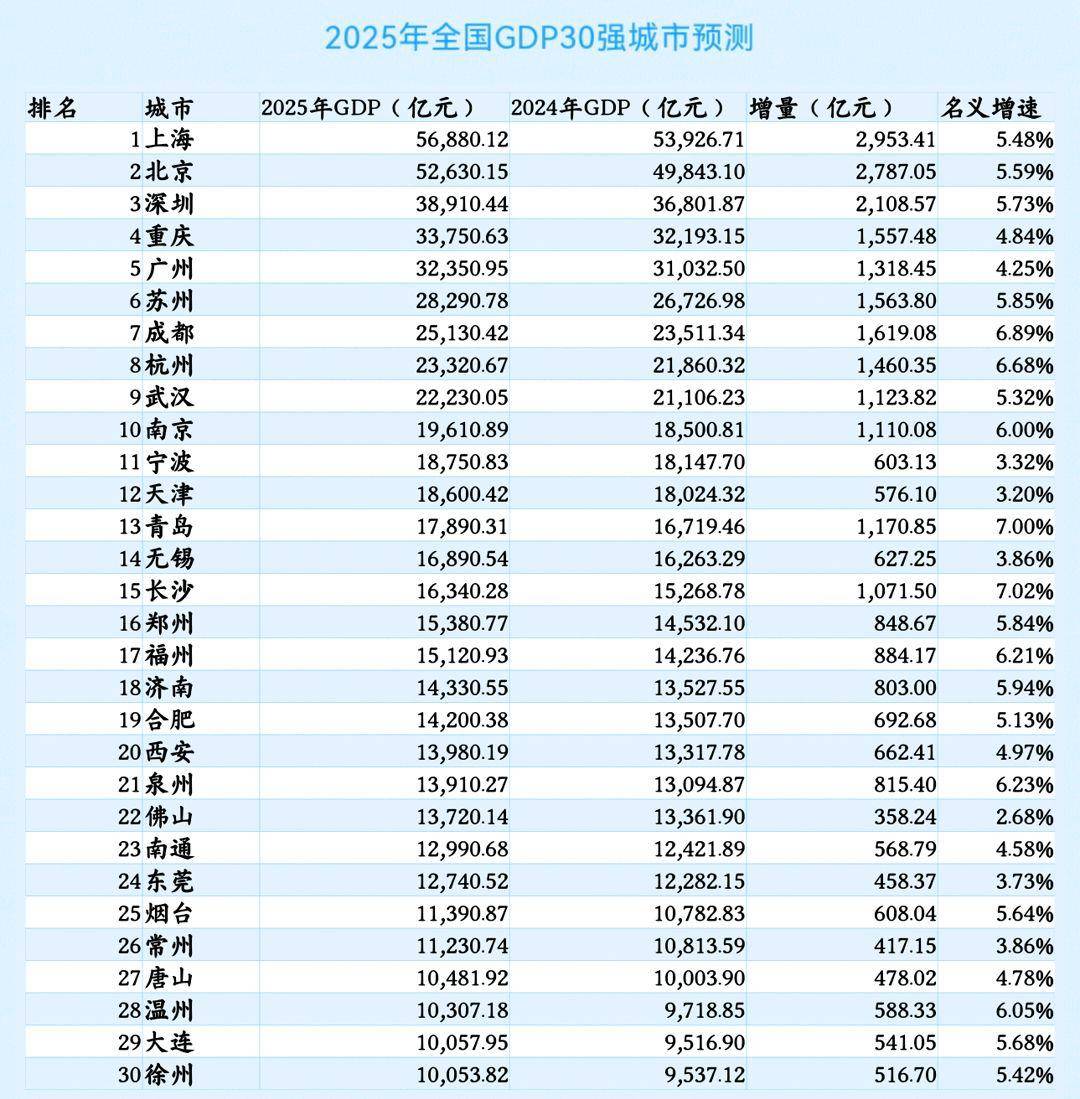
2025年GDP30强城市预测:深圳近4万亿,福州接近郑州,温州破万亿
Sou Hu Cai Jing· 2025-12-12 17:35
Core Insights - The 2025 GDP forecast for major Chinese cities highlights significant economic growth, with Shanghai leading at 56,880 billion yuan, followed by Beijing at 52,630 billion yuan, and Shenzhen at 38,910 billion yuan [1][2] Group 1: Major Cities and Economic Growth - Shanghai is projected to maintain its position as the top city with a GDP of 56,880 billion yuan, showing a nominal growth rate of 5.48% [2] - Beijing is expected to reach a GDP of 52,630 billion yuan, with a nominal growth rate of 5.59% [2] - Shenzhen's GDP is forecasted to be 38,910 billion yuan, with a nominal growth rate of 5.73%, driven by its status as a global tech innovation hub [2][3] Group 2: Emerging Cities - New first-tier cities like Chengdu and Hangzhou are showing impressive growth rates, contributing to a more balanced economic development across China [1] - Wenzhou is notable for being the first city to surpass a GDP of 1 trillion yuan, reaching 10,307 billion yuan, marking a significant milestone in regional economic development [1][6] Group 3: Shenzhen's Economic Model - Shenzhen's economy is characterized by a strong innovation ecosystem, with an expected annual patent authorization exceeding 100,000, accounting for 15% of the national total [3] - The city is projected to attract over 100 billion USD in foreign investment, with strategic emerging industries expected to grow by 12% [2][3] Group 4: Fuzhou's Economic Development - Fuzhou is forecasted to achieve a GDP of 15,120 billion yuan, with a growth rate of 6.21%, benefiting from free trade zone policies and a focus on digital economy [5] - The city aims to enhance its marine economy, with expected output surpassing 500 billion yuan and a 10% increase in port throughput [5] Group 5: Wenzhou's Economic Transformation - Wenzhou's GDP is projected to reach 10,307 billion yuan, with a growth rate of 6.05%, driven by its vibrant private economy [6][8] - The city is focusing on innovation, with an expected 5,000 new patents annually and a significant increase in cross-border e-commerce activities [6][8]
君联资本:锚定长期主义与创新驱动 促进企业创新成长
Xin Lang Cai Jing· 2025-12-12 14:13
来源:上海证券报·中国证券网 上证报中国证券网讯(记者 梁银妍)中央经济工作会议提出,坚持创新驱动,加紧培育壮大新动能。 君联资本表示,这为金融行业服务国家发展大局指明了实践路径。面对新一轮科技革命和产业变革的浪 潮,投资机构应成为助力国家科创战略的"耕耘者"、探索科技金融体制机制创新的"探路者"、打通科技 —产业—金融良性循环的"建造者"。 来源:上海证券报·中国证券网 上证报中国证券网讯(记者 梁银妍)中央经济工作会议提出,坚持创新驱动,加紧培育壮大新动能。 君联资本表示,这为金融行业服务国家发展大局指明了实践路径。面对新一轮科技革命和产业变革的浪 潮,投资机构应成为助力国家科创战略的"耕耘者"、探索科技金融体制机制创新的"探路者"、打通科技 —产业—金融良性循环的"建造者"。 一是,聚焦原始创新,培育"第一"与"唯一"。君联资本表示,投资机构应长期聚焦前沿原创和自主创 新,将投资触角精准伸向致力于解决关键技术领域"卡脖子"难题、培育全球竞争力的科技企业。 二是,创新科创金融服务模式。据君联资本介绍,公司积极探索了多项创新模式,形成了"区域锚定 +阶段聚焦"的硬科技培育路径,专门瞄准关键核心技术攻关与成果 ...
中央经济工作会议点评:重创新、扩内需,呵护经济稳增长
Wanlian Securities· 2025-12-12 12:04
Group 1: Economic Policy Insights - The Central Economic Work Conference held on December 11, 2025, emphasized the need to balance supply and demand, noting a shift from "insufficient demand" in 2024 to "prominent contradictions between strong supply and weak demand" in 2025[4] - The policy aims to "continuously expand domestic demand and optimize supply," indicating a focus on improving both new and existing economic structures[4] - Fiscal policy is expected to maintain a deficit rate around 4%, with an emphasis on optimizing expenditure structures and addressing local fiscal challenges[4] Group 2: Monetary Policy and Market Stability - Monetary policy will be adjusted flexibly in response to economic changes, with a focus on stabilizing growth and ensuring reasonable price recovery[4] - The policy statement has shifted to "flexibly and efficiently utilize" monetary tools, with expectations for structural support to be enhanced[4] - The emphasis on "reducing risks and improving quality" for small financial institutions suggests a potential acceleration in mergers within this sector[6] Group 3: Domestic Demand and Innovation - Strengthening domestic demand is a priority, with plans to implement policies that boost consumer income expectations and confidence, thereby promoting sustainable consumption growth[4] - The conference highlighted the importance of innovation in driving industrial development, with a focus on nurturing new growth drivers and enhancing the innovation ecosystem[6] - There is a commitment to invest more resources in international technology innovation centers, particularly in major urban areas like Beijing and Shanghai[6] Group 4: Risk Factors - Potential risks include slower-than-expected policy implementation, persistent weak consumer confidence, and unexpected changes in overseas trade policies[6]
中央经济工作会多个新提法释放哪些新信号?
Sou Hu Cai Jing· 2025-12-12 11:38
首次在中央文件提出"五个必须",这既是对去年经济工作规律性认识的总结和升华,又对明年经济工作具有重要指导意义 文|《财经》记者 孙颖妮 编辑 | 王延春 12月10日至11日,中央经济工作会议在北京举行。会议分析当前经济形势,部署2026年经济工作。 回顾即将过去的2025年,会议指出,今年是"很不平凡的一年"。中国社科院美国研究所研究员、副所长徐奇渊向《财经》表示,今年的确很不平 凡,2024年末,在中美贸易摩擦背景下,国内外诸多经济学家对今年的经济增长呈悲观态度,各类国际经济机构对今年中国经济增速的预测只是 略高于4%,但是后来我们都看到,中国经济扛住了关税战的冲击,外部环境还实现了阶段性缓和。今年外贸表现大超预期,总体经济增速也较平 稳,近期国际经济机构普遍上调中国增速预期,这表明中国经济具有较大韧性。 对于全年的经济增速,中国金融四十人研究院预计,在上一轮增量政策的支持下,全年5%的增长目标能如期实现,四季度经济仍能保持平稳运 行。 《财经》注意到,12月以来,多家国际机构也上调中国经济增速预期,如IMF预计2025年中国经济增速为5%,较10月预测上调0.2个百分点。世界 银行预测为4.9%,较6月 ...

【招银研究|政策】开局之年,提质增效——2025年中央经济工作会议学习体会
招商银行研究· 2025-12-12 11:17
Core Viewpoint - The Central Economic Work Conference held on December 10-11, 2025, outlines the economic work for 2026, emphasizing a balanced approach to domestic economic work and international trade, with a focus on expanding domestic demand and optimizing supply to achieve effective qualitative improvement and reasonable quantitative growth [1] Group 1: Work Tone - The conference adopts a pragmatic and positive tone, affirming that the main economic goals for 2025 will be met, with an expected GDP growth rate of 5% [2] - It acknowledges persistent challenges in economic development, including external environmental changes, domestic supply-demand imbalances, and risks in key areas [3] Group 2: Macroeconomic Policy - The macroeconomic policy will maintain strength and enhance effectiveness, with a focus on both existing and new policies [5] - Fiscal policy will be more proactive, with a projected fiscal deficit rate of 4% for 2026, corresponding to a deficit scale of 5.85 trillion, an increase of 190 billion from 2025 [7] - Monetary policy will remain moderately loose, prioritizing economic stability over inflation, with expectations for a 50 basis point reduction in reserve requirement ratios [9] Group 3: Key Work Areas - The conference identifies eight key work areas, with "expanding domestic demand" as the top priority, focusing on increasing residents' income and optimizing supply [10] - Innovation-driven policies will see significant changes, including the establishment of a comprehensive education and technology talent development plan [12] - Emphasis on green transformation and addressing risks in key areas, particularly in real estate and local government debt [14][15]
国金证券:经济工作会议的新与变
Xuan Gu Bao· 2025-12-12 10:54
Group 1 - The core viewpoint of the news is that the Central Economic Work Conference reflects a more confident assessment of the economic situation compared to previous years, indicating a shift in tone regarding external and internal challenges [1][2] - The fiscal policy is characterized by greater determination, with a focus on maintaining necessary fiscal deficits and debt levels, suggesting limited changes in fiscal space for the coming year [1][3] - Monetary policy emphasizes flexibility and efficiency, reiterating the importance of "dual cuts" (reducing reserve requirements and interest rates) as a response to economic conditions [2][3] Group 2 - The conference highlights the importance of expanding domestic demand, with a focus on optimizing consumption policies and releasing the potential of service consumption [2][3] - Investment is expected to stabilize after experiencing negative growth, with plans to increase central budget investments and optimize local government special bonds [3][4] - Innovation is driven by the emphasis on "Artificial Intelligence+", indicating its critical role in the competitive landscape and the need for supportive regulations [3][4] Group 3 - The conference stresses the need to combat "involution" and promote a unified market, which is expected to enhance corporate profitability and drive technological innovation [4] - Real estate is reintroduced as a focus area, with an emphasis on stabilizing the market and addressing local government debt risks, indicating potential new policies in this sector [4]
