
固定资产投资

Search documents
国家统计局:中国1-8月固定资产投资同比增长0.5%
Guo Jia Tong Ji Ju· 2025-09-15 02:02
Core Insights - National fixed asset investment (excluding rural households) reached 32,611.1 billion yuan from January to August 2025, showing a year-on-year growth of 0.5% [1] - Private fixed asset investment experienced a year-on-year decline of 2.3% [1] Investment by Industry - Investment in the primary industry totaled 646.1 billion yuan, with a year-on-year increase of 5.5% [3] - Investment in the secondary industry reached 11,824.6 billion yuan, growing by 7.6% [3] - Investment in the tertiary industry was 20,140.4 billion yuan, reflecting a decline of 3.4% [3] - Within the secondary industry, industrial investment grew by 7.7%, with mining investment increasing by 3.0%, manufacturing investment rising by 5.1%, and investment in electricity, heat, gas, and water production and supply surging by 18.8% [3] Infrastructure Investment - Infrastructure investment (excluding electricity, heat, gas, and water production and supply) in the tertiary industry grew by 2.0% year-on-year [3] - Notable growth in specific sectors includes water transportation investment increasing by 15.9%, water conservancy management investment rising by 7.4%, and railway transportation investment growing by 4.5% [3] Regional Investment Trends - Eastern region investment declined by 3.5% year-on-year, while the central region saw a growth of 2.5% and the western region increased by 2.3% [4] - The northeastern region experienced a decline of 6.0% [4] Investment by Registration Type - Domestic enterprises' fixed asset investment grew by 0.5% year-on-year, while investment from Hong Kong, Macau, and Taiwan enterprises increased by 2.3% [4] - Foreign enterprises' fixed asset investment saw a significant decline of 15.4% [4] Detailed Investment Metrics - Overall fixed asset investment (excluding rural households) showed a year-on-year growth of 0.5% [6] - State-owned enterprises' investment increased by 2.3%, while private investment decreased by 2.3% [6] - Specific categories include a 14.4% increase in equipment and tool purchases, while construction and installation projects saw a decline of 2.2% [6]

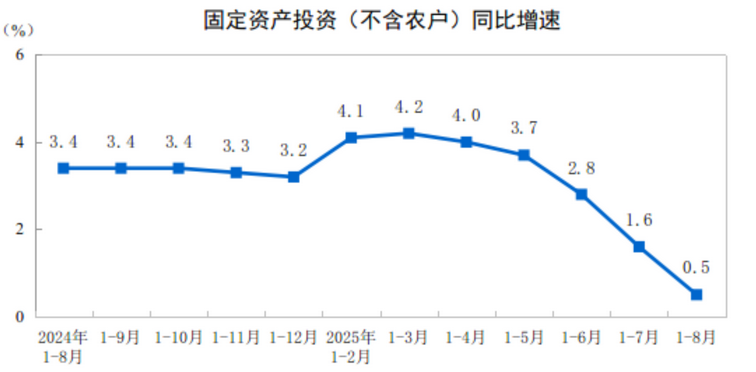
2025年1—8月份全国固定资产投资增长0.5%
Guo Jia Tong Ji Ju· 2025-09-15 02:00
Core Insights - The total fixed asset investment (excluding rural households) in China from January to August 2025 reached 32,611.1 billion yuan, showing a year-on-year growth of 0.5% on a comparable basis [1][5] - Private fixed asset investment experienced a decline of 2.3% year-on-year [1][5] Investment by Industry - Investment in the primary industry amounted to 646.1 billion yuan, with a year-on-year increase of 5.5% [3][6] - The secondary industry saw an investment of 11,824.6 billion yuan, growing by 7.6% year-on-year, with industrial investment specifically increasing by 7.7% [3][6] - The tertiary industry investment totaled 20,140.4 billion yuan, reflecting a year-on-year decrease of 3.4% [3][6] - Within the secondary industry, mining investment grew by 3.0%, manufacturing investment increased by 5.1%, and investment in electricity, heat, gas, and water production and supply surged by 18.8% [3][6] Investment by Region - Eastern region investment declined by 3.5% year-on-year, while the central region saw a growth of 2.5%, and the western region increased by 2.3%. The northeastern region experienced a decline of 6.0% [3] Investment by Registration Type - Domestic enterprises' fixed asset investment grew by 0.5%, while investment from Hong Kong, Macau, and Taiwan enterprises increased by 2.3%. In contrast, foreign enterprises' investment fell by 15.4% [4][6]
今日视点:固定资产投资增速触底回升有底气
Zheng Quan Ri Bao· 2025-09-07 22:47
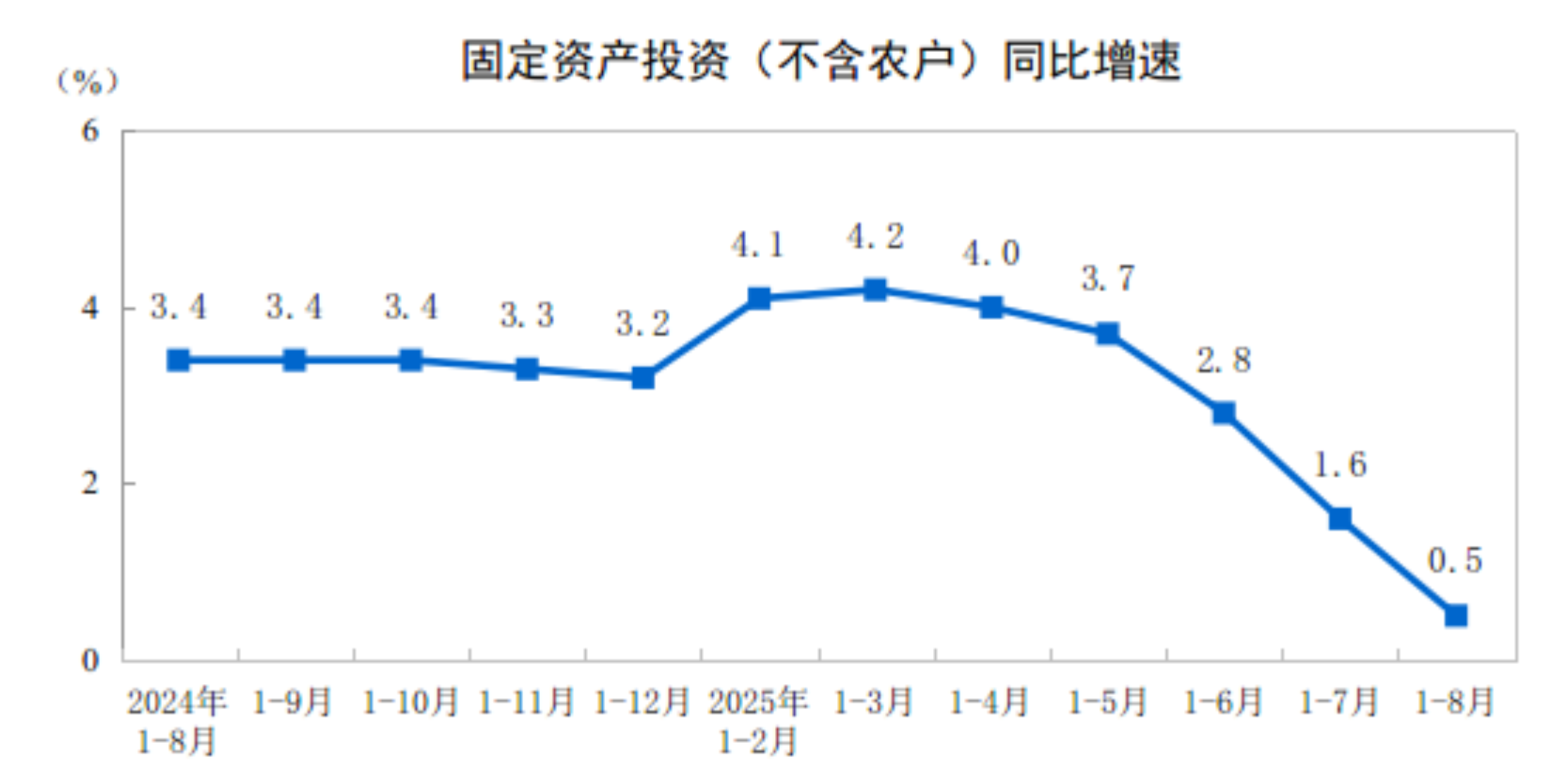
Group 1 - The core focus of the news is on the declining trend of fixed asset investment in China, which has dropped from a high of 4.2% in January to 1.6% in July, indicating a need for effective investment expansion strategies [1] - The "Artificial Intelligence +" initiative is expected to significantly boost investment in related industries, similar to the impact of the "Internet +" initiative a decade ago, with a notable increase in investment scale and long-term benefits for industrial transformation and consumption enhancement [2] - According to IDC, China's total investment in artificial intelligence is projected to exceed $100 billion by 2028, highlighting the potential growth in this sector [3] Group 2 - Equipment updates have shown a clear positive impact on stabilizing investment, with a 15.2% year-on-year increase in investment in equipment and tools from January to July, contributing 2.2 percentage points to overall investment growth [4] - Infrastructure investment is playing a crucial role in supporting economic stability, with a 3.2% year-on-year growth from January to July, contributing 43.0% to total investment growth, which is higher than the overall investment growth rate [5] - Major infrastructure projects, such as the Yarlung Tsangpo River hydropower project and new railway lines, are expected to further stimulate investment in related industries, indicating a cautious but optimistic outlook for fixed asset investment growth in the near future [5]
固定资产投资增速触底回升有底气
Zheng Quan Ri Bao· 2025-09-07 16:16
Group 1 - Fixed asset investment in China has been declining since April, with a drop from a high of 4.2% in January to 1.6% in July, indicating a need for effective investment expansion [1] - The "Artificial Intelligence +" initiative is expected to significantly boost investment in related industries, similar to the impact of the "Internet +" initiative a decade ago [1][2] - IDC predicts that China's total investment in artificial intelligence could exceed $100 billion by 2028 [3] Group 2 - Equipment updates have shown a notable impact on stabilizing investment, with a 15.2% year-on-year increase in equipment purchases from January to July, contributing 2.2 percentage points to overall investment growth [4] - The government has increased special long-term bonds for equipment updates from 150 billion to 200 billion yuan, with additional financial incentives for eligible loans [4] - Infrastructure investment has a crucial role in economic stability, with a 3.2% year-on-year growth from January to July, contributing 43% to overall investment growth [5] - Major infrastructure projects, such as the Yarlung Tsangpo River hydropower project and new railway lines, are expected to further drive investment in related industries [5]
北京经开区“十四五”GDP年均增长9.6%
Bei Jing Shang Bao· 2025-09-04 09:24
Core Insights - Since the beginning of the 14th Five-Year Plan, Beijing Economic-Technological Development Area (BDA) has achieved an average annual GDP growth rate of 9.6%, surpassing 360 billion yuan, with a remarkable growth rate of 12.3% in the first half of this year, ranking first among national-level economic development zones in terms of growth rate and contributing over 15% to the city's economic growth [1][1][1] Economic Performance - The industrial sector in BDA has shown significant performance, with total industrial output exceeding 600 billion yuan, accounting for 25.8% of the city's total; the area, which occupies only 1.37% of Beijing's land, contributes nearly 40% of the city's industrial added value [1][1] - In the first half of this year, industrial growth in BDA reached 15.6%, with leading industries such as high-end automobiles, integrated circuits, and electronic information all experiencing growth rates exceeding 20% [1][1] Structural Optimization - The industrial structure in BDA is continuously optimizing, with the ratio of secondary to tertiary industries adjusting from 65:35 in 2020 to 59:41 in 2024, indicating a 6 percentage point increase in the service sector's share [1][1] - In the first half of this year, revenue from the information service industry grew by 23.8%, retail and wholesale sales increased by 25.4%, and net income from the financial sector saw a growth of 31.4% [1][1] Investment and Innovation - Fixed asset investment in the region has grown at an average annual rate of over 28%, maintaining a scale of over 100 billion yuan for three consecutive years, with both total industrial investment and growth rate ranking first in the city [1][1] - Corporate R&D investment has increased by an average of 18.8% annually, with total R&D investment consistently ranking second in the city, reflecting strong innovation vitality and growth potential [1][1]
贵阳1-7月固定资产投资同比增长3.4%
Sou Hu Cai Jing· 2025-09-04 06:38
Group 1 - The core viewpoint of the article indicates that from January to July, the fixed asset investment in Guiyang has shown a slight recovery, with a year-on-year growth of 3.4% [1] Group 2 - By industry, the first industry investment decreased by 58.8%, while the second industry investment increased by 5.4%, and the third industry investment grew by 3.8% [1] Group 3 - In terms of specific fields, industrial investment increased by 5.5%, infrastructure investment decreased by 0.3%, and private investment grew by 3.5% [1]
宏观经济数据前瞻:2025年8月宏观经济指标预期一览
Guoxin Securities· 2025-09-02 05:25
Economic Indicators - August 2025 domestic CPI is expected to be approximately 0.1% month-on-month, with a year-on-year decline to -0.3%[3] - July 2025 PPI is projected to increase by about 0.4% month-on-month, with a significant year-on-year recovery to -2.5%[3] - Industrial added value is anticipated to rebound slightly to 6.0% year-on-year in August 2025[3] - Retail sales of consumer goods are expected to rise to 4.5% year-on-year in August 2025[3] Investment and Trade - Fixed asset investment is forecasted to continue declining, reaching a cumulative year-on-year growth of 1.3%[3] - Exports in dollar terms are projected to decrease to around 6.0% year-on-year[3] - Trade surplus for August 2025 is estimated at 992 million USD, up from 982 million USD in the previous period[4] Financial Metrics - Monthly increase in credit is expected to be 10,500 million CNY, a significant improvement from a decrease of 500 million CNY previously[4] - Total social financing is projected to increase by 26,000 million CNY for the month, compared to 11,320 million CNY previously[4] - M2 year-on-year growth rate is expected to remain stable at 8.8%[4]
南山总量稳居第一 深汕增速领先
Nan Fang Du Shi Bao· 2025-08-28 23:10
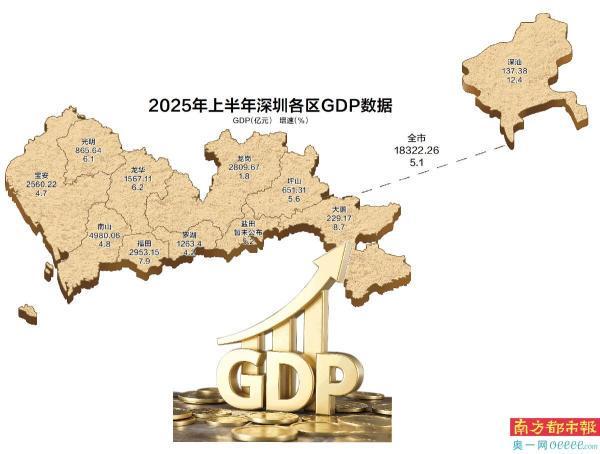
Economic Overview - Shenzhen's GDP for the first half of 2025 reached 18,322.26 billion yuan, with a year-on-year growth of 5.1% [3] - The economic performance of various districts showed stability, with some districts experiencing better growth in Q2 compared to Q1 [2][4] District Performance - The top three districts by GDP in the first half of 2025 are Nanshan District (4,980.06 billion yuan), Futian District (2,953.15 billion yuan), and Longgang District (2,809.67 billion yuan) [3] - Seven districts outperformed the city-wide GDP growth rate, with the highest growth in Shenshan Special Cooperation Zone (12.4%), Dapeng New District (8.7%), and Futian District (7.9%) [3] Industrial Growth - The industrial added value above designated size in Shenzhen grew by 4.3% year-on-year, slightly above the provincial average of 4.0% [5] - The Shenshan Special Cooperation Zone saw a significant industrial growth of 22.0%, driven mainly by the automotive manufacturing sector [5] - Nanshan District's industrial added value increased by 6.5%, reflecting a strong performance in high-tech industries [5] Consumption Trends - The total retail sales of social consumer goods in Shenzhen reached 4,948.68 billion yuan, with a year-on-year growth of 3.5% [7] - Nanshan District led in retail sales growth at 13.1%, while Bao'an District recorded a growth of 7.2% [7] - Various districts are actively promoting consumption through initiatives like issuing consumption vouchers and hosting events [7][8] Investment Insights - Fixed asset investment in Shenzhen decreased by 10.9% year-on-year, with real estate development investment down by 15.1% [8] - Five districts achieved positive growth in fixed asset investment, with Nanshan District leading at 6.5% [8] - Industrial technological transformation investment saw a remarkable increase of 47.1%, indicating a focus on industrial upgrading [8][9]
招商证券:基建正增速略收窄 关注财政发力与重大工程建设提速进展
Zhi Tong Cai Jing· 2025-08-28 07:05
Group 1 - The new regulations for existing PPP projects are expected to accelerate construction progress and alleviate operational debts for construction companies [1] - The cumulative growth rate of funds in place for fixed asset investment from January to July is 1.0%, showing improvement compared to previous months [1] - The growth rate of budgetary funds increased by 9.4% in the same period, indicating a positive trend in fiscal revenue [1] Group 2 - New signed orders in the construction industry are under pressure, with a year-on-year decrease of 1.6% in the first half of 2025 [2] - The cumulative investment in projects that have commenced construction from January to July reached 24.2 trillion yuan, with a growth rate of 8.8% [2] Group 3 - The physical workload in key sectors such as energy, transportation, and water conservancy is showing marginal weakness, with production declines in cement, steel, glass, and asphalt [3] - The price of steel increased by 2.1% month-on-month, while cement and asphalt prices decreased [3] Group 4 - The growth rate of broad infrastructure investment from January to July is 7.3%, slightly slowing down compared to previous months [4] - Fixed asset investment completion reached 28.8 trillion yuan, with a year-on-year increase of 1.6% [4] - Specific sectors like electricity and water supply are seeing significant investment growth, while transportation and water management are maintaining lower growth rates [4] Group 5 - The report suggests focusing on state-owned enterprises with strong fundamentals and low valuations under a more proactive fiscal policy [5] - It highlights three paths for industry maturation: competition among existing players, regional investment opportunities, and the development of new productive forces [5] - Recommended companies for investment include China State Construction, China Railway, and China Communications Construction [5]

25年1-7月建筑行业数据深度解读:基建正增速略收窄,关注财政发力与重大工程建设提速进展
CMS· 2025-08-27 13:32
Investment Rating - The report maintains a "Recommended" investment rating for the construction industry [1] Core Insights - The construction industry is experiencing a slight slowdown in growth, but remains resilient, with a focus on fiscal stimulus and the acceleration of major engineering projects [1] - The actual funding for fixed asset investment from January to July 2025 has shown a cumulative growth of +1.0%, with budgetary funds increasing by +9.4% [1][11] - New signed orders in the construction sector have faced pressure, with a year-on-year decline of -1.6% in the first half of 2025, while the investment in ongoing projects has maintained positive year-on-year growth [1][11] Summary by Sections Funding Availability - From January to July 2025, the cumulative growth rate of actual funding for fixed asset investment is +1.0%, compared to -1.8 percentage points in June 2025 and +3.3 percentage points for the entire year of 2024 [11] - The growth rate of national budgetary funds is +9.4%, which is an improvement from -5.4 percentage points in June 2025 [25] - The total fixed asset investment completed from January to July 2025 reached 28.8 trillion yuan, with a year-on-year growth of +1.6% [11][19] New Orders and Project Commencement - The construction industry has seen a year-on-year decline of -1.6% in new signed orders for the first half of 2025, while the investment in ongoing projects has shown a cumulative investment amount of 24.2 trillion yuan with a growth rate of +8.8% [1][11] - The construction PMI for July 2025 is reported at 52.7, indicating a rebound from the previous month [11] Work Volume - The physical work volume in the construction sector has shown a decline in the production of various building materials, with cement, steel, and glass production decreasing by -6.4%, -4.2%, and -2.8% respectively in July 2025 [1][11] - The broad infrastructure investment growth rate is recorded at +7.3% from January to July 2025, although this represents a slight slowdown compared to previous months [11][19] Investment Recommendations - The report suggests focusing on state-owned enterprises with strong fundamentals and low valuations, particularly in the context of more proactive fiscal policies [1] - It highlights three pathways for the industry to overcome bottlenecks as it matures: focusing on competitive advantages, addressing incremental demand, and developing new productive forces [1]