
货币政策宽松

Search documents
特朗普解读鲍威尔“好消息”:这意味着他将开始降息
Jin Shi Shu Ju· 2025-07-25 15:11
Group 1 - President Trump expressed confidence that the Federal Reserve is preparing to lower interest rates following a positive meeting with Chairman Powell [1][2] - Trump believes the Fed is ready to provide the monetary policy easing he has sought for months, indicating a strong economy can handle higher rates while waiting for data on the impact of tariffs [2][3] - White House Budget Director Russell Vought has been pressuring the Fed for a review and to lower rates, viewing it as a way to support the economy, particularly the real estate market [2][3] Group 2 - The tone of the meeting between Trump and Powell was more conciliatory compared to previous months, with both sides viewing the discussion positively [2][3] - Despite the positive meeting, the futures market does not expect the Fed to lower rates in the upcoming meeting, with potential action not anticipated until September [3]
印度央行行长:进一步宽松的门槛比之前更高,立场已转向中性,中性立场不意味着宽松政策方向逆转。
news flash· 2025-07-25 05:39
Core Viewpoint - The Governor of the Reserve Bank of India (RBI) indicates that the threshold for further monetary easing has become higher than before, and the stance has shifted to neutral, which does not imply a reversal in the direction of easing policies [1] Group 1 - The RBI's current neutral stance suggests a cautious approach towards monetary policy adjustments [1] - The statement emphasizes that a neutral position does not necessarily mean a tightening of monetary policy [1] - The central bank is likely to maintain a careful balance in its future policy decisions, reflecting changing economic conditions [1]
澳洲联储主席布洛克:应“审慎、渐进”地降息
智通财经网· 2025-07-24 06:31
Group 1 - The Reserve Bank of Australia (RBA) is adopting a "cautious and gradual" approach to monetary policy easing, as stated by RBA Governor Michele Bullock [1] - Despite a surprising rise in the unemployment rate to 4.3%, other indicators such as job vacancy rates remain stable, suggesting a balanced labor market [1][2] - Financial markets are betting on two more rate cuts this year, with the probability of a third cut dropping from 76% to 40% [2] Group 2 - The RBA has already cut rates twice in the current cycle, bringing the cash rate down to 3.85% [2] - Bullock indicated that the core inflation rate for the second quarter may not reach the RBA's forecast of 2.6% [3] - The expectation is that inflation will gradually decline to 2.5%, but the RBA is awaiting data to support this prediction [4]
澳洲联储主席布洛克:货币政策宽松采取审慎、渐进的方式是合适的。
news flash· 2025-07-24 03:10
Core Viewpoint - The Reserve Bank of Australia (RBA) Governor Lowe stated that a cautious and gradual approach to monetary policy easing is appropriate [1] Group 1 - The RBA is focusing on a careful and measured strategy for implementing monetary policy changes [1]
阿塞拜疆央行将再融资利率下调25个基点至7%
news flash· 2025-07-23 07:36
在7月货币政策会议上,阿塞拜疆央行将再融资利率下调25个基点至7%,为2021年底以来最低水平,标 志着自去年暂停以来首次重启宽松周期。 ...
MUFG:预计欧洲央行本周将暂停降息 今年或仅剩25基点宽松空间
Zhi Tong Cai Jing· 2025-07-23 04:34
Group 1 - MUFG expects the European Central Bank (ECB) to pause interest rate cuts this week, maintaining the deposit facility rate at 2%, which is the midpoint of its defined neutral range of 1.75%-2.25% for the year [1] - Inflation has stabilized at the ECB's target of 2%, and while oil prices are slightly higher than previous forecasts, a strong euro offsets this effect, supporting the view that policy is in a good position [1] - Officials are satisfied with current market pricing, which anticipates a further rate cut of about 25 basis points this year, and will continue to use a data-dependent approach without pre-setting a path to maintain maximum flexibility [1] Group 2 - MUFG believes there is still room for further modest rate cuts regardless of the outcome of trade negotiations, with key data releases expected before the next meeting in September, including Q2 GDP and unit labor costs [2] - If inflation data for July and August falls below expectations, it will be more challenging for decision-makers to argue that disinflation is solely due to energy and exchange rate factors [2] - The upcoming large-scale fiscal stimulus in Germany and the tightening trend in France's 2026 budget will create a divergence in fiscal policy within the region, impacting the space and pace of monetary policy [2]
政策宽松,资金价格低位,债市机会仍存
LIANCHU SECURITIES· 2025-07-18 12:22
Group 1: Report's Investment Rating - No information provided on the industry investment rating Group 2: Core Views - The bond market yield has been oscillating at a high level and has declined. In 2025, the yields of treasury bonds and policy bank bonds at all tenors have shown a trend of high - level oscillation. The short - end interest rate has risen significantly, while the long - end interest rate has risen slightly, and the spread between the long - end and short - end has narrowed. The prices of treasury bond futures have corrected from high levels [3]. - Affected by multiple factors, the bond market yield has oscillated. In Q1 2025, the central bank tightened the money market in the short term, causing the yields of bonds at all tenors to rise and the prices of treasury bond futures to correct from high levels. Since Q2, due to Trump's tariff policies, the demand for bond - type assets as a hedge has increased, leading to a decline in bond yields and an increase in treasury bond futures prices. The monetary policy remains loose, the capital price has declined, and the bond yield is at a relatively low level [3]. - Looking forward, the bond yield may mainly show an oscillating pattern in the short term and remain in a downward trend in the long term. The macro - economic fundamentals are being repaired, but the repair progress of investment, prices, and profits is still slow. The monetary policy remains loose, the money supply growth rate is expected to increase, and there is still a possibility of reserve requirement ratio cuts and interest rate cuts in the second half of the year. The capital price is at a relatively low level. Overall, the bond yield is expected to remain in a downward trend [7]. Group 3: Summary by Directory 1. Bond Market Review: After Tariff Disturbances, Yields Oscillate at Low Levels - **1.1 Bond Yields: Overall in a Downward Trend with Short - Term Oscillations** - After the tariff disturbances, the bond market has mainly oscillated. The 10 - year treasury bond yield has mostly been between 1.6% and 1.7%, and was mostly below 1.65% in June. From the perspective of the term structure, the short - end interest rate has shown a downward trend, the long - end interest rate has oscillated, and the term spread is generally at a low level and has recently increased slightly [12]. - The closing prices of treasury bond futures at different tenors have oscillated at high levels. The prices of 2 - year, 5 - year, and 10 - year treasury bond futures have all shown a downward trend, with the 10 - year showing a steeper slope [3]. - **1.2 Attribution of Bond Market Fluctuations: Liquidity Tightening Pushes Up Yields, Tariff Disturbances Pull Down Yields** - In Q1, the bond yield showed a low - level oscillation and an upward trend, mainly related to the central bank's monetary policy operations. In January, the bond yield was at a relatively low level due to the moderately loose monetary policy. From February to March, the bond yield rose because of the central bank's short - term tight monetary policy [16]. - In Q2, the bond yield decreased rapidly and remained at a low level, related to Trump's tariff shock and the central bank's moderately loose monetary policy. In April, Trump's tariff policy increased the demand for hedging assets such as bonds, pulling down the bond yield. Since mid - April, the bond market has continued to oscillate at a low level, mainly due to the continued loose monetary policy, slow repair of the economic fundamentals, and low capital prices [17]. - **1.3 Bond Market Participants: Institutions Overall Increase Holdings of Interest - Rate Bonds, and Holdings of Credit Bonds Decline** - Financial institutions have overall increased their holdings of interest - rate bonds. Commercial banks, credit unions, insurance companies, securities companies, and overseas institutions have all increased their holdings of interest - rate bonds. For example, in May 2025, commercial banks' holdings of interest - rate bonds reached 73.2 trillion yuan, an increase of 3.5 trillion yuan compared to the end of 2024 [18]. - Financial institutions' holdings of inter - bank credit bonds have declined. Commercial banks, credit unions, insurance companies, securities companies, and overseas institutions have all reduced their holdings of credit bonds. For example, in May 2025, commercial banks' holdings of credit bonds were 2.586 trillion yuan, a decrease of about 180 billion yuan compared to the end of 2024 [21]. 2. Policy Front: Monetary Policy Remains Moderately Loose, and Structural Policies Continue to Exert Force - **2.1 Monetary Policy Tone: Moderately Loose and Precise and Effective** - The monetary policy tone has been adjusted from prudent to moderately loose. In December 2024, the Central Political Bureau Meeting and the Central Economic Work Conference proposed to implement a moderately loose monetary policy. In 2025, relevant policies have continued to emphasize this tone [33]. - In May 2025, the central bank introduced a structural monetary policy, including reducing the reserve requirement ratio by 0.5 percentage points, providing about 1 trillion yuan of long - term liquidity to the market; adjusting policy interest rates; and implementing a series of measures in terms of quantity, price, and structure to support the real economy [34]. - **2.2 Money Supply: The Growth Rates of M1 and M2 Continue to Increase, and the Financing Demand of the Real Economy Improves** - The M1 growth rate has continued to improve, and the gap between M2 and M1 has decreased. The M2 year - on - year growth rate has been on the rise. The M1 year - on - year growth rate has increased significantly, indicating the continuous repair of the real economy. The decrease in the gap between M2 and M1 indicates the continuous improvement of currency activation [37]. - The social financing increment has improved, and the decline in the difference between M2 and the year - on - year growth rate of social financing stock has narrowed. The year - on - year growth rate of social financing stock has been on the rise, indicating the continuous improvement of the financing demand of the real economy. From the perspective of important sub - items of social financing, RMB loans have increased year - on - year, and government bond financing has continuously supported the performance of social financing [40][45]. - **2.3 Money Price: The Central Bank Cuts Reserve Requirement Ratios and Interest Rates, and Market Liquidity is Abundant** - Policy interest rates are in a downward trend, and the reserve requirement ratio has been cut. The 7 - day reverse repurchase rate, MLF rate, and LPR rate have all been lowered, and the reserve requirement ratios of large, medium, and small financial institutions have been cut [68]. - **2.4 RMB Exchange Rate: Slightly Appreciated, and Expected to Remain Stable in the Future** - The RMB exchange rate against the US dollar has slightly appreciated but remained stable overall. The Sino - US treasury bond yield spread is at a low level. After the tariff disturbances, the RMB may appreciate slightly, but the exchange rate is expected to remain stable overall [72]. 3. Fundamental Aspects: The Growth Rates of Total Consumption and Exports are Fast, while Investment, Prices, and Profits are Under Pressure - **3.1 Aggregate: GDP Growth Rate is Higher than the Target, Highlighting Growth Resilience** - In 2024, China's GDP achieved a growth rate of 5%. In 2025, the annual growth target is still about 5%. In Q1, the GDP growth rate reached 5.4%, and in Q2, it reached 5.2%. The cumulative growth rate in the first half of the year was 5.3%, and it is expected that the annual growth target will be easily achieved [78]. - **3.2 Production: The Repair Progress is Moderately Fast, but Manufacturing Expectations are Weak** - The growth rate of industrial added value above a designated size has been relatively stable. The PMI has increased marginally but remained below the boom - bust line, indicating that the manufacturing production repair sentiment needs to be improved [81]. - From the perspective of high - frequency data, the year - on - year growth rate of the daily coal consumption of key power plants has been moderately fast. The blast furnace operating rate has been at a low level, indicating that the repair progress of the steel industry and related industries is slow. The operating rates of automobile semi - steel tires and full - steel tires have shown different repair progress, and the operating rates of PTA, PX, UPR, polyester staple fibers, and Jiangsu and Zhejiang looms have shown different trends, indicating that the chemical and textile industries' repair progress is moderate [83][85][89][95]. - **3.3 Investment: The Growth Rate Declines Marginally, and Real Estate Investment Growth Rate Continues to be Negative** - The overall repair progress of investment is slow. The cumulative growth rate of fixed - asset investment from January to June 2025 was 2.8%, a decrease of 0.9 percentage points compared to the previous value. Manufacturing investment has a relatively fast growth rate but is declining marginally. Infrastructure investment growth has decreased. Real estate development investment has continued to be negative, dragging down the investment growth rate [98]. - High - frequency indicators related to real estate investment, such as land transaction area, land premium rate, commercial housing transaction area, second - hand housing listing volume, and second - hand housing listing price index, are all at low levels, indicating that the real estate market may still be in the stage of stopping the decline [103]. - **3.4 Consumption: The Repair Progress is Moderate, and the Growth Rates of Different Industries Show Differentiation** - The overall repair progress of consumption has accelerated. The cumulative growth rate of social retail sales from January to June 2025 was 5%. From the perspective of sub - items of social retail sales, the growth rates of different types of commodity consumption vary greatly. For example, the cumulative year - on - year growth rate of automobile consumption has improved, while the growth rate of petroleum and its products has been in a downward trend [123]. - **3.5 Trade: Exports are Less Affected by Tariffs, and Import Growth Rate is Slow** - From January to June, the cumulative year - on - year export growth rate was 5.9%, indicating that China's exports have been less affected by Trump's previous tariff policies. The import growth rate has improved marginally but remained in the negative growth range [136]. - The tariff disturbances are coming to an end, and the capital market is becoming more insensitive to tariffs. After rounds of Sino - US trade consultations, the tariffs on bilateral trade have been significantly reduced [141]. - **3.6 Prices: Consumer Prices Improve but Remain at a Low Level, and Producer Prices are Continuously in Negative Growth** - The CPI growth rate has improved marginally but remained at a low level. In June, the CPI year - on - year growth rate was 0.1%, turning positive from negative. Many food price indices are at low levels, indicating that the rebound of consumer prices is under pressure [143]. - The producer price index has continued to be negative. In June, the PPI year - on - year growth rate was - 3.6%, remaining in the negative growth range for 33 consecutive months. Many production - related price indices are in a downward trend, indicating that the repair of the production - end price index is under pressure [153]. - **3.7 Profits: Fall into Negative Growth, and the Growth Rate of Finished Goods Inventory Declines** - The growth rate of industrial enterprise profits has declined marginally and fallen into negative growth. The PPI year - on - year growth rate, which is highly related to price factors, has been continuously in negative growth, dragging down the performance of industrial enterprise profits [167]. - The cost and expenses per 100 yuan of operating income of industrial enterprises are at a high level, the asset - liability ratio has declined from a high level, and the year - on - year growth rate of finished goods inventory is at a low level [170]. 4. Capital Aspects: Prices have Fallen from High Levels, and Liquidity is Abundant - **4.1 Capital Price: At a Relatively Low Level, and Liquidity Continues to be Loose** - Capital prices are at a low level and in a downward trend. The 7 - day reverse repurchase rate, DR007, and R007 are all at relatively low levels, indicating that the capital market is abundant [176]. - **4.2 Deposit - Loan Difference: Reaching New Highs Continuously, and Deposit Growth Rate is Rebounding** - The deposit - loan difference of financial institutions has reached new highs continuously. The year - on - year deposit growth rate has rebounded, while the year - on - year loan growth rate has declined. The excess reserve ratio of financial institutions has declined marginally, indicating that the liquidity among financial institutions is abundant [178]. - **4.3 Inter - Bank Certificates of Deposit: Capital Prices are Low, and Certificate Yields are in a Downward Trend** - The yields of inter - bank certificates of deposit have rebounded recently but are in a long - term downward trend. The yields of AAA - rated 1 - year and 1 - month inter - bank certificates of deposit are in a downward trend. The spread between the 1 - month and 1 - year yields has been compressed and even inverted [181]. 5. Supply Aspects: Fiscal Policy is Exerting Force at a Moderate Pace, and Bond Net Financing is at a High Level - **5.1 Fiscal Policy Tone: More Active and Continuously Exerting Force** - The fiscal policy tone is more active. In December 2024, relevant meetings proposed to implement a more active fiscal policy. In 2025, the "Government Work Report" made clear arrangements for the deficit ratio, special treasury bonds, and local government special bonds. The cumulative new government debt scale in 2025 is 11.86 trillion yuan [185]. - **5.2 Fiscal Exertion: Large Space and Moderate Pace** - The general public budget expenditure progress is moderate, the issuance progress of treasury bonds is relatively fast, special treasury bonds have been issued, and there is still a large space for ultra - long - term special treasury bonds. The issuance progress of local government bonds is moderate. It is expected that the fiscal exertion progress will accelerate in the second half of the year, and the issuance progress of local government special bonds will speed up [6]. - **5.3 Bond Market Supply: Net Increase is Generally at a High Level, and the Rhythm is Stable** - In the first half of the year, the monthly net increase in bond issuance was at a high level in the same period, and interest - rate bonds were the main driving factor for the net increase in bonds. The weekly issuance rhythm of bonds is stable [6].
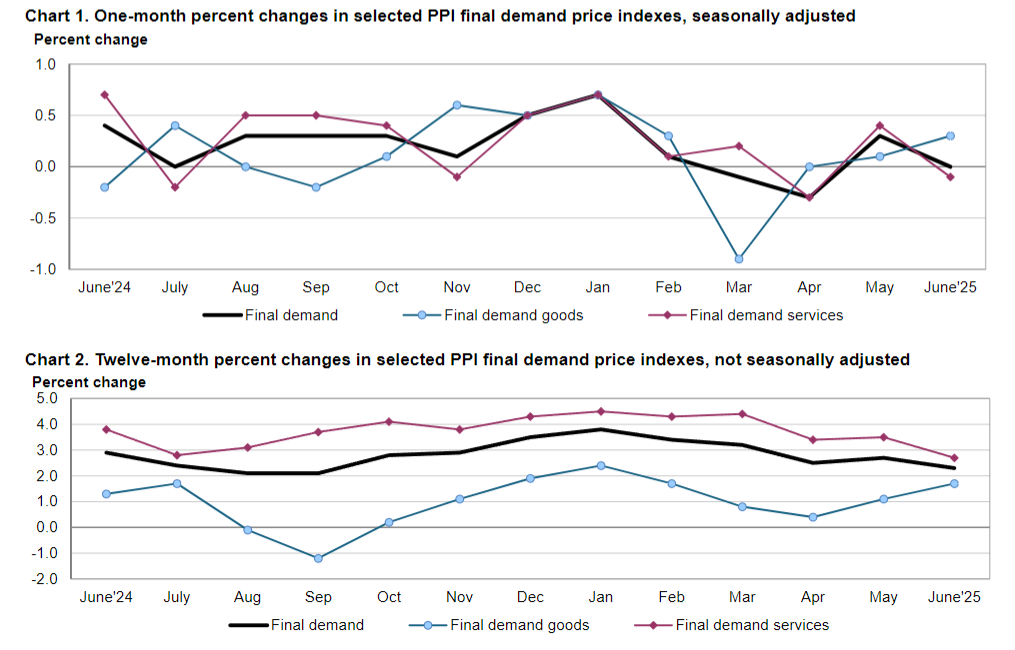
美国6月PPI报告揭晓:能源上涨、旅行住宿疲软
Xin Hua Cai Jing· 2025-07-16 13:36
Group 1: Inflation Trends - The Producer Price Index (PPI) for June 2025 recorded a year-on-year increase of 2.3%, marking the lowest level since September 2024, with market expectations at 2.5% [1] - The core PPI, excluding food, energy, and trade services, remained flat, with a 12-month cumulative increase of 2.5%, indicating low potential inflation stickiness [2] - The overall manageable producer price pressure suggests a likelihood of the Federal Reserve maintaining current interest rates or gradually lowering them [2] Group 2: Sector-Specific Insights - Energy prices saw a 0.6% increase in June, with gasoline prices rising by 1.8% and industrial electricity prices by 2.7%, indicating structural opportunities in the energy sector [3] - The demand for communication and related equipment prices increased by 0.8% in June, reflecting ongoing enterprise demand for 5G upgrades and data center construction [3] - Despite a 0.9% overall decline in transportation and warehousing services, freight forwarding prices rose by 8.0%, highlighting increased demand for logistics optimization amid global supply chain restructuring [3][4] Group 3: Consumer Services and Agricultural Products - Travel accommodation prices dropped by 4.1% in June, the largest monthly decline in six months, indicating short-term pressure on the tourism sector [5] - Egg prices plummeted by 21.8% in June, with a 12-month cumulative increase narrowing to 15.8%, primarily due to oversupply [9] - The price of unprocessed chicken decreased by 25.0%, suggesting potential short-term profitability pressures for poultry farming enterprises [9]

国泰海通:锡价中枢有望抬升 布局手握优质资源的企业
Zhi Tong Cai Jing· 2025-07-16 02:43
Group 1 - The core viewpoint is that with the decline in global tin ore grades and limited supply increments, coupled with rising costs, the tin price is expected to increase due to tight supply and high demand driven by AI development and a recovery in consumer electronics [1][2] - The report recommends specific stocks: Xiyes Co., Ltd. (000960.SZ), Xingye Silver Tin (000426.SZ), and mentions related stocks such as Huaxi Nonferrous (600301.SH) [1] Group 2 - Supply disturbances are ongoing, with limited incremental production from mines; the complete cost of tin mining is projected to rise from approximately $25,581 per ton in 2022 to $33,800 per ton by 2027 [2] - The global tin production is expected to reach 300,000 tons in 2025, reflecting a year-on-year increase of 2% [2] Group 3 - The downstream industry is experiencing high demand, particularly in soldering materials, which account for about 56% of tin consumption; the stabilization of the semiconductor cycle is expected to drive rapid demand for solder [3] - A projected supply gap of 8,300 tons in global refined tin by 2025 highlights the supply-demand imbalance [3] Group 4 - The global monetary environment is becoming more accommodative, with expectations of potential interest rate cuts by the Federal Reserve, which could positively impact asset prices and upstream raw material prices [4] - The inflation rate in the U.S. is gradually approaching the target of 2%, indicating a shift in market expectations for demand [4]



市场主流观点汇总-20250715
Guo Tou Qi Huo· 2025-07-15 10:59
Report Summary 1. Report Industry Investment Rating No relevant content provided. 2. Core View of the Report The report objectively reflects the research views of futures companies and securities companies on various commodity varieties, tracks hot varieties, analyzes market investment sentiment, and summarizes investment driving logics. It is based on the research reports publicly released by institutions in the current week, and processes and summarizes the long - short views and trading logics of each futures variety. The closing price data is from last Friday, and the weekly change is the change in the closing price of last Friday compared with the previous Friday [2]. 3. Summary by Directory 3.1 Market Data - **Commodities**: From July 7th to July 11th, 2025, the commodities with significant weekly increases include coke (6.04%), glass (5.85%), and iron ore (4.30%); while those with decreases include copper (-1.63%), corn (-2.00%), and methanol (-1.21%) [3]. - **A - shares**: The CSI 500 rose 1.96%, the SSE 50 rose 0.60%, and the CSI 300 rose 0.82% [3]. - **Overseas Stocks**: The French CAC40 rose 1.73%, the FTSE 100 rose 1.34%, while the Nasdaq Index fell -0.08%, the S&P 500 fell -0.31%, and the Nikkei 225 fell -0.61% [3]. - **Bonds**: The 2 - year Chinese Treasury bond rose 2.81%, the 5 - year rose 2.00%, and the 10 - year rose 1.08% [3]. - **Foreign Exchange**: The US Dollar Index rose 0.91%, while the US Dollar central parity rate fell -0.08%, and the Euro - US Dollar exchange rate fell -0.74% [3]. 3.2 Commodity Views Summary - **Macro - Financial Sector** - **Stock Index Futures**: Among 8 institutions' views, 4 are bullish, 0 are bearish, and 4 expect a sideways trend. The bullish logics include domestic "anti - involution" boosting market confidence, potential passive position - increasing after index breakthrough; bearish logics include weakened upward momentum at high levels and concerns about policy risks [4]. - **Treasury Bond Futures**: Among 8 institutions' views, 4 are bullish, 2 are bearish, and 2 expect a sideways trend. Bullish factors are the loose monetary policy and weak inflation environment; bearish factors are the recovery of risk appetite and short - term cooling of interest - rate cut expectations [4]. - **Energy Sector** - **Crude Oil**: Among 9 institutions' views, 2 are bullish, 2 are bearish, and 5 expect a sideways trend. Bullish logics are strong US diesel demand and a decline in active drilling rigs; bearish logics are potential impacts of US tariff policies on the global economy and high OPEC+ production in June [5]. - **Agricultural Sector** - **Live Pigs**: Among 7 institutions' views, 2 are bullish, 1 is bearish, and 4 expect a sideways trend. Bullish factors are low slaughter volume and policy regulation; bearish factors are stable sow inventory and weak demand due to hot weather [5]. - **Non - ferrous Metals Sector** - **Copper**: Among 7 institutions' views, 1 is bullish, 2 are bearish, and 4 expect a sideways trend. Bullish logics are tight mine supply and low LME inventory; bearish logics are expected US copper tariff hikes and weak demand in construction and other industries [6]. - **Chemical Sector** - **Soda Ash**: Among 7 institutions' views, 0 are bullish, 5 are bearish, and 2 expect a sideways trend. Bullish factors are the stabilization of the coal market and low short - term valuations; bearish factors are weakening basis, high production rates, and high inventory levels [6]. - **Precious Metals Sector** - **Gold**: Among 7 institutions' views, 6 are bullish, 1 is bearish, and 0 expect a sideways trend. Bullish logics are the expectation of Fed rate cuts and increased geopolitical uncertainties; bearish logics are low energy prices and potential delays in Fed policy shifts [7]. - **Black Metals Sector** - **Coking Coal**: Among 8 institutions' views, 3 are bullish, 0 are bearish, and 5 expect a sideways trend. Bullish factors are the first price increase by coke enterprises and high iron - water production; bearish factors are the resumption of coal mine production and weak construction demand [7].