
加息

Search documents
水费引爆东京通胀“炸弹” 日本央行加息获支撑 日元应声走高
智通财经网· 2025-10-31 02:19
Core Insights - Tokyo's inflation rate is accelerating, providing a basis for the Bank of Japan to continue gradual interest rate hikes and pushing the yen higher [1][2] - The core consumer price index (CPI) in Tokyo rose by 2.8% year-on-year in October, driven mainly by an increase in water fees, surpassing economists' median forecast of 2.6% [1][2] - The nationwide price increase in Japan has remained above the Bank of Japan's 2% target for three and a half years, but the central bank's governor believes there is still a gap to reach this target [1] Inflation and Economic Measures - The core inflation rate excluding fresh food and energy rose from 2.5% in September to 2.8% in October, with the overall inflation rate also recording a 2.8% increase [1] - Following the data release, the yen appreciated against the dollar, rising to 153.82 from approximately 154.17 [2] - Prime Minister Sanna Takashi plans to implement new economic measures to alleviate the impact of rising prices on consumers and businesses, including lowering gasoline taxes and providing additional subsidies to local governments [2] Industrial and Retail Performance - Japan's industrial output increased by 2.2% month-on-month in September, exceeding the consensus forecast of 1.5%, and grew by 3.4% year-on-year [3] - Retail sales in September grew by 0.3% month-on-month and 0.5% year-on-year, which is significantly lower than the inflation rate and below expectations [4] - The unemployment rate in Japan remained stable at 2.6%, with a job vacancy-to-applicant ratio of 1.20, indicating 120 job openings for every 100 job seekers [4] Monetary Policy Context - The Bank of Japan decided to maintain its benchmark interest rate, with market observers delaying expectations for the next rate hike, with about half of respondents believing December is the most likely time for the next increase [4] - Unlike the U.S., the Bank of Japan does not face significant public pressure regarding its policies, even with inflation exceeding targets [4]
突发利好!大涨!
中国基金报· 2025-10-31 02:08
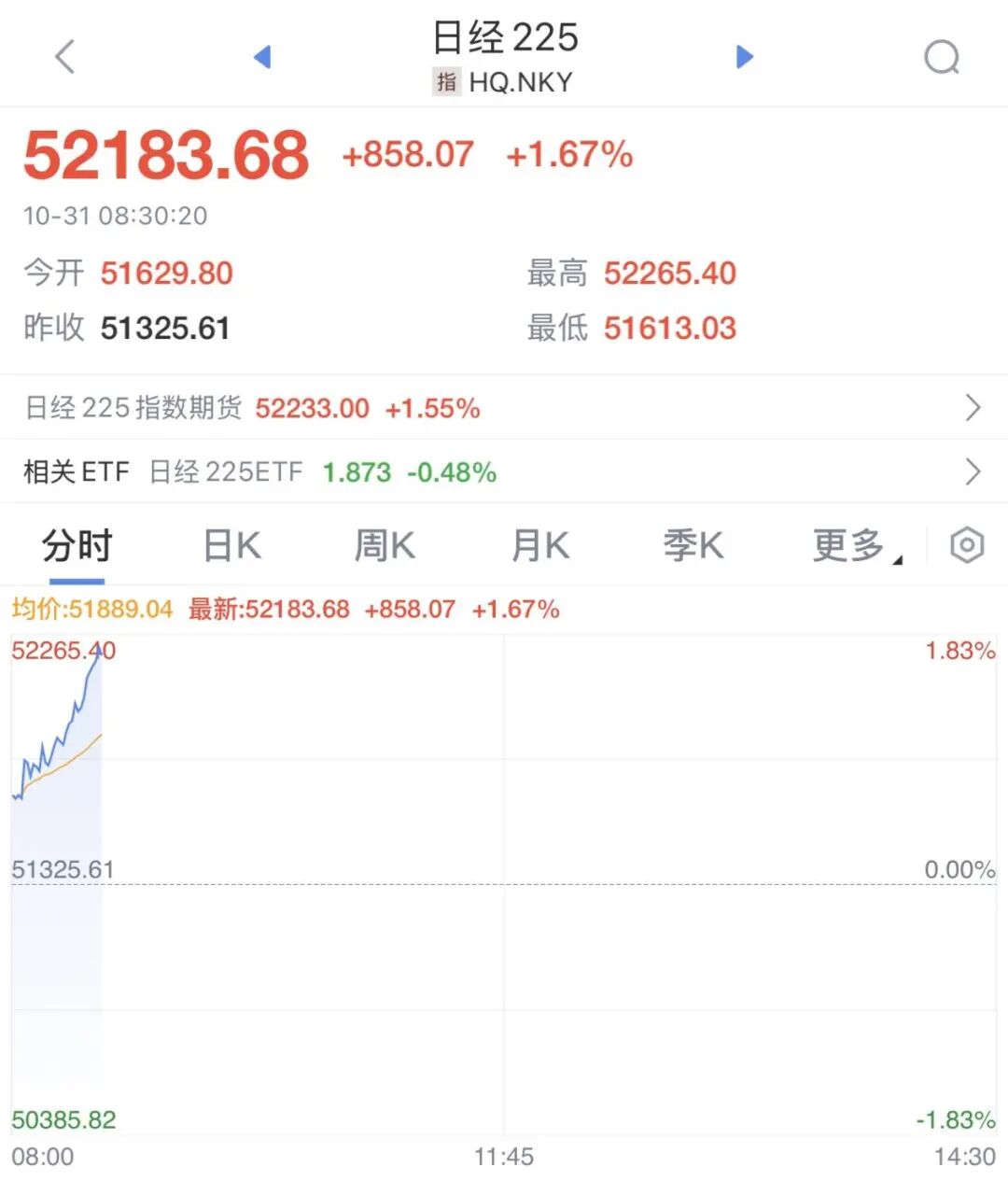
Market Overview - The Nikkei 225 index in Japan has surpassed 52,000 points for the first time, reaching a new high with an intraday increase of 1.67% [4][5] - The Tokyo Consumer Price Index (CPI) has accelerated, with the October year-on-year increase excluding fresh food rising from 2.5% in September to 2.8%, exceeding economists' expectations of 2.6% [7] - Japan's retail sales in September grew by 0.3% month-on-month and 0.5% year-on-year, both below forecasts [7] Company Performance - Hitachi's stock surged by over 10%, marking its largest increase since October 3, following the release of its mid-term report showing a 5.31% year-on-year increase in total revenue to 47,874.1 million yen and a 61.79% increase in net profit attributable to shareholders to 4,728.62 million yen [9][10] - Panasonic's stock fell by over 9% after the company downgraded its full-year profit forecast due to a weak outlook for its automotive battery business, impacted by U.S. tariffs and lower-than-expected sales [11][13] South Korean Market - The KOSPI index in South Korea opened lower but quickly rebounded, currently up by 0.36% [15][16] - South Korea's industrial output in September decreased by 1.2% month-on-month but increased by 11.6% year-on-year, surpassing expectations [16]


突发利好!大涨!
Zhong Guo Ji Jin Bao· 2025-10-31 01:45
Market Overview - The Nikkei 225 index in Japan has surpassed 52,000 points for the first time, with an intraday increase of 1.67% on October 31 [2] - The Tokyo Stock Exchange index also reached a new high, with a 1% increase [2] Economic Indicators - Tokyo's consumer prices accelerated, with the October year-on-year increase (excluding fresh food) rising from 2.5% in September to 2.8%, exceeding economists' median forecast of 2.6% [3] - Japan's retail sales in September grew by 0.3% month-on-month, below the forecast of 0.8%, and increased by 0.5% year-on-year, also below the expected 0.7% [4] - Industrial output in Japan for September rose by 2.2% month-on-month, surpassing the forecast of 1.5%, and increased by 3.4% year-on-year, exceeding the expected 1.8% [4] Company Performance - Hitachi's stock surged over 10%, marking its largest increase since October 3, following the release of its mid-term report showing a half-year revenue of 47,874.1 million yen, a year-on-year increase of 5.31%, and a net profit of 4,728.62 million yen, up 61.79% [5] - Panasonic's stock fell over 9% after it downgraded its full-year profit forecast, reporting a half-year revenue of 38,204.8 million yen, a year-on-year decrease of 10.13%, and a net profit of 1,424.04 million yen, down 24.62% [5] South Korean Market - The KOSPI index in South Korea opened lower but quickly rebounded, currently up by 0.36% [6][7] - South Korea's industrial output in September decreased by 1.2% month-on-month, contrary to the expected growth of 0.1%, while year-on-year growth was reported at 11.6%, exceeding the forecast of 5.8% [7]
超级央行周跌宕起伏 全球主要央行货币政策“分道扬镳”
2 1 Shi Ji Jing Ji Bao Dao· 2025-10-30 14:47
Group 1 - The core focus of the article is the divergence in monetary policy among major central banks, particularly the recent interest rate decisions by the Federal Reserve, Bank of Canada, European Central Bank, and Bank of Japan [1][8] - The Federal Reserve lowered interest rates by 25 basis points but indicated that further cuts are not guaranteed, reflecting a cautious approach to monetary policy [2][3] - The Bank of Canada also cut rates by 25 basis points, suggesting that its easing cycle may be nearing an end, while the European Central Bank and Bank of Japan maintained their current rates [1][8] Group 2 - The Federal Reserve's decision to end its balance sheet reduction indicates a shift towards a more neutral policy stance, with a focus on economic data for future decisions [2][3] - The article highlights the complexities faced by the Federal Reserve due to the government shutdown, which has delayed key economic data releases, complicating monetary policy decisions [5][6] - The Bank of Japan is expected to consider raising interest rates soon due to persistent inflation, marking a potential shift from its long-standing ultra-loose monetary policy [9][10] Group 3 - The article discusses the potential for the Federal Reserve to adopt a more flexible approach to monetary policy, moving away from traditional frameworks like the Taylor rule due to current economic uncertainties [7] - The European Central Bank is anticipated to maintain a more dovish stance compared to the Federal Reserve, influenced by weaker economic growth and lower inflation pressures in the Eurozone [8] - The article notes that the Japanese yen's future performance will depend on the Bank of Japan's overall policy signals, particularly regarding any potential interest rate hikes [10]
好消息来了
Xin Lang Cai Jing· 2025-10-30 13:59
Core Viewpoint - The Federal Reserve has lowered interest rates by 25 basis points, from a range of 4%-4.25% to 3.75%-4%, which was below market expectations of a 50 basis point cut [1][2][4]. Group 1: Federal Reserve Actions - The Fed's decision to stop balance sheet reduction is seen as a positive development, as it will enhance market liquidity [5][7]. - The cessation of balance sheet reduction means the Fed will no longer sell assets, preventing a contraction of market liquidity [7][8]. - The true easing of monetary policy is perceived to be more about halting balance sheet reduction rather than the interest rate cut itself [8]. Group 2: Market Reactions - Following the interest rate cut, the Nasdaq index experienced a decline, indicating market disappointment with the smaller-than-expected rate reduction [3][4]. - The market is expected to see increased capital outflows from the U.S., potentially benefiting assets in other countries [8]. Group 3: Company Insights - Nvidia has reached a market capitalization of over $5 trillion, becoming the first company to achieve this milestone, and is positioned to dominate the AI hardware market [10]. - The performance of various liquor companies has been disappointing, with Wuliangye facing significant challenges, suggesting a need for a recovery period similar to the real estate market [12]. Group 4: Investment Strategies - The Nasdaq index is currently at a high valuation, and historical patterns suggest a potential adjustment, with recommendations to start investing during a 15% pullback and to buy heavily during a 30% drop [13]. - The Shanghai Ningquan Asset Management Company has paused new investor subscriptions, a move typically aimed at protecting investors during high market valuations [14][15].

美联储降息后日本央行依旧按兵不动,但加息压力陡增
第一财经· 2025-10-30 09:38
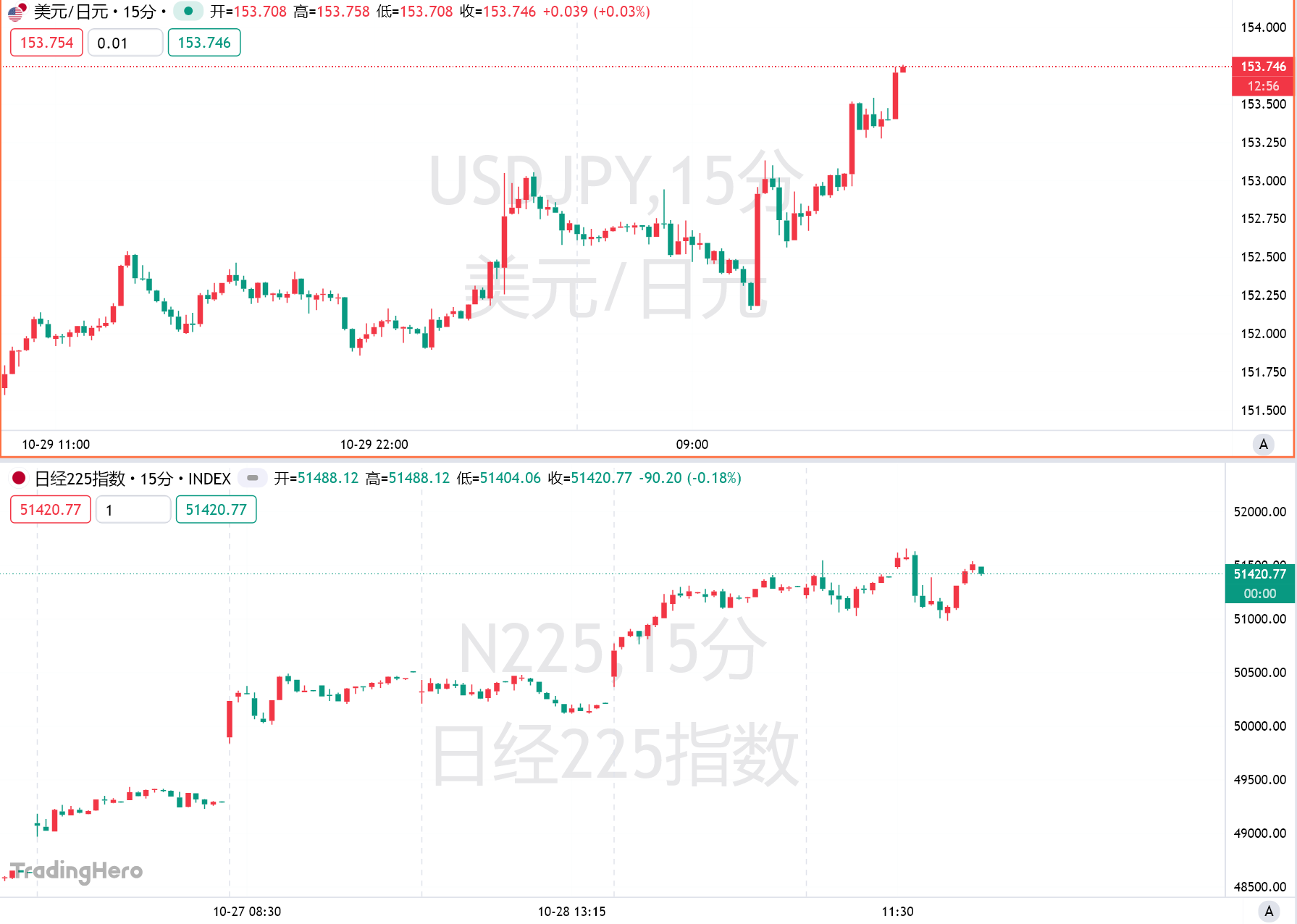
Core Viewpoint - The Bank of Japan (BOJ) maintained its benchmark interest rate at 0.5% for the sixth consecutive time, aligning with market expectations, despite increasing pressure for rate hikes due to a weakening yen and rising inflation concerns [3][7][10]. Economic and Inflation Forecasts - The BOJ revised its GDP growth forecast for the fiscal year 2025 from 0.6% to 0.7%, while maintaining forecasts for 2026 and 2027 at 0.7% and 1.0% respectively [7]. - The core Consumer Price Index (CPI) projections for the fiscal years 2025 to 2027 are set at 2.7%, 1.8%, and 2.0%, respectively, indicating a stable inflation outlook [7]. Internal and External Pressures for Rate Hikes - BOJ policymakers, including Hajime Takata and Naoki Tamura, expressed dissent against the decision to maintain the current rate, advocating for a 25 basis point increase to 0.75% [7][12]. - There is growing concern among BOJ members regarding the low real interest rates and the potential impact of exchange rate fluctuations on inflation and economic stability [7][12]. Market Reactions and Predictions - Following the BOJ's announcement, the USD/JPY exchange rate surged to 153.08, reflecting market reactions to the ongoing uncertainty and potential for future rate hikes [8]. - Analysts predict that the BOJ may raise interest rates again in December 2023 or January 2024, with expectations of increasing borrowing costs to 1% after a pause [12].

今年加息没戏?植田和男鸽派论调加剧日元崩跌
Jin Shi Shu Ju· 2025-10-30 09:03
Core Viewpoint - The Bank of Japan's decision to maintain the benchmark interest rate has led to a rise in the USD/JPY exchange rate, reaching its highest level since mid-February [1] Group 1: Monetary Policy and Economic Outlook - The market perceives that interest rate hikes may be delayed until after January next year, reflecting a dovish tone in the comments made by the Bank of Japan's Governor [3] - A Bloomberg survey indicated that 90% of economists expected the Bank of Japan to keep its policy unchanged, with only two dissenters in the recent meeting [3] - The Bank of Japan raised its economic growth forecast for the current fiscal year from 0.6% to 0.7%, while projecting that the consumer price index (CPI) may slow below 2% next year [5] Group 2: Currency and Market Reactions - The Japanese yen has depreciated over 3% against the US dollar this month, underperforming all G-10 currencies, amid expectations of continued accommodative monetary policy from the Japanese government [4] - Traders are pricing in nearly a 50% chance of a rate hike in December and about 80% for January next year [5] - The yen is viewed as undervalued, and the risk of a rate hike remains due to persistent domestic inflation [6] Group 3: Government Fiscal Policy - Japan's Economic Revitalization Minister is monitoring the impact of a weaker yen on the economy, while the Governor of the Bank of Japan has indicated a willingness to continue normalizing policy if confidence in economic outlook improves [6] - Recent comments from the Japanese Prime Minister suggest a shift towards a more responsible fiscal policy, which may provide some support for Japanese bonds [6] - Any large-scale fiscal stimulus could raise concerns about bond supply and steepen the yield curve, potentially undermining the current market sentiment [7]
日本央行维持基准利率不变 植田和男强调数据依赖与外部风险
Xin Hua Cai Jing· 2025-10-30 07:57
Core Viewpoint - The Bank of Japan (BOJ) maintained its benchmark interest rate at 0.5%, aligning with market expectations, while indicating that future rate hikes will depend on economic data rather than a predetermined schedule [1] Monetary Policy Decisions - The BOJ's decision was passed with a vote of 7 in favor and 2 against, with dissenting members advocating for a 25 basis point increase [1] - BOJ Governor Kazuo Ueda stated that the Japanese economy is experiencing a moderate recovery but still shows signs of weakness, particularly due to high uncertainty in overseas trade policies [1][2] External Pressures and Policy Independence - Ueda highlighted the potential impact of U.S. trade policies on the Japanese economy, noting that tariff costs could be passed on to consumers, affecting inflation and consumption [2] - Ueda reaffirmed that monetary policy is not influenced by political situations and emphasized the importance of close cooperation with the government [2] Inflation and Wage Dynamics - Japan's inflation has exceeded the BOJ's 2% target for 41 consecutive months, driven mainly by temporary factors affecting food prices [3] - The upcoming spring wage negotiations in 2025 will be crucial for assessing the sustainability of consumption and inflation, particularly in the automotive sector [3] Market Expectations and Future Rate Hikes - Despite maintaining the current interest rate, the BOJ reiterated its policy path, indicating potential rate increases if economic and price trends align with expectations [3][4] - Market analysts view the December meeting as a possible window for a rate hike, with expectations of gradual action from the BOJ in the coming year [3][4] Fiscal and Monetary Policy Coordination - New Prime Minister Hamada is seen as a supporter of "Abenomics," advocating for loose monetary policy and large-scale fiscal spending, while emphasizing the need for coordination between the BOJ and the government [4][5] - There is an inherent tension between fiscal expansion plans and the international demand for a stronger yen, with current exchange rates significantly lower than perceived fair value [5]
前日本央行行长黑田东彦:日美利差有望缩小 日元将升值至1美元兑120-130日元
Zhi Tong Cai Jing· 2025-10-30 06:49
Core Viewpoint - Former Bank of Japan Governor Haruhiko Kuroda suggests that the yen may appreciate to a level of 120-130 yen per dollar due to a narrowing interest rate differential between Japan and the U.S. [1] Group 1: Currency Outlook - Kuroda indicates that the current exchange rate of approximately 153 yen per dollar is too weak and expects it to revert to 120-130 yen [1] - He believes that the contrasting monetary policies of the Federal Reserve and the Bank of Japan will naturally reduce the interest rate differential, aiding the yen's appreciation [1] Group 2: Monetary Policy Context - The Bank of Japan's recent decision to maintain interest rates aligns with market expectations, passing with a 7-2 vote, while two members proposed a 25 basis point increase [1] - Market reaction to the decision was relatively muted, with little change in the 10-year Japanese government bond yields and a slight decline in the yen [1] Group 3: Economic Indicators - Kuroda notes that Japan has achieved its 2% inflation target, with an economic growth rate of approximately 1.5% and an unemployment rate of only 2.6% [2] - He suggests that current economic conditions are suitable for the Bank of Japan to consider further interest rate hikes [2] Group 4: Future Expectations - A majority of economists surveyed expect the Bank of Japan to raise interest rates in January next year, despite two members opposing the current decision [2] - Kuroda highlights that the Bank of Japan's recent decisions reflect a desire to observe the impact of U.S. tariffs on the Japanese economy, which has been less significant than previously anticipated [2]