
日美利差

Search documents
“高市日元贬值”碰壁,历史性情景渐远
日经中文网· 2026-02-15 08:06
Core Viewpoint - The Japanese yen is experiencing a depreciation trend but remains confined within the 150-160 yen per dollar range, contrary to market expectations for a breakthrough [2][4]. Group 1: Yen Depreciation Dynamics - The yen's depreciation momentum is gradually waning, influenced by Prime Minister Kishida's proactive fiscal policies, which initially led to speculative selling of the yen [2]. - Despite the yen approaching the historical depreciation threshold of 160 yen per dollar, it has not managed to break through the 150-160 yen range [2][4]. - The anticipated acceleration of yen depreciation post-election has not materialized, with the yen even appreciating to the 152 yen range due to weakening U.S. economic indicators [4]. Group 2: Factors Influencing Yen Value - The rapid depreciation of the yen from the 115 yen range in early 2022 to below 160 yen was driven by speculative selling from hedge funds, followed by actual demand-driven selling from businesses [6]. - Japan's trade and service account deficit significantly narrowed, with the deficit reported at approximately 4.24 trillion yen in 2025, down from about 21 trillion yen in 2022, indicating improved export profitability and competitiveness [6]. - The structural changes in demand have limited the impact of actual demand-driven yen selling on further depreciation, as the supply-demand distortion has been largely corrected [6][8]. Group 3: Future Outlook - Without new market factors to drive yen depreciation or U.S. dollar appreciation, a breakthrough beyond the 160 yen threshold seems unlikely [8]. - The market's focus is shifting towards the monetary policy directions of the U.S. and Japan, particularly regarding potential changes in the Federal Reserve's stance and the Bank of Japan's interest rate policies [8].


日元贬值的主因在于美国AI股上涨?
日经中文网· 2026-02-06 07:32
Core Viewpoint - The main factors influencing the fluctuation of the Japanese yen exchange rate have changed over time, with current pressures stemming from the rising stock risk premium in the U.S. and the ongoing AI boom, which complicates the traditional relationship between U.S.-Japan interest rate differentials and yen valuation [2][6]. Group 1: Yen Exchange Rate Dynamics - The yen depreciated to the 157 yen per dollar range on February 5, marking the lowest point since the U.S. financial sector initiated "exchange rate checks" on January 23 [4]. - The U.S.-Japan two-year government bond yield spread has narrowed significantly from a year ago, currently ranging between 2.25% and 2.29%, down from 3.4% [4]. - The traditional logic that a narrowing U.S.-Japan interest rate differential would strengthen the yen has failed, as external factors, particularly the rise of AI stocks in the U.S., are driving the yen's depreciation [4][6]. Group 2: Components Influencing Yen Valuation - The factors affecting the yen's exchange rate can be broken down into five components: monetary supply in the financial system, the U.S.-Japan reserve differential, future monetary policy differences, capital flows, and the U.S. stock risk premium [4]. - The U.S. stock risk premium, which reflects the excess return investors require from stocks over safer assets like bonds, has been a significant driver of yen depreciation [6]. Group 3: Investor Behavior and Trends - Japanese investors are increasingly enthusiastic about overseas stock investment trusts, with net inflows exceeding 2 trillion yen in January, marking the highest record since the new NISA tax-exempt investment scheme began [7]. - The trend of "household selling yen" is expected to continue, with predictions indicating that the actual interest rates on yen will remain low, leading to potential losses for those holding yen [9]. Group 4: Future Projections - The digital trade deficit, particularly from payments for IT services to U.S. companies, is projected to expand significantly, with estimates suggesting it could exceed 6 trillion yen by late 2025 and reach 18 trillion yen by 2035 [9]. - Analysts predict that even if domestic factors contributing to yen depreciation are resolved, the path to yen appreciation remains long, with expectations that the yen will not strengthen to 150 yen per dollar by 2026 [9].
日美利差博弈凸显走强动能
Jin Tou Wang· 2026-02-05 02:50
Core Viewpoint - The USD/JPY exchange rate is experiencing a downward trend, with the yen strengthening due to rising expectations of interest rate hikes by the Bank of Japan, while the market is still assessing the impact of U.S. economic data on Federal Reserve policies [1][2]. Group 1: Exchange Rate Dynamics - The USD/JPY pair has declined nearly 0.5% to 153.66, marking the lowest level since December 18, indicating a continuation of the recent pullback trend [1]. - The market is currently in a tug-of-war between the U.S. and Japan interest rate differentials and policy expectations, lacking a clear directional trend [1]. Group 2: Interest Rate Expectations - The core support for the yen's strength is based on the rising expectations for interest rate hikes by the Bank of Japan, with nominal wages in Japan increasing by 4.8% year-on-year in December, the largest increase since 1997 [1]. - The market has priced in a probability of another rate hike in July, with Nomura forecasting that the Bank of Japan may gradually raise rates to 1.5% by 2027 [1]. Group 3: Market Sentiment and Technical Analysis - The technical outlook for the exchange rate shows a weak oscillating pattern, with resistance at the Fibonacci retracement level of 158.19 and support at the recent low of 152.12, indicating potential for a clearer trend direction upon breakout [1]. - The MACD and RSI indicators are neutral, suggesting limited momentum, with the market awaiting key signals for a breakout [1]. Group 4: Key Economic Indicators - Attention is focused on the U.S. initial jobless claims data, which will influence Federal Reserve rate cut expectations and the dollar's performance, indirectly affecting the exchange rate [2]. - The Bank of Japan's statements and fluctuations in the Japanese stock market will also be monitored for their impact on capital flows and the yen's trajectory [2].
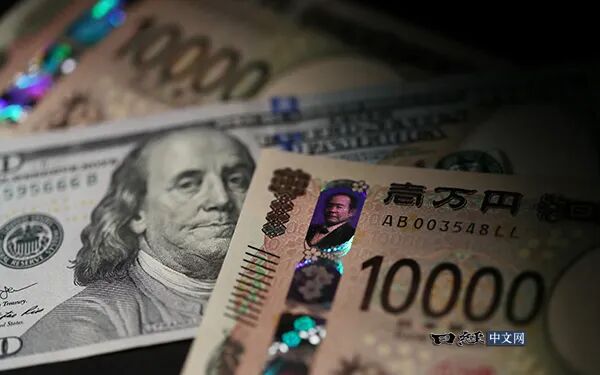
日美长期利差持续缩小,日元买盘仍未出现
3 6 Ke· 2026-01-08 23:27
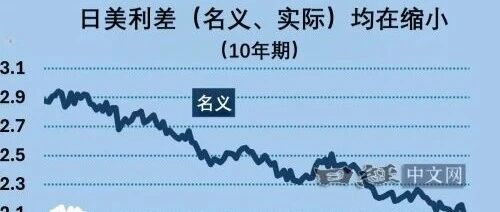
Core Viewpoint - The relationship between the Japanese yen exchange rate and the Japan-U.S. interest rate differential has significantly changed over the past six months, shifting from "interest rate changes driving exchange rate changes" to "yen depreciation leading to rising interest rates" [2][6]. Group 1: Interest Rate Dynamics - The Japan-U.S. long-term interest rate differential has continued to narrow, decreasing from approximately 2.9% six months ago to 2.075% as of January 6, with Japan's long-term rate at 2.095% and the U.S. at 4.17% [2][3]. - The actual interest rate differential, calculated from fixed-rate bond yields minus the breakeven inflation rate, has also decreased from about 2.1% to 1.58% over the same period [2][3]. Group 2: Market Reactions and Expectations - Despite the narrowing interest rate differential, there has been no significant increase in yen buying, as market concerns grow over the Bank of Japan's potential lag in raising interest rates [2][6]. - The depreciation of the yen has raised domestic inflation expectations, leading to a belief that the Bank of Japan may be forced to increase rates, thus pushing interest rates higher [6][7]. Group 3: Future Outlook - Analysts suggest that if concerns about the Bank of Japan's delayed response diminish and inflation stabilizes, the relationship between the yen exchange rate and the Japan-U.S. interest rate differential may potentially restore [7]. - The demand for U.S. 10-year Treasury bonds is expected to increase as the long-term interest rate spread widens, with projections indicating that U.S. long-term rates may decrease to the mid-3% range within a year [5].
日美长期利差持续缩小,日元买盘仍未出现
日经中文网· 2026-01-08 07:55
Core Viewpoint - The relationship between the Japanese yen exchange rate and the Japan-U.S. interest rate differential has significantly changed over the past six months, shifting from "interest rate changes driving exchange rate changes" to "yen depreciation leading to rising interest rates" [2][7]. Group 1: Interest Rate Dynamics - As of January 6, Japan's long-term interest rate was 2.095%, while the U.S. long-term interest rate was 4.17%, resulting in a Japan-U.S. interest rate differential of 2.075%, which has narrowed by over 0.8 percentage points from approximately 2.9% six months ago [4]. - The actual interest rates, calculated by subtracting the breakeven inflation rate from the nominal yield, show Japan's rate at approximately 0.32% and the U.S. at about 1.9%, leading to a narrowing of the actual interest differential from around 2.1% to 1.58% over the past six months [4]. Group 2: Market Reactions and Expectations - Despite the narrowing interest rate differential, there has been a lack of increased demand for the yen, with the exchange rate hovering around 156 yen per dollar. This is attributed to concerns that the Bank of Japan may lag in raising interest rates, leading to simultaneous increases in domestic rates and yen depreciation [7]. - The depreciation of the yen has raised import prices, increasing domestic inflation expectations, which in turn has led the market to anticipate that the Bank of Japan will be forced to raise rates [7]. Group 3: Future Outlook - There is speculation about whether the previous relationship that supported yen appreciation and dollar depreciation will be restored. Analysts suggest that if concerns about the Bank of Japan's delayed response diminish and inflation stabilizes, the linkage between the yen exchange rate and the interest rate differential may re-emerge [8].
日银加息预期飙升 美联储政策分歧加剧
Jin Tou Wang· 2025-12-15 02:29
Group 1 - The USD/JPY exchange rate is currently at 155.82, showing a narrow fluctuation, primarily influenced by the policy dynamics between the Bank of Japan (BOJ) and the Federal Reserve (Fed) [1] - The market is focused on the BOJ's monetary policy meeting on December 18-19, with an 80% probability of a 25 basis point rate hike to 0.75% [1] - A Reuters survey indicates that 90% of economists expect the BOJ to raise rates, which would narrow the interest rate differential between Japan and the US [1] Group 2 - Concerns about unwinding yen carry trades are rising, with the total scale of such trades reaching 142 trillion yen (approximately 930 billion USD) [2] - If the BOJ raises rates, it could trigger a sell-off in assets due to the unwinding of carry trades, further lowering the USD/JPY exchange rate [2] - Morgan Stanley predicts the BOJ will raise rates in December, forecasting the USD/JPY to gradually test the support level of 154.40, while Goldman Sachs suggests waiting for wage data before adjusting positions [2] Group 3 - The BOJ's rate decision on December 19 and the Fed's policy signals will be crucial for determining the direction of the exchange rate [3] - If the BOJ raises rates and the Fed adopts a more dovish stance, the USD/JPY could test support levels of 154.40 or even 151.35 [3] - In the medium to long term, if the BOJ begins a rate hike cycle while the Fed enters a rate-cutting phase, the narrowing interest rate differential could lead to a downward trend in the exchange rate [3]
被忽视的风险:日本长端收益率失控,会否触发美股“10月式暴跌”?
Hua Er Jie Jian Wen· 2025-12-03 14:26
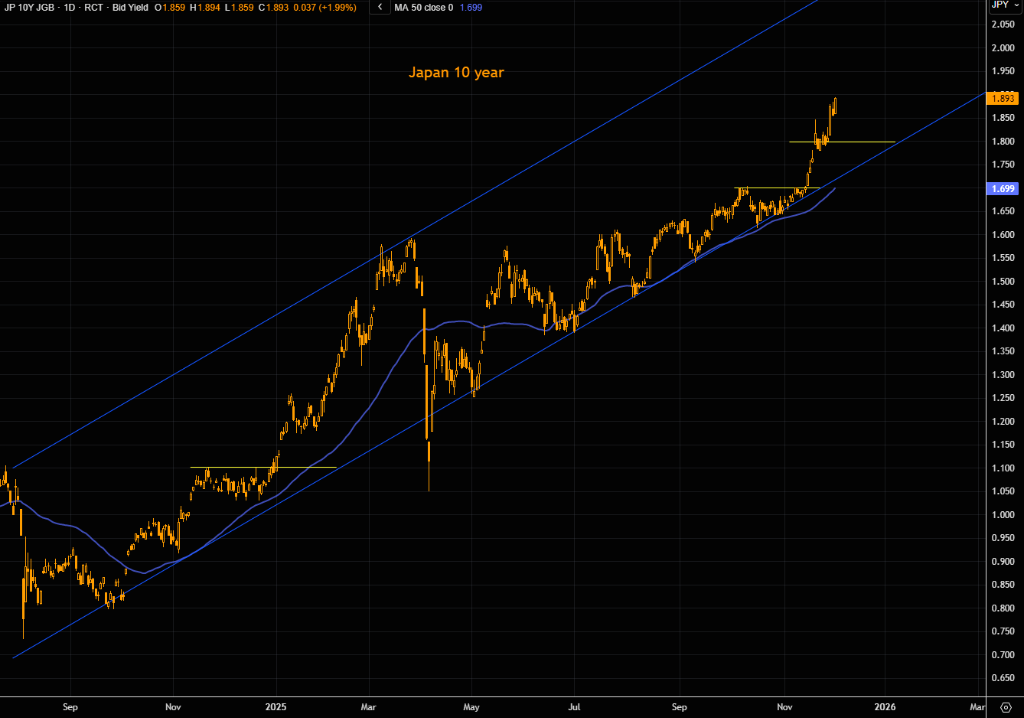
Core Viewpoint - Japan's long-term government bond yields are experiencing a significant and uncontrolled rise, with the 10-year yield approaching the critical 2% level and the 30-year yield soaring to 3.43%, indicating potential global market risks [1][4]. Group 1: Yield Trends - The 10-year government bond yield in Japan has been consistently reaching new highs, driven by a "magnet effect" around the 2% mark, with technical indicators suggesting a strong upward trend [2]. - The 30-year bond yield has shown even stronger performance, breaking through the 3.3% level and indicating substantial upward potential due to a lack of resistance above [4][6]. Group 2: Historical Context - Analysts recall the significant market drop in late October last year when Japanese rates began to rise, which coincided with a sharp decline in the Nasdaq 100 index, highlighting a historical correlation between Japanese rates and U.S. equity performance [5][8]. Group 3: Market Volatility - The current rise in Japanese bond yields is characterized by a clear trend, breaking through technical resistance levels and indicating strong upward momentum [6]. - Despite most traders not including Japanese rate changes in their daily risk assessments, this macro-level shift could significantly increase market volatility [9][11]. Group 4: Global Impact - The widening yield spread between Japanese and U.S. 10-year bonds is reshaping global capital allocation, reflecting deepening monetary policy divergence and potentially triggering large-scale cross-border capital flows [12]. - The increase in the yield spread may lead to adjustments in arbitrage trading, particularly affecting yen carry trades, which could have significant implications for global risk asset prices [12]. Group 5: Safe-Haven Assets - The gold market has begun to react to the rise in Japanese long-term yields, indicating that gold prices are sensitive to changes in Japanese government bonds and reflecting growing market concerns about potential risks [14][15]. - The movement in gold prices, whether measured in yen or dollars, signals an increase in demand for safe-haven assets, often foreshadowing broader market adjustments [15][17].
受日债波及 美债收益率飙升
Xin Hua Cai Jing· 2025-12-02 03:01
Group 1 - The core message of the news highlights significant volatility in global bond markets, with rising yields driven by strong signals from the Bank of Japan regarding potential interest rate hikes [1] - The Bank of Japan's Governor, Kazuo Ueda, indicated a willingness to consider raising policy rates based on economic and inflation analysis, marking the clearest signal for a rate hike to date [1] - Market expectations for a December rate hike by the Bank of Japan have surged from below 25% to approximately 80% within a week, influencing the Japanese yen's appreciation and putting upward pressure on Japanese government bond yields [1] Group 2 - The potential initiation of a rate hike cycle by the Bank of Japan could lead to a narrowing of the interest rate differential between Japan and the U.S., prompting capital to flow back from overseas markets [2] - On December 1, the 10-year U.S. Treasury yield rose by 7.7 basis points to 4.09%, while the 30-year yield also increased by over 7 basis points, reflecting the selling pressure in the bond market [2] - Recent concerns over economic slowdown and rising expectations for interest rate cuts had previously led to a decline in U.S. Treasury yields, with the 10-year yield dropping below 4% [2] Group 3 - The CME "FedWatch" tool indicates a nearly 90% probability of a 25 basis point rate cut by the Federal Reserve in December [3] - The U.S. manufacturing Purchasing Managers' Index (PMI) fell from 48.7 in October to 48.2 in November, indicating a continued contraction in manufacturing activity for the ninth consecutive month, below market expectations [3] - Factors such as tariff policies and fiscal uncertainty have contributed to the accelerated contraction in U.S. manufacturing activity, as reported by the Institute for Supply Management [3]
【环球财经】日元短线反弹但难以持续 日本央行行长:密切关注外汇波动影响
Xin Hua Cai Jing· 2025-11-18 09:39
Core Viewpoint - The Japanese yen has recently experienced volatility, hitting a nine-month low, prompting concerns from the Japanese Finance Minister about potential market interventions and increasing safe-haven demand for the yen [1][2]. Group 1: Currency Market Dynamics - The USD/JPY exchange rate is currently around 155.10, having reached a high of 155.37, the highest since February 4 [1]. - The Japanese Finance Minister has expressed caution regarding the "one-sided rapid fluctuations" in the foreign exchange market, indicating a higher likelihood of intervention [1]. - The Bank of Japan's Governor stated that the central bank is adjusting monetary support to achieve a stable 2% inflation target, closely monitoring the impact of exchange rate fluctuations on the economy [1]. Group 2: Economic and Fiscal Concerns - The narrowing interest rate differential between Japan and the U.S. due to potential rate hikes by the Bank of Japan and rate cuts by the Federal Reserve may support the yen, while rising domestic long-term interest rates could pressure the yen [2]. - The Japanese government is considering a significant economic stimulus plan of approximately $149 billion, raising concerns about increasing national debt and steepening the yield curve of Japanese government bonds [2]. - Japan's unexpected GDP decline in Q3 has led to skepticism about the Bank of Japan's ability to raise interest rates in the short term, adding further pressure on the yen [2]. Group 3: Investor Sentiment and Recommendations - Investors are worried that the government's fiscal policies may exert downward pressure on the yen, with expectations that the government will tolerate a moderate weakening of the yen to support corporate profits and wage growth [2]. - Barclays economists suggest that further fiscal expansion will likely keep the USD/JPY at elevated levels due to the yen's sensitivity to fiscal risks [2]. - Goldman Sachs warns that the market's sensitivity to fiscal issues has increased, indicating that any policy adjustments could lead to significant volatility in the yen [3].
前日本央行行长黑田东彦:日美利差有望缩小 日元将升值至1美元兑120-130日元
Zhi Tong Cai Jing· 2025-10-30 06:49
Core Viewpoint - Former Bank of Japan Governor Haruhiko Kuroda suggests that the yen may appreciate to a level of 120-130 yen per dollar due to a narrowing interest rate differential between Japan and the U.S. [1] Group 1: Currency Outlook - Kuroda indicates that the current exchange rate of approximately 153 yen per dollar is too weak and expects it to revert to 120-130 yen [1] - He believes that the contrasting monetary policies of the Federal Reserve and the Bank of Japan will naturally reduce the interest rate differential, aiding the yen's appreciation [1] Group 2: Monetary Policy Context - The Bank of Japan's recent decision to maintain interest rates aligns with market expectations, passing with a 7-2 vote, while two members proposed a 25 basis point increase [1] - Market reaction to the decision was relatively muted, with little change in the 10-year Japanese government bond yields and a slight decline in the yen [1] Group 3: Economic Indicators - Kuroda notes that Japan has achieved its 2% inflation target, with an economic growth rate of approximately 1.5% and an unemployment rate of only 2.6% [2] - He suggests that current economic conditions are suitable for the Bank of Japan to consider further interest rate hikes [2] Group 4: Future Expectations - A majority of economists surveyed expect the Bank of Japan to raise interest rates in January next year, despite two members opposing the current decision [2] - Kuroda highlights that the Bank of Japan's recent decisions reflect a desire to observe the impact of U.S. tariffs on the Japanese economy, which has been less significant than previously anticipated [2]