
A股市场

Search documents
四点半观市 | 机构:A股市场中期展望依然向好 创业板具有较好风险收益比
Shang Hai Zheng Quan Bao· 2025-11-04 10:32
Group 1 - The domestic commodity futures market showed mixed results, with the shipping index (European line) rising over 3% and lithium carbonate dropping over 4% [1] - The China convertible bond index closed down 0.67%, with notable gainers including Zhongneng Convertible Bond and Zhenhua Convertible Bond, which rose 13.15% and 9.57% respectively [1] - The ETF market had varied performances, with the Asia-Pacific Selected ETF leading gains at 2.35%, while the Nikkei 225 ETF fell by 5.76% [1] Group 2 - UBS Securities expressed a positive mid-term outlook for the A-share market, suggesting that growth style remains the main investment theme, with the ChiNext board showing a favorable risk-reward ratio [2] - In the context of AI investments, Invesco's Chief Global Market Strategist noted that the potential of AI is undeniable, but the ultimate winners in the sector will take time to identify, recommending a diversified investment approach [2] - CICC highlighted that the market's upward trend is likely to continue, with structural highlights in sectors such as AI computing power, machinery, automotive, and innovative pharmaceuticals [2] Group 3 - The Chief Economist of AVIC Securities indicated that external risks are easing, leading to improved market risk appetite, and suggested a balanced investment approach focusing on themes like smart technology and aerospace [3] - The recent announcement regarding gold tax policies aims to encourage on-site gold trading by clarifying distinctions between investment and non-investment uses [2]

起底A股2025年三季报
3 6 Ke· 2025-11-04 01:54
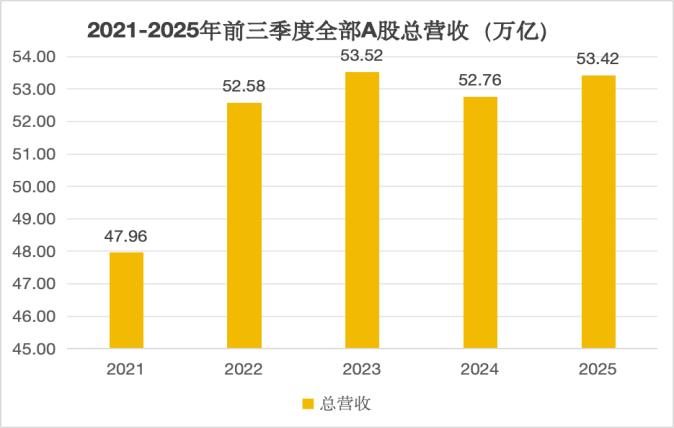
Group 1 - The total revenue of A-shares reached 53.52 trillion yuan in the first three quarters of 2025, showing a year-on-year growth of 1.25%, indicating overall stability compared to previous years [2][3] - The total profit for A-shares in the first three quarters of 2025 was 6.09 trillion yuan, an increase of 6.47% year-on-year, breaking the downward trend observed since 2022 [3][8] - The operating profit margin for A-shares during this period was 11.40%, higher than the levels from 2022 to 2024, but slightly lower than the 2021 figure of 11.84% [3][8] Group 2 - Excluding financial stocks, the total revenue for A-shares in the first three quarters of 2025 was 46.28 trillion yuan, with a modest year-on-year increase of 0.61% [5][8] - The total profit for A-shares excluding financial stocks was 3.34 trillion yuan, reflecting a year-on-year increase of 2.45%, although this growth was weaker compared to previous years [8][9] - The financial sector accounted for 13.37% of the total revenue in A-shares, highlighting its significant role in the market [5] Group 3 - The revenue from A-shares excluding the CSI 300 index was 39.83% of the total market revenue in the third quarter of 2025, with a year-on-year growth of 1.80% [29] - The total profit for A-shares excluding the CSI 300 in the third quarter was 0.41 trillion yuan, showing a year-on-year increase of 17.14%, although it has not yet returned to the levels seen in 2023 [31] - The operating profit margin for A-shares excluding the CSI 300 was 5.59%, which is less than half of the overall A-share operating profit margin [31] Group 4 - The total revenue for A-shares in the third quarter of 2025 was 18.43 trillion yuan, marking a year-on-year increase of 3.37%, the highest in the past five years [20] - The total profit for A-shares in the third quarter increased by 14.51% year-on-year, indicating a significant improvement in overall profitability [22] - The operating profit margin for the third quarter reached 11.99%, reflecting a stronger performance compared to the first three quarters [24] Group 5 - The overall performance of A-share companies indicates a stabilization in revenue and a recovery in profit, aligning with macroeconomic conditions [37] - There is a need for continued support for the real economy, particularly for small and medium-sized enterprises, which play a crucial role in economic vitality and employment [38] - The economic development path is described as winding, but the future outlook remains positive [39]

A股三大指数小幅低开,黄金股继续调整
Ge Long Hui· 2025-11-04 01:34
Core Viewpoint - The A-share market opened with slight declines across the three major indices, indicating a cautious market sentiment at the start of trading [1] Market Performance - The Shanghai Composite Index opened down by 0.08% - The Shenzhen Component Index opened down by 0.23% - The ChiNext Index opened down by 0.2% [1] Sector Performance - The dye, Hainan Free Trade Zone, and real estate sectors showed the highest gains - The precious metals and Web 3.0 concept sectors opened lower [1]
市场分析:光伏电网行业领涨,A股小幅上行
Zhongyuan Securities· 2025-11-03 11:34
Investment Rating - The industry is rated as "stronger than the market," indicating an expected increase of over 10% relative to the CSI 300 index within the next six months [15]. Core Views - The A-share market experienced a slight upward trend after initial declines, with significant support at 3937 points for the Shanghai Composite Index. Key sectors such as electric grid equipment, photovoltaic equipment, banking, and gaming showed strong performance, while sectors like batteries, small metals, semiconductors, and jewelry underperformed [3][4][7]. - The average price-to-earnings (P/E) ratios for the Shanghai Composite and ChiNext indices are 16.19 times and 49.81 times, respectively, indicating a favorable environment for medium to long-term investments [4][14]. - The total trading volume on the two exchanges reached 21,332 billion, above the median of the past three years, suggesting active market participation [4][14]. Summary by Sections A-share Market Overview - On November 3, the A-share market showed a pattern of initial decline followed by recovery, with the Shanghai Composite Index closing at 3976.52 points, up 0.55%. The Shenzhen Component Index closed at 13404.06 points, up 0.19%, while the ChiNext 50 Index fell by 1.04% [7][8]. - Over 70% of stocks in the two markets rose, with notable gains in shipbuilding, gaming, cultural media, coal, and photovoltaic equipment sectors. Conversely, small metals, batteries, jewelry, non-metallic materials, and precious metals saw declines [7][9]. Future Market Outlook and Investment Recommendations - The A-share market is at a critical transition point, with expectations of a sideways trading pattern in November as the market prepares for potential year-end rallies. The market is likely to see a rebalancing trend between growth and value styles, as well as between large-cap and small-cap stocks [4][14]. - It is recommended to maintain a balanced portfolio, seeking equilibrium between technology growth and dividend value, while being mindful of both offensive and defensive strategies. Short-term investment opportunities are suggested in electric grid equipment, photovoltaic equipment, gaming, and banking sectors [4][14].

瑞达期货股指期货全景日报-20251103
Rui Da Qi Huo· 2025-11-03 09:24
Report Summary 1. Report Industry Investment Rating No information provided. 2. Core Viewpoints - A-share Q3 reports showed good overall performance, providing bottom support for the market, but the decline in domestic manufacturing prosperity in October may suppress subsequent market trends [2]. - After the meeting between the leaders of China and the United States, there is no more positive news in the short term, showing a situation of "good news exhausted". - The pressure on the RMB exchange rate restricts the loose monetary policy. It is recommended to wait and see for now. 3. Summary by Relevant Catalogs 3.1 Futures Market - **Futures Contract Prices**: IF (2512) latest price is 4634.8, down 1.8; IH (2512) is 3016.6, unchanged; IC (2512) is 7239.6, down 24.8; IM (2512) is 7398.0, up 0.8 [2]. - **Futures Spreads**: IF - IH spread is 1628.6, up 4.4; IC - IF spread is 2646.6, down 3.6; etc. - **Futures - Spot Basis**: IF basis is -18.6, down 9.3; IH basis is 0.3, down 3.4; IC basis is -94.0, down 5.4; IM basis is -140.1, down 1.6. 3.2 Market Sentiment - **Trading Volume and Balance**: A - share trading volume is 21,329.04 billion yuan, down 2169.10 billion yuan; margin trading balance is 24,864.02 billion yuan, down 126.85 billion yuan [2]. - **Other Indicators**: North - bound trading volume is 2842.58 billion yuan, down 78.16 billion yuan; reverse repurchase operation volume is +783.0 billion yuan, etc. 3.3 Industry News - **PMI Data**: In October, manufacturing PMI was 49.0%, down 0.8 ppts from last month; non - manufacturing business activity index was 50.1%, up 0.1 ppts; composite PMI output index was 50.0%, down 0.6 ppts [2]. - **Corporate Earnings**: As of October 31, the total revenue of A - share listed companies in the first three quarters was 53.41 trillion yuan, up 1.20% year - on - year; net profit attributable to shareholders was 4.70 trillion yuan, up 5.34% year - on - year. - **Stock Market Performance**: A - share main indices generally rose. Shanghai Composite Index rose 0.55%, Shenzhen Component Index rose 0.19%, and ChiNext Index rose 0.29%. 3.4 Key Data to Watch - November 3, 23:00: US October ISM manufacturing PMI - November 4, 11:30: Australian central bank interest rate decision - November 5, 21:15: US October ADP employment data - November 7, 9:30: China October trade data - November 9, 9:30: China October CPI and PPI [3]

再谈“棋至中盘”——中美釜山元首峰会及四中全会后的经济与金融形势
2025-11-03 02:36
中美高层对话旨在稳定双边关系,避免因美方内部不协调导致政策反复, 显示中国对通过沟通解决问题的意愿。 中国经济展现韧性,GDP 和贸易增速表现出色,表明中国有能力应对外 部压力,并对自身发展充满信心。 中美经贸团队就主要问题达成共识,反映双方认识到贸易战的负面影响, 并开始重新评估对策,寻求务实解决方案。 美国当前对华策略的调整,部分原因是中国的实力增强,以及美国自身 面临的经济压力,如美联储降息与停止量化紧缩并存。 特朗普政府面临财政挑战,联邦利息支出大幅增加,限制了其通过财政 手段解决国内问题的空间,需更激进的货币政策。 美国制造业空心化削弱了其工业基础和军事实力,进而影响美元霸权, 并导致美元信用下降和通货膨胀。 中国已将外部变数纳入考量,积极应对挑战,中美关系未来可能经历波 动,但中国已做好准备应对各种情况,A 股市场长期向好。 Q&A 如何看待最近中美元首在釜山的会晤? 再谈"棋至中盘"——中美釜山元首峰会及四中全会后的 经济与金融形势 20251031 摘要 美国制造业空心化对其经济和军事力量有何影响? 美国制造业空心化带来了两个重要影响。首先,工业实力是军事实力的重要基 础,制造业空心化削弱了美 ...
【机构策略】A股市场可能面临新一轮横盘调整
Zheng Quan Shi Bao Wang· 2025-11-03 01:04
Group 1 - CITIC Securities believes that the current index level of 4000 points is significantly better than the same level in 2015, with a notably lower valuation, suggesting that there is no need to overly focus on the index itself [1] - The report highlights three key areas for investment: upgrading traditional manufacturing, Chinese companies going abroad, and edge AI, while short-term attention should be given to potential rebound opportunities following the third quarter reports [1] - Caixin Securities indicates that the market is shifting from macro-driven logic to a fund-driven logic due to the concentration of macro events, with institutional funds likely to take profits in high-valuation sectors, leading to a potential rebalancing of market styles [1] Group 2 - CITIC Jiantou notes that after a period of high market sentiment and the realization of three major benefits, the A-share market is at a high position and may face a new round of horizontal adjustment due to a lack of favorable news [2] - The report mentions that the allocation ratio in the electronic industry exceeds 25%, the innovation and entrepreneurship board exceeds 40%, and the growth style exceeds 60%, all at their highest levels since 2010, which may trigger structural adjustments [2] - From a seasonal effect perspective, the report suggests that as year-end profits are often realized, large-cap value styles tend to dominate [2]
A股10月收官,沪指一度站上4000点,关注A500ETF易方达(159361)、沪深300ETF易方达(510310)等投资价值
Mei Ri Jing Ji Xin Wen· 2025-10-31 16:15
Market Overview - The A-share market closed in October with the Shanghai Composite Index rising by 1.85%, briefly surpassing 4000 points, marking a nearly 10-year high [1] - Weekly market performance showed a mixed trend, with sectors such as energy metals, solid-state batteries, photovoltaic equipment, medical services, and cloud office leading in gains, while semiconductor, insurance, and banking sectors faced declines [1] Index Performance - The CSI 300 Index decreased by 0.4%, the CSI A500 Index fell by 0.05%, the ChiNext Index increased by 0.5%, the STAR Market 50 Index dropped by 3.2%, and the Hang Seng China Enterprises Index declined by 2.1% [1][3] - The rolling price-to-earnings (P/E) ratios for the indices are as follows: CSI 300 at 14.5x, CSI A500 at 17.0x, ChiNext at 42.4x, STAR Market 50 at 160.6x, and Hang Seng China Enterprises at 10.9x [3] Sector Analysis - The CSI A500 Index covers 500 securities from various industries, representing 91 out of 93 three-level industries, indicating broad market coverage [4] - The ChiNext Index consists of 100 stocks with high market capitalization and liquidity, heavily weighted towards strategic emerging industries, particularly in power equipment, communications, and electronics, which together account for nearly 60% [4] - The STAR Market 50 Index is characterized by "hard technology" leaders, with semiconductors making up over 50% and combined with medical devices and photovoltaic equipment, accounting for nearly 75% [4] Historical Performance - Over the past month, the CSI 300 Index has shown a cumulative change of -0.0%, while the ChiNext Index has seen a -1.6% change [7] - Year-to-date performance indicates the CSI 300 Index has increased by 17.9%, and the ChiNext Index has risen by 48.8% [7] - The Hang Seng China Enterprises Index has experienced a cumulative increase of 25.8% this year [7]

A股三大指数集体下跌!富时中国A50指数期货跌幅扩大至1%
Ge Long Hui· 2025-10-31 03:29
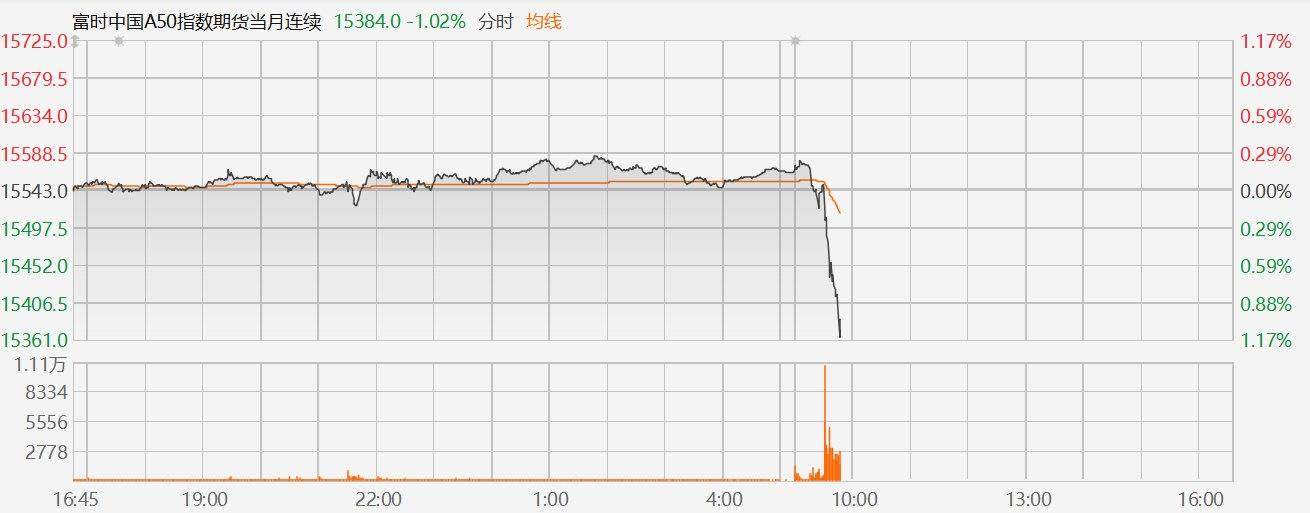
Group 1 - The FTSE China A50 Index futures have seen an expanded decline of 1% [1]
A股三大指数小幅低开,黄金、零售板块盘初活跃
Ge Long Hui· 2025-10-31 01:35
Core Viewpoint - Significant progress has been made in China-US economic and trade negotiations, with the US agreeing to cancel the 10% "fentanyl tariff" on Chinese goods [1] Market Reactions - A-shares opened slightly lower, with the Shanghai Composite Index down 0.05%, the Shenzhen Component down 0.11%, and the ChiNext Index down 0.08% [1] - International gold prices rebounded, surpassing $4000 per ounce, leading to a collective rise in gold stocks [1] - The retail sector became active at the beginning of trading following the issuance of a notice by the Ministry of Finance and four other departments regarding the improvement of duty-free shop policies to boost consumption [1] - Small metals, coal, and semiconductor sectors opened lower [1]