
全国统一大市场

Search documents
《关于加强政府投资基金布局规划和投向指导的工作办法(试行)》
Sou Hu Cai Jing· 2026-01-12 02:39
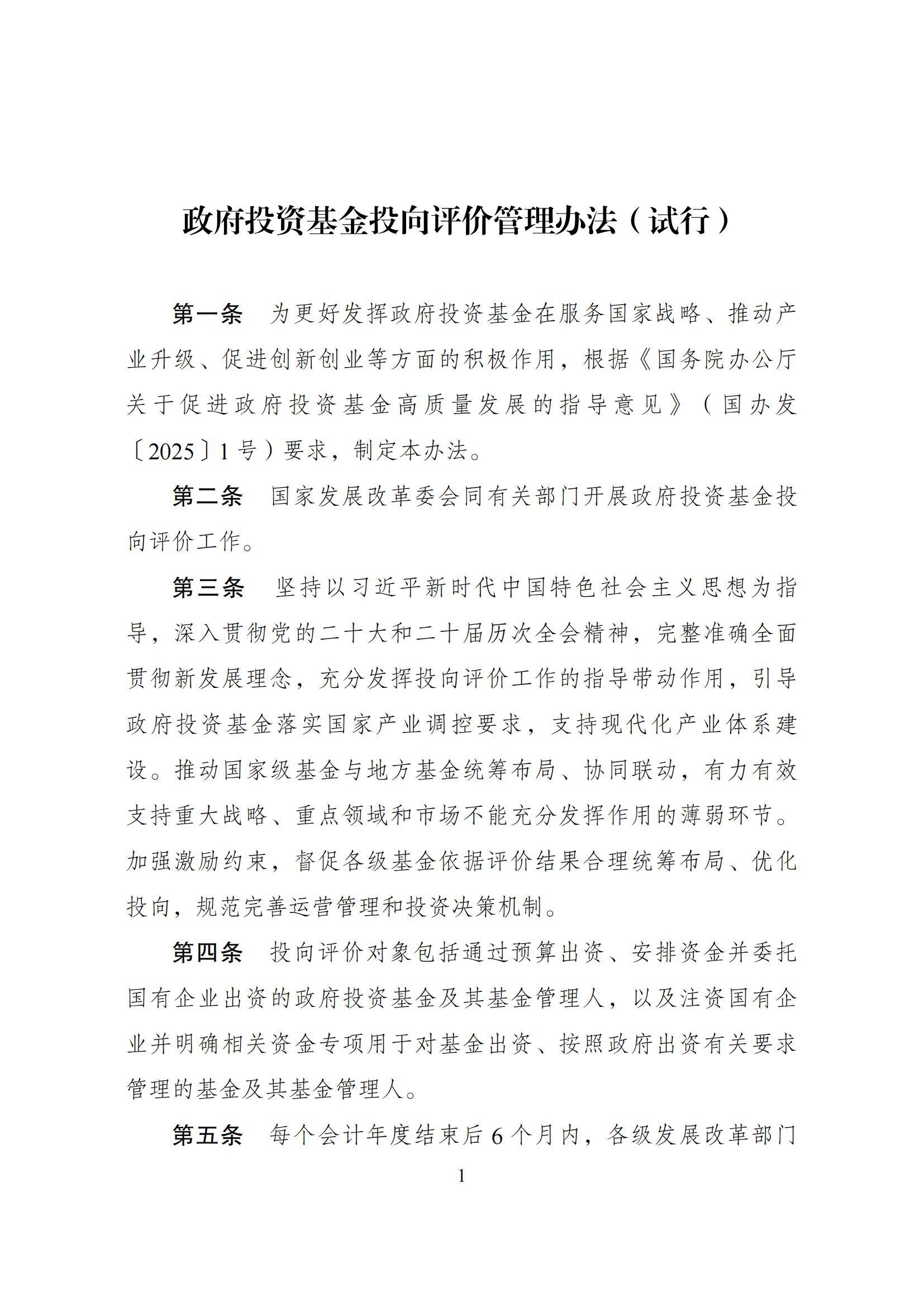
投资界1月12日消息,国家发展改革委、财政部、科技部、工业和信息化部联合发布《关于加强政府投资基金布局规划和投向指导的工作办法》,这是首次 在国家层面对政府投资基金的布局和投向作出系统规范。 设。推动国家级基金与地方基金统筹布局、协I 支持重大战略、重点领域和市场不能充分发挥' 加强激励约束,督促各级基金依据评价结果合3 投向,规范完善运营管理和投资决策机制。 《工作办法》围绕政府投资基金"投向哪、怎么投、谁来管"三方面,提出14项政策举措。其中明确,国家级基金要立足全局,围绕基金定位,重点支持国家 现代化产业体系建设和关键核心技术攻关,着力补齐产业短板、突破发展瓶颈。同时,要求地方基金结合本地产业基础和发展实际选择投资方向,在项目投 资中落实全国统一大市场要求,重点支持产业升级、创新能力提升,以及小微民营企业和科技型企业孵化,引导社会资本有效参与。 此外,国家发展改革委同步制定了《政府投资基金投向评价管理办法》,按照"正面引导与负面约束相结合"的思路,建立覆盖基金运营管理全过程、定量与 定性相结合的投向评价体系,进一步强化政策导向和规范管理。 附件:《关于加强政府投资基金布局规划和投向指导的工作办法》、《政 ...

新华财经早报:1月12日
Xin Hua Cai Jing· 2026-01-11 23:59
Group 1 - The Ministry of Commerce has outlined eight key areas of focus for the national business system in 2026, with a primary emphasis on implementing consumption promotion initiatives and building a unified national market [1][1][1] - The National Healthcare Security Administration is piloting the "Personal Medical Insurance Cloud" project to create a comprehensive smart healthcare management model by aggregating and utilizing personal health data [1][1][1] - The China Securities Regulatory Commission aims to enhance the institutional environment for long-term investments and improve services for technology innovation enterprises, focusing on risk prevention and high-quality development during the 14th Five-Year Plan period [1][1][1] Group 2 - The "Tianma-1000" unmanned transport aircraft has successfully completed its first flight test, designed for logistics, emergency rescue, and material delivery, capable of autonomously loading and unloading tons of goods within five minutes [1][1][1] - The Baotou Rare Earth Products Exchange has launched a rare earth price index, which will serve as a price "barometer" and "guideline" for the rare earth market, utilizing transaction data and a rigorous index model [1][1][1]

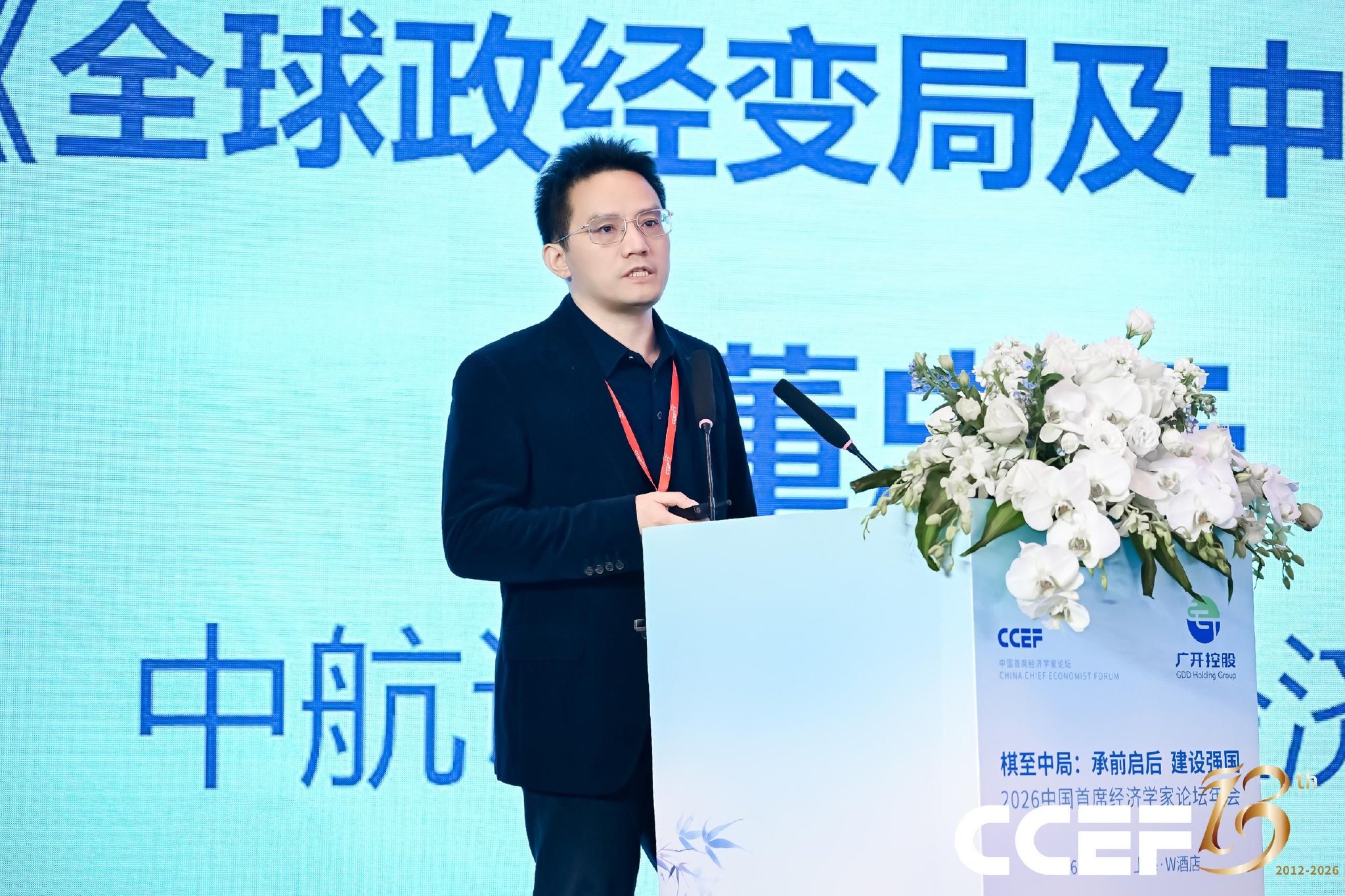
中航证券董忠云:中国将成为全球资金的重要“避风港”
Xin Lang Cai Jing· 2026-01-11 12:28
Core Viewpoint - The chief economist of AVIC Securities, Dong Zhongyun, stated that China's development momentum will become increasingly strong by 2026 [1][4]. Group 1: Key Themes of the 14th Five-Year Plan - The core keywords of the 14th Five-Year Plan are domestic demand, technology, and openness [3][6]. - The plan emphasizes the construction of a national unified market, focusing on technological breakthroughs through extraordinary measures, and promoting institutional openness [3][6]. Group 2: Importance of Expanding Domestic Demand - It is essential for China to accelerate the construction of a national unified market to facilitate the smooth operation of both international and domestic dual circulation, thereby cultivating a strong domestic demand market and enhancing economic resilience in extreme situations [3][7]. Group 3: Commitment to Openness - China is committed to institutional openness and will continue to expand high-level openness, which is necessary for integrating into the global economy and demonstrating the responsibilities of a major power [4][7]. - In the context of changing global political and economic landscapes, funds are expected to flow towards safe, stable, and high-potential countries, with China becoming an important "safe haven" for global capital by 2026 [4][7].
中信证券:短期市场热度偏高,情绪没有转弱迹象
Xin Lang Cai Jing· 2026-01-11 09:43
Group 1 - The market's early-year excitement is driven by a concentration of funds that missed out on the previous year, with a backdrop of "people's desire for growth" [1][2] - The current market movement is primarily seen in thematic sectors and small-cap stocks, rather than in the direction of allocation-type funds [3][4] - Short-term market heat is high, but sentiment indicators have not shown signs of weakening, suggesting that the upward trend in thematic and small-cap stocks may continue until after the Two Sessions [4][15] Group 2 - The performance of small and mid-cap growth styles has significantly outperformed large-cap value styles, with the CSI 500 index rising by 7.9% and the CSI 2000 by 7.2%, compared to the CSI 300's 2.8% [3][13] - The commercial aerospace sector has seen a notable increase, with a trading volume of 729.1 billion yuan on January 9, accounting for 23.1% of total A-share trading [3][13] - The current market environment is characterized by abundant allocation and quantitative funds, while individual stock pricing funds are scarce, indicating a need for a shift back to fundamental-driven trends [15][16] Group 3 - For the year, allocation-type funds are increasingly focused on reducing volatility in their equity positions, as long-term interest rates continue to decline [17][18] - Recommended sectors for investment include resources and traditional manufacturing, with an emphasis on enhancing pricing power, as well as increasing allocations to non-bank financials [7][18] - The market's current excitement may not be the right time for allocation-type funds to chase hot sectors, with a more strategic approach suggested for the critical structural adjustment window in late March to April [15][16]

【大宗周刊】港口期现聚新力!2025年大宗商品现货市场大事记
Qi Huo Ri Bao· 2026-01-11 00:43
Core Viewpoint - The construction of a national unified market is a strategic initiative aimed at facilitating domestic circulation, breaking regional barriers, optimizing resource allocation, and enhancing the resilience of industrial and supply chains, with the futures and spot markets playing a crucial role in this process [2]. Group 1: Market Integration and Innovation - Shandong Port Group's investment holding company has aligned with national strategic deployments, focusing on futures-spot integration innovation to enhance market functions and strengthen collaborative empowerment [2]. - The company has achieved a comprehensive futures-spot market system, becoming the first in the nation to implement a full license layout, integrating clearing houses, futures companies, risk management subsidiaries, delivery centers, and spot trading centers [2]. Group 2: Supply Chain Solutions - To address liquidity pressures faced by LPG clients, the company has developed a sales-based procurement model utilizing port inventory and electronic warehouse receipts, successfully activating 21,400 tons of LPG inventory [3]. - The company has explored a comprehensive service model for the rubber industry, helping partners save over 10% in production costs annually by eliminating intermediary trade markups and using futures tools to mitigate price volatility risks [3]. Group 3: Risk Management and Cost Reduction - The company has created an integrated supply chain service plan to manage risks associated with iron ore price fluctuations and variable import costs, effectively lowering overall costs for enterprises [4]. - A collaboration with Xinhua News Agency has led to the establishment of a commodity index system that provides authoritative price benchmarks, enhancing market monitoring and risk prevention capabilities [4]. Group 4: Technological Advancements - The company has launched the "Port Cloud Warehouse" electronic warehouse receipt service platform, leveraging advanced technologies like blockchain and big data, facilitating over 21 billion yuan in financing for clients [5]. - Regular cross-border RMB settlement for crude oil transactions has been established, promoting international market connectivity and resource allocation efficiency [5]. Group 5: Future Development and Strategic Goals - The company aims to continue enhancing its service capabilities and deepen futures-spot integration to support the construction of a national unified market and contribute to high-quality economic development [6].
更好发挥通道作用 开放红利辐射全国——访海南省委副书记、省长刘小明
Jing Ji Ri Bao· 2026-01-10 22:11
Core Viewpoint - The construction of a unified national market is a significant strategic deployment by the central government, aimed at fostering high-quality development and enhancing the overall national development framework [1] Group 1: Innovations and Achievements in Market Construction - Hainan has actively integrated into the national unified market, breaking down barriers and enhancing institutional integration to create a first-class business environment [1] - The province has implemented the shortest foreign investment negative list in the country and has optimized 127 administrative licensing items into a notification commitment system, ranking first nationally [1][2] - The "Natural Resources Supermarket" platform has been launched to address information asymmetry in resource allocation, facilitating the transaction of land and sea usage rights [2] Group 2: Market Order and Competition - Hainan has introduced the first Fair Competition Regulation in the country, establishing a comprehensive system to maintain fair competition and protect intellectual property rights [3] - The province has expanded the "machine management" reform to various sectors, ensuring transparency and reducing human intervention in transactions, with over 2000 projects and a transaction volume exceeding 150 billion [3] Group 3: Government Regulation and Market Efficiency - Hainan has focused on standardizing government actions to enhance market efficiency, transitioning from management to service-oriented governance [4] - The province has implemented local regulations to streamline administrative inspections, achieving a completion rate of 75.4% in resolving historical issues affecting the business environment [4] Group 4: Significance of Hainan Free Trade Port - The launch of the Hainan Free Trade Port marks a significant step in expanding high-level openness and serves as a strategic point for domestic and international dual circulation [5] - The port's operation will facilitate the integration of international high-standard trade rules, reducing transaction costs and enhancing the attractiveness of the domestic market [5][6] Group 5: Future Directions for Hainan - Hainan aims to become a high-quality service hub for enterprises going abroad, enhancing cooperation with key domestic regions and exploring new markets, particularly in Southeast Asia [7] - The province plans to establish a new hub for the flow of goods and resources, leveraging policies to attract cross-border capital and enhance logistics systems [7] - Hainan will focus on becoming a frontier for institutional openness, aligning with international standards in digital economy and cross-border data management [8]
21社论丨优化供需结构,持续提振投资与消费预期
21世纪经济报道· 2026-01-10 02:11
Group 1 - The core viewpoint of the articles indicates a positive trend in price recovery for 2025, with CPI and PPI showing simultaneous growth, suggesting a foundation for price warming in 2026 [1][2][3] - CPI increased by 0.8% year-on-year, surpassing the previous value of 0.7%, and the month-on-month CPI rose by 0.2%, marking a three-year high [1] - The rise in CPI is primarily driven by the increase in industrial consumer goods prices, excluding energy, which rose by 0.6%, contributing approximately 0.16 percentage points to the CPI increase [1] Group 2 - PPI showed a month-on-month increase of 0.2%, marking three consecutive months of growth, with the growth rate expanding by 0.1 percentage points compared to the previous month [1][2] - The improvement in PPI is attributed to industry capacity governance and market competition order, which have positively influenced supply-demand structures, leading to price increases in certain sectors [2][3] - International commodity prices, particularly in non-ferrous metals, have positively impacted domestic PPI levels, while the decline in international oil prices has negatively affected domestic oil extraction and refining prices [3] Group 3 - The current price recovery is a direct result of coordinated demand-side expansion and supply-side governance policies, with structural characteristics and policy-driven features [3] - The sustainability of this price recovery and its transmission to broader investment and consumption expectations will determine whether the economy can enter a virtuous cycle in 2026 [3] - Continued efforts to expand domestic demand and improve supply-demand relationships are essential for stabilizing the real estate market and stimulating the stock market, which will facilitate smoother transmission from PPI to CPI [4]

全省实有经营主体超1160万户
He Nan Ri Bao· 2026-01-09 23:19
截至2025年12月底,全省经营主体密度达1181.589户/万人,企业密度为351.146户/万人。经营主体质的 有效提升和量的合理增长,正在为全省经济高质量发展提供有力支撑,成为河南加速融入服务全国统一 大市场的生动写照。(记者 孔学姣) 深化"高效办成一件事"改革,行政审批环节精简20%;试点信用修复"免申即办",修复失信主体63.1万 户;联合金融机构推出"认证贷",为中小微企业注入金融"活水"超100亿元……一段时间以来,市场监 管部门以"心贴心"的服务优化软环境,营造良好创业氛围,让经营主体在中原大地放心投资、安心经 营。 企业的快速增长,也得益于河南加速拥抱全国统一大市场,以超常规举措推进"五统一、一开放"各项工 作落地见效。"我们牵头开展'企业无感迁移、一业一查、规范监管执法'三大攻坚行动,让企业来去更 自由、监管执法更高效。"省市场监管局有关负责人说。 1月9日,记者从省市场监管局获悉,截至2025年12月底,全省实有经营主体1160.53万户,较2024年同 期增长2.9%。其中,实有企业343.6万户,较2024年同期增长7.98%;实有个体工商户797.53万户,较 2024年同期增长 ...
CPI同比涨幅继续扩大 PPI同比降幅收窄
Xin Lang Cai Jing· 2026-01-09 17:39
Group 1 - In December 2025, the Consumer Price Index (CPI) increased by 0.2% month-on-month and 0.8% year-on-year, while the Producer Price Index (PPI) rose by 0.2% month-on-month but decreased by 1.9% year-on-year [1][2] - The CPI's year-on-year growth rate expanded by 0.1 percentage points compared to the previous month, reaching the highest level since March 2023, primarily driven by an increase in food prices, which rose by 1.1% [1][3] - Key food items such as fresh vegetables and fruits saw price increases of 18.2% and 4.4%, respectively, contributing approximately 0.16 percentage points to the CPI's year-on-year increase [1][2] Group 2 - The month-on-month CPI increase was influenced by rising prices of industrial consumer goods, excluding energy, which rose by 0.6%, contributing about 0.16 percentage points to the CPI [2] - The PPI's year-on-year decline of 1.9% showed a narrowing of the decline by 0.3 percentage points from the previous month, with significant price reductions in coal mining and lithium-ion battery manufacturing [3] - Prices in sectors such as external storage devices and biomass liquid fuels increased by 15.3% and 9.0%, respectively, indicating a growth in new productive forces [3]
锚定开局目标 凝聚奋进合力
Xin Lang Cai Jing· 2026-01-09 16:41
Group 1: Economic Development Strategy - The core focus for 2026 is to ensure a strong start for the "14th Five-Year Plan" with an emphasis on high-quality economic and social development [1] - The Central Economic Work Conference has prioritized eight key tasks, including domestic demand-led growth, innovation-driven development, and reform initiatives [1][2] Group 2: Domestic Demand and Investment - The emphasis on domestic demand aims to build a robust domestic market, with policies targeting both investment and consumption [2] - Measures to stabilize investment include increasing government investment, implementing major engineering projects, and stimulating private investment [2] - Consumption strategies involve optimizing policies for replacing old consumer goods, expanding service consumption, and improving the quality of consumer supply [2] Group 3: Urban Development and Infrastructure - The focus on urban renewal includes implementing a specialized plan for urban updates and conducting city assessments [3] - Key infrastructure projects will include the renovation of gas pipelines and the construction of comprehensive underground utility corridors [3] Group 4: Innovation and Technology - The strategy emphasizes innovation-driven growth, with a focus on fostering new productive forces through technological advancements and industrial upgrades [4] - Specific initiatives include enhancing industrial technology capabilities, supporting emerging industries, and promoting the integration of artificial intelligence [5] Group 5: Data and Digital Economy - The year 2026 is designated as the "Year of Data Element Value Release," focusing on integrating data into economic value creation [6] - Efforts will be made to enhance data flow, promote data technology innovation, and support the development of digital industry clusters [6] Group 6: Reform and Market Dynamics - The reform agenda aims to eliminate systemic barriers to high-quality development, with a focus on creating a unified national market [7] - Financial reforms will enhance market supervision and facilitate cross-border financial services [7] Group 7: Social Welfare and Employment - The strategy includes measures to improve employment and social welfare, focusing on enhancing public services and ensuring stable prices for essential goods [9][10] - Specific actions will target skill development, social insurance coverage, and support for vulnerable groups [10][11]