有色金属等

Search documents
股指缩量反弹
Hua Tai Qi Huo· 2026-03-25 05:09
1. Report Industry Investment Rating There is no information about the report industry investment rating provided in the content. 2. Core Viewpoints of the Report - Geopolitical factors remain the core concern of the market. After the Trump administration released more signals of easing the situation, most global equity markets rebounded. The domestic market also showed a shrinking - volume rebound. Attention should be paid to potential positive factors from domestic policies. If the market trading volume effectively increases in the future, it is expected to drive the market to form a trend - upward [1][3]. 3. Summary According to Related Catalogs 3.1 Market Analysis - **Macro - aspect**: The State Administration for Market Regulation held a symposium on price supervision and anti - unfair competition work, emphasizing efforts in various aspects such as deepening price supervision, rectifying "involution - style" competition, and strengthening anti - unfair competition law enforcement [1]. - **Geopolitical - aspect**: Trump stated that the US had "won" in the action against Iran, and the US proposed a 15 - condition conflict - ending plan to Iran through Pakistan, including requirements on nuclear plans, missile capabilities, and regional issues [1]. 3.2 Index Performance - **Spot Market**: A - share major indices rebounded. The Shanghai Composite Index rose 1.78% to 3881.28 points, and the ChiNext Index rose 0.5%. Most sector indices rose, with only the petroleum and petrochemical, and coal industries closing down. The environmental protection, textile and apparel, building materials, and non - ferrous metal industries led the gains. The trading volume on that day was 2.1 trillion yuan. As of the end of February, the scale of existing private equity funds reached 22.6 trillion yuan, an increase of 160 billion yuan from the end of the previous month, hitting a new high. Overseas, the preliminary value of the US S&P Global Composite PMI in March dropped to 51.4, a new low in 11 months. The manufacturing and service sectors showed different trends: the manufacturing PMI rose to 52.4, exceeding expectations, while the service PMI dropped to 51.1, also a new low in 11 months. The three major US stock indices closed down, with the Nasdaq falling 0.84% to 21761.89 points [2]. - **Futures Market**: In the futures market, the basis of IF, IH, and IM decreased. In terms of trading volume and open interest, both the trading volume and open interest of index futures decreased [2]. 3.3 Strategy - Geopolitical factors are still the core focus of the market. After the Trump administration released more signals of easing the situation, most global equity markets rebounded. The domestic market showed a shrinking - volume rebound. Attention should be paid to potential positive factors from domestic policies. If the market trading volume effectively increases in the future, it is expected to drive the market to form a trend - upward [3]. 3.4 Chart Information - **Macro - economic Charts**: Include charts showing the relationship between the US dollar index and A - share trends, US Treasury yields and A - share trends, RMB exchange rate and A - share trends, and US Treasury yields and A - share style trends [6][8][10]. - **Spot Market Tracking Charts**: Table 1 shows the daily performance of major domestic stock indices on March 24, 2026, including the Shanghai Composite Index, Shenzhen Component Index, ChiNext Index, etc. There are also charts of the trading volume of the Shanghai and Shenzhen stock markets and the margin trading balance [13]. - **Stock Index Futures Tracking Charts**: Table 2 shows the trading volume and open interest of IF, IH, IC, and IM index futures, including the current values and changes. Table 3 shows the basis of index futures (futures - spot). Table 4 shows the inter - period spreads of index futures. There are also multiple charts related to the open interest, net open interest of foreign capital, basis, and inter - period spreads of different index futures contracts [17][39][45].
中东局势升级,滞涨隐忧压制股市
Dong Zheng Qi Huo· 2026-03-22 13:42
1. Report Industry Investment Rating - The rating for the stock index is "Oscillating" [4] 2. Core View of the Report - The escalation of the Middle - East situation and concerns about stagflation are suppressing the stock market. The global stock market continues to be under pressure due to geopolitical factors such as the continuous escalation of the US - Iran situation and the substantial blockade of the Strait of Hormuz. The expectation of stagflation has escalated again. In the stagflation trading, "inflation" has been initially priced, while "stagnation" has not been fully traded. For the A - share market, there have been significant recent declines, and risk - aversion trading is dominant. In the short term, as the war situation expands, there are few opportunities for the stock index. It is recommended to take a risk - averse strategy and wait in a low - position until the situation becomes clear [2][10] 3. Summary According to the Directory 3.1 One - Week View and Overview of Macro Key Events - Next week's view: The escalation of the Middle - East situation and concerns about stagflation are suppressing the stock market. The global stock market continues to be under pressure, and the expectation of stagflation has escalated again. For the A - share market, there have been significant declines, and risk - aversion trading is dominant. In the short term, there are few opportunities for the stock index, and a risk - averse strategy is recommended [10] 3.2 One - Week Market Quotes Overview 3.2.1 Global Stock Market Weekly Overview - From March 16th to March 20th, the global stock market denominated in US dollars declined. The MSCI Global Index fell 1.79%. Among them, emerging markets (- 0.42%) > frontier markets (- 1.08%) > developed markets (- 1.97%). The South Korean stock market rose 5.39%, leading the global stock market, while the South African stock market fell 5.62%, performing the worst globally [11] 3.2.2 Chinese Stock Market Weekly Overview - From March 16th to March 20th, Chinese equities declined significantly, with Hong Kong stocks > A - shares > Chinese concept stocks. Among A - share indices, the ChiNext Index rose 1.26% weekly, the only rising index, while the micro - cap stock index performed the worst, with a decline of 6.91%. The average daily trading volume of A - shares this week was 22,113 billion yuan, a decrease of 287.6 billion yuan compared to the previous week [14] 3.2.3 Weekly Overview of GICS Primary Industries in Chinese and Foreign Stock Markets - Most of the global GICS primary industries declined this week. The leading industry was energy (+ 3.05%), and the lagging industry was materials (- 5.81%). In the Chinese market, the financial sector had the smallest decline (- 1.05%), and the materials sector was the worst (- 10.44%) [18] 3.2.4 Weekly Overview of China A - share CITIC Primary Industries - Among China A - share CITIC primary industries this week, 2 industries rose (12 last week), and 28 industries fell (18 last week). The industry with the largest increase was communications (+ 1.71%), and the industry with the largest decline was non - ferrous metals (- 11.91%) [21] 3.2.5 Weekly Overview of China A - share Styles: Large - cap Growth Dominates - This week, growth outperformed value, and the market - capitalization style favored large - cap stocks [25] 3.2.6 Overview of Futures Index Basis - There are relevant data on the annualized basis rate of the current - quarter contracts of IH, IF, IC, and IM (excluding dividends), but specific data is not presented in the summary text [29][31] 3.3 Overview of Index Valuation and Earnings Forecast 3.3.1 Broad - based Index Valuation - Presented the PE and PB data of various broad - based indices such as the Shanghai Composite 50, CSI 100, etc. this week, their eight - year percentile, the values at the beginning of the year, and the changes during the year [33] 3.3.2 Primary Industry Valuation - Presented the PE and PB data of various primary industries such as petroleum and petrochemicals, coal, etc. this week, their eight - year percentile, the values at the beginning of the year, and the changes during the year [34] 3.3.3 Equity Risk Premium of Broad - based Indices - The ERP of the CSI 300, CSI 500, and CSI 1000 increased slightly this week [35][40] 3.3.4 Consensus Earnings Growth Rate of Broad - based Indices - The expected earnings growth rate of the CSI 300 in 2025 was adjusted down to 7.45%, and in 2026 it was adjusted up to 10.46%; the expected earnings growth rate of the CSI 500 in 2025 was adjusted down to 18.57%, and in 2026 it was adjusted up to 24.33%; the expected earnings growth rate of the CSI 1000 in 2025 was adjusted down to 16.60%, and in 2026 it was adjusted up to 25.23% [41] 3.4 Liquidity and Capital Flow Tracking 3.4.1 Interest Rates and Exchange Rates - This week, the 10 - year bond yield decreased, the 1 - year bond yield decreased, and the spread widened. The US dollar index was 99.5, and the offshore RMB was 6.9062 [51] 3.4.2 Tracking of Trading - type Funds - This week, the average daily trading volume of north - bound funds decreased by 17.6 billion yuan compared to last week, and the margin trading balance decreased by 1 billion yuan compared to last week [50] 3.4.3 Tracking of Funds Flowing in through ETFs - There are 30 on - market ETFs tracking the CSI 300, 29 on - market ETFs tracking the CSI 500, 15 on - market ETFs tracking the CSI 1000, and 40 on - market ETFs tracking the CSI A500. This week, the shares of ETFs tracking the CSI 300 increased by 1.4 billion, the shares of ETFs tracking the CSI 500 increased by 0.6 billion, the shares of ETFs tracking the CSI 1000 increased by 0.76 billion, and the shares of ETFs tracking the CSI A500 decreased by 5 billion [54][60] 3.5 Tracking of Domestic Macro High - frequency Data 3.5.1 Supply Side: Tire Operating Rate Recovered after the Spring Festival - There are data on the national blast furnace operating rate, coking enterprise operating rate, domestic crude steel daily output, and tire operating rate, but specific data is not presented in the summary text [63][66] 3.5.2 Consumption Side: Crude Oil Prices Soared - The crude oil price soared to around $103.68 per barrel. The year - on - year growth rate of passenger car wholesale sales rebounded. There are also data on the transaction area of first - hand housing in 30 large and medium - sized cities, the transaction area of second - hand housing in 16 key cities, the land transaction area of 100 large and medium - sized cities, and the listing volume and listing price of second - hand housing nationwide, but specific data is not presented in the summary text [77] 3.5.3 Inflation Observation: Agricultural Product Prices Declined - The prices of agricultural products dropped sharply from a high level. The production material prices have not fully reflected the impact of oil prices [80]
【债券日报】:转债市场月度跟踪20260313-20260313
Huachuang Securities· 2026-03-13 14:51
1. Report Industry Investment Rating No information about the industry investment rating is provided in the report. 2. Core Viewpoints - The convertible bond market continued to be weak today, with valuations compressing on a month - on - month basis. The trading sentiment in the convertible bond market heated up, but the overall market showed a downward trend [1]. - The central price of convertible bonds decreased, and the proportion of high - price bonds declined. The valuation of convertible bonds compressed, with different types of convertible bonds showing different trends in price and premium rate [2]. - Most of the underlying stock industry indices declined, and the convertible bond market also had more declining industries. Different industries had different performance in terms of closing price, conversion premium rate, conversion value, and pure bond premium rate [3]. 3. Summary by Relevant Catalogs Market Main Index Performance - The CSI Convertible Bond Index decreased by 1.04% month - on - month, the Shanghai Composite Index decreased by 0.82%, the Shenzhen Component Index decreased by 0.65%, the ChiNext Index decreased by 0.22%, the SSE 50 Index decreased by 0.50%, and the CSI 1000 Index decreased by 1.46%. The large - cap growth style was relatively dominant, with large - cap growth decreasing by 0.06%, large - cap value decreasing by 0.16%, mid - cap growth decreasing by 1.06%, mid - cap value decreasing by 1.28%, small - cap growth decreasing by 0.87%, and small - cap value decreasing by 0.66% [1][7]. Market Fund Performance - The trading volume of the convertible bond market was 71.943 billion yuan, a month - on - month increase of 14.73%. The total trading volume of the Wind All - A Index was 2.417276 trillion yuan, a month - on - month decrease of 1.76%. The net outflow of the main funds in the Shanghai and Shenzhen stock markets was 4.0095 billion yuan, and the yield of the 10 - year Treasury bond increased by 0.91bp to 1.81% [1]. Convertible Bond Price and Valuation - The weighted average closing price of convertible bonds was 139.51 yuan, a month - on - month decrease of 0.88%. Among them, the closing price of equity - biased convertible bonds was 199.31 yuan, a month - on - month increase of 2.06%; the closing price of debt - biased convertible bonds was 121.96 yuan, a month - on - month decrease of 0.35%; the closing price of balanced convertible bonds was 132.14 yuan, a month - on - month decrease of 0.81%. The proportion of high - price bonds above 130 yuan was 73.41%, a month - on - month decrease of 2.22pct. The price median was 137.91 yuan, a month - on - month decrease of 0.93% [2]. - The fitted conversion premium rate of 100 - yuan par value was 37.90%, a month - on - month decrease of 1.58pct; the overall weighted par value was 106.98 yuan, a month - on - month decrease of 0.51%. The premium rate of equity - biased convertible bonds was 14.43%, a month - on - month increase of 1.01pct; the premium rate of debt - biased convertible bonds was 89.32%, a month - on - month increase of 1.39pct; the premium rate of balanced convertible bonds was 25.22%, a month - on - month decrease of 0.97pct [2]. Industry Performance - In the A - share market, the top three industries with the largest declines were non - ferrous metals (-2.70%), computer (-2.70%), and national defense and military industry (-2.69%); the top three industries with the largest increases were food and beverage (+0.87%), building decoration (+0.60%), and banking (+0.38%). In the convertible bond market, 26 industries declined, with the top three industries with the largest declines being communication (-7.15%), national defense and military industry (-3.67%), and machinery and equipment (-2.75%); only two industries rose against the trend, namely petroleum and petrochemicals (+0.73%) and banking (+0.21%) [3]. - In terms of closing price, the large - cycle decreased by 0.84%, manufacturing decreased by 2.08%, technology decreased by 3.37%, large - consumption decreased by 1.00%, and large - finance decreased by 0.16%. In terms of conversion premium rate, the large - cycle decreased by 0.45pct, manufacturing decreased by 0.85pct, technology increased by 0.27pct, large - consumption decreased by 1.5pct, and large - finance decreased by 0.26pct. In terms of conversion value, the large - cycle decreased by 0.27%, manufacturing decreased by 1.22%, technology decreased by 3.40%, large - consumption decreased by 0.67%, and large - finance decreased by 0.12%. In terms of pure bond premium rate, the large - cycle decreased by 1.3pct, manufacturing decreased by 3.4pct, technology decreased by 5.4pct, large - consumption decreased by 1.3pct, and large - finance decreased by 0.2pct [3][4]. Industry Rotation - Food and beverage, building decoration, and banking led the rise. The daily increase rates of food and beverage, building decoration, and banking in the underlying stocks were 0.87%, 0.60%, and 0.38% respectively; the daily increase rates in the convertible bond market were - 0.30%, - 1.09%, and 0.21% respectively [53].
ESG市场观察周报:我国部署2026年碳减排目标,欧盟立法明确2040年减排90%-20260309
CMS· 2026-03-09 06:04
- The report does not contain any quantitative models or factors related to quantitative finance or engineering[1][2][3] - The content primarily focuses on ESG market trends, carbon reduction goals, and international climate policies, without discussing any quantitative models or factor construction methodologies[10][12][13] - No quantitative backtesting results, formulas, or performance metrics for models or factors are provided in the report[18][19][24]
金融工程:AI识图关注电力、电网、公用事业
GF SECURITIES· 2026-03-08 23:30
- The report explores the use of convolutional neural networks (CNNs) to model price-volume data and predict future prices, mapping learned features to industry theme indices such as the National Green Power Index, CSI Green Power Index, and CSI Electric Power Equipment Theme Index[80][82] - The CNN-based approach involves constructing standardized charts of price-volume data for individual stocks over specific time windows, which are then used as input for the CNN model to identify patterns and trends[80] - The latest thematic allocation based on the CNN model includes sectors like electricity, power grids, and public utilities, with specific indices such as the CSI All-Electric Power Utility Index and CSI All-Public Utility Index being highlighted[80][82]
2026.03.02-2026.03.06日策略周报:受中东冲突影响,A股指数震荡下行-20260308
Xiangcai Securities· 2026-03-08 07:56
Core Insights - The A-share indices experienced a downward trend due to escalating conflicts in the Middle East, particularly the blockade of the Strait of Hormuz by Iran, which led to a significant rise in international oil prices and increased global inflation expectations [2][12] Industry Performance - Among the 31 first-level industries, the top gainers were Oil and Petrochemicals and Coal, with increases of 8.06% and 3.79% respectively, while the largest declines were seen in Media and Non-ferrous Metals, which fell by 6.97% and 5.47% respectively [3][18] - In the 124 second-level industries, the best performers were Oil Service Engineering and Electric Grid Equipment, with weekly gains of 12.73% and 6.66%. Year-to-date, Oil Service Engineering and Small Metals led with increases of 60.08% and 41.71% respectively. The largest weekly declines were in Energy Metals and Digital Media, down 9.22% and 8.24% respectively, with year-to-date declines in Aviation Airports and State-owned Large Banks II of 12.79% and 8.69% respectively [3][21] - In the 259 third-level industries, the top gainers were Coal Chemical and Oil and Gas Refining Engineering, with weekly increases of 15.17% and 14.58%. Year-to-date, Oil and Gas Refining Engineering and Communication Cables and Accessories led with increases of 75.77% and 54.40% respectively. The largest weekly declines were in Photovoltaic Processing Equipment and Communication Value-added Services, down 12.18% and 10.42% respectively, with year-to-date declines in Aviation Transportation and Brand Consumer Electronics of 14.29% and 9.99% respectively [4][22] Investment Recommendations - The report suggests a long-term view for 2026, indicating it is the beginning year of the "14th Five-Year Plan," with the central bank implementing proactive fiscal policies and moderately loose monetary policies to support stable economic growth and maintain a "slow bull" market for A-shares [5][24] - Short-term focus should be on sectors benefiting from the "14th Five-Year Plan" related to new productivity (technology, environmental protection), structural opportunities in traditional sectors related to "anti-involution," defensive dividend sectors related to long-term capital inflows, and sectors benefiting from the Middle East conflict [5][24]
粤开市场日报-20260305
Yuekai Securities· 2026-03-05 07:52
Market Overview - The A-share market indices all rose today, with the Shanghai Composite Index increasing by 0.64% to close at 4108.57 points, the Shenzhen Component Index rising by 1.23% to 14088.84 points, the Sci-Tech 50 up by 1.72% to 1405.35 points, and the ChiNext Index gaining 1.66% to 3216.94 points [1][10] - Overall, 4076 stocks rose while 1304 stocks fell, with a total trading volume of 239 billion yuan, an increase of 243 billion yuan compared to the previous trading day [1] Industry Performance - Among the Shenwan first-level industries, the following sectors saw gains: Communication (+2.84%), Power Equipment (+2.18%), Machinery (+2.05%), Electronics (+2.02%), and Computers (+1.68%). Conversely, the sectors that declined included Agriculture, Forestry, Animal Husbandry, and Fishery (-2.02%), Oil and Petrochemicals (-1.81%), Non-ferrous Metals (-0.64%), Coal (-0.18%), and Transportation (-0.05%) [1][15] Concept Sectors - The leading concept sectors with significant gains today included Mini LED, New Display Technology, Ultra High Voltage, Nuclear Fusion, Cultivated Diamonds, Nuclear Power, Superconductors, Superhard Materials, Cameras, AI Wearable Devices, Third Generation Semiconductors, Virtual Power Plants, OLED, Charging Piles, and Low-priced ChiNext Stocks [2][12]
金融市场流动性与监管动态周报:历史上两会前后A股风格如何演绎?-20260224
CMS· 2026-02-24 14:31
Market Performance - Historically, A-shares tend to perform well in the two weeks leading up to the National People's Congress (NPC), with a probability of over 50% for indices like the CSI 1000 and CSI 500 to rise, averaging over 3% returns in the two weeks prior [9][18] - After the NPC, the probability of market increases rises significantly, with indices like the CSI 1000 and CSI 500 showing a 64% probability of rising in the weeks following the congress [9][18] Style Performance - There is a calendar effect observed in A-shares around the NPC, where small-cap stocks generally outperform both before and after the congress, driven by expectations of stable growth policies and active financing [12][18] - The small-cap growth and value styles are expected to dominate during the NPC period, while large-cap styles may gain traction in the month following the congress [12][18] Industry Performance - Industries such as basic chemicals, non-ferrous metals, and construction materials show strong performance before and after the NPC, with over 50% probability of rising in the weeks leading up to the congress [14][18] - Post-NPC, industries like real estate, construction materials, and consumer goods are expected to see higher probabilities of increases as stable growth policies are implemented [16][18] Liquidity and Funding - The liquidity indicators show a net outflow of financing funds amounting to 830.2 billion yuan, with a significant drop in ETF inflows [30][36] - The issuance of public funds increased by 340.3 million units, indicating a rise in demand for equity investments despite the overall net outflow [30][36] Market Sentiment - Market sentiment has shown a decrease in trading activity, with the proportion of financing transactions in A-share trading falling to 8.6% [44] - The VIX index has decreased, indicating improved risk appetite in the market, with the Nasdaq and S&P 500 indices also showing positive performance [46][48]
资金风向标 | 两融余额较上一日减少172亿元 有色金属行业获融资净偿还额居首
Sou Hu Cai Jing· 2026-02-09 03:19
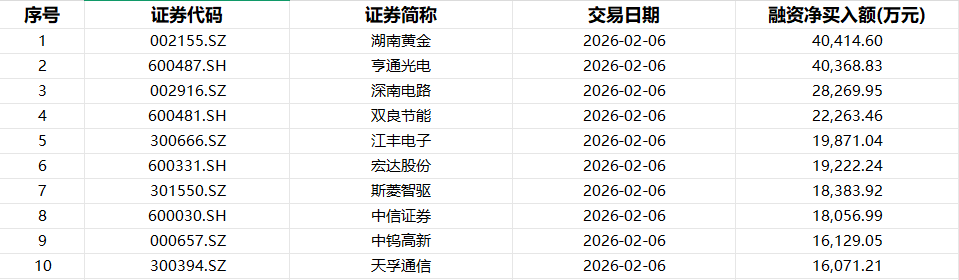
Summary of Key Points Core Viewpoint - As of February 6, the margin trading balance in A-shares is 26,636.6 billion yuan, a decrease of 17.2 billion yuan from the previous trading day, accounting for 2.6% of the A-share circulating market value [1] Group 1: Margin Trading Data - The margin trading transaction amount on the same day was 191.166 billion yuan, down by 8.185 billion yuan from the previous trading day, representing 8.83% of the A-share transaction amount [1] - All 31 primary industries in Shenwan showed a net repayment status, with the non-ferrous metals industry having the highest net repayment amount of 2.052 billion yuan [1] Group 2: Individual Stock Performance - A total of 21 individual stocks had a net buying amount exceeding 100 million yuan, with Hunan Gold leading at a net buying amount of 404.146 million yuan [2] - Other notable stocks with significant net buying amounts include Hengtong Optic-Electric, Shenzhen South Circuit, Shuangliang Energy, Jiangfeng Electronics, Hongda Shares, Starlight Intelligent Drive, CITIC Securities, Zhongtung High-Tech, and Tianfu Communication [2]







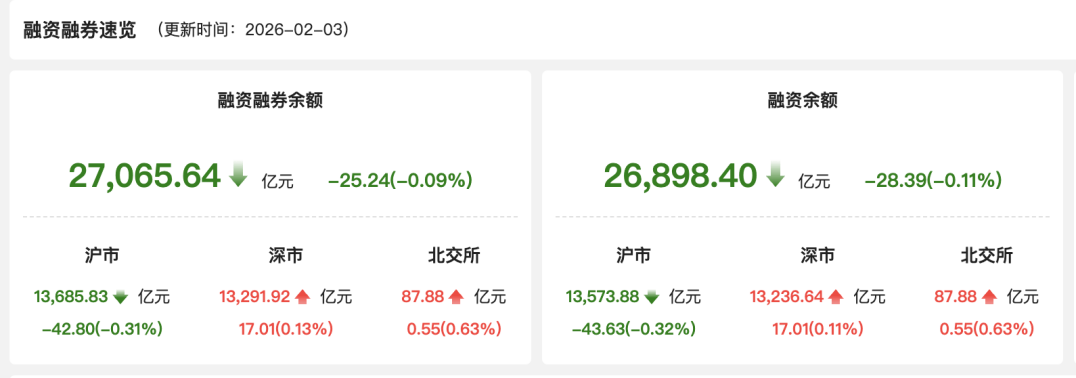
3日两融余额减少25.24亿元 通信行业获融资净买入居首
Sou Hu Cai Jing· 2026-02-04 01:57
Summary of Key Points Core Viewpoint - The total margin trading balance in A-shares decreased to 27,065.64 billion yuan, reflecting a slight decline of 25.24 billion yuan or 0.09% from the previous trading day, representing 2.64% of the A-share circulating market value [1]. Margin Trading Data - The margin trading turnover for the day was 2,453.77 billion yuan, which is an increase of 21.38 billion yuan or 0.88% from the previous trading day, accounting for 9.56% of the total A-share trading volume [1]. - The financing balance was reported at 26,898.40 billion yuan, with a decrease of 28.39 billion yuan or 0.11% [2]. Sector Performance - Among the 31 primary industries tracked by Shenwan, 12 industries experienced net financing inflows, with the telecommunications sector leading with a net inflow of 1.561 billion yuan. Other notable sectors included defense, media, home appliances, and non-ferrous metals [2]. Individual Stock Performance - A total of 39 stocks had net financing inflows exceeding 100 million yuan, with Aerospace Development leading at 970 million yuan. Other significant stocks included Tianfu Communication, Xinwei Communication, and several others [3][4].