
加息

Search documents
美国CPI数据“不及预期”:比特币和以太坊会因此“狂欢”还是“跌落神坛”?
Sou Hu Cai Jing· 2025-10-24 17:49
Core Viewpoint - The recent US Consumer Price Index (CPI) data was lower than expected, raising questions about its impact on Bitcoin (BTC) and Ethereum (ETH) prices, with potential implications for market liquidity and risk appetite [1][2]. Group 1: Impact of CPI Data - A lower-than-expected CPI typically leads to reduced expectations for interest rate hikes, which can enhance market liquidity [3][4]. - Increased liquidity may drive more investments into high-risk assets like Bitcoin and Ethereum, potentially pushing their prices higher [3][4]. - The overall risk appetite in the market may improve, encouraging investors to take on more risk, benefiting cryptocurrencies [3][4]. Group 2: Market Reactions and Considerations - The degree of the CPI miss (slight vs. significant) can influence market reactions, with minor misses likely causing only small fluctuations [5]. - Other macroeconomic factors, such as employment data and geopolitical events, can also significantly affect market direction [6]. - Market sentiment may already account for the possibility of interest rate cuts, leading to a "buy the rumor, sell the news" effect where prices may not rise as expected after the data release [6]. Group 3: Broader Economic Implications - A lower CPI could indicate weak consumer demand, suggesting potential economic slowdown, which may negatively impact all asset classes, including cryptocurrencies [6][8]. - While inflation concerns may ease, worries about economic recession could rise, affecting the attractiveness of high-risk assets like Bitcoin and Ethereum [8][9]. - Long-term trends in cryptocurrency prices will still be influenced by fundamental macroeconomic factors, including global economic growth and regulatory policies [9].
每日机构分析:10月24日
Sou Hu Cai Jing· 2025-10-24 08:08
Group 1 - The Federal Reserve remains highly sensitive to inflation fluctuations, with ongoing price pressures from tariffs and immigration policies complicating anti-inflation trends [1] - The U.S. September CPI report is expected to show a year-on-year increase of 3.1%, marking a 16-month high, which will test the Fed's monetary policy direction [2] - Japan's rising inflation, with the consumer price index accelerating to 2.9% in September, opens the door for a potential interest rate hike by the Bank of Japan in December [3] Group 2 - South Korea's GDP growth is projected to accelerate in Q3, with a median forecast of 1.0% quarter-on-quarter growth and 1.5% year-on-year growth, driven by government cash subsidies and strong exports [3] - The Malaysian ringgit is expected to trade around 4.20 against the U.S. dollar, with potential upward movement due to anticipated Fed rate cuts [4] - Russia's central bank may halt or slow its rate-cutting cycle due to inflation risks exacerbated by attacks on oil refineries and upcoming tax increases [5]
日本央行:9月核心CPI涨2.9%,加息时机仍存分歧
Sou Hu Cai Jing· 2025-10-24 06:47
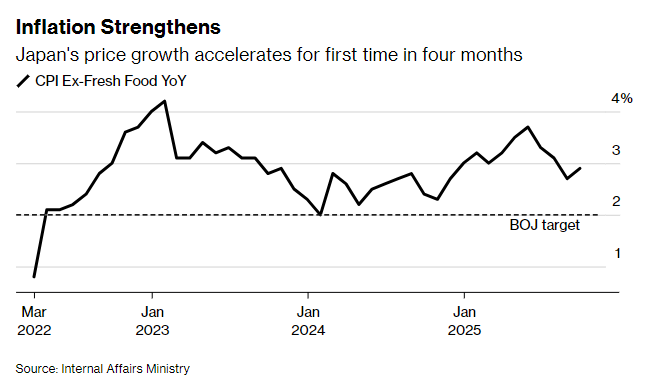
Core Insights - Japan's core CPI rose by 2.9% year-on-year in September, exceeding the central bank's target for the third consecutive year, driven by energy and food prices [1] - The inflation data has accelerated beyond expectations, increasing pressure for a rate hike in the upcoming policy meeting [1] - The Bank of Japan's internal concerns about inflation risks have risen, with two members proposing a rate increase to 0.75% during the September meeting, marking the first hawkish voices [1] Inflation and Economic Indicators - The core CPI, excluding fresh food, increased to 2.9% in September from 2.7% in August, aligning with expectations [1] - Food prices, excluding fresh items, surged by 7.6% year-on-year, while the core indicator rose by 3.0%, showing a slowdown compared to August [1] - Service sector price increases are significantly lower than those of goods [1] Economic Growth and Central Bank Stance - Despite ongoing inflation, growth momentum is weakening, with private sector growth losing steam in October, manufacturing contracting, and service sector momentum diminishing [1] - The Bank of Japan remains cautious, expressing concerns over the impact of U.S. tariffs [1] - The central bank exited its aggressive stimulus plan last year and raised rates to 0.5% in January, with Governor Ueda emphasizing the need for sustainable inflation before further rate hikes [1] Market Expectations - Most analysts and investors anticipate that the central bank will maintain the current interest rate, but the inflation exceeding targets and internal divisions have heightened expectations for a rate hike, potentially delaying the next increase until January next year [1]
日本央行:9月核心CPI涨2.9%,或持续按兵不动
Sou Hu Cai Jing· 2025-10-24 06:47
Core Insights - Japan's core consumer price index (CPI) rose by 2.9% year-on-year in September, exceeding the 2% target and accelerating from 2.7% in August, which sustains short-term interest rate hike expectations [1] - The core CPI, excluding volatile food prices, showed a year-on-year increase of 3%, down from 3.3% in August, indicating a mixed inflation trend [1] - The inflation in Japan is primarily driven by rising energy costs and food prices, with food prices (excluding fresh items) increasing by 7.6% year-on-year in September [1] Economic Indicators - The overall consumer price index and core CPI both recorded a 2.9% increase, aligning with expectations but accelerating from the previous month [1] - Service sector prices increased by only 1.4%, significantly lower than the 4.2% rise in goods prices, highlighting a disparity in inflation across sectors [1] - Rice prices surged by 63% year-on-year in September, reaching the highest level since 2006, following last year's rice shortage [1] Monetary Policy Outlook - The Bank of Japan is set to hold a monetary policy meeting next week to consider the inflation data and discuss whether to maintain the current interest rate of 0.5% [1] - Experts predict that the inflation rate, excluding food, may meet or exceed the central bank's expectations, although the Bank of Japan has been cautious in its recent statements [1] - The central bank raised the short-term interest rate to 0.5% in January after ending its aggressive stimulus program last year, with potential for another rate hike in January 2024 [1]
日本CPI加速,加息时机仍存争议
Hua Er Jie Jian Wen· 2025-10-24 04:19
Core Insights - Japan's September inflation data exceeded expectations, with the core Consumer Price Index (CPI) rising 2.9% year-on-year, maintaining above the Bank of Japan's 2% target for over three years, adding pressure for interest rate hikes in the upcoming policy meeting [1] - Despite persistent inflation, there is a division within the Bank of Japan regarding the timing of interest rate hikes, with most analysts expecting the central bank to keep rates unchanged at 0.5% during the next meeting [1][4] - The new Prime Minister emphasized the government's ultimate responsibility for economic policy and the importance of close coordination with the central bank [1] Inflation Drivers - The acceleration in inflation is primarily driven by rising energy costs and ongoing increases in food prices, with food prices (excluding fresh items) rising 7.6% year-on-year [2] - The core inflation measure, excluding fresh food and fuel costs, rose 3.0% year-on-year, slightly down from 3.3% in August [2] - Service prices increased by 1.4% year-on-year, significantly lower than the 4.2% increase in goods prices, indicating that businesses are gradually passing on higher labor costs [2] Economic Growth Concerns - Despite ongoing inflation, economic data indicates a weakening growth momentum, with the latest Purchasing Managers' Index (PMI) showing further loss of momentum in the private sector for October [2] - The manufacturing sector remains in contraction, while the service sector, although a key growth driver, is showing signs of slowing momentum [2] Central Bank Policy Outlook - The Bank of Japan's policymakers may prefer to wait for more robust economic signals before taking action, with recent statements reflecting caution regarding the impact of U.S. tariffs on the economy [3][4] - The central bank exited a decade-long aggressive stimulus plan last year and raised short-term rates to 0.5% in January, believing Japan is nearing a sustainable 2% inflation target [4] - The Bank of Japan's Governor emphasized the need for sustainable inflation driven by strong domestic demand and wage growth before resuming the rate hike cycle [5] - While most economists and investors expect the central bank to maintain rates next week, the persistent inflation above target and increasing internal divisions within the bank are raising expectations for future rate hikes [5]
日本通胀又抬头!新首相高市早苗上任即迎首道考题
智通财经网· 2025-10-24 01:49
Core Insights - Japan's core inflation rate accelerated to 2.9% in September, up from 2.7% in August, marking the first increase in four months, which poses governance challenges for the new Prime Minister, Kishi Matsumoto [1][4] - The inflation data aligns with economists' expectations, indicating that last year's substantial utility subsidies have contributed to this year's inflation figures [1][4] Inflation Data - The Consumer Price Index (CPI) excluding fresh food rose by 2.9% year-on-year in September, consistent with economists' median forecasts [1][4] - Energy prices increased by 2.3% year-on-year, reversing a decline of 3.3% in August, while the government implemented utility subsidies to help households cope with the summer heat [4][5] - Rice prices, a significant contributor to inflation, saw a year-on-year increase of 49.2%, down from 69.7% in August, indicating a slowdown in inflationary pressure [4][6] Economic Policy Implications - The inflation report supports Prime Minister Kishi Matsumoto's focus on addressing the cost of living crisis as a top priority [4][6] - Economists predict that the Bank of Japan (BOJ) will maintain its current policy rate in the upcoming meeting, with potential rate hikes expected in December or January [5][6] - The BOJ faces challenges in tightening monetary policy due to persistent price pressures, despite a cautious approach to avoid premature tightening [5][6] Future Outlook - A core inflation indicator, excluding energy prices, rose by 3.0%, showing a slight slowdown from 3.3% [5] - Service prices, a key component of sustainable inflation, increased by 1.4% year-on-year, slightly down from the previous month [5] - The potential for further declines in core inflation is suggested as rice price increases have peaked [6]

日本9月核心CPI同比上涨2.9% 能源成本推升通胀
Xin Hua Cai Jing· 2025-10-24 00:39
Core Insights - Japan's core consumer price index (CPI) rose by 2.9% year-on-year in September, indicating a slight rebound from August and highlighting the cost of living pressures the new government will face [1][1][1] - Rising energy costs are the primary driver behind the inflation increase, with key inflation indicators remaining at or above the Bank of Japan's 2% target for three and a half years [1][1][1] - Economists predict that the Bank of Japan may implement its next interest rate hike in December 2025 or January 2026, with a shift in expectations for a 25 basis point increase from October to December [1][1][1] Economic Policy Implications - The new Prime Minister, Sanna Takashi, has identified addressing the cost of living crisis as a key focus of her administration, with current inflation data providing a basis for her policy agenda [1][1][1] - The coordination between the government and the Bank of Japan regarding monetary policy will be tested as the new administration seeks to manage inflation while addressing economic challenges [1][1][1]
“鸽派首相”反而促使日央行更鹰?前央行官员预测:最快12月加息
Xin Lang Cai Jing· 2025-10-23 05:12
Core Viewpoint - The Bank of Japan (BOJ) is likely to raise interest rates before December, influenced by the new Prime Minister's expansionary fiscal policies, which may help the economy withstand U.S. tariffs [1][2]. Group 1: Interest Rate Outlook - Former BOJ member Maeda Eiji suggests that the central bank should gradually increase interest rates, as the slow pace has led to negative effects such as soaring urban housing prices and rising living costs due to a weak yen [1]. - Maeda predicts that the BOJ may raise rates to 0.75% in December or January, with a potential further increase to 1% by summer next year, entering the neutral interest rate range [3][4]. Group 2: Economic Conditions - The impact of U.S. tariffs on Japan's economic growth is less severe than initially expected, and Japanese companies are likely to maintain positive capital expenditure and wage increase plans [1]. - The BOJ's next policy meeting is scheduled for October 29-30, where they will discuss maintaining the current rate of 0.5% and release new economic growth and inflation forecasts [3]. Group 3: Government and Monetary Policy Interaction - There are concerns that the new Prime Minister, who supports expansionary fiscal and dovish monetary policies, may lead to a delay in rate hikes. However, Maeda argues that the government's stimulus measures could actually accelerate inflation, prompting the BOJ to raise rates sooner [5].
日本央行年底前加息概率被低估?鸽派首相或挡不住紧缩步伐
Jin Shi Shu Ju· 2025-10-22 06:10
Group 1 - A majority of economists expect the Bank of Japan to raise key interest rates in October or December, with nearly 96% predicting a minimum increase of 25 basis points by the end of March next year [1][2] - Among 75 economists surveyed, 60% anticipate the Bank of Japan will raise short-term rates from 0.50% to 0.75% within the current quarter [1] - The internal stance of the Bank of Japan's policy committee appears to favor an interest rate hike, despite potential delays due to domestic political and global economic uncertainties [2] Group 2 - Financial markets currently price in a 40% probability of an interest rate hike before the end of the year [3] - High City Sawa, the newly appointed Prime Minister, has committed to increasing government spending in key areas such as energy and economic security under a framework of "responsible and proactive fiscal policy" [3] - Among respondents, 67% expressed uncertainty about agreeing with High City Sawa's economic policies [3][4] Group 3 - Concerns about the impact of fiscal policies on financial health were raised by nearly two-thirds of respondents [4] - Market pressures, such as rising long-term bond yields, may constrain fiscal expansion efforts [5]
每日投行/机构观点梳理(2025-10-21)
Jin Shi Shu Ju· 2025-10-21 10:14
Group 1 - Morgan Stanley suggests shorting the dollar in a "blonde girl" environment where US stocks rise while Treasury losses are controlled [1] - Bank of America warns that tightening credit conditions may trigger passive selling, indicating potential bear market signals for the stock market [1] - Goldman Sachs expects a 0.3% month-on-month increase in both overall and core CPI for September, maintaining core inflation around 3.1% [2] Group 2 - Societe Generale indicates that a mild recession in the US could lead to a weaker dollar due to potential rate cuts [3] - UBS believes that the Bank of Japan is likely to raise interest rates in the coming months, supported by rising long-term inflation expectations [4] - Citigroup does not anticipate that the new Japanese Prime Minister will pressure the Bank of Japan to avoid rate hikes, given the current economic context [5] Group 3 - Goldman Sachs predicts Brent crude oil prices will drop to $52 per barrel by Q4 next year, citing inventory increases and refining margins [8] - Singapore Bank notes that investors may still be keen to increase gold allocations during price pullbacks, raising their 12-month gold price forecast to $4,600 per ounce [9] - Canadian banks forecast record corporate earnings for Q3, supporting the Toronto stock market's upward trend [10] Group 4 - Huachuang Securities reports a recovery in fund allocations to credit bonds, suggesting opportunities in 4-5 year maturities [11] - Galaxy Securities highlights a market style shift benefiting the food and beverage index, with a focus on new consumption trends [12] - CITIC Securities observes a divergence in economic data for September, with production remaining resilient while demand indicators decline [13] Group 5 - CITIC Securities notes that recent adjustments to Hainan's duty-free shopping policy could boost sales, enhancing consumer experience and increasing foot traffic [14] - CITIC Securities also reports advancements in solid-state battery technology, which may accelerate the commercialization process [15]