
半导体

Search documents
四川双马:目前公司在保持原有建材生产制造业务经营的同时正在着力发展生物医药研发生产业务
Zheng Quan Ri Bao Wang· 2026-01-22 09:47
Core Viewpoint - Sichuan Shuangma is focusing on developing its biopharmaceutical research and production business while maintaining its existing building materials manufacturing operations [1] Group 1: Company Operations - Sichuan Shuangma is engaged in industrial investment and management as well as private equity fund management [1] - The company is managing and participating in investments in multiple private equity funds across various sectors including smart manufacturing, semiconductors, new energy, new consumption, health care, and biotechnology [1] Group 2: Investment Philosophy - The company adheres to the philosophy of promoting industry through capital, supporting the development of the real economy [1]

中天精装(002989.SZ):2025年前三季度,公司创新业务收入规模较小
Ge Long Hui· 2026-01-22 06:44
Core Viewpoint - The company is establishing new subsidiaries to focus on innovative businesses, which are expected to have a minor impact on overall revenue in the near term [1] Group 1 - The company will set up a controlling subsidiary, Shenzhen Weifeng Technology Co., Ltd., focusing on semiconductor packaging and testing equipment [1] - Another subsidiary, Zhejiang Zhongtian Shucan Technology Co., Ltd., will primarily engage in AI integration services [1] - The revenue from these innovative businesses is expected to be small in scale during the first three quarters of 2025, not significantly affecting the company's total operating revenue [1]

澄天伟业拟定增募资8亿元加码热门赛道,此前实控人及一致行动人完成大额减持
Mei Ri Jing Ji Xin Wen· 2026-01-22 05:53
Group 1 - The core point of the article is that Cheng Tian Wei Ye (300689), a stock that has increased sixfold, has announced a plan to raise 800 million yuan through a private placement, while its actual controller and related parties have reduced their holdings by nearly 6% in the past six months [1] - The company plans to invest the raised funds into popular technology sectors such as liquid cooling and semiconductors [1] - Cheng Tian Wei Ye was listed on the ChiNext board in 2017, and its main business includes the production, sales, and services of smart cards and specialized chips [1] Group 2 - The actual controller of the company is Feng Xueyu, and the company is involved in trending concepts like liquid cooling servers, chips, and semiconductors [1]
股指期权数据日报-20260122
Guo Mao Qi Huo· 2026-01-22 05:40
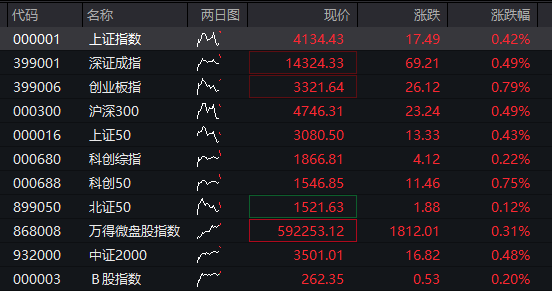
1. Report Industry Investment Rating - No relevant information provided 2. Core View - On January 21, the A - share market fluctuated higher. Gold stocks had a limit - up surge, and the semiconductor and AI computing power industry chains exploded. The Shanghai Composite Index rose 0.08% to 4116.94 points, the Shenzhen Component Index rose 0.7%, the ChiNext Index rose 0.54%, the Beixin 50 rose 0.14%, the Kechuang 50 rose 3.53%, the Wind All - A rose 0.57%, the Wind A500 rose 0.37%, and the CSI A500 rose 0.44%. The total trading volume of A - shares throughout the day was 2.62 trillion yuan, compared with 2.8 trillion yuan the previous day [5] 3. Summary by Related Catalogs 3.1 Market Review - **Index Performance**: The closing price of the SSE 50 was 3067.1753, with a decline of 0.11%, a trading volume of 198.826 billion yuan, and a turnover of 6.566 billion. The closing price of the CSI 300 was 4723.0692, with an increase of 0.09%, a trading volume of 665.331 billion yuan, and a turnover of 26.635 billion. The closing price of the CSI 1000 was 8247.6798, with an increase of 0.79%, a trading volume of 564.721 billion yuan, and a turnover of 32.568 billion [3] - **CFFEX Stock Index Option Trading**: For the SSE 50, the option trading volume was 2.86 million contracts, with 1.83 million contracts for call options and 1.03 million contracts for put options, and the PCR was 0.56. The option position was 5.92 million contracts, with 3.66 million contracts for call options and 2.26 million contracts for put options, and the PCR was 0.62. For the CSI 300, the option trading volume was 9.17 million contracts, with 6.10 million contracts for call options and 3.08 million contracts for put options, and the PCR was 0.50. The option position was 16.37 million contracts, with 9.77 million contracts for call options and 6.60 million contracts for put options, and the PCR was 0.68. For the CSI 1000, the option trading volume was 25.82 million contracts, with 15.13 million contracts for call options and 10.70 million contracts for put options, and the PCR was 0.71. The option position was 28.26 million contracts, with 14.25 million contracts for call options and 14.02 million contracts for put options, and the PCR was 0.98 [3] 3.2 Volatility Analysis - **SSE 50 Volatility**: The report presents the historical volatility, historical volatility cone, and volatility smile curve of the SSE 50, including values such as the current value, maximum, minimum, and different percentile values [4] - **CSI 300 Volatility**: The report shows the historical volatility, historical volatility cone, and volatility smile curve of the CSI 300, including various percentile values and the current value [4] - **CSI 1000 Volatility**: The report provides the historical volatility, historical volatility cone, and volatility smile curve of the CSI 1000, including different percentile values and the current value [4]
锦浪科技涨2.01%,成交额4.00亿元,主力资金净流入996.38万元
Xin Lang Cai Jing· 2026-01-22 03:02
Group 1 - The core viewpoint of the news is that Jinlang Technology has shown a positive stock performance with a year-to-date increase of 11.02% and a market capitalization of 31.562 billion yuan as of January 22 [1] - As of January 9, the number of shareholders for Jinlang Technology increased to 70,400, with an average of 4,563 circulating shares per person, indicating a slight decrease of 1.20% [2] - For the period from January to September 2025, Jinlang Technology achieved a revenue of 5.663 billion yuan, representing a year-on-year growth of 9.71%, and a net profit attributable to shareholders of 865 million yuan, reflecting a growth of 29.39% [2] Group 2 - Jinlang Technology has distributed a total of 660 million yuan in dividends since its A-share listing, with 318 million yuan distributed over the past three years [3] - As of September 30, 2025, the top ten circulating shareholders of Jinlang Technology include significant institutional investors, with Hong Kong Central Clearing Limited holding 4.7163 million shares, a decrease of 267,500 shares from the previous period [3] - New entrants among the top ten circulating shareholders include the Guangfa High-end Manufacturing Stock A and the photovoltaic ETF, indicating a shift in shareholder composition [3]

思特威跌2.03%,成交额6.51亿元,主力资金净流出2382.57万元
Xin Lang Cai Jing· 2026-01-22 02:46
Core Viewpoint - The stock of Sitwei (Shanghai) Electronic Technology Co., Ltd. has shown fluctuations in trading, with a recent decline of 2.03% and a market capitalization of 40.637 billion yuan. The company specializes in high-performance CMOS image sensor chips, with a significant increase in revenue and net profit year-on-year [1][2]. Group 1: Stock Performance - As of January 22, Sitwei's stock price was 101.01 yuan per share, with a trading volume of 6.51 billion yuan and a turnover rate of 1.95% [1]. - Year-to-date, Sitwei's stock has increased by 6.23%, with a 6.67% rise over the last five trading days and an 11.10% increase over the last 20 days. However, there has been a decline of 9.91% over the last 60 days [1]. Group 2: Financial Performance - For the period from January to September 2025, Sitwei reported a revenue of 6.317 billion yuan, representing a year-on-year growth of 50.14%. The net profit attributable to shareholders was 699 million yuan, marking a significant increase of 155.99% [2]. - Since its A-share listing, Sitwei has distributed a total of 176 million yuan in dividends [2]. Group 3: Shareholder Information - As of September 30, 2025, the number of shareholders for Sitwei increased to 18,300, a rise of 38.46%. The average number of circulating shares per shareholder decreased by 27.78% to 17,619 shares [2]. - The top ten circulating shareholders include Hong Kong Central Clearing Limited, which holds 11.2342 million shares, an increase of 4.8608 million shares from the previous period [2].

创业板早盘涨1%,AI算力产业链延续强势, 军工板块活跃,恒指小幅上涨,黄金股大幅调整,商品齐涨
Hua Er Jie Jian Wen· 2026-01-22 02:15
Core Viewpoint - Tianfu Communication, a leading company in optical modules, has shown impressive performance driven by multiple favorable factors including rising storage chip prices and the strengthening of the AI computing power industry chain, contributing to the upward trend in the ChiNext and Sci-Tech 50 indices [1] Market Performance - On January 22, A-shares opened higher with all three major indices rising, particularly the ChiNext which increased by over 1%. The semiconductor and AI computing power sectors continued to strengthen, while gold stocks experienced significant adjustments [1] - The Hang Seng Index and the Hang Seng Tech Index opened higher but later declined, with most tech stocks falling [1] - As of the report, the Hang Seng Index rose by 0.29% and the Hang Seng Tech Index by 0.12% [2] Bond Market - The bond market saw a decline in government bond futures, with the 30-year main contract down by 0.05%, the 10-year contract down by 0.04%, and shorter-term contracts also experiencing slight declines [2][3] Commodity Market - Domestic commodity futures mostly rose, with lithium carbonate increasing by over 3%, and other commodities like asphalt, polysilicon, and fuel oil rising by 2%. However, precious metals like platinum and palladium saw declines of over 2% [3][5] Company Performance - Tianfu Communication, as a leader in optical devices, maintained growth with a profit forecast for 2025 expected to be between 1.881 billion to 2.15 billion yuan, representing a year-on-year increase of 40% to 60% [7] - Cambridge Technology, a rising star in optical modules, anticipates a profit of 252 million to 278 million yuan for 2025, with a year-on-year growth rate of 51.19% to 66.79% [8] Sector Trends - The AI computing power industry chain is showing strength, with companies like Longxin Zhongke rising by 8% and Tianfu Communication by over 4% [6] - The military industry sector experienced a surge, with companies like Triangle Defense hitting the daily limit up and others like Beimo High-Tech and Aerospace Technology rising over 6% [9][10]



平安证券(香港)港股晨报-20260122
Ping An Securities Hongkong· 2026-01-22 02:03
Market Overview - The Hong Kong stock market experienced fluctuations, with the Hang Seng Index closing at 23,831 points, down 145 points or 0.61% [1] - The market saw a net inflow of funds through the Stock Connect, totaling 484 million HKD, with the Shanghai and Shenzhen Stock Connects contributing 283 million HKD and 201 million HKD respectively [1] - The US stock market rebounded significantly, with the Dow Jones rising over 800 points, closing up 588 points or 1.2% at 49,077 points [2] Sector Performance - In the Hong Kong market, local real estate, software, and 5G concept sectors faced declines, while gold stocks performed well [1] - The technology sector, particularly semiconductor stocks, showed strong performance, with notable gains from companies like SMIC and Kuaishou, which rose by 3.69% and 3.62% respectively [1] - The US technology sector led the rebound, with Nvidia and Intel seeing increases of 3% and 11.7% respectively, the latter reaching a 52-week high [2] Investment Opportunities - The report emphasizes the importance of "technological self-reliance" and AI applications as key themes for future growth in the Hong Kong stock market, suggesting that leading companies in these sectors may see long-term development opportunities [3] - It is recommended to focus on sectors supported by government policies, including AI, semiconductors, and industrial software, as well as consumer sectors expected to benefit from increased domestic demand [3] - The report highlights the potential of upstream non-ferrous metals benefiting from anticipated interest rate cuts by the Federal Reserve in 2026, alongside strong performance in Q1 earnings [3] Key Company Insights - Li Ning Company, a leading sports brand in China, reported a revenue of 14.817 billion HKD for the first half of 2025, reflecting a year-on-year growth of 3.3% [10] - The company's gross margin was 50%, slightly down from the previous year due to increased promotional competition and adjustments in channel structure [10] - Li Ning's net profit for the same period was 1.737 billion HKD, a decline of 11% year-on-year, with a net profit margin of 11.7% [10]
晶方科技跌2.01%,成交额4.88亿元,主力资金净流出749.99万元
Xin Lang Cai Jing· 2026-01-22 01:52
Core Viewpoint - The stock of Jingfang Technology has experienced fluctuations, with a recent decline of 2.01% and a total market capitalization of 20.641 billion yuan, while the company shows significant revenue and profit growth year-on-year [1][2]. Financial Performance - For the period from January to September 2025, Jingfang Technology achieved a revenue of 1.066 billion yuan, representing a year-on-year increase of 28.48%, and a net profit attributable to shareholders of 274 million yuan, up 48.40% year-on-year [2]. - The company has distributed a total of 496 million yuan in dividends since its A-share listing, with 130 million yuan distributed over the past three years [2]. Stock Market Activity - As of January 22, 2025, Jingfang Technology's stock price is 31.65 yuan per share, with a trading volume of 488 million yuan and a turnover rate of 2.32% [1]. - The stock has increased by 14.43% year-to-date, with an 8.32% rise over the last five trading days and a 14.18% increase over the last 20 days [1]. Shareholder Structure - As of September 30, 2025, the number of shareholders for Jingfang Technology reached 147,700, an increase of 7.82% from the previous period, while the average number of circulating shares per person decreased by 7.26% to 4,416 shares [2][3]. - The second-largest circulating shareholder is Dongwu Mobile Internet Mixed A, holding 9.6 million shares, a decrease of 4.8575 million shares from the previous period [3].

半导体+国产芯片+光伏概念联动2连板!综艺股份9:30再度涨停,背后逻辑揭晓
Jin Rong Jie· 2026-01-22 01:46
Group 1 - The core viewpoint of the article highlights that Zongyi Co., Ltd. has experienced a consecutive two-day trading limit increase, indicating strong market interest and potential for further growth [1] - The stock reached a trading limit at 9:30 AM with a transaction volume of 298 million yuan and a turnover rate of 3.41%, reflecting significant trading activity [1] - The company plans to acquire control of Jilai Microelectronics through cash capital increase or share transfer, which is expected to constitute a major asset restructuring and involves integration in the semiconductor business [1] Group 2 - Zongyi Co., Ltd. operates in multiple sectors, including solar power plants and chip design, aligning with the current market focus on semiconductors, domestic chips, and photovoltaic-related sectors [1] - The combination of various themes surrounding the company's operations has heightened market attention and interest in its stock performance [1]
