国产算力

Search documents
寒武纪优化基础软件平台,或加速国产算力落地 | 投研报告
Zhong Guo Neng Yuan Wang· 2025-11-11 02:04
Overall Industry Performance - The electronic industry is experiencing a volatile and differentiated performance, with mixed results across various sectors [3] - The Shanghai Composite Index rose by 1.08%, while the Shenzhen Component Index increased by 0.19%, and the CSI 300 Index went up by 0.82% [2] Sector Analysis - The Other Electronics II sector showed the strongest performance with a weekly increase of 5.03%, leading the entire industry [3] - The Components sector rose by 2.14%, with printed circuit boards increasing by 1.90%, while passive components fell by 3.25%, indicating significant differentiation within the sector [3] - The Semiconductor sector remained flat overall, but there were notable internal differences, with semiconductor equipment rising by 4.80% and discrete devices increasing by 1.28%, while analog chip design and integrated circuit testing fell by 3.56% and 3.17% respectively [3] - The Optical and Optoelectronic sector slightly declined by 0.25%, with LEDs increasing by 1.07% and optical components decreasing by 1.04% [3] - The Consumer Electronics sector dropped by 2.45%, continuing its adjustment trend, with brand consumer electronics down by 6.22% [3] - The Electronic Chemicals II sector fell by 0.82%, with the Electronic Chemicals III sub-sector experiencing a similar decline [3] Notable Company Developments - Anshi China announced it has established sufficient inventory to meet customer demand until the end of the year [4] - Blue Arrow Electronics exited the semiconductor investment fund, terminating the co-investment matter [4] - Supermicro, in collaboration with Intel and Micron, set a world record in quantitative trading performance testing [4] - Samsung SDI is in talks with Tesla regarding LFP battery orders, targeting the U.S. energy storage market [4] - Lite-On Optoelectronics reported growth in both revenue and net profit for the first three quarters, with domestic OLED materials making significant breakthroughs [4] Investment Insights - The recent update of Cambrian's self-developed basic software platform NeuWare is seen as a comprehensive enhancement rather than a simple functional upgrade, shifting the value proposition of domestic computing power from "hardware replacement" to "platform replacement" [5] - As domestic hardware and software platforms accelerate their autonomy, the ecosystem for domestic chips may be strengthened, potentially leading to a new phase for domestic computing power [5]

华泰证券:短期继续“哑铃型”配置,关注低位景气品种
Mei Ri Jing Ji Xin Wen· 2025-11-10 00:39
Core Viewpoint - The short-term market is in a policy and performance vacuum, requiring more catalysts for the index to break through key levels, with the market likely to remain volatile [1] Group 1: Market Strategy - The recommendation is to maintain a "barbell" strategy in asset allocation [1] - In the technology sector, the pressure of crowding has eased, and after adjustments, the cost-effectiveness is gradually improving, focusing on low-position targets in areas such as Hang Seng Technology, domestic computing power, and AI applications [1] - Given the uncertainties both domestically and internationally, previously underperforming dividend stocks are experiencing a rebound, with current opportunities in banks and certain cyclical dividend stocks [1] Group 2: Sector Focus - The third-quarter reports and high-frequency indicators are cross-validating, indicating that varieties with non-crowded valuations and chips, such as new energy and chemicals, are worth attention [1] - In the medium term, seven key clues will be monitored: policy cycle, technology cycle, real estate cycle, capacity cycle, inventory cycle, energy cycle, and capital market reform, with advanced manufacturing and pro-cyclical consumption being potential decisive factors [1]

华泰证券:短期继续“哑铃型”配置 关注低位景气品种
Di Yi Cai Jing· 2025-11-10 00:33
Core Viewpoint - The market is currently in a policy and performance vacuum, requiring more catalysts for the index to break through key levels, with a likely focus on volatility in the near term [1] Group 1: Market Strategy - The recommendation is to maintain a "barbell" strategy in asset allocation [1] - In the technology sector, the pressure from overcrowding has eased, and after adjustments, the cost-effectiveness is gradually improving, with a focus on low-position targets in areas such as Hang Seng Technology, domestic computing power, and AI applications [1] - Given the uncertainties both domestically and internationally, previously underperforming dividend stocks are expected to see a rebound, with current opportunities in banks and certain cyclical dividend stocks [1] Group 2: Sector Focus - The third-quarter reports and high-frequency indicators are cross-validating, indicating that varieties with non-crowded valuations and chips, such as new energy and chemicals, are worth attention [1] - In the medium term, seven key clues will be monitored: policy cycle, technology cycle, real estate cycle, capacity cycle, inventory cycle, energy cycle, and capital market reform, with advanced manufacturing and pro-cyclical consumption being potential decisive factors [1]
蚂蚁透露!部署的万卡国产算力集群已媲美国际,超节点有望成国产算力加速发展重要动力
Xuan Gu Bao· 2025-11-09 23:32
Group 1 - Alibaba Group is building large-scale AI infrastructure and increasing investment to create a super AI cloud [1] - Ant Group has deployed a domestic computing power cluster at the scale of ten thousand cards, achieving over 98% stability in training task performance [1] - Minsheng Securities believes that super nodes are expected to become mainstream technology under cluster expansion, enhancing the domestic computing power ecosystem [1] Group 2 - The industry is focusing on building ultra-high bandwidth and ultra-low latency ScaleUp networks to connect multiple XPU high-speed interconnections into super nodes [2] - Huaxi Securities suggests that regardless of future restrictions on overseas computing power chip sales to China, domestic computing power development will remain a key focus of policy support [2] Group 3 - Zhongke Shuguang has launched the world's first 640-card single-machine super node, which can support trillion-parameter large model training and improve performance by 30%-40% compared to traditional solutions [3] - Qihua Data is constructing high-end GPU computing server clusters and expanding its data storage business into the AI server field [3]
计算机周观察20251109:英伟达对华销售芯片再遭限制,中科曙光发布全球首个单机柜级640卡超节点
CMS· 2025-11-09 12:44
Investment Rating - The report maintains a "Recommendation" rating for the industry, indicating a positive outlook for the sector's fundamentals and expected performance relative to the benchmark index [3]. Core Insights - The report highlights the ongoing restrictions on NVIDIA's chip sales to China, which may impact the competitive landscape in the AI and computing sectors [6][9]. - The launch of the world's first single-cabinet 640-card super node, scaleX640, by Inspur is noted as a significant technological advancement, enhancing performance and efficiency in large-scale computing deployments [6][10]. - The domestic software companies are showing signs of recovery from a low base, with institutional holdings and expectations at low levels, suggesting potential for growth as AI applications evolve [6][17]. Summary by Sections Weekly Highlights - NVIDIA faces new restrictions on chip sales to China, affecting its market presence [9]. - Inspur has introduced the scaleX640 super node, which boasts significant performance improvements and is designed for large-scale deployments [10]. - The performance of overseas SaaS companies has been positively influenced by AI technology applications, with many reporting substantial revenue growth [12]. Market Performance Review - The computer sector experienced a decline of 2.54% in the first week of November 2025, with notable stock performances from companies like Chunzong Technology and Yingfang Software [18][19].


曙光超节点重磅发布,国产算力有望持续取得突破
Orient Securities· 2025-11-08 12:14
Investment Rating - The industry investment rating is maintained as "Positive" [4] Core Insights - The release of the Shuguang super node marks a significant breakthrough in domestic computing power, showcasing advantages over traditional intelligent computing methods through high-speed interconnection technology, which enhances bandwidth and reduces latency [6] - The Shuguang Scale X640 super node, launched on November 6, 2025, is the world's first 640-card single-cabinet super node, designed for training trillion-parameter models, improving performance by 30%-40% compared to traditional solutions [6] - Domestic computing power and super nodes are expected to continue achieving breakthroughs, with the Shuguang X640 demonstrating top-tier performance, efficiency, reliability, and openness in the AI computing system [6] Summary by Sections Investment Recommendations and Targets - Recommended stocks include Haiguang Information (688041, Buy), Zhongke Shuguang (603019, Buy), and others that are either rated or not rated [3] Industry Overview - The report focuses on the computer industry in China, highlighting advancements in domestic computing capabilities and the competitive landscape [4][6]

曙光 scaleX640 重磅发布,国产算力加速突破
GUOTAI HAITONG SECURITIES· 2025-11-07 06:15
Investment Rating - The report assigns an "Increase" rating for the stocks mentioned, indicating a potential rise of over 15% relative to the CSI 300 index within the next 12 months [5][13]. Core Insights - The launch of the Shuguang scaleX640 marks a significant advancement in domestic computing power, achieving a 30-40% performance improvement in trillion-parameter model training and inference compared to traditional solutions [2][5]. - The scaleX640 enhances the cost-effectiveness of inference scenarios and is expected to accelerate the breakthrough of domestic computing chips in training applications [5]. - The report highlights the long-term stability of the scaleX640, which has undergone over 30 days of reliability testing, ensuring support for large-scale cluster deployments [5]. - The open architecture of the scaleX640 is anticipated to facilitate the integration of domestic computing software ecosystems and unify supernode structures, potentially leading to rapid iterations in domestic supernodes [5]. Summary by Sections Performance and Features - The scaleX640 boasts a 20-fold increase in computing density per cabinet and supports trillion-parameter model training, with a performance boost of 30-40% in inference scenarios compared to traditional methods [5]. - Innovative technologies such as ultra-high-speed orthogonal architecture, high-density blades, immersion phase change cooling, and high-voltage direct current power supply are employed in the scaleX640 [5]. Recommended Stocks - The report recommends the following stocks: - Cambrian-U (688256.SH) with a closing price of 1480.00 and an EPS forecast of 5.04 for 2025 [7]. - Haiguang Information (688041.SH) with a closing price of 239.68 and an EPS forecast of 1.34 for 2025 [7]. - SMIC (688981.SH) with a closing price of 124.85 and an EPS forecast of 0.46 for 2025 [7]. - Zhaoyi Innovation (603986.SH) with a closing price of 227.20 and an EPS forecast of 2.35 for 2025 [7]. - Shengke Communication-U (688702.SH) with a closing price of 119.31 and an EPS forecast of 0.04 for 2025 [7]. - The report also mentions Chipone Technology (688521) as a related stock [5].



刚刚,全球级超节点首落中国,赛局变了
国芯网· 2025-11-06 13:11
Core Viewpoint - The article emphasizes the significant advancements in China's semiconductor industry, particularly in the context of domestic data centers and the increasing demand for local chip solutions, which may lead to a reduction in the market share of imported chips like NVIDIA's in China [2][4]. Group 1: Domestic Chip Advancements - The recent release of the world's first single-cabinet 640-card super node, scaleX640, by Zhongke Shuguang marks a major breakthrough in domestic chip technology, designed to compete directly with NVIDIA's CUDA ecosystem [4]. - The scaleX640 super node features a "one-to-two" high-density architecture, achieving ultra-high-speed interconnects and enabling the construction of large-scale, high-bandwidth, low-latency communication domains [4]. - Compared to similar products in the industry, the scaleX640 has doubled its overall computing performance and increased the computing density by 20 times within a single cabinet [4]. Group 2: Competitive Landscape - Despite some performance gaps in underlying chip capabilities compared to NVIDIA's NVL72 super node architecture, the scaleX640 has surpassed NVIDIA in cooling technology, power supply solutions, hardware architecture, computing integration, and power density [5]. - Huang Renxun, CEO of NVIDIA, stated that China is poised to win the AI race due to favorable regulatory environments and lower energy costs, while criticizing certain countries for hindering progress [5]. - The emergence of open computing clusters like scaleX640 is seen as a way to bridge the gap in computing power by fostering collaboration across the AI industry, positioning China's AI innovation as a critical component for future advancements [5].


推理效率提升100%!“星火X1.5”发布,科大讯飞刘庆峰:AI红利已到兑现时刻
Zhong Guo Zheng Quan Bao - Zhong Zheng Wang· 2025-11-06 12:21
Core Insights - The company iFLYTEK has launched the "Xinghuo X1.5" deep reasoning model based on domestic computing power, emphasizing the transformative impact of AI on various industries and the need for integrated hardware and software solutions [1][2] Group 1: Product Development and Performance - The "Xinghuo X1.5" model utilizes a MoE (Mixture of Experts) architecture with a total parameter count of 293 billion and an activation count of 30 billion, achieving a 100% improvement in inference efficiency compared to its predecessor [2] - The model demonstrates capabilities in language understanding, text generation, knowledge Q&A, logical reasoning, mathematical skills, and coding, with its mathematical ability being internationally leading [2] - iFLYTEK's revenue for the first three quarters reached 16.989 billion yuan, a year-on-year increase of 14.41%, while the net profit for Q3 was 172 million yuan, a 202.40% increase year-on-year [3][4] Group 2: Market Position and Competitive Edge - iFLYTEK has secured the highest number and value of bids in the large model project market in China from January to September, with a total bid amount of 5.45 billion yuan in Q3 alone [4] - The company has made significant advancements in training efficiency for deep reasoning, increasing it from 30% to over 84% [3] Group 3: AI Integration and User Engagement - iFLYTEK has introduced integrated hardware solutions that enhance AI applications in real-world scenarios, achieving high accuracy rates in noisy environments with products like the intelligent office notebook and AI translation earphones [5] - The "AI Star Friend" product, designed as an emotional companion, has shown high user engagement with an average usage frequency of 9.8 times per week and a monthly active rate of 56% [6]

国产算力反弹,能否梅开二度?——科创芯片ETF大涨点评
Sou Hu Cai Jing· 2025-11-06 09:46
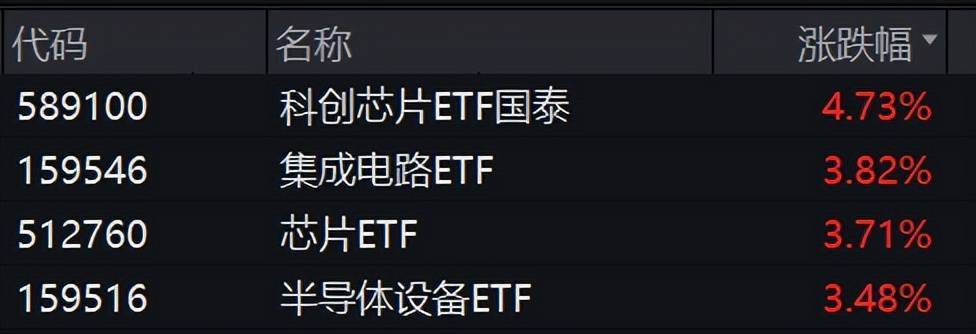
Market Performance - The market showed a strong upward trend with a total trading volume of 2.06 trillion yuan, an increase of 182.9 billion yuan compared to the previous trading day. The Shanghai Composite Index rose by 0.97%, the Shenzhen Component Index increased by 1.73%, and the ChiNext Index gained 1.84% [1] - The computing power sector rebounded, with domestic computing power showing stronger performance. The Science and Technology Innovation Chip ETF rose by 4.73%, the Integrated Circuit ETF increased by 3.82%, the Chip ETF gained 3.71%, and the Semiconductor Equipment ETF rose by 3.48% [1][2] Factors Driving the Increase - Negative sentiment has partially dissipated. Following the National Day holiday, TSMC's CoWoS capacity adjustment and strong overseas computing power contributed to market recovery. Despite optimistic capital expenditure statements from cloud companies, the market's expectations were not fully met, leading to a noticeable recent pullback. The computing power sector rebounded as value became more apparent during this pullback [3] - Continuous price increases in storage products are driven by AI demand, leading to a supply-demand mismatch. The shift of major overseas manufacturers towards DDR5 and HBM has caused a rapid exit of DDR4 capacity, resulting in price hikes. The tightness in related capacities is expected to persist and may worsen through 2026. According to CFM, prices for storage products in servers, mobile devices, and PCs are expected to continue rising in Q4 [3][4] - On the news front, the launch of the world's first single-cabinet 640-card super node scaleX640 by Inspur on November 6 during the World Internet Conference indicates advancements in high-bandwidth, low-latency communication technology [3] Future Outlook - There remains growth potential in both domestic and overseas capital expenditures, with no immediate concerns regarding capital spending. Recent financial reports indicate that cloud companies maintain an optimistic outlook on capital expenditures. For instance, Google raised its 2025 capital expenditure forecast from $80 billion to $91-93 billion, while Meta increased its forecast to $70-72 billion [6] - The demand for AI and related technologies is on the rise, with major cloud companies showing strong cash flow growth driven by AI. Except for Amazon, the other three major companies have capital expenditures in 2025 that account for less than 75% of their operating cash flow, indicating robust financial health [6] Investment Recommendations - Investors are advised to consider both North American and domestic computing power sectors for potential investments. The overall pace of AI development is accelerating, with improving fundamentals and no immediate tariff risks. However, market volatility may persist due to increased profit-taking, suggesting a strategy of buying on dips [7] - For overseas computing power, it is recommended to focus on communication ETFs with high core content, while for domestic computing power, the Science and Technology Innovation Chip ETF is expected to benefit from the release of domestic GPUs and rising storage prices. The Semiconductor Equipment ETF is also highlighted for its improved fundamentals due to advanced process expansion and storage capacity increases [7]