创新驱动

Search documents
中央经济工作会议:如何定调2026?
Yang Shi Wang· 2025-12-12 00:17
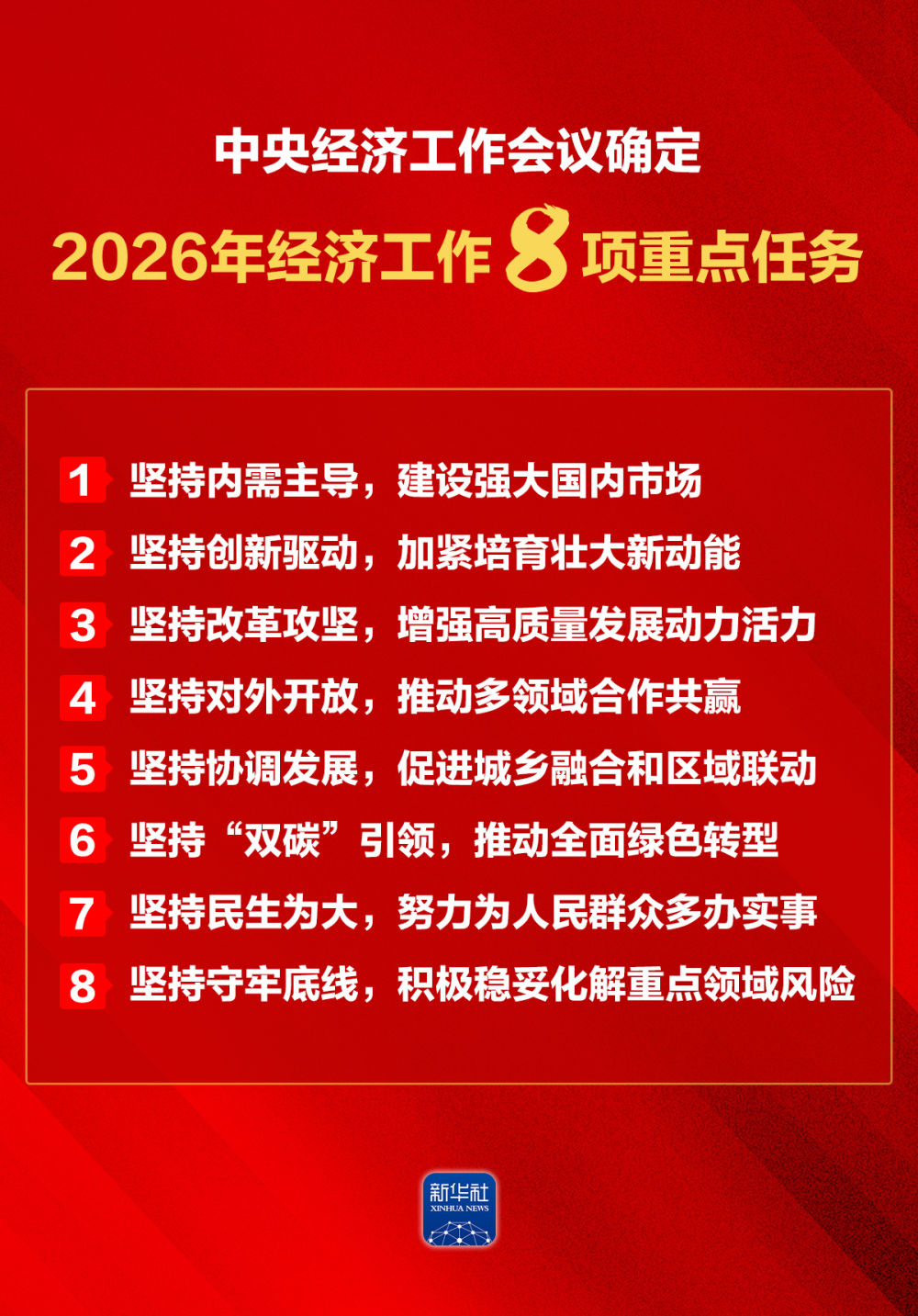
Core Viewpoint - The annual Central Economic Work Conference concluded on December 11, 2025, outlining the economic development direction for 2026, emphasizing stability and progress, quality improvement, and efficiency enhancement [1] Group 1: Economic Policy Direction - The conference clarified the policy orientation for economic work in 2026, focusing on maintaining stability while seeking progress [1] - The emphasis is on domestic demand as the main driver, innovation as a key factor, and reform as a critical challenge [1] Group 2: Key Tasks for 2026 - Eight major tasks for 2026 were identified, highlighting the importance of improving people's livelihoods [1]
中金:联合解读中央经济工作会议
中金点睛· 2025-12-11 23:47
Core Viewpoint - The Central Economic Work Conference held on December 10-11 in Beijing objectively analyzed the development situation of the Chinese economy, addressing various concerns regarding consumption, investment, real estate, corporate accounts, and market competition order. The policy direction for next year is "stability while seeking progress, improving quality and efficiency" [2][14]. Macro: Responding to Concerns, Improving Quality and Efficiency - The conference highlighted the importance of domestic demand as a primary task, emphasizing the implementation of special actions to boost consumption and the expansion of quality goods and services supply. It also aims to eliminate unreasonable restrictions in the consumption sector to unleash service consumption potential [5][6]. - On the demand side, the conference proposed a plan to increase urban and rural residents' income and optimize the implementation of "two new" policies, which may involve increasing social security spending to enhance disposable income and promote consumption growth [6][9]. - Government investment is expected to lead the way in stabilizing investment, with a focus on increasing central budget investment and optimizing the use of local government special bonds to alleviate financial pressures [6][9]. - The conference emphasized the need to actively and prudently resolve risks in key areas, particularly in the real estate sector, where it aims to stabilize the market and improve residents' purchasing power [7][9]. Strategies: Balancing Growth and Reform - The conference reiterated the need for a proactive fiscal policy while maintaining necessary fiscal deficits and total debt levels. It aims to optimize fiscal spending and strengthen fiscal management [10][23]. - Monetary policy is expected to remain moderately loose, with a focus on promoting stable economic growth and reasonable price recovery. The use of various policy tools, including interest rate cuts, is anticipated to be more flexible and efficient [11][24]. - The conference stressed the importance of innovation-driven development, with measures to enhance the role of enterprises in innovation and promote high-quality development of key industrial chains [12][16]. Real Estate: Focus on Supply Issues - The conference underscored the need to stabilize the real estate market, advocating for measures to control new supply, reduce inventory, and improve supply quality. It encourages the acquisition of existing homes for affordable housing [29][30]. - The emphasis on resolving inventory issues reflects a heightened focus on the real estate sector's challenges, particularly in light of the ongoing supply-demand imbalance [29][30]. Consumption: Continuous Policy Support - The conference prioritized domestic demand, reiterating the importance of consumption in driving economic growth. It plans to implement measures to enhance residents' income and stabilize employment for key groups [38]. - Policies aimed at boosting consumer confidence and spending are expected to continue, with a focus on increasing the quality and availability of goods and services [38].


落细落实经济工作八项重点任务 实现“十五五”良好开局
Zheng Quan Shi Bao· 2025-12-11 18:36
Core Points - The Central Economic Work Conference held on December 10-11 outlines the economic work for 2025 and analyzes the current economic situation, setting specific policy arrangements and goals for 2026 [1] - The conference emphasizes the need for a "good start" to the 14th Five-Year Plan, with expectations for China's economic growth rate to be around 5% in 2026, as international organizations have raised their growth forecasts for China [1] Fiscal Policy - The fiscal policy for the 14th Five-Year Plan will continue to adopt a "more proactive" approach, maintaining necessary fiscal deficits while optimizing the structure of fiscal expenditures [2][3] - The fiscal deficit rate is expected to remain at or above 4%, with a total debt scale projected to increase from 12 trillion yuan this year [2][3] - There is a clear focus on "investing in people," with an emphasis on improving human capital and enhancing social welfare expenditures [3] Monetary Policy - The macroeconomic policy will adopt a more proactive stance, with monetary policy expected to remain "appropriately loose" and maintain ample liquidity [4][5] - The use of various policy tools, including interest rate cuts and reserve requirement ratio reductions, will be implemented flexibly and efficiently to support economic stability [4][5] - Structural monetary policy tools will be enhanced to support key areas such as expanding domestic demand and technological innovation [5] Domestic Demand Expansion - Expanding domestic demand is prioritized, with specific measures including the implementation of a plan to increase urban and rural residents' income and stabilize investment [6] - The focus on consumption and investment as key drivers for expanding domestic demand indicates a shift towards demand-side strategies [6] Innovation and Technology - The establishment of three international science and technology innovation centers in Beijing, Shanghai, and the Guangdong-Hong Kong-Macau Greater Bay Area is highlighted as a core strategy for fostering innovation [7][9] - The centers aim to leverage existing resources and address global technological competition, enhancing China's position in the global market [7][9] Market Reforms - The conference emphasizes the need for reforms to optimize the market environment, stimulate enterprise vitality, and deepen financial system support [10] - A key reform initiative includes the establishment of a unified national market, with a focus on improving the regulatory framework to support this goal [10] Capital Market Development - Continuous deepening of capital market reforms is emphasized, with a focus on enhancing the market's ability to serve technological innovation and the real economy [11][12] - The reforms will aim to improve the inclusiveness and coverage of the multi-tiered market system, facilitating the entry of long-term capital [12] Trade and Investment - The conference stresses the importance of promoting regional and bilateral trade and investment agreements to enhance cooperation and trade facilitation [14][15] - The focus on maintaining a multilateral trade system and expanding high-standard free trade agreements is seen as crucial for China's trade strategy [14][15] Real Estate Market Stability - The meeting underscores the importance of stabilizing the real estate market, with a particular emphasis on "de-stocking" as a key measure [16][17] - Encouraging the acquisition of existing housing for affordable housing purposes is identified as a significant strategy to address market challenges [17]
(经济观察)明确“路线图” 中央经济工作会议部署八项任务
Zhong Guo Xin Wen Wang· 2025-12-11 15:28
Core Insights - The Central Economic Work Conference outlined eight key tasks for China's economic work in 2026, emphasizing the importance of domestic demand and innovation as primary drivers for economic growth [1][2][3] Group 1: Domestic Demand and Market Development - The first task is to "insist on domestic demand as the main driver and build a strong domestic market," highlighting its significance in the overall economic development strategy [1] - The conference plans to implement actions to boost consumption and optimize policies related to new projects, indicating that expanding domestic demand remains a primary focus for economic work [1] Group 2: Innovation and New Growth Drivers - The second task emphasizes "insisting on innovation-driven development and accelerating the cultivation of new growth drivers," which is seen as crucial for constructing a new development pattern and expanding domestic demand [1][2] - Technological innovation is expected to create new products and consumption demands while reducing costs, thereby increasing supply [1] Group 3: Reform and High-Quality Development - The third task focuses on "insisting on reform to enhance the vitality of high-quality development," which includes deepening reforms and optimizing the business environment to remove institutional barriers [2] - This approach aims to stimulate internal dynamics and facilitate economic circulation [2] Group 4: Open Economy and International Cooperation - The fourth task is to "insist on opening up and promoting win-win cooperation in multiple fields," recognizing the complex changes in the development environment and the need for high-level openness to enhance domestic and international market interactions [2] Group 5: Coordinated Development - The fifth task emphasizes "insisting on coordinated development to promote urban-rural integration and regional linkage," which is essential for achieving a broader and more robust new development pattern [2] Group 6: Green Transformation - The sixth task focuses on "insisting on carbon neutrality as a guiding principle to promote comprehensive green transformation," aligning with the goals of reducing carbon emissions and promoting sustainable growth [2] Group 7: Social Welfare and Stability - The seventh task is to "insist on prioritizing people's livelihoods and strive to do practical things for the public," reiterating the importance of stabilizing employment, businesses, markets, and expectations [2][3] Group 8: Risk Management - The eighth task is to "insist on maintaining a bottom line and actively and prudently resolving risks in key areas," particularly in stabilizing the real estate market and managing local government debt risks [3] - The conference emphasizes a shift in economic policy focus from growth to quality and efficiency, advocating for a coordinated approach to policy implementation [3]
李迅雷解读中央经济工作会议:大国关系成为影响经济重要变量,以苦练内功开展“经贸斗争”
Xin Lang Cai Jing· 2025-12-11 14:57
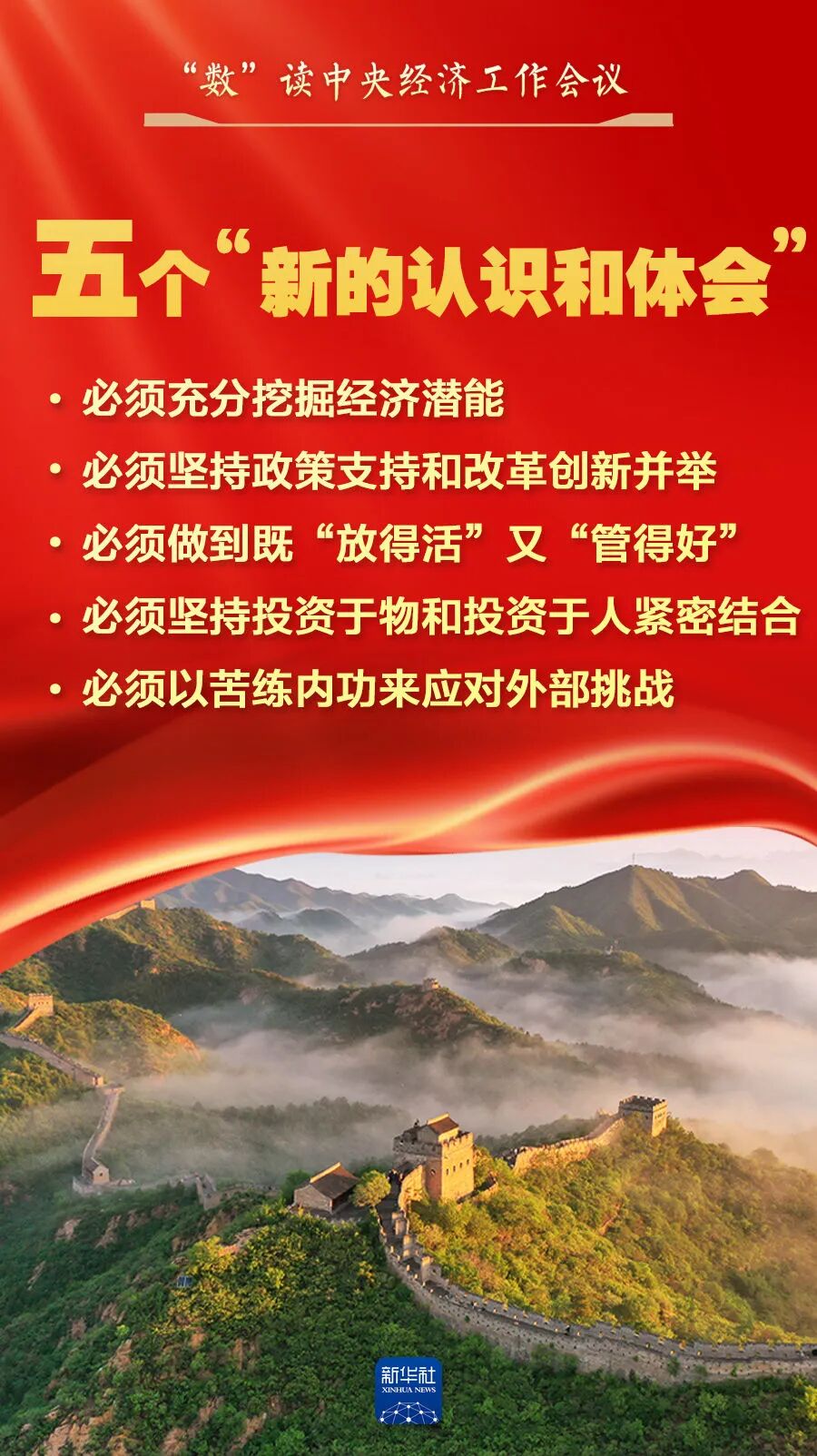
Core Viewpoint - The Central Economic Work Conference emphasizes the transition to a stock economy, highlighting the need for strategic responses to external economic pressures and the importance of balancing domestic economic work with international trade dynamics [1][2][3]. Group 1: Economic Strategy and Policy - The conference indicates a shift in focus towards internal capabilities to address external challenges, with a commitment to "stability while seeking progress" as a guiding principle for economic work [2][3]. - The emphasis on expanding domestic demand is identified as a key strategy to counter external shocks, with specific actions to boost consumer spending and increase residents' income [3][17]. - Investment policies will aim to stabilize and increase central budget investments, aligning with major project launches in the early years of the 14th Five-Year Plan [3][17]. Group 2: Trade and External Relations - The conference acknowledges the deepening impact of external environmental changes, reflecting a more confident stance in dealing with tariffs and technology restrictions [2][16]. - There is a focus on integrating trade and investment, as well as domestic and foreign trade, to enhance resilience in external demand [18]. Group 3: Fiscal and Monetary Policy - The fiscal policy will maintain necessary deficits and debt levels while optimizing project implementation, with expectations for a slight increase in the fiscal deficit rate to 4.2-4.5% [19][20]. - Monetary policy will remain flexible, with anticipated adjustments including a reduction in reserve requirements and interest rates, while also considering price stability as a new objective [20][21]. Group 4: Innovation and Structural Reform - The conference stresses the importance of innovation-driven growth, with initiatives to develop new economic drivers and enhance the quality of existing industries [22][23]. - There is a commitment to reforming the market structure to prevent "involution" and promote a unified national market, ensuring that traditional industries are not neglected in favor of new developments [23]. Group 5: Real Estate and Risk Management - The conference outlines measures to stabilize the real estate market, including targeted policies for inventory reduction and supply optimization [24]. - It also addresses the need to manage risks in key areas such as local government debt and small financial institutions, indicating a proactive approach to financial stability [12][24].
权威解读!中央经济工作会议这些提法,很新!
Shang Hai Zheng Quan Bao· 2025-12-11 14:51
Core Insights - The Central Economic Work Conference held on December 10-11, 2025, outlined key economic tasks for 2026, emphasizing the importance of domestic demand and market stability [1][2][10]. Group 1: Economic Policy Direction - The conference established a policy tone of "seeking progress while maintaining stability" and "improving quality and efficiency," highlighting a higher demand for economic quality and effectiveness [3][4]. - It was noted that macroeconomic policies will focus on both short-term and long-term adjustments, enhancing the effectiveness of governance [4]. Group 2: Fiscal Policy - A more proactive fiscal policy will be implemented, with a projected deficit rate of no less than 4% and an increase in new debt scale [5][6]. - The fiscal spending structure will shift towards supporting consumption and improving residents' welfare, including increased childcare subsidies and pension benefits [5][6]. Group 3: Monetary Policy - The conference reiterated the commitment to a moderately loose monetary policy, emphasizing the flexible use of various policy tools such as interest rate cuts and reserve requirement ratio adjustments [7][9]. - The aim is to enhance liquidity and promote economic stability through effective monetary policy coordination [7][9]. Group 4: Domestic Demand and Consumption - The primary task for 2026 is to "maintain domestic demand as the main driver and build a strong domestic market," with a focus on boosting consumption and investment [10][11]. - Specific measures to stimulate consumption include increasing fiscal support and expanding the range of supported consumer goods [11]. Group 5: Innovation and New Growth Drivers - The conference highlighted the importance of "innovation-driven development" as a key task, aiming to create a comprehensive innovation ecosystem [12][13]. - Initiatives include establishing international technology innovation centers and enhancing intellectual property protection in emerging fields [12][13]. Group 6: Capital Market Reforms - Continuous deepening of capital market reforms was emphasized, focusing on improving the investment and financing functions of the capital market [16][17]. - Future measures may include optimizing capital market infrastructure and enhancing investor protection [17]. Group 7: Real Estate Market Stability - The conference stressed the need to stabilize the real estate market through targeted policies, including inventory reduction and promoting affordable housing [25]. - Measures may involve using special bond funds to acquire existing housing for public welfare and implementing tax incentives for home purchases [25]. Group 8: Energy Strategy - The conference called for the formulation of a national energy strategy, focusing on building a new energy system and expanding green electricity applications [22][23]. - This marks a significant shift in energy development strategy, aiming to replace traditional fossil fuels with clean energy sources [22][23]. Group 9: Local Government Debt Management - The conference addressed the need to manage local government debt risks proactively, encouraging compliance and restructuring of existing debts [27][28]. - Strategies include replacing high-cost debts with lower-interest bonds and utilizing asset management techniques to mitigate risks [27][28].
川财证券首席经济学家陈雳:中国经济更重视消费升级与内需拉动
Bei Jing Shang Bao· 2025-12-11 14:47
Core Viewpoint - The 2026 macroeconomic outlook emphasizes a shift towards innovation-driven growth, with a focus on consumption and internal demand as key drivers of economic stability and transformation [3][4]. Group 1: Economic Trends - The year 2026 marks the beginning of the "14th Five-Year Plan," where China's economy is expected to achieve qualitative improvements through deepened reforms and expanded openness [1]. - Consumption remains the "ballast stone" for economic growth, with internal demand being elevated to a strategic priority [3]. - The transition from traditional factor-driven growth to innovation-driven growth is anticipated, alongside accelerated construction of a modern industrial system [3]. Group 2: Policy and Monetary Environment - The monetary policy is expected to maintain a moderately loose stance, characterized by stability in total volume and precision in structure [4]. - The timing and intensity of interest rate cuts and reserve requirement ratio adjustments will be flexibly managed based on economic conditions and inflation [4]. - There is an expectation for an increase in the scale of special bonds to support effective investment and ensure funding continuity for ongoing projects [4]. Group 3: Investment Opportunities - A combination of policies is expected to stabilize and activate the market, with the capital market showing a more robust and active trend in 2025 [4]. - The A-share market is projected to experience a structural bull market led by technology and new materials, with significant gains in sectors such as precious metals, communication, and power equipment [5]. - The military industry is anticipated to enter a new development cycle driven by certain demand and structural upgrades, while the coal and electricity sectors may present structural opportunities [5].
中央经济工作会议释放十大政策信号
21世纪经济报道· 2025-12-11 13:59
此次中央经济工作会议释放了哪些新信号,21世纪经济报道记者进行了梳理和解读。 作者丨王峰 编辑丨周上祺 中央经济工作会议12月10日至11日在北京举行。会议对2025年做出了"我国经济顶压前行、向 新向优发展"的重要判断。 这一局面来之不易,特别是2024年9月26日中央政治局会议果断部署一揽子增量政策,使社会 信心有效提振,经济明显回升,2025年宏观政策贯彻落实了多项超常规逆周期调节举措。 对于2026年经济工作,中央经济工作会议提出"加大逆周期和跨周期调节力度",其中对多项宏 观政策的部署,措辞则从2025年的"加大""加强""增加""扩大"等,转为更加注重"保持""优 化"。同时,会议提出了多项新举措、新任务。 信号一:继续实施更加积极的财政政策 会议指出,保持必要的财政赤字、债务总规模和支出总量,加强财政科学管理,优化财政支出 结构,规范税收优惠、财政补贴政策。重视解决地方财政困难,兜牢基层"三保"底线。严肃财 经纪律,坚持党政机关过紧日子。 会议还指出,适当增加中央预算内投资规模,优化实施"两重"项目,优化地方政府专项债券用 途管理。 回顾2025年,赤字率从2024年的3%提升至2025年的4% ...
锚定高质量发展 凝聚期货行业正向力量
Xin Lang Qi Huo· 2025-12-11 13:48
Core Viewpoint - The recent Central Economic Work Conference emphasized the importance of "seeking progress while maintaining stability" and "improving quality and efficiency," guiding the financial market to support high-quality development of the real economy [1] Group 1: Service to the Real Economy - The company focuses on serving the real economy as its foundational mission, implementing the "insurance + futures" model in agriculture with over 260 projects covering 24 provinces, involving 14 key agricultural products, and a total project amount exceeding 5.8 billion [2] - These projects have benefited over 560,000 farming households, providing price guarantees and contributing to the stability of primary product supply [2] - In the industrial sector, the company targets key industries like new energy and high-end manufacturing, offering personalized hedging solutions, with a 20% year-on-year increase in the number of clients served [2] Group 2: Reform and Innovation - The conference highlighted the need for reform and innovation to enhance development momentum, with the futures industry relying on product innovation and service upgrades [3] - The company actively engages in industry innovation, participating in the development of carbon emission rights and new energy materials derivatives, providing risk management tools for low-carbon transitions [3] - A comprehensive online and offline service system has been established, utilizing digital tools to lower the barriers for enterprises to participate in the futures market [3] Group 3: Risk Management - The company has built a comprehensive risk control system, emphasizing customer suitability management and strict regulatory compliance, with no major risk events reported throughout the year [4] - A monitoring system is in place to track abnormal trading behaviors, enhancing risk awareness among clients [4] - The company conducted over 350 investor education activities in 2025, reaching 120,000 investors, with 45% of activities focused on risk warnings for small and medium investors [4]

明年经济工作怎么干 记住“八个坚持”
Xin Hua She· 2025-12-11 13:30
Core Viewpoint - The Central Economic Work Conference has outlined eight key tasks for economic work in 2026, focusing on domestic demand, innovation, reform, openness, coordinated development, green transformation, improving people's livelihoods, and risk management [1]. Group 1: Domestic Demand and Market Development - Emphasis on maintaining domestic demand as the primary driver and building a strong domestic market [1]. Group 2: Innovation and New Momentum - Focus on innovation-driven growth and accelerating the cultivation of new growth drivers [1]. Group 3: Reform and High-Quality Development - Commitment to tackling reforms to enhance the vitality and momentum for high-quality development [1]. Group 4: Openness and Cooperation - Advocacy for maintaining openness and promoting win-win cooperation across multiple fields [1]. Group 5: Coordinated Development - Support for coordinated development to promote urban-rural integration and regional synergy [1]. Group 6: Green Transformation - Commitment to leading with "dual carbon" goals and promoting comprehensive green transformation [1]. Group 7: Livelihood Improvement - Focus on prioritizing people's livelihoods and striving to address practical issues for the populace [1]. Group 8: Risk Management - Emphasis on safeguarding the bottom line and actively and prudently resolving risks in key areas [1].