加息

Search documents
就在刚刚,美联储对外宣布了,美联储鲍尔森表示,如果通胀出现飙升,美联储将不得不采取行动,实现2%通胀率非常重要
Sou Hu Cai Jing· 2025-10-14 15:37
Core Viewpoint - The Federal Reserve's recent comments on inflation indicate a serious concern about rising prices, with a specific focus on maintaining the 2% inflation target, which has been a long-standing policy goal since 2012 [3][5][9] Inflation Indicators - The core PCE inflation rate, a key indicator monitored by the Federal Reserve, peaked at over 5% in 2023 but has since decreased to 3.9% as of August [3] - The Consumer Price Index (CPI) showed a decline from 9.1% in June 2022 to 3.7% in September 2023, yet essential items like food, housing, and healthcare continue to rise [5] Market Sentiment and Expectations - Public expectations for inflation remain high, with a survey indicating a 3.6% expectation for the next year, suggesting a lack of confidence in returning to the 2% target [5] - Market reactions to Federal Reserve signals have shown volatility, with the probability of interest rate hikes increasing from 15% to over 30% in early October [7] Monetary Policy Actions - The Federal Reserve has raised interest rates to a range of 5.25% to 5.50%, the highest level in 22 years, which increases borrowing costs for consumers and businesses [7] - The total credit card debt in the U.S. surpassed $1 trillion in Q2 2023, indicating significant financial pressure on consumers [7] Economic Challenges - The Federal Reserve faces a dilemma between managing rising debt levels among consumers and businesses and controlling inflation, which remains stubbornly high [9] - The potential for further interest rate hikes or balance sheet reduction could tighten market liquidity, impacting economic growth [11] External Factors - Ongoing trade issues, particularly between the U.S. and China, and rising international oil prices are contributing to inflationary pressures, complicating the Federal Reserve's policy decisions [5][9]


日本执政联盟破裂新首相或“难产” 日央行或推迟加息
2 1 Shi Ji Jing Ji Bao Dao· 2025-10-14 15:03
Market Overview - The Japanese stock market experienced significant declines, with the Nikkei 225 index falling by 2.58% and the Topix index dropping by 1.99% as of October 14 [1][2] - The decline was primarily driven by political instability following the announcement of the Komeito party's withdrawal from the ruling coalition with the Liberal Democratic Party, raising concerns about the potential inability of the new LDP president, Sanae Takaichi, to assume the role of Prime Minister [1][2] Currency and Bond Market - The Japanese yen showed volatility, initially declining but later rising due to increased demand for safe-haven assets, although it has depreciated by 2.79% against the US dollar for the month [1][3] - Japanese long-term government bond yields continued to rise, indicating investor disinterest in Japanese bonds, with the 20-year bond yield increasing by 0.15% and the 30-year bond yield rising by 0.81% [3][4] Political Impact on Financial Markets - The political uncertainty in Japan is expected to continue affecting the stock market, with potential for further declines if the political deadlock persists and external negative factors arise [3][6] - Analysts suggest that if political stability is restored and global risk appetite improves, the Japanese stock market may stabilize and rebound [3][6] Government Debt Concerns - Concerns regarding Japan's fiscal sustainability are heightened, with government debt exceeding 260% of GDP, leading to fears of increased bond issuance and potential fiscal deterioration [4][5] - The market anticipates that if the new government opts for fiscal stimulus measures, it could further increase the supply of government bonds, necessitating higher yields as compensation [4][5] Interest Rate Outlook - The likelihood of a rate hike by the Bank of Japan has diminished significantly, with current expectations for an increase in October at only 10%, down from 63% earlier in the month [6] - The political instability may lead the Bank of Japan to adopt a cautious approach regarding monetary policy, delaying any potential rate hikes until the political landscape stabilizes [6]
关税重压下出口受挫 日本第三季度经济或陷入萎缩
Zhi Tong Cai Jing· 2025-10-10 06:37
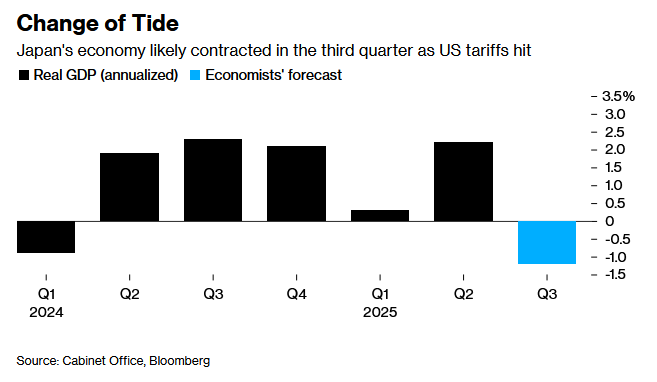
Group 1 - Japan's economy is expected to contract in the third quarter after five consecutive quarters of growth, primarily due to the impact of U.S. tariffs on exports [1][4] - Economists predict a year-on-year decline of 1.2% in Japan's GDP for the third quarter, a significant shift from previous expectations of a 0.1% increase [1][4] - The third quarter GDP data is scheduled to be released on November 17 [1] Group 2 - The potential economic downturn may provide support for the economic stimulus plan proposed by the new Liberal Democratic Party president, Sanae Takaichi [4] - Takaichi faces various economic challenges, including inflation pressures and trade tensions, with a focus on consolidating political support [4] - The Bank of Japan may slow down its interest rate hikes in response to the economic slowdown, with a monetary policy decision expected on October 30 [4] Group 3 - Economists forecast a 4% quarter-on-quarter decline in Japan's exports for the third quarter, worsening from a previous estimate of 3.1% [4] - Exports to the U.S. have seen significant declines, despite a trade agreement that fixed the tariff rate at 15%, which is still higher than before [4] - Many Japanese companies are reportedly lowering prices to absorb some of the tariff impacts and alleviate the burden on consumers [4] Group 4 - Private consumption in Japan is expected to grow by 0.5%, benefiting from wage increases resulting from spring labor negotiations [5] - However, core inflation remains significantly above the Bank of Japan's 2% target, continuing to erode household purchasing power [5]
瑞穗证券:仍预计日本央行短期将维持鹰派立场
Xin Hua Cai Jing· 2025-10-10 01:27
Core Viewpoint - The likelihood of a rate hike by the Bank of Japan in October is diminishing, but the central bank will maintain a hawkish stance in the short term without feeling an urgent need to raise rates [1] Group 1: Interest Rate Policy - The Bank of Japan has already implemented a 60 basis point increase, which has led to a significant rise in long-term Japanese government bond yields [1] - The central bank is expected to act cautiously to avoid excessive tightening of the economy [1] Group 2: Economic Sentiment and Risks - Weak household confidence may limit the Bank of Japan's actions [1] - There is a potential risk of a sudden appreciation of the yen due to increasing policy divergence between the Federal Reserve and the Bank of Japan, which could negatively impact Japan's exports and asset markets [1]
日本自民党总裁高市早苗:无意引发日元过度贬值
Di Yi Cai Jing· 2025-10-09 13:24
据报道,日本自民党总裁高市早苗表示,无意引发日元过度贬值;目前不便就加息发表评论。 (文章来源:第一财经) ...
日本薪资增长骤然失速 高市早苗上任先迎“冰冷现实”
智通财经网· 2025-10-08 02:00
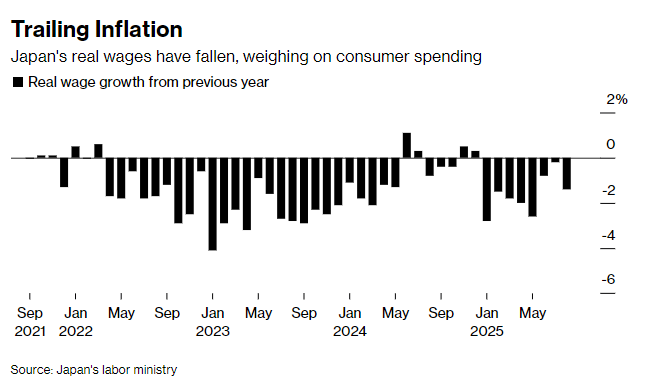
Core Insights - Japan's wage growth has dropped to its lowest level in three months, with real wages continuing to decline, presenting challenges for the new ruling party leader, Sanae Takaichi, who has promised to address rising living costs [1][4] Wage Growth and Economic Indicators - In August, nominal wages increased by 1.5% year-on-year, significantly down from 3.4% in the previous month and below economists' expectations of 2.7% [1][4] - Real cash income fell by 1.4% in August, marking the eighth consecutive month of decline, also weaker than anticipated [1][4] - The number of companies issuing extra bonuses decreased, leading to a 10.5% year-on-year drop in bonuses for August [4] Central Bank and Monetary Policy - Despite the disappointing wage data, a moderate growth trend in wages suggests that the Bank of Japan may still proceed with gradual interest rate hikes as planned [4] - Market expectations for a rate hike by the Bank of Japan have significantly cooled, with the probability dropping to about 25% from approximately 68% earlier in the week [4][6] - Takaichi's election as the ruling party leader has raised concerns about a more cautious monetary policy stance, which could impact market expectations [4][6] Economic Measures and Inflation - Takaichi is expected to introduce new economic measures to help families cope with inflation, including reducing gasoline and diesel taxes [5] - The persistent issue of rising living costs, particularly in essential goods like rice, has historically contributed to the ruling party's electoral losses [5] Key Economic Factors - The Bank of Japan's Governor, Kazuo Ueda, has emphasized the importance of wage growth and the impact of U.S. tariffs on Japanese corporate profits as critical factors to monitor for future economic outlooks [6] - The current economic data supports Takaichi's view that Japan's economy is not robust enough to warrant a tightening of monetary policy at this time [6]
GDP增长预期2.6%,华尔街三大投行警告,美国经济或面临过热风险
Sou Hu Cai Jing· 2025-10-07 16:37
Core Viewpoint - Wall Street analysts warn that the U.S. economy is in a "overheated" state, leading to concerns among retail investors about potential market volatility [1][2][6] Economic Conditions - Major investment banks like Goldman Sachs, UBS, and Citigroup have revised their GDP growth forecasts to as high as 2.6%, indicating a significant shift in outlook from previous cautious predictions [1] - The current economic environment is characterized by low interest rates, which have led to increased market leverage and speculative investments [1][4] Market Reactions - Analysts express mixed sentiments, with some criticizing the market's optimism towards the Federal Reserve while simultaneously engaging in riskier investments [2] - UBS warns that the overheating economy could lead to a complete reshuffling of asset allocations for fund managers [2] Consumer Behavior - Despite economic challenges, consumer spending remains robust, with technology companies significantly increasing capital expenditures, reminiscent of the 2000 internet bubble [4] - The labor market shows signs of weakness, yet wages have not decreased, which continues to fuel consumer confidence and spending [4] Investment Strategies - UBS suggests that small-cap stocks may outperform large-cap stocks in the current market, while Citigroup recommends focusing on copper options due to expected increases in global oil demand [6] - The investment landscape is shifting, with retail investors feeling uncertain as market conditions evolve rapidly [6][9] Regulatory Environment - Recent regulatory measures, such as the proposed "Price Law Amendment," are perceived as insufficient to protect ordinary consumers, with concerns that top capital will continue to benefit disproportionately [8] Market Sentiment - Social media reflects a mix of humor and anxiety regarding the economic situation, with investors actively discussing strategies to avoid pitfalls in a volatile market [8][9] - The general sentiment among retail investors is one of caution, emphasizing the importance of preserving capital amid market fluctuations [9]



日本央行暗示加息需耐心,紧盯美国关税与工资增长动向
智通财经网· 2025-10-06 08:23
Core Viewpoint - The Bank of Japan maintains a cautiously optimistic outlook on the economic prospects but warns of persistent uncertainties regarding the impact of U.S. tariffs on corporate profits, suggesting a wait-and-see approach before any interest rate hikes [1][2]. Economic Assessment - The Bank of Japan's assessment of eight regions indicates a "moderate recovery or rebound" in the economy, although one region's evaluation was downgraded [1]. - Some businesses are delaying spending plans due to uncertainties surrounding tariff impacts, while others are facing upward pressure on wages due to labor shortages and rising costs [2]. Wage and Capital Expenditure Trends - There is a potential for continued wage growth driven by structural labor shortages, but the actual impact of U.S. tariffs on corporate profits is just beginning to manifest, complicating wage negotiations for the following year [1][2]. - Many companies plan to increase capital expenditures to optimize operations and meet IT demands, although some are postponing or reviewing their spending plans due to tariff uncertainties [2]. Monetary Policy Context - The next policy meeting of the Bank of Japan is scheduled for October 29-30, where the regional economic assessment will be a key reference for deciding whether to raise the current interest rate of 0.5% [1]. - The recent election of new Liberal Democratic Party president, who supports fiscal expansion and a loose monetary policy, may influence the Bank of Japan's stance on interest rates [2][3]. Market Implications - The new leadership's support for stimulus plans is expected to boost the stock market but may exert pressure on the yen [3]. - Expectations regarding the Bank of Japan's policies could support short-term government bonds, while long-term bonds may face challenges due to concerns over increased fiscal spending [3].
日本央行行长植田和男讲话提高加息预期
Sou Hu Cai Jing· 2025-10-03 06:13
Core Viewpoint - The Bank of Japan's Governor Kazuo Ueda warned that the duration of rising prices may last longer than expected, potentially putting pressure on consumer spending. He indicated that if economic performance meets expectations, the Bank of Japan will raise the benchmark interest rate [2]. Group 1: Economic Outlook - Ueda's remarks have heightened market expectations for a near-term interest rate hike by the Bank of Japan [2]. - The current benchmark interest rate in Japan remains low, and when considering the inflation rate, the real interest rate in Japan is still negative [2]. Group 2: Market Implications - The anticipated interest rate hike by the Bank of Japan could strengthen the yen further, enhancing its safe-haven appeal [2]. - The Bank of Japan's monetary policy is largely aligned with that of the Federal Reserve, as indicated by Warren Buffett's recent increase in investments in Japanese trading companies [2]. Group 3: Potential Economic Impact - A gradual increase in the benchmark interest rate may negatively impact the Japanese economy, as higher rates could exacerbate existing economic challenges [2].