
降息

Search documents
卡什卡利力挺鲍威尔:政府攻击实为干预货币政策,1月降息“太早”
Jin Shi Shu Ju· 2026-01-14 14:16
Core Viewpoint - The actions of the Trump administration towards the Federal Reserve over the past year are fundamentally about monetary policy, as stated by Minneapolis Fed President Kashkari, who defended Fed Chair Powell amid a criminal investigation led by the Justice Department [1] Group 1: Federal Reserve Independence - Kashkari emphasized the importance of explaining to voters why the independence of the Federal Reserve is crucial for the health and vitality of the U.S. economy [1] - The Supreme Court has signaled a different view of the Federal Reserve compared to other independent agencies, potentially granting the Trump administration more power over the Fed [2] - If the Supreme Court sides with Trump, it could undermine the foundational independence of the Federal Reserve, allowing future presidents to dismiss Fed officials at will [2] Group 2: Monetary Policy and Interest Rates - The Federal Funds rate currently hovers between 3.5% and 3.75%, a level that Kashkari believes positions the Fed well [2] - There is significant division among decision-makers regarding recent interest rate decisions, with some officials opposing a rate cut due to persistent inflation above the Fed's 2% target [4] - Kashkari expressed caution regarding further rate cuts, citing a solid economic foundation despite some labor market cracks and ongoing high inflation [4][5] Group 3: Economic Outlook - Kashkari warned that inflation could remain above target levels for the next two to three years, potentially leading to prolonged high inflation [5] - A significant rise in unemployment, particularly if accompanied by easing inflation, could prompt a change in Kashkari's strategy [5] - The current economic resilience suggests that tight monetary policy may not be as impactful as perceived, as there have not been widespread layoffs despite reduced hiring [4]
【白银期货收评】沪银日内上涨8.03% 美国核心CPI通胀放缓
Jin Tou Wang· 2026-01-14 09:23
Group 1 - The core viewpoint indicates that silver prices are experiencing upward momentum due to geopolitical concerns and market sentiment, with the Shanghai silver premium expanding to 2600 yuan per kilogram [3] - On January 14, the closing price of Shanghai silver futures was 22,763 yuan per kilogram, reflecting an increase of 8.03% in daily trading volume [1] - The spot price of silver in Shanghai was reported at 22,920 yuan per kilogram, showing a premium of 157 yuan per kilogram over the futures price [1] Group 2 - The U.S. core CPI inflation has slowed down, but expectations for a rate cut in January have diminished significantly, indicating a cautious outlook from the Federal Reserve [2][3] - The Chicago Mercantile Exchange plans to launch a 100-ounce silver futures contract on February 9, which may impact trading dynamics in the silver market [2] - The ADP weekly employment report indicates that private sector employers added an average of 11,750 jobs per week over the four weeks ending December 20, 2025, reflecting ongoing labor market strength [1]
事件点评:资金利率开始偏紧的原因
KAIYUAN SECURITIES· 2026-01-14 06:44
1. Report Industry Investment Rating - No information provided regarding the industry investment rating 2. Core Viewpoints of the Report - The decline in capital interest rates in December may be for two reasons: preparing for an interest - rate cut or being related to the Vanke incident [3][5] - The decline in capital interest rates does not necessarily indicate an upcoming interest - rate cut, considering the recent equity market fluctuations and the lessons of 2015 [4] - The target range for the 10 - year Treasury bond is 2 - 3%, with a central value of around 2.5% [6] 3. Summary by Related Catalogs 3.1 Event Review - Since December, the capital interest rate has declined first and then rebounded. The overnight interest rate DR001 dropped from 1.3 - 1.5% to below 1.3% (minimum 1.24%), and then rose to 1.33% on January 12 [2][3] 3.2 Reasons for the Decline in Capital Interest Rates in December 3.2.1 Preparing for an Interest - Rate Cut - Similar to the situation in late April 2025 when the capital interest rate declined before the central bank cut interest rates on May 7, 2025. However, the State Council's executive meeting on January 9 focused on structural policies rather than overall interest - rate cuts [3] - Considering the fluctuations in the equity market and the negative effects of excessive monetary loosening, the decline in capital interest rates does not necessarily mean an interest - rate cut [4] 3.2.2 Related to the Vanke Incident - The Vanke incident started to ferment at the end of November, and the capital interest rate began to decline. It further declined in mid - December. In previous major credit risk events (the Baoshang incident in 2019, the Yongmei incident in 2020, and the Vanke incident in 2025), the capital interest rate declined significantly. The central bank may aim to protect liquidity and prevent risk contagion [5] - The decline in capital interest rates in the Baoshang incident lasted for 1.5 months, in the Yongmei incident for 2 months. The current decline has lasted for 1.5 months, so it is reasonable for the interest rate to return to the previous range (DR001 1.3 - 1.5%) in mid - January [5] 3.3 Bond Market Views 3.3.1 Fundamental Analysis - The falsification of the under - expected economic recovery, combined with possible loose credit and fiscal policies at the beginning of 2026, will accelerate the cyclical recovery [6] 3.3.2 Monetary Policy - If there is a loose monetary policy (such as reserve requirement ratio cuts, interest - rate cuts, bond purchases), it will be a chance for under - allocation, similar to the situation in 2025 [6] 3.3.3 Inflation - Inflation is rising. Attention should be paid to whether the PPI month - on - month growth can remain positive [6] 3.3.4 Capital Interest Rates - If the month - on - month inflation continues to rise, there is a possibility of capital tightening, and the yield of short - term bonds will also start to rise [6] 3.3.5 Real Estate - Real estate is not used as a means to stabilize growth this time. Similar to the situation in the US after 2008, real estate is a lagging indicator. It may bottom out after the recovery of various economic indicators and the rise of the stock market [6] 3.3.6 Bonds - The target range for the 10 - year Treasury bond is 2 - 3%, with a central value of around 2.5% [6]
美联储新主席揭晓在即、鲍威尔被调查,特朗普能如愿掌控利率吗?
Sou Hu Cai Jing· 2026-01-14 05:57
Core Viewpoint - The selection of the new chairperson of the Federal Reserve is a focal point in global financial markets, with the announcement expected in January 2026. The three finalists are Christopher Waller, Kevin Hassett, and Kevin Warsh, all of whom support interest rate cuts but differ in their approaches and views on the reform of the Federal Reserve's functions [1][4][5]. Candidate Profiles - Christopher Waller, aged 67, has a background in macroeconomics and has served as a director at the St. Louis Federal Reserve Bank since 2009. He has been a Federal Reserve Board member since December 2020 and holds multiple committee positions within the Fed [2]. - Kevin Hassett, 64, has held various economic advisory roles, including serving as the chair of the Council of Economic Advisers under Trump. He advocates for immediate and significant liquidity release due to the productivity revolution driven by artificial intelligence [1][4]. - Kevin Warsh, the youngest at 56, has experience in both the private sector and as a former Federal Reserve governor. He emphasizes the need to reduce the balance sheet before considering interest rate cuts and criticizes past aggressive quantitative easing policies [4][5]. Divergent Views on Monetary Policy - Hassett is the most aggressive in advocating for immediate and substantial liquidity release, believing that technological advancements will mitigate inflation [4]. - Warsh supports a more cautious approach, suggesting a balance sheet reduction before rate cuts, and criticizes the Fed's deviation from its core responsibilities [4]. - Waller suggests that current interest rates are only 50 to 100 basis points away from neutral levels and advocates for a data-driven approach to rate adjustments [4]. Concerns Over Federal Reserve Independence - The ongoing criminal investigation into Jerome Powell has raised concerns about the Fed's independence, potentially influencing the new chair's ability to implement aggressive rate cuts [1][7][8]. - Analysts note that regardless of who is appointed, the new chair will not have unilateral control over interest rates, as decisions are made by the Federal Open Market Committee (FOMC), which currently shows significant internal disagreement on the pace of rate cuts [7][9]. Market Predictions - As of the latest updates, Warsh is leading in the predictions for the new chair position, with probabilities of 40% to 42% compared to Hassett's 36% to 38% and Waller's 10% [6][7]. - Analysts suggest that Warsh's experience and views align well with both the need for independence and the current economic context, making him a strong candidate [6][7]. FOMC Composition and Future Implications - The FOMC's voting members include 12 individuals, with a small proportion currently leaning dovish. The upcoming changes in the committee's composition will be crucial for future monetary policy decisions [10][12]. - The current structure allows for potential changes in the board, with Trump having the opportunity to nominate new members, which could further influence the Fed's direction [13][14].

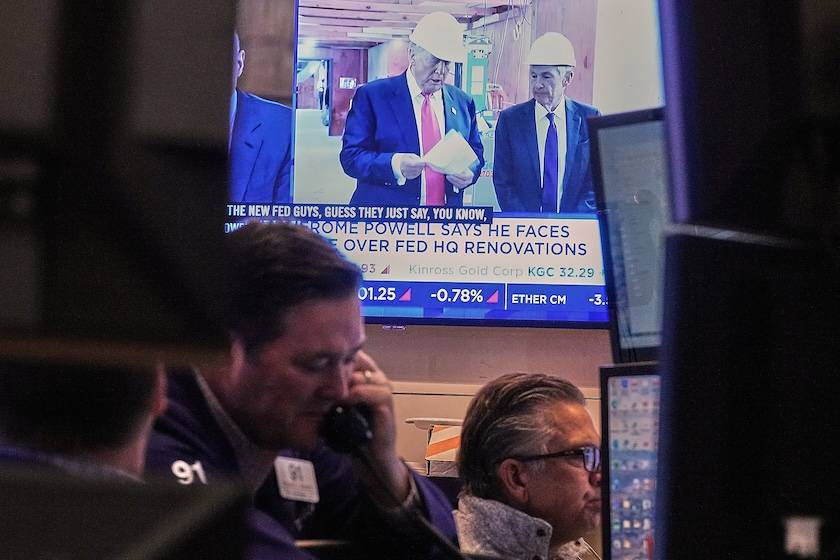
光大期货:美通胀数据公布,短期黄金热度不减
Sou Hu Cai Jing· 2026-01-14 05:19
Core Insights - The core inflation level in the U.S. has slowed down compared to expectations, with the December CPI data showing a year-on-year increase of 2.7%, aligning with both expectations and previous values [1] - The core CPI year-on-year growth is reported at 2.6%, matching the previous value but slightly below the expected 2.7% [1] - The probability of a rate cut in January remains significant, supported by the current employment and inflation data [1] Economic Context - The U.S. President continues to advocate for the Federal Reserve to lower interest rates [1] - Amid the potential pause in rate cuts by the Federal Reserve in January, geopolitical issues have become a short-term focus, with renewed concerns over U.S.-Iran tensions, Greenland, and other geopolitical conflicts [1] - The ongoing geopolitical tensions are likely to sustain interest in gold as a safe-haven asset in the short term [1]
美国12月核心通胀降温,关注中国12月进出口数据
Hua Tai Qi Huo· 2026-01-14 03:15
Report Industry Investment Rating No relevant information provided. Core View of the Report - The inflation narrative is prominent currently. The subsequent boost in consumption and the advancement of "anti - involution" remain unchanged. The future path of price recovery still depends on supply - side policies. There are signs of inflation cooling in the US in December. Attention should be paid to China's December import and export data. There is a certain divergence in domestic and foreign economic outlooks. The report suggests seizing opportunities in commodities and stock index futures, and recommends buying futures of stock indices, precious metals, and non - ferrous metals on dips [1][2][4] Summary According to Related Catalogs Market Analysis - The Central Economic Work Conference in December emphasized boosting consumption and addressing "involution - style" competition. The 2026 People's Bank of China work conference focused on promoting high - quality economic development and reasonable price recovery through monetary policy tools. Geopolitical tensions between Iran and Venezuela are rising, and the global competition for minerals and energy resources is intensifying. The Fed's third - in - command stated that there is no strong pressure to change interest rates. CME will adjust the margin setting method for gold, silver, platinum, and palladium contracts [1] Economic Data Comparison - Overseas economic sentiment has been declining since October, while China's exports and new orders remain positive. China's November foreign trade growth rebounded, with exports increasing by 5.9% and imports by 1.9% year - on - year in US dollars. China's November economic data was under pressure, but the official manufacturing and non - manufacturing PMIs in December were better than expected. The US December ISM manufacturing index declined slightly and has been below 50 for 10 consecutive months. The US December non - farm payrolls were lower than expected, and the unemployment rate remained high. The US December CPI was in line with expectations, and the core CPI hit a four - year low [2] Commodity Analysis - Currently, focus on non - ferrous metals and precious metals with high certainty, and look for opportunities in low - valued commodities. The long - term supply shortage in the non - ferrous metals sector persists, with aluminum and nickel being preferred within the sector. Pay attention to short - term risks in the new energy sector. The LME copper inventory has dropped to a six - month low. In the energy sector, the US plans to "distribute" Venezuelan oil, and Trump hopes to lower oil prices. In the chemical sector, there is potential for "anti - involution" in methanol and PTA. For agricultural products, monitor weather forecasts and short - term pig diseases. There are opportunities to buy precious metals on dips [3] Strategy - Buy stock index futures, precious metals, and non - ferrous metals on dips [4] Important News - Trump will interview Rick Rieder for the Fed chair position on the 15th, and Rieder supports lowering the US benchmark interest rate to 3%. The investigation of Powell has caused internal strife. The New York Fed President said the labor market is stable and inflation may peak in the first half of 2026. The US December CPI was 2.7% year - on - year, in line with expectations, and the core CPI was 2.6%. Trump pressured the US Supreme Court on tariffs and imposed a 25% tariff on countries trading with Iran. Japan's Prime Minister intends to dissolve the House of Representatives. CME adjusted the margin setting for precious metal contracts. The LME copper inventory dropped to a six - month low. Some commodity futures had significant price movements on January 13th [6]
事关降息,美联储重要信号!金价,跌了→
Sou Hu Cai Jing· 2026-01-14 03:11
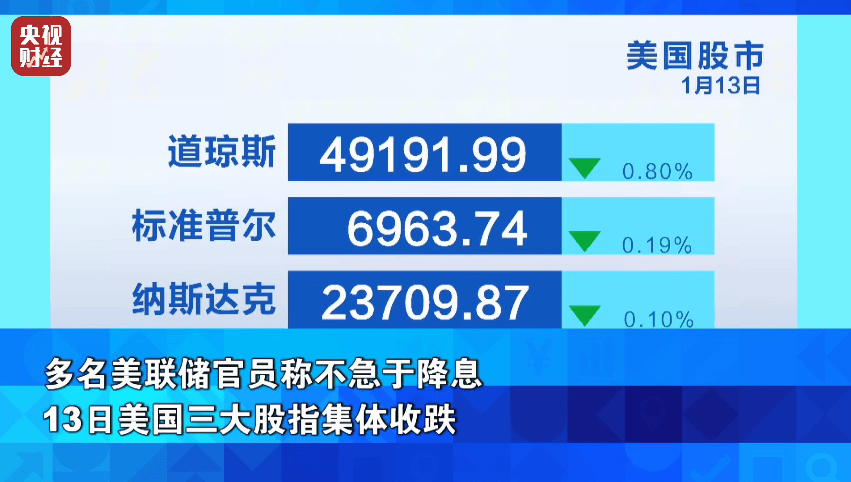
Group 1 - Multiple U.S. Federal Reserve officials have stated that there is no urgent need for interest rate cuts based on the current economic situation [1][3] - Market expectations remain for the Federal Reserve to implement two rate cuts totaling 50 basis points this year, leading to a rebound in the U.S. dollar index and a decline in international gold prices [1][11] - The Dow Jones fell by 0.80%, the S&P 500 dropped by 0.19%, and the Nasdaq decreased by 0.10% on the day of the Federal Reserve officials' statements [3] Group 2 - JPMorgan Chase reported better-than-expected earnings for Q4 of fiscal year 2025, but its investment banking revenue fell short of expectations, resulting in a stock price drop of over 4% [5] - Other major financial institutions also experienced stock declines, with Morgan Stanley down over 2%, Goldman Sachs and Bank of America both down over 1% [5] - Visa and Mastercard shares fell by nearly 4.5% and 3.8%, respectively, amid concerns over future profitability in the financial sector [5] Group 3 - In Europe, stock indices showed mixed results, with the UK market slightly down by 0.03%, France down by 0.14%, and Germany up by 0.06% [8] - Investors are cautious due to geopolitical risks, including the investigation into Federal Reserve Chairman Powell and rising oil prices due to tensions in Iran [8][10] Group 4 - International oil prices saw significant increases, with light crude oil futures for February closing at $61.15 per barrel, up by 2.77%, and Brent crude for March at $65.47 per barrel, up by 2.51% [10] - International gold prices faced pressure, with February gold futures closing at $4599.10 per ounce, down by 0.34%, while silver prices rose by 1.47% to $86.338 per ounce [11]
国泰君安期货所长早读-20260114
Guo Tai Jun An Qi Huo· 2026-01-14 01:47
1. Report Industry Investment Ratings - Not provided in the content 2. Core Views of the Report - Trump continues to pressure the Fed and Powell, but it may be difficult to achieve results. If Powell or the Fed yields, it may bring further turmoil to the US and global financial systems [7]. - Tin prices have broken through historical highs and are expected to continue rising, with the first target at 400,000 yuan/ton and the next target around 450,000 yuan/ton [8][9]. - Crude oil may have a 2 - 4 dollars/barrel rebound space in the short - term, but there is still significant downward pressure in the first half of the year, and it may test 50 dollars/barrel [11]. - Double - offset paper has alleviated the warehouse receipt contradiction and is expected to fluctuate weakly in the short - term. In the long - term, it is still recommended to short at high prices [13]. 3. Summaries by Relevant Catalogs 3.1. Pre - market Focus - Trump criticizes Powell and calls for a large - scale interest rate cut. The Fed's independence is under threat, and the market is waiting to see if there will be an interest rate cut this month [7]. 3.2. Top Picks by the Director 3.2.1. Tin - Tin prices have reached a new high. Supply is tight, inventory is low, and price transmission to downstream is smooth. Future prices are expected to rise [8][9]. 3.2.2. Crude Oil - Short - term price may rise due to geopolitical risks and good spot market transactions, but there is downward pressure in the first half of the year [11]. 3.2.3. Double - offset Paper - Warehouse receipt quantity has increased, and the price is expected to decline in the short - term. In the long - term, supply is redundant, and demand is weak [13]. 3.3. Commodity Research Morning Report 3.3.1. Precious Metals - Gold: Safe - haven sentiment has rebounded. - Silver: Reached a new high [15][20]. 3.3.2. Base Metals - Copper: LME cancelled warehouse receipts have increased, supporting the price [23]. - Zinc: High - level volatility has increased [26]. - Lead: Overseas inventory has decreased, supporting the price [29]. - Tin: Broke through the historical high [32]. - Aluminum: Running strongly; Alumina: Continuing to bottom out; Cast aluminum alloy: Following electrolytic aluminum [36]. - Platinum: Range - bound; Palladium: Narrow - range oscillation [39]. - Nickel: Industry and secondary funds are in a game, with wide - range oscillation [43]. - Stainless steel: Nickel - iron has raised the oscillation center, and the market is betting on Indonesian policies [44]. 3.3.3. Energy Metals - Carbonate lithium: Oscillating strongly, pay attention to market sentiment changes [49]. 3.3.4. Industrial Metals - Industrial silicon: Downstream production cuts, and demand is decreasing marginally [52]. - Polysilicon: Pay attention to factory quotes [53]. 3.3.5. Ferrous Metals - Iron ore: Valuation is high, be cautious about chasing up [56]. - Rebar: Oscillating repeatedly [58]. - Hot - rolled coil: Oscillating repeatedly [58]. - Ferrosilicon: Wide - range oscillation [63]. - Silicomanganese: Wide - range oscillation [63]. - Coke: High - level oscillation [67]. - Coking coal: High - level oscillation [67]. - Steam coal: Supply - demand contradiction is not prominent, and the price will be adjusted in a narrow range in the short - term [69]. 3.3.6. Forestry Products - Logs: Oscillating repeatedly [72]. 3.3.7. Chemicals - p - Xylene: Cost support is strong [76]. - PTA: Polyester plans to cut production, pay attention to the implementation strength [76]. - MEG: Valuation has limited downward space [76]. - Rubber: Wide - range oscillation [84]. - Synthetic rubber: High - level oscillation [88]. - LLDPE: Standard product production ratio remains low, and spot prices are rising [91]. - PP: Downstream export rush supports propylene, and PP cost support is strong [93]. - Caustic soda: Oscillating weakly [96]. - Pulp: Oscillating [101]. - Glass: Original sheet price is stable [106]. - Methanol: Oscillating with support [109]. - Urea: Oscillating [113]. - Styrene: Short - term oscillation [117]. - Soda ash: Spot market changes little [121]. - LPG: Short - term supply is tight, and geopolitical disturbances are strong [126]. - Propylene: Spot supply and demand are tightening, with a strong upward trend [127]. - PVC: Oscillating weakly [135]. - Fuel oil: Geopolitical factors drive up the price, and there is still support below [138]. - Low - sulfur fuel oil: Following the rise, the high - low sulfur price difference in the overseas spot market continues to rebound [138]. 3.3.8. Shipping - Container Freight Index (European Line): Running weakly [140]. 3.3.9. Textiles - Short - fiber: Oscillating strongly, hold long TA and short PF positions [157]. - Bottle chips: Oscillating strongly, hold long - short spread positions [157]. 3.3.10. Paper Products - Offset printing paper: Short at high prices [160]. 3.3.11. Agricultural Products - Pure benzene: Short - term oscillation [165]. - Palm oil: There are doubts about Indonesia's B50 policy, and POGO is expected to shrink [169]. - Soybean oil: The momentum of US soybeans is limited, pay attention to the spill - over effect of crude oil [169]. - Soybean meal: May follow US soybeans to digest the USDA report, and the market is weak [175]. - Soybeans: Spot prices are stable and strong, and the market may oscillate [175]. - Corn: Pay attention to spot prices [178]. - Sugar: Running weakly [182]. - Cotton: Continuing the adjustment trend [186]. - Eggs: Spot is profitable, and the sentiment for far - month contracts is weakening [192]. - Hogs: Demand has negative feedback, and supply release is postponed [195]. - Peanuts: Oscillating [199].
【广发宏观陈嘉荔】美国12月通胀数据公布后降息概率有无变化
郭磊宏观茶座· 2026-01-14 01:37
Core Viewpoint - The December 2025 US CPI shows a year-on-year increase of 2.7%, consistent with previous values and expectations, while the month-on-month increase is 0.3%, higher than the previous 0.1% and in line with expectations. The core CPI year-on-year increase is 2.6%, matching the previous value but lower than the expected 2.7% [1][5][15] Summary by Sections Inflation Data - The overall CPI year-on-year increase is 2.7%, with a month-on-month increase of 0.3%, driven by rebounds in food and service prices. The core CPI year-on-year increase is 2.6%, with a month-on-month increase of 0.2%, higher than the previous 0.1% but lower than the expected 0.3% [1][5][15] Core Goods and Services - Core goods prices remained flat, with a year-on-year increase of 1.4% and a month-on-month change of 0%. Notably, used car prices fell significantly by -1.1% month-on-month, which is much lower than the average of 0.5% in October and November, impacting the core CPI by approximately 3 basis points [11][12] - Core service prices rebounded, with a month-on-month increase of 0.3%, up from an average of 0.1% in October and November, and a year-on-year increase of 3%. Rent was a major contributor, with both OER and primary residence rent increasing by 0.3% month-on-month [2][12][13] Market Reactions - Following the data release, expectations for interest rate cuts remained largely unchanged. The probability of no rate cuts in January, March, and April is high, while the probability of a cut in June is 48.1%, slightly up from 46.2% [3][17] - The US dollar index continued to appreciate slightly, reaching 99.18, while US stock markets saw declines, with the Dow down 0.8% and the S&P 500 down 0.19% [3][17][18] Federal Reserve and Policy Outlook - The divergence between the White House and the Federal Reserve regarding interest rate policy is a key market focus. The ongoing criminal investigation into Fed Chair Powell regarding potential perjury related to the Fed's renovation project raises questions about the independence of monetary policy [4][19]

今日期货市场重要快讯汇总|2026年1月14日
Xin Lang Cai Jing· 2026-01-14 00:56
Group 1: Precious Metals Futures - New York gold prices showed volatility, initially breaking through $4640/oz with a daily increase of 0.56%, then falling to $4580/oz with a daily decrease of 0.76%, and finally breaking back above $4600/oz with a daily increase of 0.02% [1][12] - Spot gold performed strongly, breaking through $4590/oz with a daily increase of 0.08%, reaching a historical high of $4631.34/oz, and ultimately breaking $4630/oz with a daily increase of 0.75% [1][13] - The silver market was also active, with New York silver breaking through $89/oz with a daily increase of 4.61%, previously breaking $88/oz with a daily increase of 3.42%, and finally breaking $87/oz with a daily increase of 0.73% [1][13] Group 2: Basic Metals Futures - Tin's main contract increased by 4% in a single day, currently priced at 398,380.00 yuan [3][15] Group 3: Energy and Shipping Futures - WTI crude oil prices broke through $61/barrel with a daily increase of 2.85% [4][16] - Domestic fuel oil's main contract showed strong performance, increasing by 5% in a single day, currently priced at 2,560.00 yuan, having previously risen by 4% to 2,536.00 yuan [5][17] - The API crude oil inventory for the week ending January 9 recorded 5.278 million barrels, significantly exceeding expectations of -2.238 million barrels and the previous value of -2.766 million barrels [6][18] Group 4: Macro and Market Impact - The U.S. has relaxed export controls on Nvidia's H200 chips to China, with related sales now subject to approval and security review by the U.S. Department of Commerce, which will also collect fees from the transactions [7][19] Group 5: Other Market Dynamics - Bitcoin prices continued to rise, breaking through $93,000 (daily increase of 1.98%), $94,000 (daily increase of 2.98%), $95,000 (daily increase of 5.05%), and ultimately surpassing $96,000 with a daily increase of 5.18% [9][21] - Ethereum broke through $3,200 (daily increase of 3.62%) and further surpassed $3,300 with a daily increase of 8.77% [10][22] - Methanol's main contract increased by 2% in a single day, currently priced at 2,308.00 yuan [11][23]