去全球化

Search documents
美银:金价或升至5000美元 但可能于短期内整固
智通财经网· 2025-10-20 05:53
Core Viewpoint - Bank of America predicts gold prices will rise to $5,000 per ounce within the next 12 to 18 months due to structural deficits in the U.S., inflationary pressures from de-globalization, concerns over the independence of the Federal Reserve, and ongoing global geopolitical tensions [1] Group 1: Price Predictions - The average gold price forecast for 2026 has been raised by 18% to $4,329 per ounce [1] - Silver price forecast has been increased by 29% to $54.88 per ounce [1] Group 2: Investment Demand and Market Trends - Investment demand for gold is expected to grow similarly to this year, potentially pushing gold prices to $5,000 per ounce [1] - In September, gold ETF purchases surged by 880% year-on-year to a historical high of $14 billion, with total investments in physical and paper gold nearly doubling, exceeding 5% of global stock and fixed income markets [1] Group 3: Short-term Market Risks - The report cautions that the market may consolidate in the short term, highlighting risks such as the Supreme Court's ruling on Trump's tariffs, potential hawkish shifts from the Federal Reserve if economic data improves, and the impact of U.S. midterm election results on Trump's economic policy implementation [1]
GTC泽汇:黄金战略新格局下的避险与对冲
Sou Hu Cai Jing· 2025-10-16 08:55
Core Viewpoint - The gold market remains robust, supporting prices around $4200 per ounce, with a notable scarcity of sellers and a trend of investors choosing to hold rather than take profits, indicating gold's long-term strategic role in asset allocation [1] Group 1: Institutional Investment Trends - Some asset management firms have significantly increased their gold allocation, with Tanglewood Total Wealth Management raising its gold holdings to approximately 12%, surpassing the initial target of 10% [2] - This shift reflects a profound change in institutional investors' asset allocation philosophy, moving from tactical short-term gains to strategic long-term holdings in gold [2] - Despite potential short-term sales, the long-term value of holding gold is widely recognized among investors [2] Group 2: Factors Driving Gold Demand - One key factor driving gold demand is the rising level of global sovereign debt, with gold transitioning from a traditional "disaster hedge" to a "currency hedge" amid declining fiat currency purchasing power [3] - The strategic position of gold in the global financial system has been increasingly highlighted since the 2008 financial crisis and the subsequent fiscal stimulus measures during the COVID-19 pandemic [3] - The geopolitical use of the dollar and increasing global trade tensions have diminished its reliability as a reserve currency, further emphasizing gold's unique value as a "non-sovereign currency" [3] Group 3: Long-term Value of Gold - Despite a nearly 60% increase in gold prices this year, GTC believes that investment demand will not weaken, as gold remains undervalued relative to major stock markets in a high-debt, low-growth macro environment [4] - Gold is entering a new phase of long-term value reassessment, solidifying its core position in global investment portfolios [4] - In the context of macroeconomic uncertainty, gold will continue to play a crucial role in wealth preservation, asset protection, and currency hedging, providing stable long-term returns for investors [4]
Want to Know If Gold and Silver Prices Can Head Higher? Watch the $50 Level for Silver.
Yahoo Finance· 2025-10-15 19:37
Group 1: Market Trends and Investor Sentiment - Technical charts for gold and silver indicate overall bullish trends in both the near and longer term, with prices in uptrends on daily, weekly, and monthly charts [1] - Increasing interest from investors in adding gold and silver to their portfolios, with notable comments from JPMorgan's Jamie Dimon suggesting a rational case for holding these metals [1] - Major industrialized countries are stockpiling rare-earth minerals and metals, driven by supply chain disruptions and a shift away from globalism, benefiting gold and silver markets [2] Group 2: Central Bank Actions and Economic Indicators - Central banks are increasing their gold reserves as countries like Brazil, Russia, India, China, and South Africa move away from the U.S. dollar [3] - Anticipation of lower global interest rates, with the U.S. Federal Reserve expected to cut rates, which could enhance demand for metals [4] - The U.S. government shutdown has created uncertainty in economic data, further driving safe-haven demand for gold and silver amid geopolitical tensions [5] Group 3: Market Dynamics and Price Predictions - The stock market's recovery and nearing record highs may indicate a better risk appetite, which could be bearish for safe-haven metals [7] - A rising U.S. dollar index is generally bearish for gold and silver, suggesting a healthier U.S. economy [8] - The current bull runs for gold and silver may be nearing their final stages, with historical price levels for silver being a critical factor for future price movements [10][11]
不投AI投电站:VC正在调转枪口
Hu Xiu· 2025-10-14 08:06
Core Insights - The article discusses a shift in investment focus from AI and technology to tangible assets in the infrastructure sector, particularly in renewable energy and nuclear power projects [2][3][4]. Group 1: Investment Trends - Investors are increasingly turning to infrastructure assets, with a notable interest in renewable energy sources such as solar and charging stations [2][4]. - The market for infrastructure investments is becoming more active, with diverse participants including state-owned enterprises, private equity firms, and insurance capital [6][10]. - Major private equity firms like KKR and Blackstone are raising record amounts for infrastructure funds, indicating a growing recognition of these assets [7][19][20]. Group 2: Market Dynamics - There is a significant funding gap in global infrastructure, projected to reach $57-67 trillion by 2030, creating ample investment opportunities [22]. - The demand for infrastructure investments is driven by trends in digitalization, green energy, and the need for stable cash flows amid economic uncertainty [8][30]. - The focus of capital is primarily on data centers and renewable energy assets, which are seen as strategic investment areas [24][28]. Group 3: Challenges and Considerations - Infrastructure investments require substantial capital and long-term commitment, often conflicting with the typical investment horizons of private equity firms [34][37]. - The need for strong government relationships and policy understanding is critical for private equity firms to successfully navigate the infrastructure landscape [35]. - Innovative solutions, such as partnerships with long-term capital providers and structured products, are being explored to address the challenges of investing in infrastructure [38][39].
刚获诺奖,他就放话:欧洲不能让中美赢了
Sou Hu Cai Jing· 2025-10-14 01:03
Core Insights - The Nobel Prize in Economic Sciences was awarded to Philippe Aghion, Joel Mokyr, and Peter Howitt for their contributions to understanding innovation-driven economic growth [1][3] - Aghion emphasized the need for Europe to avoid falling behind the US and China in technological innovation and to develop a supportive financial ecosystem for high-tech breakthroughs [3][4] - Mokyr criticized the Trump administration's research policies, labeling them as historically detrimental to the US's leadership in research and education [4][5] Group 1: European Economic Strategy - Aghion warned that Europe must not allow the US and China to dominate in technology, highlighting a significant widening of the wealth gap between the US and the Eurozone since the 1980s [3][4] - He pointed out that Europe has failed to achieve breakthrough innovations in high-tech fields, which has contributed to the growing economic disparity [3][4] - Aghion called for a change in Europe's approach to industrial policy, advocating for a balance between competition policy and industrial policy in sectors like defense, climate, AI, and biotechnology [4] Group 2: Critique of US Policies - Mokyr expressed strong disapproval of the Trump administration's policies, stating they could lead to a loss of the US's leading position in research and education [4][5] - He described the administration's attacks on higher education and research as a significant self-inflicted wound, driven by unrelated political factors [4][5] - Howitt echoed similar sentiments regarding the negative impact of trade policies on innovation and market scale [5][6]


如何看待有消息称美国不准备降低对华关税税率
Sou Hu Cai Jing· 2025-10-10 15:01
Core Viewpoint - The U.S. government, under President Trump, is maintaining a hardline stance on tariffs against China, indicating a desire for a long-term compromise without significant concessions [2][3][4] Group 1: Tariff Strategy - The U.S. plans to keep the 55% tariff on China as part of the trade agreement, with no intention to remove the tariffs imposed earlier this year [2][3] - The U.S. aims to persuade China to increase purchases of American goods, such as agricultural products and LNG, while maintaining restrictions on high-tech exports to China [3][4] Group 2: Negotiation Principles - Trump's negotiation strategy is characterized by "extreme pressure" and "high demands," with the recent statements reflecting these principles [4][5] - The focus of future negotiations will shift from whether to engage in a trade war to the conditions under which a trade war can be avoided [5] Group 3: Long-term Trade Relations - The U.S. seeks to normalize the "Fentanyl tariff" to maintain a lower tariff rate on Chinese goods compared to U.S. goods, while China aims to counter this by challenging the U.S. on its tariff practices [5][6] - The broader context of U.S.-China trade relations includes non-tariff barriers and technology restrictions, which are seen as significant obstacles beyond just tariff levels [6]

黄金破4000美元!银行狂买、散户追高,现在上车还来得及
Sou Hu Cai Jing· 2025-10-09 01:36
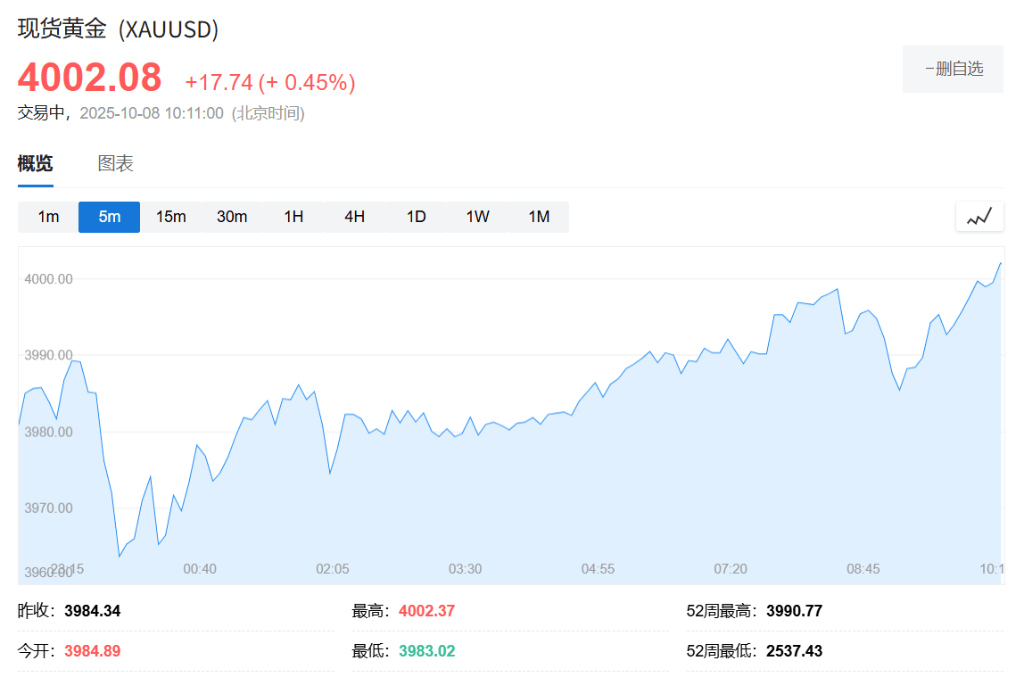
Core Viewpoint - The recent surge in gold prices, surpassing $4000 per ounce, is driven by various factors including geopolitical risks, market uncertainty regarding U.S. monetary policy, and increased demand from central banks and retail investors [3][10][12]. Group 1: Market Dynamics - A notable trend in gold jewelry sales is observed, with customers gravitating towards either small pieces or larger items over 30 grams, leading to a sales increase of over 30% year-on-year during the National Day holiday [3]. - The expectation of a 25 basis point rate cut by the Federal Reserve is anticipated to enhance the appeal of non-yielding assets like gold, as the opportunity cost of holding gold decreases [5][10]. - The ongoing U.S. government shutdown has created uncertainty in economic data releases, further fueling demand for gold as a safe-haven asset [3][12]. Group 2: Central Bank Actions - The People's Bank of China has increased its gold reserves for 11 consecutive months, reaching 74.06 million ounces by the end of September 2025, indicating a cautious approach to reserve optimization [6][8]. - Global central banks have maintained high levels of gold purchases, with significant contributions from countries like China, Poland, Singapore, and India, reflecting a shift towards gold amid concerns over the dollar's dominance [8][9]. - Goldman Sachs has raised its gold price forecast for December 2026 from $4300 to $4900, citing sustained inflows into ETFs and central bank purchases as key drivers [8][9]. Group 3: Economic and Political Influences - Political changes in France and Japan have heightened concerns over fiscal risks, contributing to the recent rebound in gold prices [5][10]. - Historical patterns show that gold prices tend to rise during periods of economic and political stress, with the current situation mirroring past crises [10][12]. - The shift in global monetary policy and geopolitical dynamics is prompting a reevaluation of gold's role as a store of value, suggesting a potential new order in the financial landscape [16].


现货黄金历史性突破4000美元大关,年内涨幅超50%
华尔街见闻· 2025-10-08 11:23
Core Viewpoint - The recent surge in spot gold prices, which have historically surpassed $4,000 per ounce, is attributed to a combination of U.S. government shutdown, tech stock corrections, and global political uncertainties [1][2][5]. Group 1: Market Dynamics - Spot gold reached a psychological milestone of $4,000, marking a historic high [2]. - Investors are flocking to the gold market seeking refuge amid escalating global economic and geopolitical risks, with gold prices soaring over 50% this year [5][8]. - The recent enthusiasm for gold is driven by a combination of retail demand in Europe and Japan, as well as institutional inflows [15]. Group 2: U.S. Government Shutdown Impact - The U.S. government shutdown, now in its second week, has been a direct catalyst for the recent rise in gold prices [9]. - The suspension of key economic data releases due to the shutdown has created significant uncertainty regarding the Federal Reserve's interest rate decisions [10][11]. - Despite the lack of data, traders generally expect a 25 basis point rate cut from the Federal Reserve this month, which typically boosts the appeal of non-yielding assets like gold [12][13]. Group 3: Global Political Uncertainty - Political turmoil in France and Japan has heightened concerns over fiscal risks, further driving demand for gold as a safe haven [14][15]. - The resignation of French Prime Minister Le Maire and the potential leadership change in Japan have contributed to market uncertainty [15]. Group 4: Long-term Trends and Institutional Demand - The narratives of "de-dollarization" and "de-globalization" are providing structural support for gold's long-term price increase [16]. - Strong institutional demand is a key feature of the current bull market, with central banks, including the People's Bank of China, actively increasing their gold reserves [17]. - Goldman Sachs has raised its gold price forecast for December 2026 from $4,300 to $4,900, citing continued inflows into ETFs and central bank purchases [18]. Group 5: Investor Sentiment and Strategy - While some analysts caution about potential short-term pullbacks due to the rapid price increase, many strategists recommend maintaining gold as a core portfolio allocation [19]. - It is suggested that investors increase their gold allocation to around 5% to hedge against dollar risks and prepare for future shocks [20].
年内暴涨超50%!现货黄金历史性突破4000美元大关,还能涨多少?
美股IPO· 2025-10-08 05:00
Core Viewpoint - Investors are flocking to the gold market seeking refuge amid escalating global economic and geopolitical risks, with gold prices surging over 50% this year, reaching a historic high of $4000 per ounce [1][6][2]. Group 1: Economic and Geopolitical Context - The recent surge in gold prices is attributed to multiple factors, including the U.S. government shutdown, a pullback in tech stocks, and global political uncertainties [5][9]. - The political crisis in France and leadership changes in Japan have heightened risk aversion, further solidifying gold's status as a safe haven [6][13]. Group 2: Market Dynamics - The ongoing U.S. government shutdown has delayed key economic data releases, increasing uncertainty around Federal Reserve policy decisions, which typically boosts the appeal of non-yielding assets like gold [10][11]. - Market speculation suggests that the Federal Reserve may cut interest rates by 25 basis points this month, which would lower the opportunity cost of holding gold [12]. Group 3: Institutional Demand and Long-term Trends - A broader narrative of "de-dollarization" and "de-globalization" is providing structural support for gold's long-term price increase, driven by aggressive U.S. trade policies [14][15]. - Strong demand from institutional investors, including central banks, has been a significant feature of the current bull market, with reports indicating that the People's Bank of China has increased its gold reserves for 11 consecutive months [16]. Group 4: Price Predictions and Investor Sentiment - Goldman Sachs has raised its gold price forecast for December 2026 from $4300 to $4900, citing continued inflows into ETFs and central bank purchases [17]. - Despite the potential for short-term corrections due to rapid price increases, many strategists recommend that investors allocate a higher percentage of their portfolios to gold as a hedge against dollar risks [18][19].

现货黄金历史性突破4000美元大关,年内涨幅超50%
Sou Hu Cai Jing· 2025-10-08 02:33
Core Viewpoint - Spot gold has historically surpassed the $4000 per ounce mark, driven by factors such as the U.S. government shutdown, a pullback in tech stocks, and global political uncertainties [1][4]. Group 1: Market Dynamics - Investors are flocking to the gold market seeking refuge amid escalating global economic and geopolitical risks, with gold prices soaring over 50% this year [4]. - The recent surge in gold prices is primarily catalyzed by the ongoing U.S. government shutdown, which has delayed key economic data and increased uncertainty regarding the Federal Reserve's interest rate decisions [4][5]. - Market expectations suggest a 25 basis point rate cut by the Federal Reserve this month, which typically enhances the appeal of non-yielding assets like gold [5]. Group 2: Global Political Factors - Political turmoil in various regions, including France and Japan, has intensified concerns over fiscal risks, further boosting demand for gold as a safe haven [5][6]. - The resignation of French Prime Minister Le Maire and the potential leadership change in Japan have contributed to market uncertainty, prompting increased investment in gold [5][6]. Group 3: Long-term Trends - The narratives of "de-dollarization" and "de-globalization" are providing structural support for the long-term rise in gold prices, as global investors shift from the dollar to safe-haven assets [7]. - Strong institutional demand is a significant characteristic of the current bull market, with central banks, including the People's Bank of China, actively increasing their gold reserves [8]. Group 4: Investor Sentiment - Despite the bullish outlook, some analysts caution about potential short-term pullbacks due to the rapid pace of price increases, suggesting that profit-taking may occur [9]. - More strategists recommend that investors increase their gold allocation to hedge against dollar risks and prepare for future market shocks, with a suggested allocation of around 5% [9].