外汇对冲

Search documents
欧洲养老金狂抛美元,期权市场却押注抛售潮将暂告一段落
Jin Shi Shu Ju· 2025-06-13 02:35
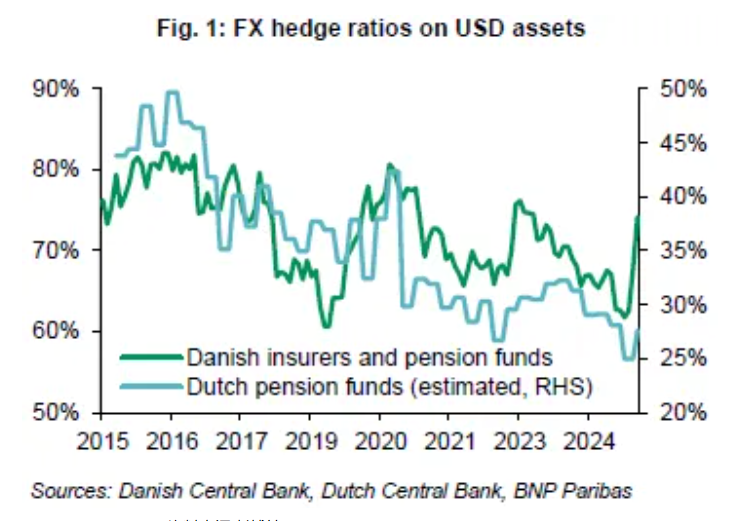
Group 1 - European pension funds are increasing their foreign exchange hedging, leading to significant dollar sell-offs, particularly in the Netherlands and Denmark, where unhedged dollar exposure has decreased from 23% to 20% of total assets [1] - Danish pension funds have reduced their dollar exposure by $37 billion since the beginning of the year, with a record hedging ratio of 74.2% in April [2] - The trend of hedging against dollar assets is gaining global attention, with many companies in Switzerland, Japan, and Australia still at historically low levels of currency protection [2] Group 2 - The dollar has weakened for five consecutive months, with a pessimistic indicator reaching extreme levels, suggesting a potential calm period for the dollar ahead of the Federal Reserve's next interest rate decision [3][6] - Despite the dollar's decline, traders are reducing their bearish bets on the dollar, indicating a shift in sentiment as recent economic data shows resilience in the U.S. economy [7][8] - The consensus on Wall Street remains that the dollar will continue to weaken, driven by tariff anxieties and softening economic data, with predictions pointing to further declines through 2025 [11]

法巴银行:欧洲养老金减少美元敞口
news flash· 2025-06-12 13:07
Core Viewpoint - European investors are reducing their exposure to the US dollar, with further risks anticipated ahead [1] Group 1: Currency Exposure - Societe Generale analysts report that Dutch pension funds increased their foreign exchange hedging ratio by 3 percentage points in the first quarter [1] - Danish pension funds have cut their US dollar exposure by $37 billion this year [1] Group 2: Market Predictions - Societe Generale is betting on the euro strengthening against the dollar, with a target of 1.20 for the EUR/USD exchange rate [1] - Analysts indicate that Danish pension funds have become significant buyers of euros against the dollar as exchange rates rise [1]
去美元化,这一回亚洲经济体是“认真”的
凤凰网财经· 2025-06-12 12:53
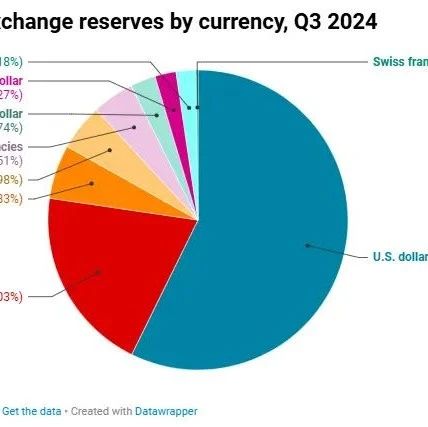
Core Viewpoint - The article discusses the rising trend of "de-dollarization" in Asia, driven by various factors including geopolitical uncertainties and the desire to reduce reliance on the US dollar for trade and investment [1][2]. Group 1: De-dollarization Trend - ASEAN has committed to promoting the use of local currencies in trade and investment through measures like local currency settlement and enhancing regional payment connectivity [1]. - The trend of de-dollarization is gaining momentum as individuals and businesses in ASEAN begin to convert dollar savings back to local currencies, and large investors actively hedge foreign investments [2]. - The share of the US dollar in global foreign exchange reserves has decreased from over 70% in 2000 to 57.8% in 2024, indicating a global reduction in reliance on the dollar [4]. Group 2: Market Reactions and Strategies - Investors are reassessing their portfolios, moving away from dollar-heavy allocations due to the perception of the dollar being used as a weapon in trade and sanctions [2]. - Asian economies, particularly those heavily reliant on trade, are expected to see a significant decline in demand for the dollar, with over 80% of trade in the 10+3 cooperation mechanism still denominated in dollars as of last November [3]. - There is a notable increase in dollar exposure hedging among Asian investors, with Japanese life insurance companies raising their hedging ratio from approximately 44% to around 48% in recent months [3]. Group 3: Structural Changes and Challenges - The article raises the question of whether the current de-dollarization trend is a temporary phase or indicative of a more profound structural change [4]. - Despite the ongoing trend, experts caution that replacing the dollar as the primary reserve currency remains challenging, with significant hurdles still in place [7]. - The potential for structural change may depend on the US's implementation of sanctions and the behavior of central banks regarding dollar holdings [7].
巴克莱:外汇对冲回报吸引 日本投资者转向美投资级企业债
news flash· 2025-05-28 13:24
金十数据5月28日讯,巴克莱分析师在一份报告中指出,由于外汇对冲后回报具有吸引力,日本投资者 持续将资金投入美国投资级企业债。分析师表示,外汇对冲成本上升正促使日本投资者更青睐美国投资 级企业债,而非美国国债。在日本央行过去宽松政策推动的国内低收益率环境下追求利差收益,加上近 年来外汇对冲成本上升,共同推动了对海外利差产品的强劲需求。 巴克莱:外汇对冲回报吸引 日本投资者转向美投资级企业债 ...

【期货热点追踪】外汇对冲比例飙升,美元被高估10%!“做空美国”时机已到?
news flash· 2025-05-20 00:47
期货热点追踪 外汇对冲比例飙升,美元被高估10%!"做空美国"时机已到? 相关链接 ...
海湖庄园协议魅影!新台币之后,下一个是韩元?
华尔街见闻· 2025-05-15 10:06
Group 1 - The core viewpoint of the article is that the South Korean won (KRW) has significant appreciation potential, being undervalued by approximately 12% according to Nomura's model, making it one of the most undervalued currencies among emerging markets and G10 currencies [1][3][4] - The discussion between South Korea's Deputy Finance Minister and the U.S. Treasury Assistant Secretary regarding the USD/KRW market indicates that the Trump administration may favor a weaker dollar, potentially making exchange rates a key topic in upcoming trade negotiations [2][3] - The potential increase in foreign exchange hedging by the National Pension Service (NPS) could lead to a substantial rise in demand for the won, as NPS could raise its foreign exchange hedging ratio to 10% of its overseas investments, which amounts to a potential foreign exchange sale of $49.7 billion [4][5] Group 2 - Basic economic factors also support the appreciation of the won, with various models indicating that the won is persistently undervalued, reinforcing the notion that external pressures are not the only drivers of its potential rise [3][4] - There are risks associated with foreign investment sell-offs or repatriation, as South Korean retail investors have significant overseas investments and may begin to liquidate assets due to concerns over a weakening dollar [5] - The asset management industry in South Korea, with a total asset management scale of $1.3 trillion, may also increase foreign exchange hedging, further contributing to upward pressure on the won [5]

海湖庄园协议魅影!新台币之后,下一个是韩元?
Hua Er Jie Jian Wen· 2025-05-15 07:58
Group 1 - The core viewpoint of the articles indicates that the South Korean won (KRW) has significant appreciation potential, being undervalued by approximately 12% according to Nomura's model, making it one of the most undervalued currencies among emerging markets and G10 currencies [1][3][4] - The discussions between South Korean and U.S. officials regarding the KRW/USD exchange rate suggest that the U.S. government may favor a weaker dollar, potentially making exchange rates a key topic in upcoming trade negotiations [2][3] - The South Korean National Pension Service (NPS) may increase its foreign exchange hedging ratio, which could significantly boost demand for the KRW, especially if the NPS raises its overseas investment hedging ratio to 10% [1][4] Group 2 - Basic economic factors also support the appreciation of the KRW, as various models indicate that the currency remains undervalued, reinforcing the notion that external pressures are not the sole drivers of its potential rise [3][4] - The potential for foreign investment outflows or currency hedging by asset management firms, which manage approximately $1.3 trillion, poses a risk that could further influence the KRW's value [4] - As of May 9, 2025, South Korean retail investors have a total overseas investment of $139 billion, with indications that they are selling overseas assets due to concerns over a weakening dollar, which could impact the KRW [4]
Aflac(AFL) - 2025 Q1 - Earnings Call Transcript
2025-05-01 12:00
Financial Data and Key Metrics Changes - Aflac reported net earnings per diluted share of $0.05, significantly impacted by net investment losses compared to net investment gains in Q1 2024 [6] - Adjusted earnings per diluted share remained unchanged at $1.66 year-over-year [6][13] - Adjusted return on equity (ROE) was 12.7% excluding foreign currency remeasurement, indicating a solid performance [13] Business Line Data and Key Metrics Changes - Aflac Japan experienced a 12.6% year-over-year sales increase, driven by significant contributions from Sumitas and a 6.3% increase in cancer insurance sales [6][8] - Aflac US saw a 3.5% year-over-year increase in sales, with strong performance in group life, disability, and network dental [9][17] - Net earned premiums for Aflac Japan declined by 5%, while underlying earned premiums adjusted for deferred profit liability and other factors declined by 1.4% [14] Market Data and Key Metrics Changes - Aflac Japan's total benefit ratio was 65.8%, down 120 basis points year-over-year, while the U.S. total benefit ratio was 47.7%, up 120 basis points year-over-year [15][18] - Persistency in Japan improved to 93.8%, up 40 basis points year-over-year, while U.S. persistency increased to 79.3%, up 60 basis points year-over-year [16][17] Company Strategy and Development Direction - The company aims to appeal to younger customers through products like Sumitas and is focused on cross-selling medical and cancer policies [7][9] - Aflac continues to emphasize strong capital and cash flow management while maintaining a commitment to liquidity and capital ratios [10][11] - The company is strategically deploying capital, having repurchased $900 million in stock and paid $317 million in dividends in Q1 2025 [11][23] Management's Comments on Operating Environment and Future Outlook - Management expressed confidence in the underlying strengths of the business and potential for continued growth in both Japan and the U.S. [12] - The company is closely monitoring economic trends and adjusting its capital management strategies accordingly [38][41] - Management highlighted the importance of maintaining strong premium persistency and adapting to market conditions [10][11] Other Important Information - Aflac Japan launched a new cancer insurance product in March 2025, which is expected to contribute positively to sales [54] - The company has a robust hedging strategy in place to manage foreign currency exposure, particularly related to the yen [26][97] Q&A Session Summary Question: Why did the ESR ratio decline in Q1? - Management explained that the decline was due to the strengthening yen, partially offset by higher Japan interest rates and dividends flowing to Aflac Inc. [32][33] Question: How should we think about capital planning given recent macro changes? - Management indicated that capital management is designed with a long-term view and is not expected to change significantly despite macroeconomic volatility [37][41] Question: What are the expectations for the new cancer product sales? - Management expressed confidence that the new cancer product will continue to grow, with expectations for sales in 2025 to exceed those of 2024 [54][100] Question: How is the competitive landscape for medical insurance in Japan? - Management acknowledged increased competition but emphasized Aflac's pioneering position in cancer insurance and ongoing efforts to maintain market share [58][59] Question: How are remeasurement gains expected to trend? - Management noted that significant remeasurement gains are typically unlocked in the third quarter, with smaller adjustments in other quarters [63][66] Question: Is there any anti-U.S. sentiment affecting sales in Japan? - Management stated that there is no observable anti-American sentiment affecting the business, citing strong economic ties between the U.S. and Japan [116][117]

高盛交易台:亚洲经济体会从美国资产中进行多元化配置吗?
Goldman Sachs· 2025-04-28 15:33
Investment Rating - The report indicates a preference for short positions in CNY CFETS index and short SGDNEER basket, suggesting a bearish outlook on these currencies [3][4]. Core Insights - Asian economies show limited evidence of diversifying away from US assets, primarily due to low domestic yields and growth concerns [1][2]. - Malaysia, Singapore, China, and India exhibit signs of increased USD FX hedging and asset diversification, while Japan sees foreign inflows into its assets [1][2][28]. - The report highlights that Singapore and Hong Kong have the highest US asset holdings as a percentage of GDP, indicating significant room for diversification [5][6]. Summary by Sections Section 1: Diversification Potential - Singapore and Hong Kong lead in US asset holdings relative to GDP, followed by Taiwan, Japan, and Korea [5][6]. - China’s US asset holding is relatively low at 12% of GDP when accounting for indirect holdings [5][6]. Section 2: Willingness to Diversify - China is diversifying its reserves by increasing gold holdings, now at nearly 6% of total reserves, but has not sold US treasuries [11][13]. - Taiwan's central bank holds over 80% of its FX reserves in US treasuries, indicating confidence in these assets despite potential diversification [18][19]. - Korea's National Pension Service plans to increase international asset exposure to 60% by 2028, showing no intent to repatriate assets [25][26]. Section 3: Market Observations - Malaysia's government is guiding a shift towards domestic asset allocation, with EPF reducing overseas exposure [34][35]. - Singapore's large US asset holdings are supported by its status as a financial hub, with signs of month-end repatriation flows [38][39]. - India's central bank emphasizes gold accumulation for reserve diversification amid geopolitical uncertainties [47][48]. Section 4: Currency and Investment Trends - The report notes a shift in international investors' preferences from long-duration to short-duration US treasuries, contributing to a steepening of the UST curve [59][60]. - Malaysia's foreign currency deposit ratio has increased, indicating a trend towards domestic investments [55][57].
美元、美股“双杀” 外国投资者急寻外汇对冲保护
智通财经网· 2025-04-28 06:49
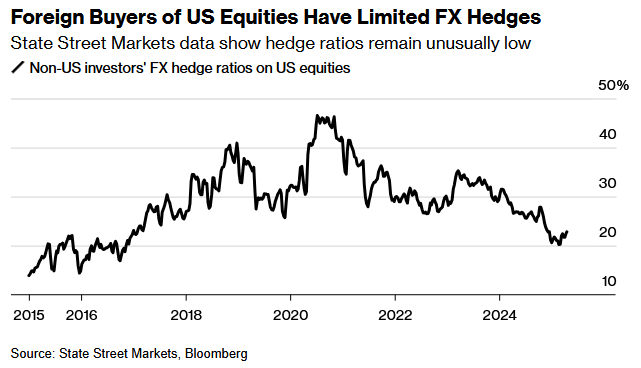
Core Viewpoint - The long-standing strategy of foreign investors buying US dollars and investing in the S&P 500 and Nasdaq indices has faced significant challenges due to the recent trade war initiated by the Trump administration, leading to substantial losses in both stock and currency investments [1] Group 1: Market Performance - The S&P 500 index has declined by 6% this year, while returns for investors using euros and yen have dropped by 14% [1] - The rapid deterioration of this trading strategy has caused anxiety among foreign investors who previously viewed the US as a safe haven for returns [1] Group 2: Currency Hedging - Many foreign investors are now eager to increase currency hedging in their US stock portfolios, with current foreign investment assets in the US stock market amounting to approximately $18 trillion, nearly one-fifth of the total market capitalization [1][5] - The overall currency hedging ratio for foreign investors in US stocks is currently at 23%, significantly lower than the nearly 50% level seen in 2020 [5] Group 3: Hedging Costs and Strategies - The cost of hedging for investors based on currencies like the Swiss franc or yen is approximately 4% annualized for three-month hedges, while for euro-based investors, it exceeds 2% [6] - The demand for options trading as a hedging method has surged, with the trading volume of euro-dollar options reaching new highs, although increased volatility has also raised hedging costs by about 15% this year [7] Group 4: Market Outlook - Despite the current challenges, some market participants remain cautious about predicting the dollar's future movements, citing unpredictability in exchange rate fluctuations [11] - Analysts suggest that even a small outflow of international investment from the US could lead to significant market impacts, given that international investors hold approximately $28 trillion in US assets [11]