容量电价

Search documents
中金 | 储能观市系列(1):政策迎风期,中国独立储能建设加速
中金点睛· 2025-12-09 23:46
Core Viewpoint - The Chinese large-scale energy storage industry is transitioning from "policy-driven" to "market-driven," with clearer business models and diversified application scenarios, entering a new phase of large-scale and high-quality development [2]. Group 1: Market Trends and Data - The domestic new energy storage bidding scale reached 205.30 GWh from January to October 2025, a year-on-year increase of 45%, with central and state-owned enterprises' procurement scale increasing by 61% [4]. - The supply side of leading battery manufacturers is nearing full capacity, and the tight supply-demand situation is expected to continue until the second quarter of 2026 [4]. - The theoretical installation space for independent energy storage is estimated to be around 158 GW/634 GWh for 2026-2027, supported by declining electricity costs on the generation side [5]. Group 2: Business Model Evolution - Before the "Document 136," the value of energy storage was primarily derived from "obtaining renewable energy project permits," with low utilization rates [6]. - After the "Document 136," independent energy storage can realize its true value through "peak-valley price arbitrage + capacity market + ancillary services," with internal rates of return (IRR) exceeding 10% in regions like Inner Mongolia and Xinjiang [4][5]. - The capacity price policy has led to a short-term rush for installations, with independent energy storage expected to benefit from this policy window [5]. Group 3: Capacity Compensation Mechanism - The capacity compensation mechanism is gradually replacing the previous capacity leasing price, with provinces like Inner Mongolia and Gansu already implementing compensation standards [15]. - The compensation standards vary, with Gansu setting a preliminary compensation of 330 yuan/kW·year, while Inner Mongolia compensates based on actual discharge [15]. - The establishment of a capacity compensation mechanism aims to create stable price signals to guide investment in flexible resources like energy storage [15]. Group 4: Auxiliary Services Market - The auxiliary services market is evolving from single peak and frequency regulation to a more diversified and market-oriented approach [18]. - Independent energy storage currently participates mainly in frequency regulation services, with significant compensation in provinces like Guangdong and Shanxi [20]. - As the auxiliary services market develops, energy storage is expected to expand its participation to include backup and ramping services, providing additional revenue streams [20]. Group 5: Economic Viability of Independent Energy Storage - The economic viability of independent energy storage projects is influenced by peak-valley price differences, capacity compensation, and ancillary service revenues [21]. - Initial calculations indicate that the capital IRR for independent energy storage in regions like Inner Mongolia can reach up to 37.3%, primarily driven by capacity compensation [24]. - The sensitivity of capital IRR to capacity compensation levels and duration is significant, with longer compensation periods enhancing project attractiveness [25].


广州发展(600098):能源产业链布局,成长分红攻守兼备
Shenwan Hongyuan Securities· 2025-11-29 12:30
Investment Rating - The report initiates coverage with a "Buy" rating for the company [3][11]. Core Insights - The company is positioned as a comprehensive energy service provider in Guangdong, with a strong focus on stable growth and high dividends. It has a diversified business model covering electricity, energy logistics, gas, renewable energy, energy storage, and energy finance, which enhances its operational synergy [10][21]. - The company has maintained a consistent dividend policy, with a dividend payout ratio exceeding 50% over the past three years. The dividend for 2024 is projected at 0.27 CNY per share, marking a historical high in dividend scale [10][45]. Summary by Sections 1. Company Overview - The company is a state-owned enterprise controlled by the Guangzhou State-owned Assets Supervision and Administration Commission, with a diversified energy portfolio across multiple provinces and regions [21][24]. - It has achieved significant green transformation, with over 76% of its installed capacity being green energy [23]. 2. Financial Performance - The company reported a total revenue of 379.34 billion CNY for the first nine months of 2025, a year-on-year increase of 5.46%, and a net profit of 21.59 billion CNY, up 36% year-on-year [33]. - The projected revenues for 2025-2027 are 484.95 billion CNY, 513.84 billion CNY, and 530.19 billion CNY, respectively, with net profits of 22.45 billion CNY, 24.04 billion CNY, and 23.54 billion CNY [11][12]. 3. Business Segments Power Generation - The company has a solid foundation in thermal power, with a total controllable thermal power capacity of 483.65 million kW, including 250 million kW from coal and 233.65 million kW from gas [51]. - The company is expanding its renewable energy capacity, with wind and solar projects reaching a total installed capacity of 595 million kW [10][13]. Natural Gas - The natural gas segment is expected to see significant growth, with a projected revenue of 105.94 billion CNY in 2025, driven by increased sales volume and cost reduction strategies [12][39]. - The company has secured long-term LNG contracts to ensure stable gas supply, enhancing its competitive advantage [68]. Energy Logistics - The energy logistics business is expected to maintain stable revenue, although profit margins may decline in the short term due to fluctuating coal and oil prices [12][39]. 4. Valuation - The current stock price corresponds to a PE ratio of 10.5 for 2025, which is below the industry average. The report estimates a reasonable market value of 301.2 billion CNY, indicating a potential upside of 27.3% from the current market capitalization [11][12].

“五问五答”看当前火电投资逻辑
Changjiang Securities· 2025-11-10 11:11
Investment Rating - The report maintains a "Positive" investment rating for the power generation industry [11]. Core Viewpoints - The thermal power industry is at a historical turning point with a shift from old to new investment frameworks, suggesting that the capital market's duration for thermal power may exceed market expectations. Both the "old cycle framework" and the "new dividend framework" provide logical support for this view [5][19]. - The profitability per kilowatt-hour for thermal power has recovered to a high level, with major companies like Huaneng International achieving a profit of 0.051 yuan/kWh in the first three quarters of 2025, indicating a significant recovery [17][19]. - The shift in investment frameworks has led to a reassessment of valuation methods, with price-to-earnings (PE) ratios and dividend yields becoming more relevant than price-to-book (PB) ratios, which have shown distortions in the past [6][28]. Summary by Sections Profitability Recovery and Investment Logic - The report discusses the recovery of profitability in the thermal power sector, highlighting that the current environment allows for effective transmission of coal price increases through electricity prices, thus maintaining profitability [5][19]. - The capacity price mechanism is expected to stabilize earnings, reducing the correlation between profitability and coal prices, which enhances predictability and sustainability of future earnings for thermal power operators [23][24]. Valuation Methods - The report critiques the traditional reliance on PB ratios for valuing thermal power companies, suggesting that PE ratios or dividend yields are more appropriate under the new investment framework. Some thermal power companies have PE ratios below 10x, indicating potential for revaluation as the market adjusts [6][28][30]. National vs. Regional Power Companies - The report recommends focusing on national thermal power companies like Huaneng International and Datang Power, as they are expected to perform better due to the capacity price mechanism and the central government's enhanced focus on value management and dividend advocacy [7][36]. Coal Price Dynamics - The report notes that the expected correlation between rising coal prices and falling thermal power stock prices has weakened, particularly as the market transitions to a new investment framework. The anticipated increase in capacity prices in 2026 is expected to further support thermal power operators' earnings [8][41]. Future Profit Growth Points - Major thermal power companies are expected to adapt flexibly to industry and regional policy changes, allowing them to diversify their energy sources and mitigate risks associated with over-reliance on a single energy type. The report also highlights the potential for increased shareholder returns as capital expenditures peak [9][49].


市场震荡下,储能为何成资金新宠?
2 1 Shi Ji Jing Ji Bao Dao· 2025-11-07 10:57
Core Insights - The market is experiencing increased volatility, with the Shanghai Composite Index fluctuating around 4000 points, leading to a shift in investment focus towards sectors like technology, new energy, and pharmaceuticals [1] - Investors are increasingly interested in energy storage, a previously less-known field, as discussions around it have intensified both online and offline [1] Industry Analysis - The "136 Document," released in February, marks a significant policy shift by allowing renewable energy pricing to be determined by market supply and demand, leading to increased price volatility [2] - Energy storage systems benefit from this change by storing electricity when prices are low and discharging it when prices are high, thus capitalizing on the price differences created by renewable energy's intermittent nature [2] - Energy storage is crucial for addressing the consumption issues of renewable energy, enabling the storage of excess electricity generated when the grid cannot accommodate it [3] Economic Viability - New policies, including capacity pricing, provide a stable revenue stream for energy storage systems, enhancing their economic attractiveness and increasing investment interest [4] - The limited availability of suitable locations for energy storage systems, such as proximity to substations and power generation sites, further drives investment enthusiasm [4] Investment Strategy - Investment in energy storage should focus on the entire supply chain, including energy storage cells, power conversion systems, inverters, and thermal control equipment, making it suitable for index-based investments [5] - The performance of battery components has seen significant price increases due to strong demand, but the market remains cautious about the stability of the industry fundamentals [6] - The Energy Storage Battery ETF (159566) tracks a high-purity index focused on battery manufacturing and energy storage systems, avoiding exposure to upstream materials and midstream components, making it a preferred investment tool during market fluctuations [6]
A股午后强势拉升,新能源集体爆发,海南自贸概念活跃
Zheng Quan Shi Bao· 2025-11-05 09:19
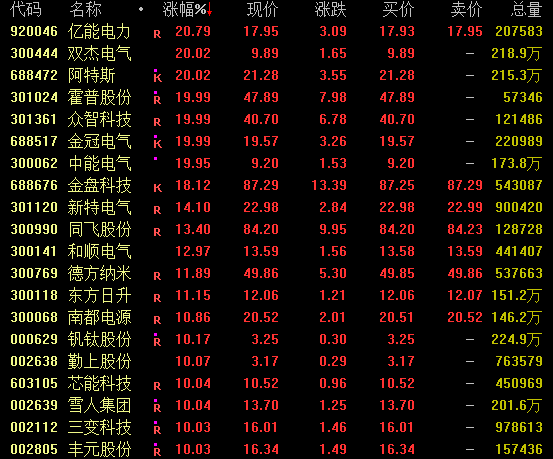
Market Overview - A-shares experienced a strong afternoon rally with the ChiNext Index rising over 1%, while Hong Kong stocks gradually stopped falling, with the Hang Seng Index briefly turning positive [1] - The Shanghai Composite Index closed up 0.23% at 3969.25 points, the Shenzhen Component Index rose 0.37% to 13223.56 points, and the ChiNext Index increased by 1.03% to 3166.23 points [1] - Total trading volume in the Shanghai and Shenzhen markets was 189.45 billion yuan, a decrease of approximately 44 billion yuan from the previous day, remaining below 200 billion yuan for two consecutive days [1] New Energy Sector - The new energy sector saw a collective surge, with companies like YN Power, Shuangjie Electric, and others hitting the 20% limit up [3] - Sunshine Power, with a market capitalization exceeding 400 billion yuan, rose over 7% with a total trading volume of 233.7 billion yuan, leading the A-share market in trading volume [3] - The global demand for energy storage is expected to grow significantly, driven by the increase in new energy penetration and the decline in energy storage system costs, with a projected acceleration in domestic energy storage demand starting in 2026 [4][5] Hainan Free Trade Zone - The Hainan Free Trade Zone concept was active, with stocks like Intercontinental Oil and Gas and Hainan Development hitting the limit up [7] - The construction of the Hainan Free Trade Port is approaching a significant milestone, with full island closure operations expected by 2025, marking a shift in investment focus from B2C consumption to B2B industrial upgrades and high-value-added services [8] Coal Sector - The coal sector saw strong gains, with companies like Antai Group and Baotailong hitting the limit up, and others like Daya Energy and Zhongmei Energy rising over 3% [10] - The domestic coal production growth rate is gradually slowing due to safety regulations and overproduction checks, with expectations of a supply gap in December due to increased winter storage demand [11] - Analysts predict that the average price of thermal coal at ports may rise by over 15% quarter-on-quarter in Q4, with potential price peaks exceeding 850 yuan per ton [12]
南网储能20251031
2025-11-03 02:36
Summary of Conference Call for Nanning Meixu Pumped Storage Project Industry Overview - The conference call discusses the pumped storage and new energy storage industry, focusing on the Nanning Meixu pumped storage project and other related projects by the company. Key Points and Arguments 1. **Project Timeline and Capacity** - The Nanning Meixu pumped storage project is expected to be fully operational by the end of 2025 with a capacity of 2.4 million kilowatts. Two units are already operational, and the remaining two are expected to be operational by the end of the year, entering commercial operation in January 2026 [2][6][4]. 2. **Future Projects** - Other projects, including Zhaoqing Langjiang and Huizhou Zhongdong, are planned to have their first units operational by the end of 2026, with full operation expected in the first half of 2027. Additional projects in Maoming, Guilin, and other locations are scheduled for completion between 2027 and 2029 [2][6]. 3. **Revenue Composition** - For the first three quarters, the company's pumped storage business generated revenue of 3.083 billion yuan, accounting for 62% of total revenue. Peak regulation hydropower contributed 1.65 billion yuan (31%), while new energy storage contributed 267 million yuan (5.02%) [2][9]. 4. **Profit Contribution** - Pumped storage and new energy storage businesses contribute over 90% of the company's total profit. However, due to centralized management costs, it is challenging to break down the specific profitability of each business segment [2][10]. 5. **Pricing Mechanism** - The pricing mechanism for new energy storage is expected to reference pumped storage, including capacity compensation and market transaction income. The National Development and Reform Commission is working on a unified pricing policy [4][15]. 6. **Cost of Projects** - The comprehensive cost of the Ningxia project is approximately less than 0.8 yuan per watt. The construction cost for the Lijiang Huaping all-vanadium flow battery project is estimated at 1.7-1.8 yuan per watt [4][17]. 7. **Market Entry and Profitability** - The Meixu project has entered the spot market, but the contribution to overall profit is limited due to low price differentials in the Guangdong spot market. The revenue from the spot market is around ten million yuan, which is relatively small compared to capacity fees [2][7]. 8. **Future Capacity Goals** - The company aims to achieve a total installed capacity of 3.6 billion kilowatts by 2035, with plans to add 2 million kilowatts during the 14th Five-Year Plan and 3 million kilowatts during the 15th Five-Year Plan [4][14]. 9. **Technological Advancements** - The company is exploring various energy storage technologies, including sodium-ion batteries and emerging technologies like gravity storage and compressed air storage, to enhance its portfolio [4][18]. 10. **Regulatory Environment** - The company is closely monitoring the regulatory environment as provinces are developing specific policies regarding capacity compensation and participation in the spot market [4][15]. Additional Important Information - The company is currently in the first pricing cycle, and the reduction of capacity and energy fees will be spread over three years to mitigate profit impacts [2][12]. - The internal rate of return for completed projects is set at 6.5%, influenced by capital input, loan rates, and operational costs [3][16]. - The company emphasizes that it will not pursue unprofitable projects, adhering to a conservative approach in project development [4][19].

华能国际(600011):Q3业绩超预期,煤价下跌大幅改善盈利能力
Shenwan Hongyuan Securities· 2025-10-29 08:45
Investment Rating - The investment rating for Huaneng International is upgraded to "Buy" [2][7] Core Insights - The company's Q3 performance exceeded expectations, with total revenue of RMB 172.975 billion, a year-on-year decrease of 6.19%, while net profit attributable to shareholders increased by 40.70% to RMB 14.841 billion [7] - The decline in coal prices has significantly improved the profitability of thermal power generation, with a tax-pre profit of RMB 13.268 billion for coal power, up 102% year-on-year [7] - The company continues to expand its renewable energy capacity, with new installations of wind and solar power increasing by 50.28% and 23.28% respectively [7] - The stability of capacity pricing is expected to enhance profit predictability, with a projected cash dividend of RMB 0.27 per share for 2024, corresponding to a dividend yield of 3.49% [7] - Profit forecasts for 2025-2027 have been raised to RMB 15.214 billion, RMB 16.146 billion, and RMB 17.335 billion respectively, reflecting the positive impact of falling coal prices and stable capacity pricing [7] Financial Data and Profit Forecast - Total revenue for 2025 is estimated at RMB 241.484 billion, with a year-on-year growth rate of -1.7% [6] - Net profit attributable to shareholders for 2025 is projected at RMB 15.214 billion, representing a year-on-year growth of 50.1% [6] - Earnings per share for 2025 is expected to be RMB 0.97, with a projected PE ratio of 8 [6][7] - The gross profit margin is forecasted to be 18.8% for 2025, with a return on equity (ROE) of 10.1% [6]
发电企业如何布局储能业务?
2025-10-27 15:22
Summary of Key Points from Conference Call Industry Overview - The conference call discusses the energy storage business layout for power generation companies in the context of the energy sector, particularly focusing on the implications of policy changes and market dynamics related to energy storage systems [1][3][4]. Core Insights and Arguments - **Policy Changes**: The cancellation of mandatory energy storage requirements (Document 136) has led to varied regional responses, with some areas still imposing storage requirements through alternative means. Companies are optimizing existing storage facilities and planning long-term modifications starting in 2025 [1][3]. - **Market Growth**: The early deployment of energy storage devices is expected to face a significant demand for battery replacements around 2026-2027, which could create new growth opportunities in the energy storage market [1][3]. - **Limited Willingness for Large-Scale Storage**: Power generation companies show limited willingness to invest in large-scale energy storage despite high profitability, as it is not their core business. Even with capacity compensation and pricing incentives, large-scale construction is unlikely [4][5]. - **Grid Dispatch Authority**: The key to resolving renewable energy consumption issues lies in the authority of grid dispatch. Some regions, like Liaoning, are trialing decentralized dispatch authority to alleviate issues of renewable energy waste [1][6][10]. - **Capacity Pricing Policies**: The national government is considering implementing capacity pricing policies to address the worsening rates of renewable energy waste. Discussions are ongoing regarding the calculation of energy storage capacity pricing [10][11]. - **Revenue Sources**: Energy storage capacity pricing primarily derives from electricity sales revenue, with the costs of regulation borne by society. For instance, Gansu province plans to increase coal power capacity pricing to 330 RMB per kilowatt, although this is still under discussion due to rising electricity costs [11][14]. Additional Important Insights - **Independent Storage Advantages**: Independent energy storage systems are favored over self-built systems due to guaranteed usage frequency and stronger frequency modulation capabilities, despite higher initial investment costs [2][14]. - **Future Trends**: As the profitability of renewable energy projects declines, a shift towards autonomous dispatch could significantly improve economic outcomes. Some sites are beginning to implement storage systems in a manner similar to previous mandatory configurations [7][10]. - **Impact of Grid Dispatch on Distributed Energy**: The authority of grid dispatch is crucial for the autonomous regulation of distributed energy sources. Current regulations require grid approval for the construction and operation of storage facilities [8][9]. - **Government Response to Energy Waste**: The government is exploring measures to mitigate the significant waste rates of wind and solar energy, including the potential decentralization of dispatch authority and the implementation of capacity pricing [10][12]. This summary encapsulates the key points discussed in the conference call, highlighting the current state and future outlook of the energy storage market within the power generation industry.
河南新型储能新政解读
2025-10-22 14:56
Summary of Key Points from the Conference Call Industry Overview - The conference call discusses the **energy storage market** in China, particularly focusing on **Henan Province** and its new policies aimed at promoting energy storage development. The overall sentiment is optimistic about the growth of the energy storage sector driven by renewable energy projects, with companies like **CATL** and **Sungrow** highlighted as key players in this space [1][5]. Core Insights and Arguments - **High Growth Forecast**: The energy storage market is expected to maintain a high growth trajectory in the coming years, with a conservative estimate of a **30% to 40%** increase in new installations next year, potentially reaching over **200 GWh** [1][9]. - **New Policy Implementation**: Henan Province has introduced a new energy storage policy that guarantees a bottom-line revenue of **0.383 CNY** per kWh for independent storage operations, covering at least **350 discharges** annually [1][6]. - **Capacity Compensation**: The capacity compensation standard in Henan is set at **165 CNY** per kW per year, which is higher than most provinces in China, indicating a supportive regulatory environment for energy storage projects [4][16]. - **Supply Chain Challenges**: There is a significant supply constraint in battery cells, with leading manufacturers' production schedules extending into **February 2026**. This has led to increased costs and potential project delivery delays for energy storage integrators [4][22]. Additional Important Content - **Integration Projects**: Henan is implementing a **source-grid-load-storage integration project** with a capacity of **2.3 GW**, which corresponds to over **5 GWh** of storage capacity. This aims to address renewable energy consumption issues and enhance photovoltaic power absorption [1][10]. - **Investment Returns**: Green electricity direct connection projects are noted for their high investment returns, especially in the northwest regions where green electricity costs are lower than grid electricity prices [1][15]. - **Market Dynamics**: The overall global energy storage cycle is in a high growth phase, with Europe and emerging markets experiencing significant expansion. The U.S. market continues to perform well despite policy pressures [3]. - **Future Policy Adjustments**: The capacity pricing policy is expected to evolve, with a focus on establishing a more robust framework at the generation side and distributing costs among commercial users [4][16]. Conclusion - The energy storage market in Henan and across China is poised for substantial growth, supported by favorable policies and increasing demand for renewable energy solutions. However, challenges such as supply chain constraints and the need for effective integration of storage solutions remain critical factors to monitor in the coming years [1][22].


国内储能深度:配储退出,独储登台,高质量需求爆发且持续
Soochow Securities· 2025-09-26 02:06
Investment Rating - The report maintains a positive outlook on the independent energy storage sector, highlighting the economic viability and significant demand growth in the market [2][3]. Core Insights - The transition from mandatory energy storage to independent energy storage is underway, with local governments implementing capacity price compensation policies to establish a market-oriented revenue mechanism [2][3]. - The domestic energy storage demand forecast has been revised upward, with expectations of continued strong growth, particularly in regions like Xinjiang and Inner Mongolia [2][3]. - The supply of energy storage cells is expected to remain tight until the second half of 2026, benefiting leading companies in the industry [2][3]. - The report emphasizes the importance of innovative business models and integrated system solutions, which are expected to enhance profitability for companies with technological and resource advantages [2][3]. Summary by Sections PART 1: Capacity Price Policies and Independent Storage Models - The shift from mandatory energy storage to independent storage is supported by new policies that provide stable cash flow through capacity price compensation [2][3]. - The report outlines the differences in revenue structures and economic viability between mandatory and independent storage models, with independent storage showing superior profitability potential [11][36]. PART 2: Revised Domestic Energy Storage Demand Forecast - The report projects that domestic energy storage installations will reach 149 GWh in 2025 and 194 GWh in 2026, with a long-term forecast of 340 GWh by 2030 [2][3]. - The demand for energy storage is significantly driven by the development of data centers, which are expected to account for one-third of total energy storage demand by 2030 [2][3]. PART 3: Supply Constraints and High-Quality Development - The report anticipates a continued shortage of energy storage cells until the second half of 2026, with global demand expected to reach 521 GWh in 2025 and 710 GWh in 2026 [2][3]. - The focus on high-quality development in the energy storage industry is expected to benefit leading companies, as well as improve the performance of second-tier players [2][3]. PART 4: Valuation Comparison and Investment Recommendations - The report recommends investing in leading companies such as CATL, Sungrow, and others, while also highlighting the potential of emerging players in the market [2][3]. - The overall sentiment is bullish on the large-scale energy storage sector, driven by strong demand in Europe and emerging markets, as well as favorable policies in the U.S. [2][3].